StoneX logo

February '25 Farmer Fertilizer Focus - Urea

By: Josh Linville, Vice President- Fertilizer

February '24 UREA
 
Josh Linville
Fertilizer - Vice President
StoneX Financial Inc. - FCM Division
Major Global Urea Export Location Price Graphs

The intention of the below graphs are not to use to say "my price should be X based on this graph".  These prices are derived from an FOB price point average.  The intent is to show major global price movement trends.  Your values will likely have significant basis difference (similar to your local grain price being different than the traded market price).

This graph is labeled as MT in USD currency.
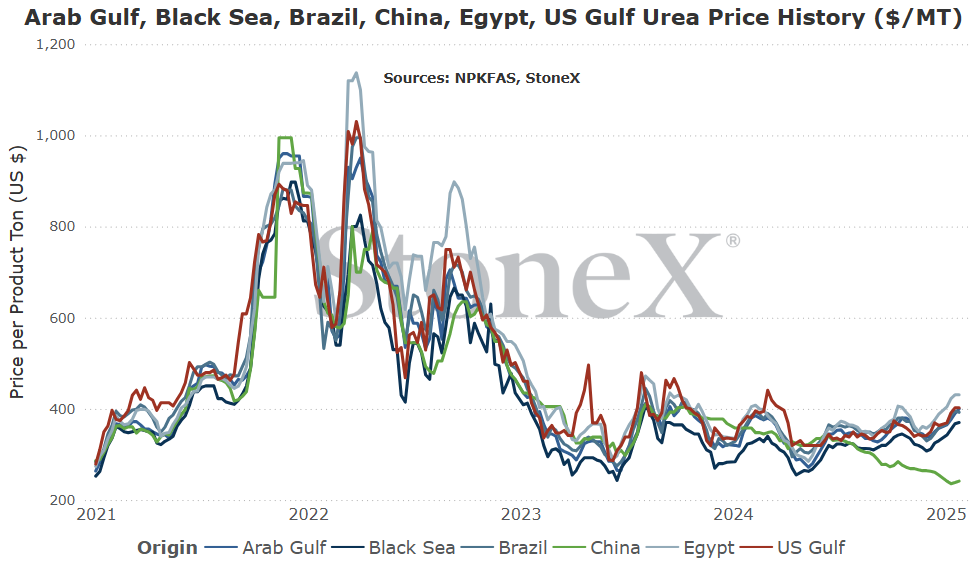
image-20250127085526-1

What everyone wants to know first, what do we think will happen going forward
GLOBAL
Every fundamental factor that I watch is telling me that prices should rally over the next month or two.
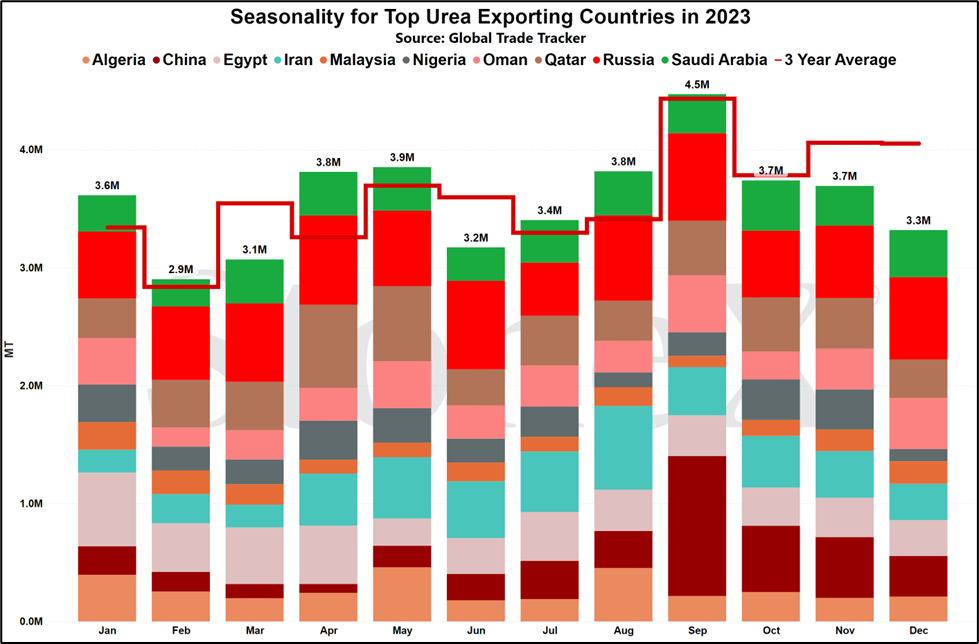
Chinese exports are still non-existent.  That is 5M tons per year missing.
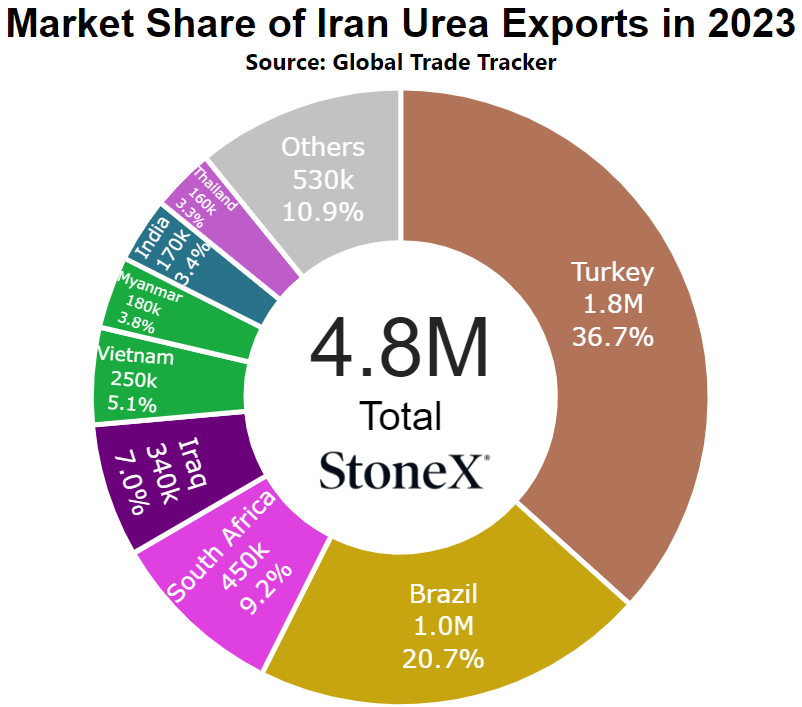
Iran production is still offline.  That is 4.8M tons of exports missing on an annual basis.
European production is still 75% of normal.  That is 3+M tons of production missing/new demand.
All of those on their own would be enough to make me bullish.  However, we are also contending with the conclusion of the India urea purchase tender.  They should wrap up most excess product in the west thru February and into early March...when global spring buyers have to step forward.   That means it will be a heyday for March ship tonnages.
Because of all of the above, I am still in the bull camp even with prices up like they are.
However, a word of warning/caution.
  • Chinese exports are still non-existent...but their stockpiles are huge.  Record high's by some accounts.  Could this mean the government softens its export ban to allow some tons to flow?  How will that be interpreted?
  • Iran production is offline...but it isn't expected to be a long term situation.  They should return sooner than later we think.  If they return, does that do much to change things?
  • Europe...I have no hope for Europe today.
If we see Iran/China return, it could change the emotion of the marketplace.  Fundamentally, the global S&D remains tight and it isn't as though either country would ship their annual tonnage on day one.  It would be a work in progress.
However, fertilizer likes to trade on emotion just as much as fundamentals.  If they see either coming back, it could spark a sell off.
Still, I am ultimately calling for higher global prices in February and March.  April is a bit to far to call today.
NORTH AMERICA
So the global urea market outlook is fairly bullish if you read the above.  That means I should be ultra bullish N.A. values.
Today, nitrogen demand is growing.  We started 2025 expecting U.S. corn acres to sit at 92M.  We then revised them 500K higher to 92.5M.  That is the number we sat on as I left with the family for Orlando.  A week after, when returning, that number jumped to the mid-93M acre range.  Some are speculating as high as 95 to 96M acres based on seed company feedback.  Every additional acre means more nitrogen fertilizer demand.
Then, we have to deal with NOLA/N.A. values still lagging the world.  If the world was long product, it could certainly sit back at a discount and wait for product to be dumped.  However, the world is not long product.  It is very tight.  That means long positions can be choosy...and N.A. needs to gets its price in line or higher than other destinations to get tons rolling.
Reread the global POV for things we need to watch but assuming those complete changes do not occur, N.A. urea values should continue to rally thru the next few months.  Sidedress season and beyond is a different POV that will have to be determined as we get into the thick of it.
 
General Global Urea Information
image 97976
image 97977
image 97978
image 97979
What has happened in the last 30 days?
India gets limited tons in last tender, forced to retender
Every India urea purchase tender has a story and ultimately helps create a direction for the market.
Their last tender announced in December was no exception. 
From the beginning, it was playing out to be a big one.  When the tender was announced, it was with the added caveat that they were targeting 1.5M tons.  500K tons for East coast ports and 1M tons for West coast ports.  When pricing information was released, the story went off the rails.  For the west coast, a single offer came in nearly $12 lower than the next offer to set an aggressively low L1.  The east coast...well, it was a mistake.  A company submitted a $299 price which was $80+ lower than the next lowest price.  The offer was supposed to show $399, but India was not in the mood to allow the correction so it became the east coast L1.  For reference, India requires that all offers either decline or negotiate their offer price to the lowest/L1 offer value.  This is why that value is so important.
In the end, the west coast received very few tons while the east coast received exactly zero.  The company that submitted the $299 refused to supply the 50K tons associated with the offer.  All other East coast offers refused to negotiate.
Quickly, the story was how quickly India would announce their next purchase tender...it took less than a month.
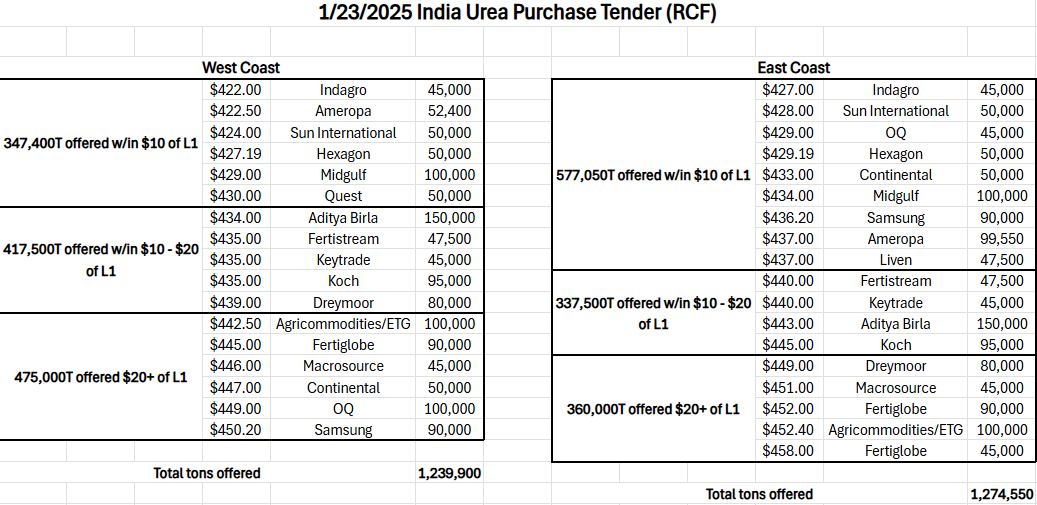
In late January, RCF was tapped to handle the highly anticipated tender.  They came with the same details in that they were targeting 1.5M tons.  500K tons for East coast ports and 1M tons for West coast ports.  This one saw offers at a much more manageable range...but still spread out as you can see below.
As I write this, it is being reported that only 558K tons have been agreed upon vs their 1.5M ton goal.  While we are still waiting on final official results, there is little that makes us believe this tonnage total will change.  That means they have secured just over a third of their expectations.  
The main question folks have is "why didn't more tons agree to sell?"  Frankly, our POV is that all other offers either did not have tons in hand to offer (which is why they were so much higher on their price) or that they believe they will have a better opportunity to sell at a higher price in the coming weeks when demand starts hammering the world.
Today, we are highly expecting another purchase tender announcement in the first few weeks of February.  It is more likely that this shipment window will cover a large chunk, if not all, of March which will put them in direct competition with the rest of the Northern Hemisphere who is also buying to prepare for their spring seasons.
India has not been the cause of recent global urea bullishness.  That has much more to do with production issues.  What India has done is uncover the story.  There is no surprises to their demand and it was already baked into global S&D's.  However, when India falls this short on tonnage awards on back to back tenders, global manufacturers/long positions take notice...
 
image-20250127183927-1
What does this mean for farmers?
India demand in itself is not propelling prices higher.  This demand is highly anticipated in the world.  It isn't as though global urea markets are shocked that they are needing imports.
What India has done is reveal the tight supply story that has been building and from what I can tell some have missed.  By failing on back to back tenders, it has shown that global supplies are tight and given confidence to the market that it can move values up.
For farmers, it means higher prices.  If/when they tender in the coming weeks, they will be in direct competition with the rest of the Northern Hemisphere who is also trying to prepare for their spring.  More competition on less tons is a lethal combination.
Iranian production goes offline, helps spark global values
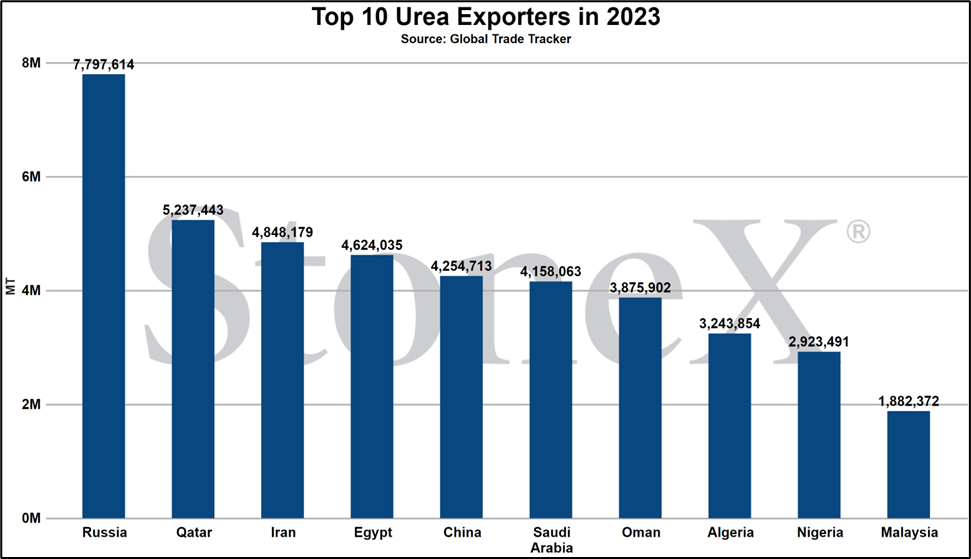
I spend a lot of time discussing China when I talk about global markets and with good reason.  China typically exports between 5 to 5.5M tons per year which represents approximately 10% of the global urea export marketplace.  When China is participating heavily, the world feels soft as players get fearful of the competition.  When China is absent, the boogeyman is gone and so prices tend to build.
So if we believe China has that power with that footprint, it makes sense that we should treat Iran in similar fashion.  
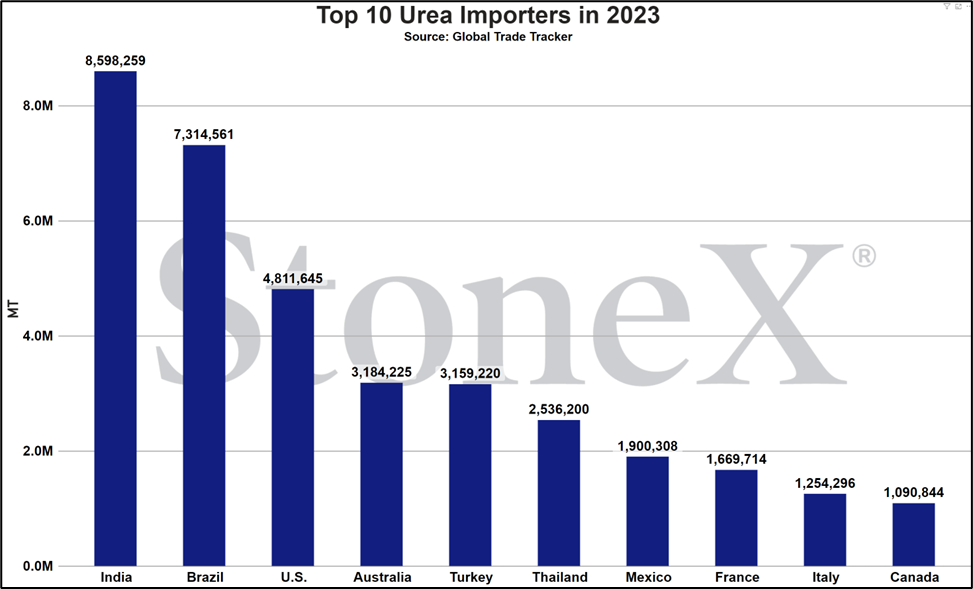
If you scroll up to the world's largest exporters, you will notice Iran sitting in 3rd place for 2023 with around 4.8M tons exported.  In the global markets, Iran is typically talked about with an asterisk.  Yes, their urea is the same analysis as all other global urea.  Yes, their exports can add/subtract from the global S&D.  However, with years of sanctions and concerns of their reliability, they are treated different.  Many traders/countries will not do business with them.  That creates a situation where Iranian urea values are a discount to other Middle Eastern region values.  Still their export urea ton counts the same as any other export urea ton around the world, so when they go missing it gets felt.
And that has been the story.
Last month, Iranian nitrogen fertilizer production all but stopped due to gas supply shortages.  While details of the "why" have been a bit fuzzy, we believe it comes down to 2 factors:
  1. Years of sanctions have not allowed materials/personnel to enter the country to keep gas infrastructures in top shape which may reduce supply capabilities.
  2. Iran is currently in their "winter" season which means temperatures drop.  That causes residential demand to spike to stay warm.  This surge of demand overwhelms their gas S&D and causes the government to slow/stop industrial demand in favor of its people.

Globally, supplies were already tight with Chinese exports not existing (more below) and European production still at 75% with fears rising it could get worse (again, more below).  For every 30 days that Iranian production is offline, the world loses 400K tons that cannot be "made up" short term.  This, combined with India laying the supply story bare, helped to finally spark price ideas significantly higher.

Now, we do not believe this will be a long term issue. We are expecting to see reports that production has returned in the coming weeks, but there are no guarantees to this.  When they return, no doubt it will remove some of the worst fears in the market, but damage will have already been done and the calendar simply isn't the buyers friend.

What does this mean for farmers?

If this was a story on its own, I probably wouldn't be worried.  I think this is a short term event which will hopefully result in less than 1M tons lost.

However, it isn't a story in its own.

  • Chinese exports still do not exist (that could change but hasn't yet).
  • European production is still 75% of normal (higher chance it gets worse than better).

Adding Iran offline to this mix was the final nail in the coffin.  When all 3 are combined and broken down to an annualized basis, the world is losing 1M+ tons per month.

The world does not have that kind of excess capacity available.  Supplies are down.  Demand looks solid.  In Econ 101, the answer was higher prices...

Chinese exports close 2024 well behind normal
As expected, China closed out 2024 with record low urea exports which played a huge part in leaving the global S&D extremely tight to start 2025.
For some back story, China's new approach began back in 2021.  Prior to that year, they would typically export between 5 and 5.5M tons.
When late 2021/22 saw global urea prices skyrocket and fears of supply shortages gripped the world, the Chinese government stepped in.  They realized how important urea was to their farmers and understood the risk the world was posing.  With supplies tight, the fear from their perspective was that exports could decimate their own supplies and leave their farmers without product.  In free markets, this would be allowed to happen as the best market wins.
China is not a free market...
Rather than run this risk, they opted to start restricting exports with two goals in mind:
  1. Ensure adequate supplies for domestic farmers.
  2. Put pressure on domestic values, putting their own farmers in better position vs the world.

Fortunately for Chinese farmers, the strategy has worked.  Unfortunately for the rest of the world, the strategy worked and continues to be used today.

There was hope in 2023 that typical export flows were returning.  While the year closed less than normal, seeing 4.25M tons be released was welcome...but that helped keep their values higher.  2025 saw enormous restrictions put into place and 2024 calendar year trade data reflects that only 266K tons departed.  In perspective, this is 5M tons less than the market is used to.  This leaves a massive hole in the global S&D and the world has been paying the price.

Now the question is what will happen in 2025.

On the one hand, there is reason to be hopeful.  We have recently heard rumors/seen reports that Chinese stockpiles of urea are at record levels.  This helps answer our question of where all the tons have been going because their operating rates have remained high.  In a normal situation, we would think that the government would allow exports to return to help alleviate these massive stockpiles.  If Chinese exports are allowed to return, it would add much needed supply to the world and take an edge off the current story.  

On the other hand, the government should be caring more for its farmers than manufacturers.  If they allow exports, it is likely that values will start to climb domestically which is in stark contrast to their stated goals.  From their perspective, would you rather allow exports which helps several manufacturers or keep exports low and prices down which helps hundreds of millions of farmers?

Ultimately, it is China.  We do not know what they do.  We take a very reactionary position in terms of their programs meaning that we try to think thru the possibilities.  While we do not know what route they will take, at least we will have a game plan for if/when one plays out.

Today, our stance is that exports will remain very restricted near-term which will keep global supplies tight and prices higher...but there is a chance they return.
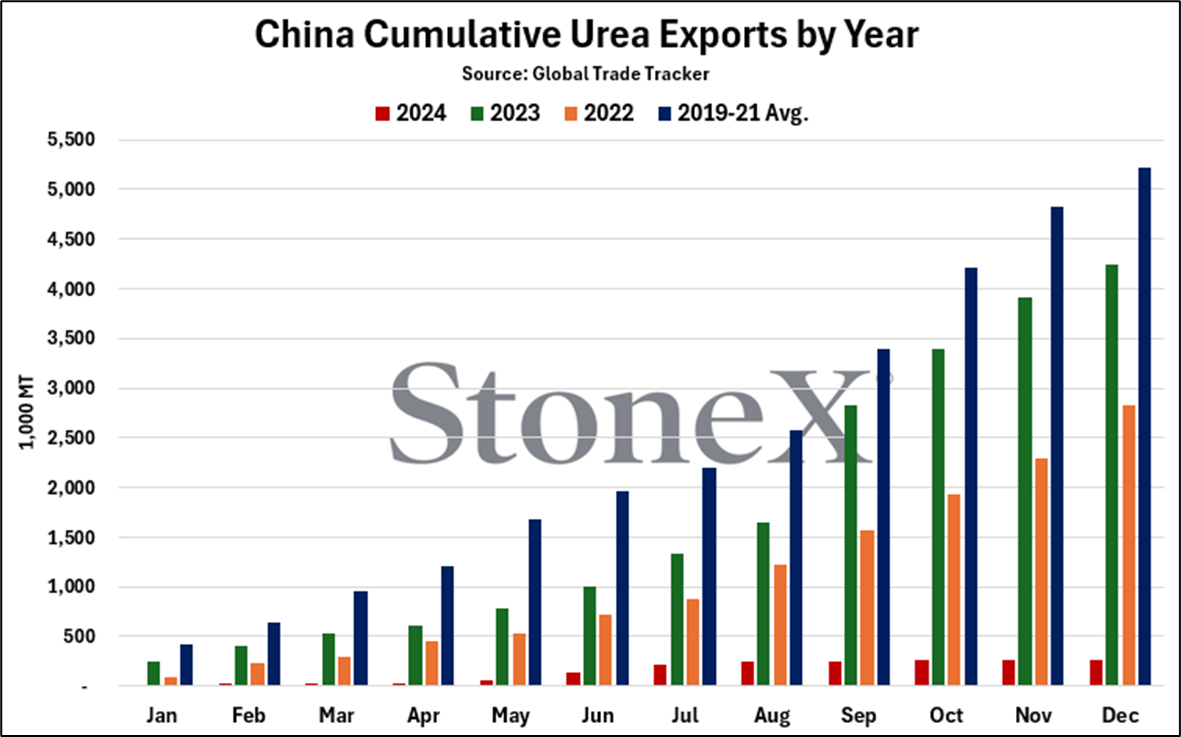
image 107453

What does this mean for farmers?

When I spoke about Iran above, I stated that for it I wouldn't be nearly as worried if it stood on its own.

China not exporting is a story with or without help.

China represents 10% of the global urea export market and is highly driven by government interaction.  That means we have no freaking clue what will happen with a large chunk of tons.

Calendar year 2024 closed with excessively low exports which result in much tighter global supplies.  Could they keep 2025 exports slow?  Yes.  Would that move the market?  Yes.  Could they resume exports in 2025?  Yes.  Would that move the market?  Yes.

For now, we must assume exports will remain low until they are not and as long as they are low, urea prices are high.
European production rates remain lower, fears rising it could get worse
This is a story that has been ongoing since late 2021, but it remains just as important now as it was back then.
Without diving into the whole history of it, Europe has struggled with nitrogen fertilizer production rates.  Historically, they received the bulk of their gas supplies from Russia which helped keep their values low and production at 100%.  However, Europe's push to green as well as Russia's threat and eventual invasion of Ukraine strained relations to the point where gas supplies stopped.  It peaked when an unknown party attacked the Nordstream pipeline at an underwater spot.  While questions still remain on who caused the attack, the answer does not change the conclusion: gas flows are still not existent.
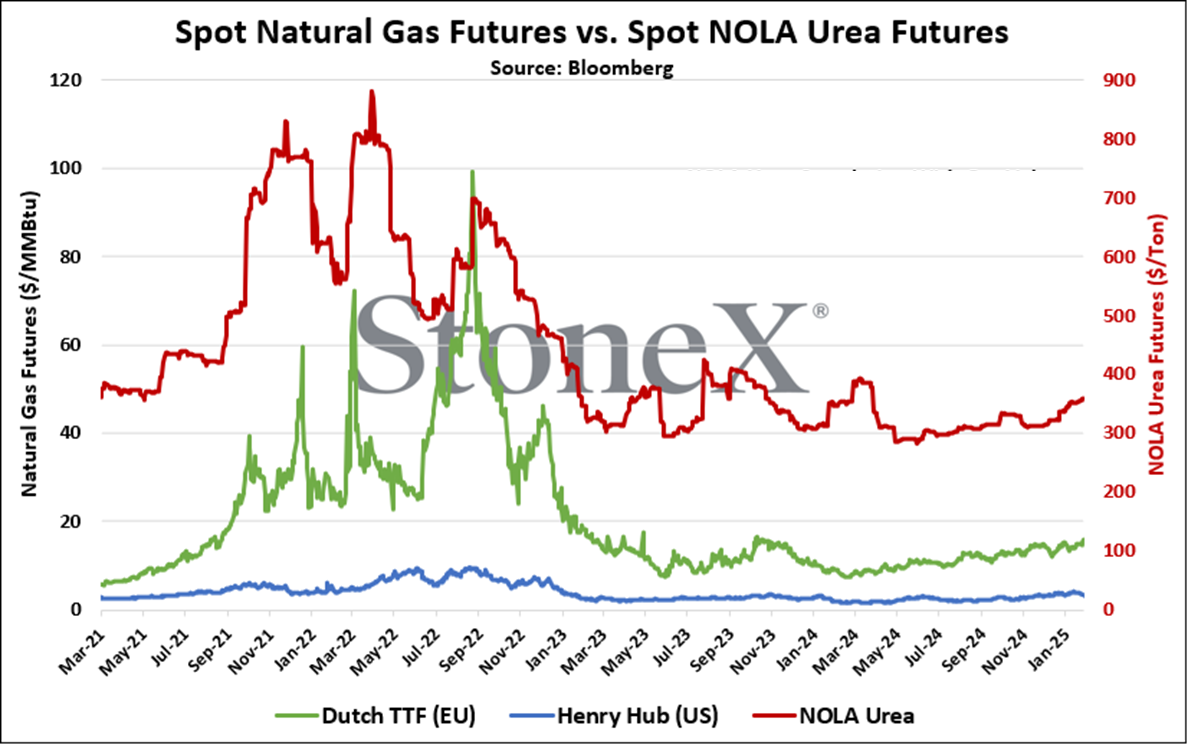
That has caused Europe to become reliant on the rest of the world.  While it has done a fine job of finding new trade routes, these fresh lanes come at a higher cost.  We commonly track the Dutch TTF market for an overarching view, much like we watch Henry Hub for the U.S. / N.A.  Historically, those values were in the single digit range but today have traded in the $10 - $15 area...and have been pushing higher.
These higher prices have caused European nitrogen production to suffer with current rates believed to be approximately 75% of normal.  To put that into context, that equates to roughly 3.5M tons of urea production offline and roughly 2M tons of UAN production.  Not only does that remove much needed supply from a global S&D which is already struggling, it pushes that demand to the rest of the world.  It isn't as though farmers in those areas will just give up and farm without nitrogen.  They are forced to go look for alternative sources of material which puts them in direct competition with other buyers.
This has been highly impactful for the global urea marketplace.  Due to the high cost of production, Europe is, in my view, the swing global producer based on economics.  Many across N.A. believe that urea values are set based on Henry Hub values.  That viewpoint is correct, back when Henry Hub values were elevated.  Today, they are some of the cheapest in the world.  That keeps N.A. production at high levels and its urea continues to be priced vs the world.  Today, global urea markets take a lot of their ques from Dutch TTF.  If you look at the graph below, you do not need to be a statistician to see which gas values equates to urea values.
Recently, global urea values have been spiking due to tight inventories.  It doesn't help that Dutch values have been climbing as well.  The correlation remains high.
Some are hopeful that Trump will be able to find common ground and eventually peace between Russia and Ukraine.  If he does, the world will celebrate...but a cautionary tale for those who will see it as a sign that Europe production is returning.  Remember that the Nordstream pipeline was not just shut down, it was blown up under water.  Those repairs are not easy and take time.  Also, the rupture means that the inside of the pipe has been exposed to sea water for a long time.  Very possible that we are not looking at a repair but rather a replacement.  These things take time.
image 107459
What does this mean for farmers?
European production being low hurts in 2 ways.  It hurts global supplies by removing 3 to 3.5M tons on an annual basis.  It also hurts demand as farmers there are forced to buy from other areas.
European farmers are paying a higher price because relying on something further away means higher costs.  World farmers are paying a higher price because a worsened S&D does that.
Unfortunately, global events have domestic impacts.
NOLA/N.A. values continue to lag the world, raises import concerns
It doesn't matter where you farm in the world, unless your government protects your pricing, you are part of the global market.  Where the world market goes, so to does your market. 
I grew up watching Disney on ABC...when we could get the channel turned to 2 with the locking pliers!!  I grew up listening to stories and in my professional career have come to believe that prices tell a story if you know how to listen.
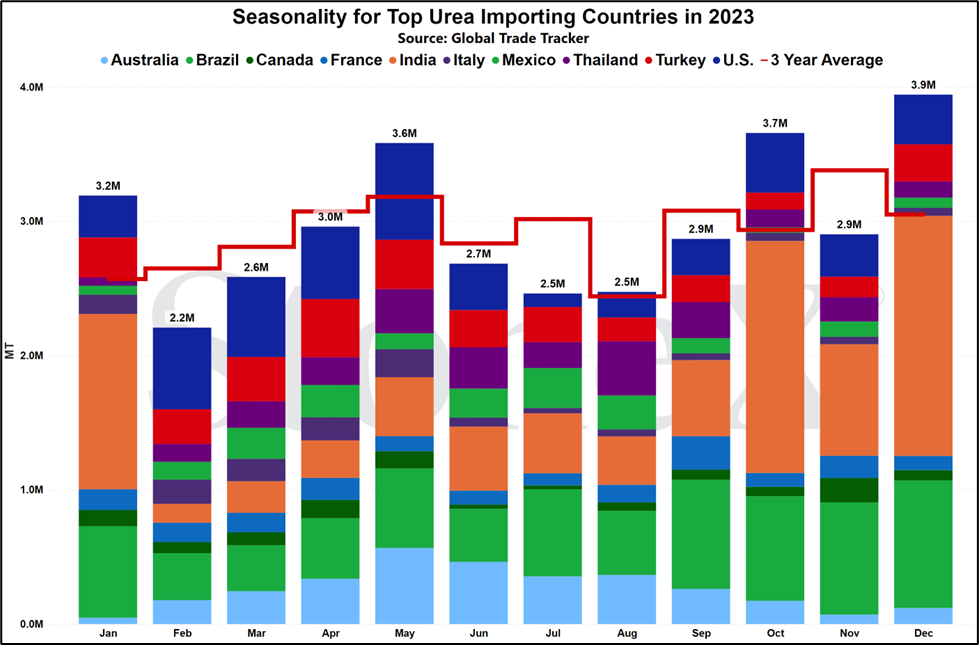
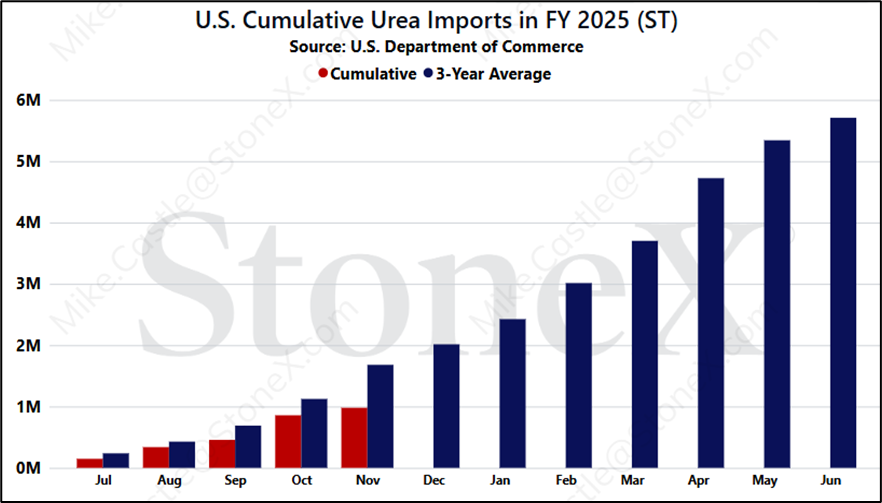
This is why I spend so much time watching NOLA urea values vs the world.  The U.S. / N.A. is a net importing area for urea.  For fertilizer year 2025, which is where we currently are, our forecasts show a need for approximately 5.15M tons to be imported and historically speaking, half of our flows come from the Middle East.  The flow which does/does not come is highly impacted by the NOLA price vs replacement.
When the world is long product, our price can sit at even money to a discount and likely still receive tons.  Manufacturers/sellers are more desperate to find sales and N.A. represents a safe haven of sorts.  You know the demand is there year after year.  It is a relatively safe credit territory.  Even at a slightly discounted price, you can get your tons gone.
However, when the world is short product, it can be more choosy with where to go.  With plenty of destinations available, there is little need to sell at a lower price.  Even if you hold your price higher and miss a sale, you know you have plenty of opportunities ahead.
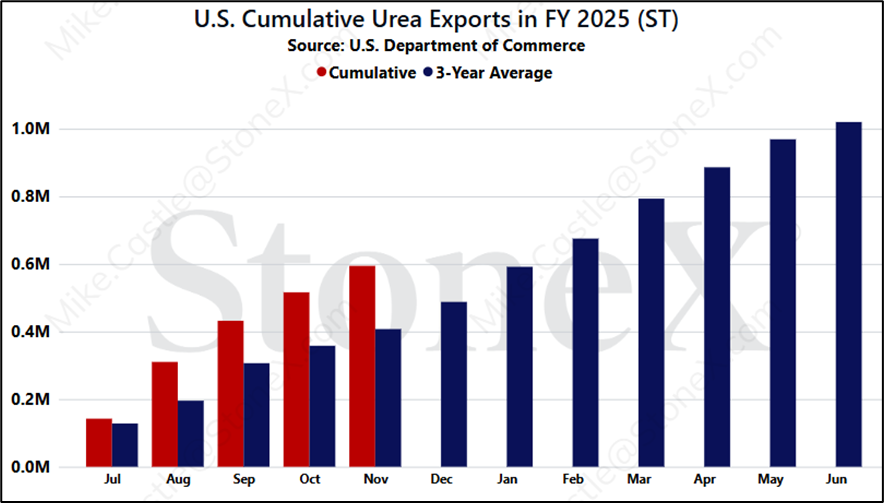
Since the start of this fertilizer year which started July 2024, NOLA urea values have been a discount to world replacement.  The trade data for July thru November (U.S. delays data 2 months so November is most up to date) shows that imports are lagging behind average.  In fact, NOLA urea values have dipped low enough a couple times that we have actually seen exports ahead of normal paces.  This only increases the number of imports needed to meet spring demand.
image 107460image 107461
To top it all off, N.A. nitrogen demand has been growing with corn acres.  We started 2025 at 92M acres in the U.S. and quickly revised it to 92.5M.  After a week, another 1M acres were added.  More scary, some are speculating 95 - 96M acres are possible based on a corn leaning corn/bean price ratio and seed sales feedback.  95 - 96M seems a stretch, but it continues to reflect the bullish corn acre market.  Every added acre adds more nitrogen demand.
Now, I AM NOT saying there will be shortages.  There is still time...but time is running out.  We currently believe that January thru June imports need to hit 3.8M tons.  January and February are not likely to be robust.  It takes a month for a vessel to arrive and we have seen NOLA trading a discount to the world for all of December and January.  Also, June is a bit of a toss month that will see 200 - 300K tons added.  June is simply too late to catch spring demand.  That puts the onus on March/April/May.  Is it possible?  Yes, but we need to start calling on them.
Today, as I write this, NOLA sits at a $25 discount to replacement and normally we are moving to a $25+ premium to the world.  That assumes the world market does not appreciate and assumes we are not overly desperate for tons and the world isn't very tight on supplies.
  • I am fearful global values will continue to appreciate.
  • I am fearful that the N.A. market is about to get fearful as we flip the calendar to February.
  • The world IS tight on supplies.

Our prices have rallied pretty hard since last month but do not let that fool you.  There could certainly be more bullishness left...

What does this mean for farmers?

This is what worries me that N.A. farmers haven't seen the worst of price increases.

My biggest fear is that the market is going to "freak out" in the coming couple weeks as it realizes the poor S&D situation.  When it does, a buying frenzy will begin and prices almost always go higher when that happens.  

We still have time to get imports but that time is running out.  We could see NOLA prices jump $50 from where they sit right now just to get to normal world premiums.  That would put our price $25 over replacement and turn on the light for vessels to arrive.  However, given how tight we see the S&D, I'm not sure $25 premium is enough.

Then we have to factor in the world market.  The above assumes global markets stay flat and I do not believe that will be the case.  I've been wrong before and markets are always changing but today, there are a lot more factors that point to higher prices than lower.

We are in a race, starting behind and have a lot of ground to cover.

Where are current values in relation to the past

NOLA/New Orleans, Louisiana 

Number 3 global importer in 2022
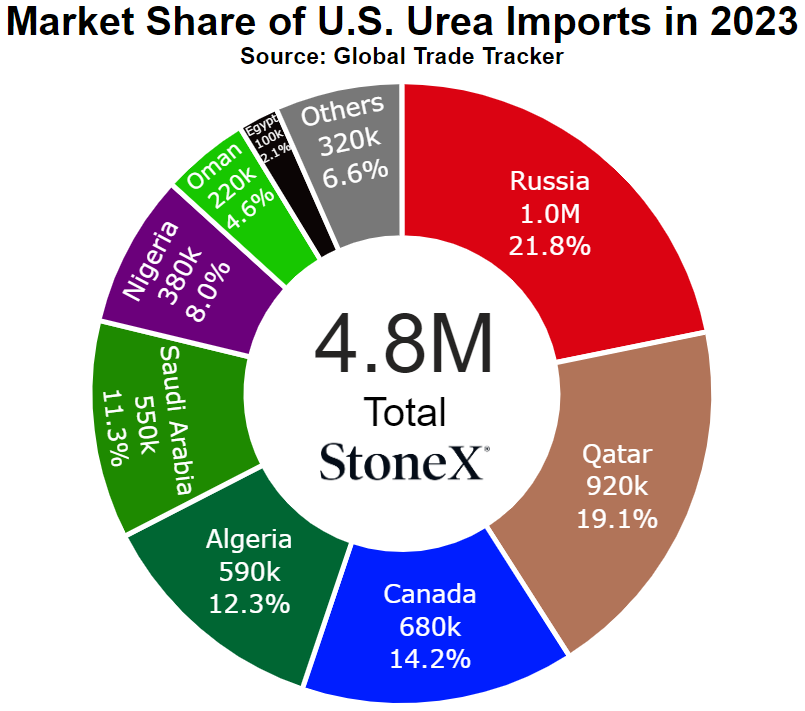
image-20240826091327-1

Price comparisons

Vs 30 days ago - 11% or approximately $35 higher

Vs 90 days ago - 11% or approximately $35 higher

Vs 6 months ago - 19% or approximately $58 higher

Vs 1 year ago - 5% or approximately $17 higher
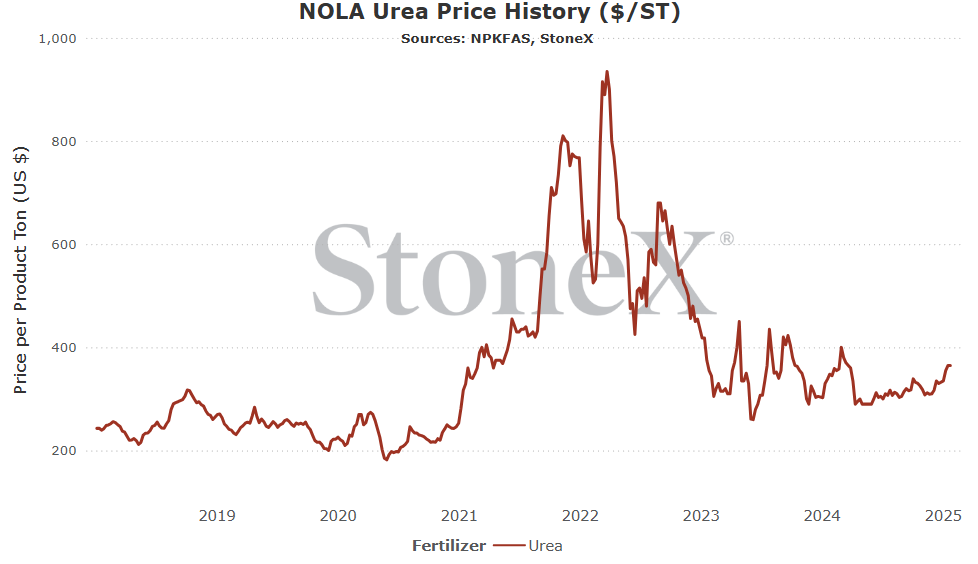
image-20250127085616-2

U.S. Midwest Average

Vs 30 days ago - 7% or approximately $26 higher

Vs 90 days ago - 8% or approximately $30 higher

Vs 6 months ago - 13% or approximately $48 higher

Vs 1 year ago - 11% or approximately $42 higher


U.S. Southern Plains Average

Vs 30 days ago - 10% or approximately $40 higher

Vs 90 days ago - 10% or approximately $40 higher

Vs 6 months ago - 19% or approximately $68 higher

Vs 1 year ago - 7% or approximately $28 higher


U.S. Northern Plains Average

Vs 30 days ago - 4% or approximately $15 higher

Vs 90 days ago - 5% or approximately $21 higher

Vs 6 months ago - 11% or approximately $40 higher

Vs 1 year ago - 3% or approximately $12 higher


Middle East

Number 1 exporter (as a region, not as individual nations)
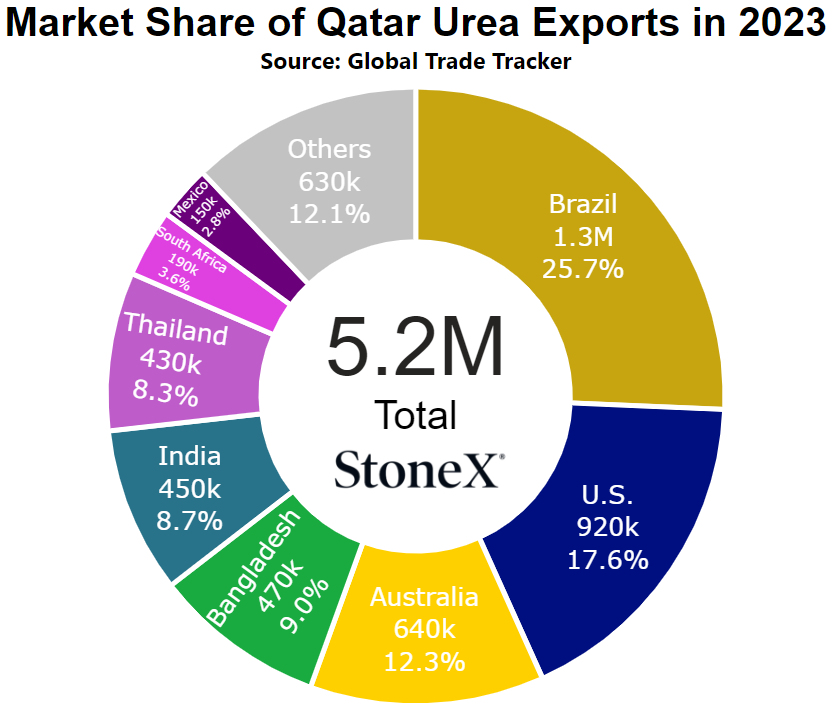
image-20240826091434-3

image-20240826091459-4

image-20240826091529-5

image-20240826091558-6

Vs 30 days ago - 12% or approximately $43 higher

Vs 90 days ago - 5% or approximately $20 higher

Vs 6 months ago - 15% or approximately $54 higher

Vs 1 year ago - 10% or approximately $35 higher
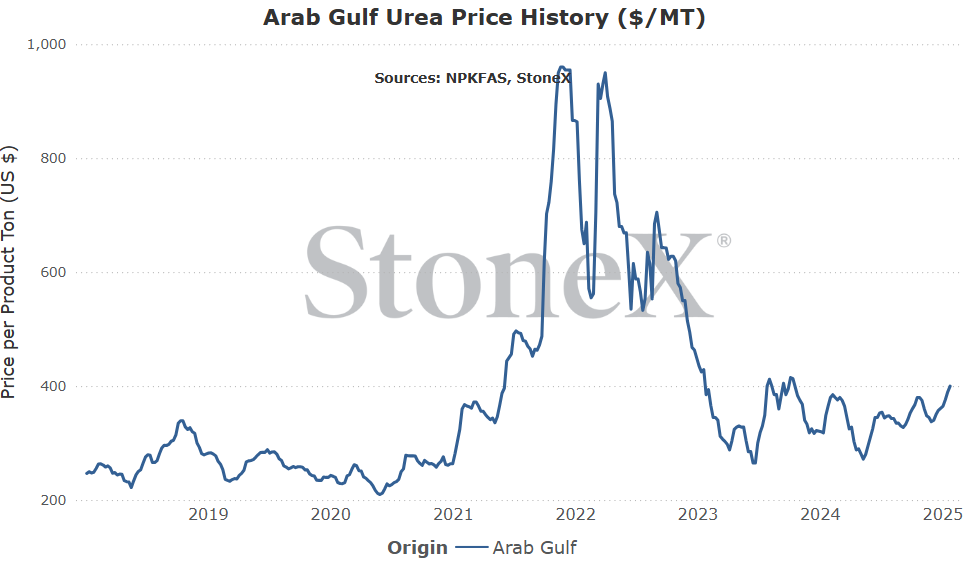
image-20250127085848-3

Egypt

Number 4 global exporter in 2022
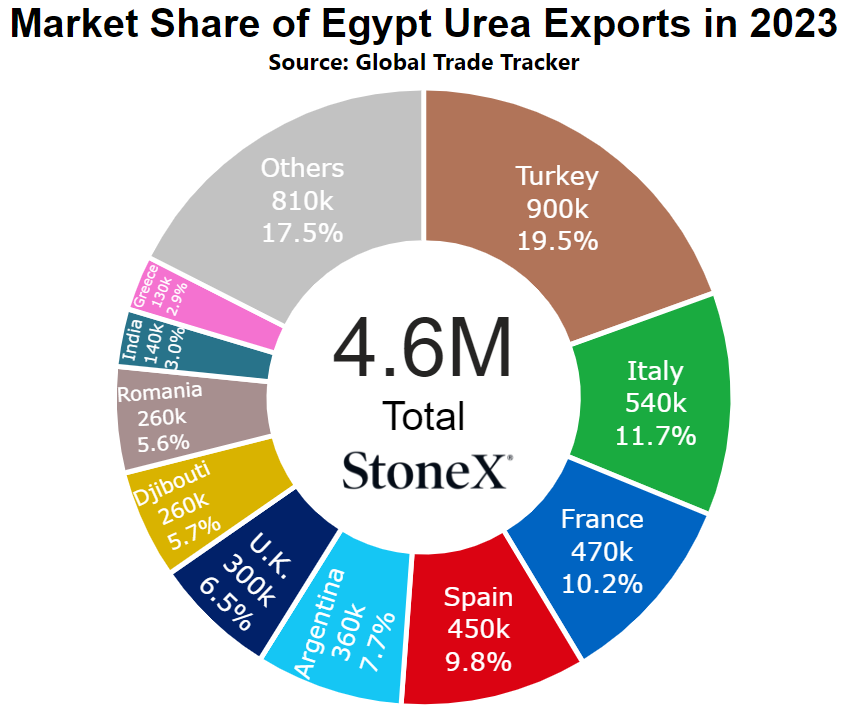
image-20240826091630-7

Price comparisons

Vs 30 days ago - 11% or approximately $43 higher

Vs 90 days ago - 7% or approximately $28 higher

Vs 6 months ago - 18% or approximately $67 higher

Vs 1 year ago - 11% or approximately $44 higher
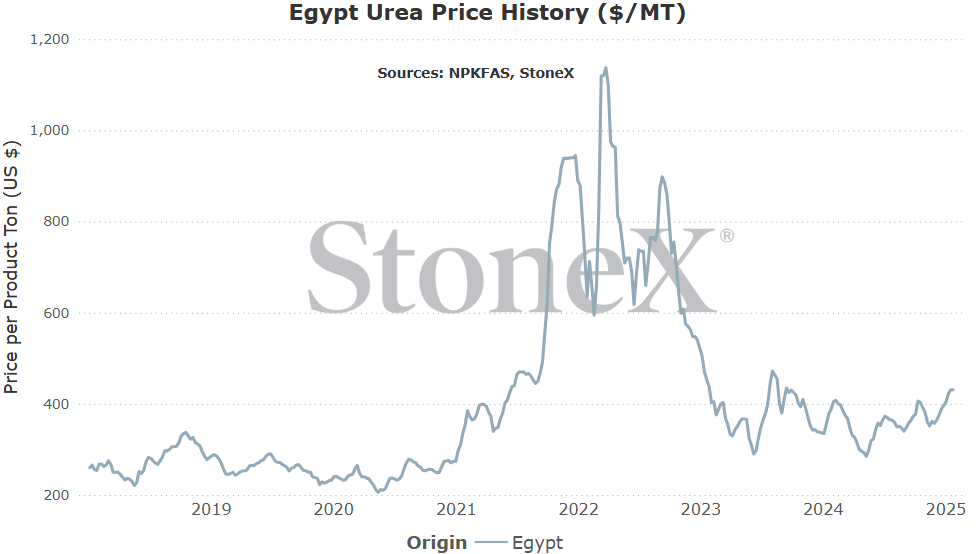
image-20250127085930-4


Black Sea

Number 1 global exporter in 2022
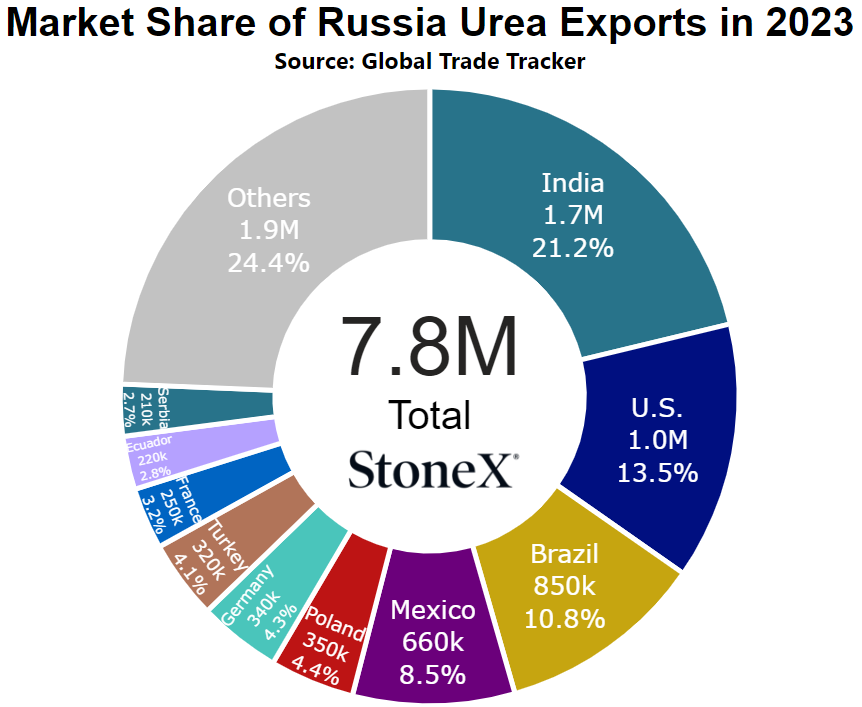
image-20240826091656-8

Price comparisons

Vs 30 days ago - 12% or approximately $40 higher

Vs 90 days ago - 7% or approximately $25 higher

Vs 6 months ago - 14% or approximately $45 higher

Vs 1 year ago - 15% or approximately $48 higher
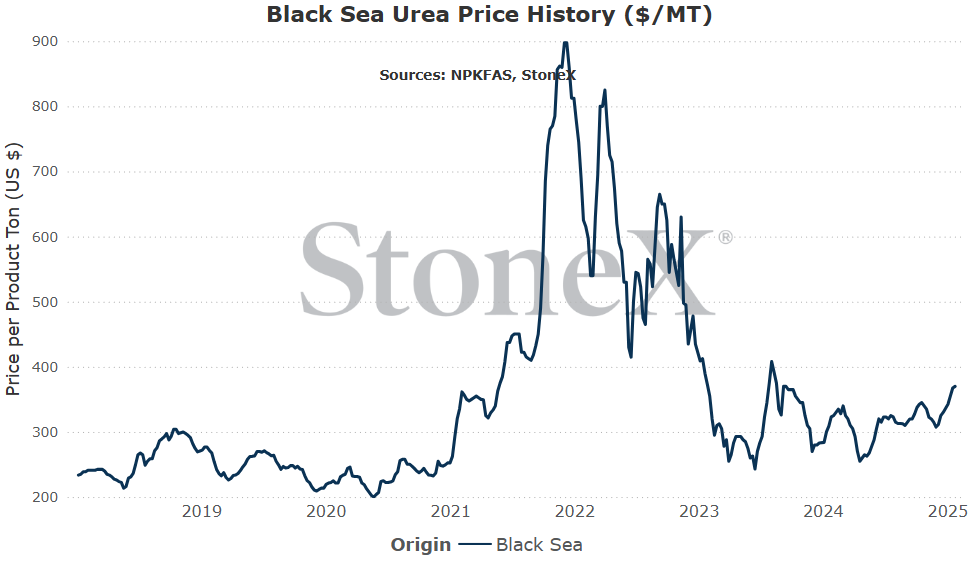
image-20250127090009-5

China

Number 9 global exporter in 2022
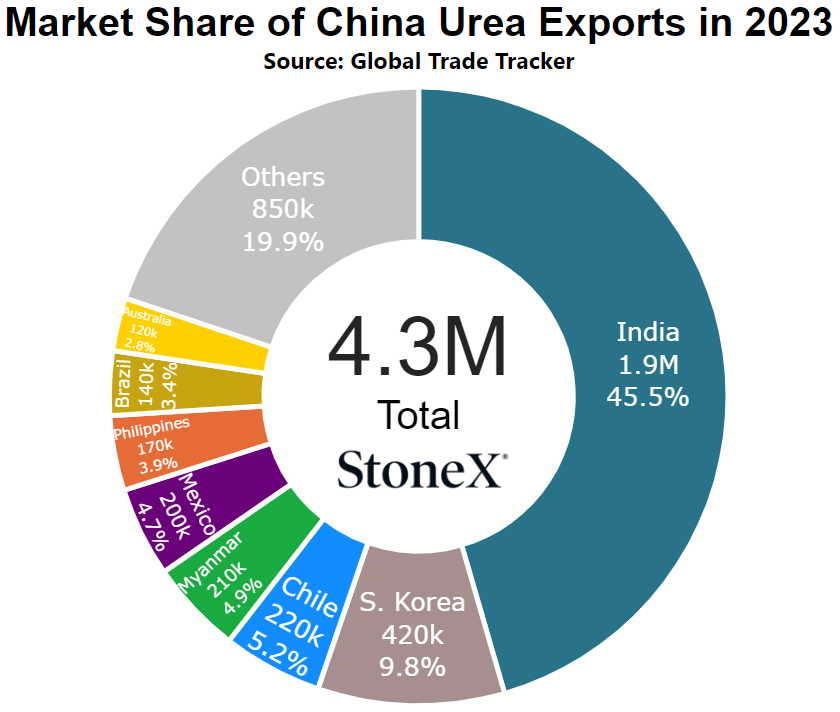
image-20240826091723-9

Price comparisons

Vs 30 days ago - -5% or approximately $14 lower

Vs 90 days ago - -13% or approximately $35 lower

Vs 6 months ago - -26% or approximately $84 lower

Vs 1 year ago - -32% or approximately $116 lower
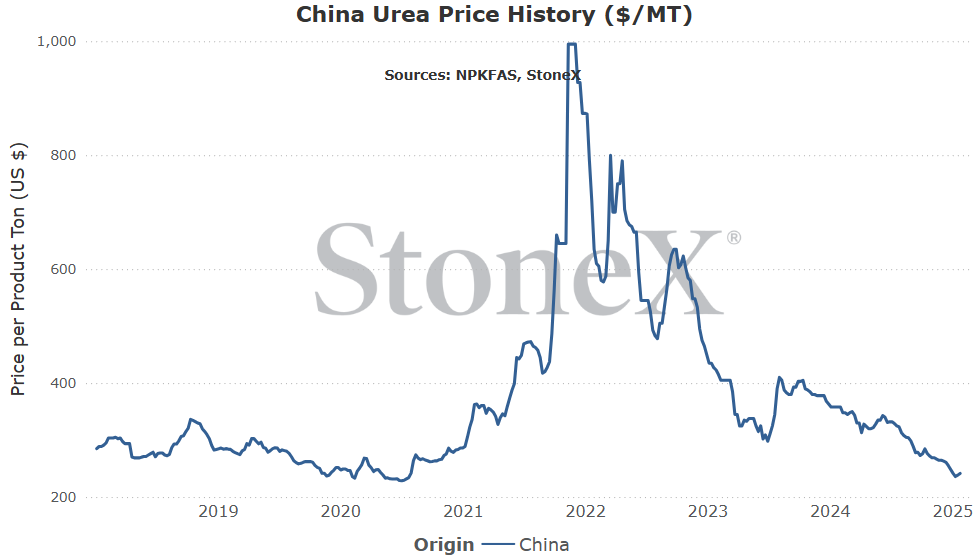
image-20250127090055-6

Brazil

Number 2 global importer in 2022
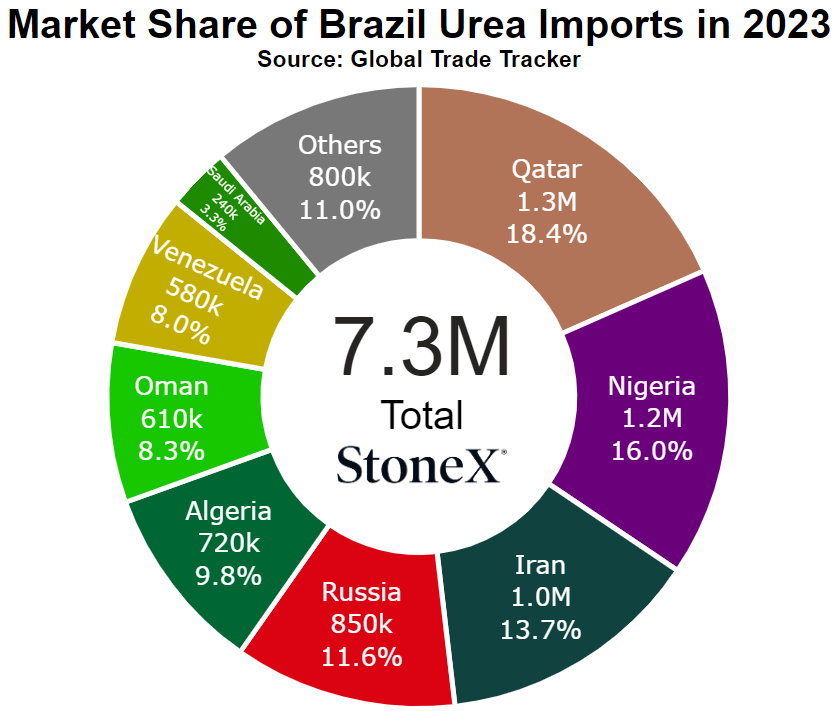
image-20240826091747-10

Price comparisons

Vs 30 days ago - 9% or approximately $34 higher

Vs 90 days ago - 3% or approximately $13 higher

Vs 6 months ago - 8% or approximately $30 higher

Vs 1 year ago - 6% or approximately $23 higher
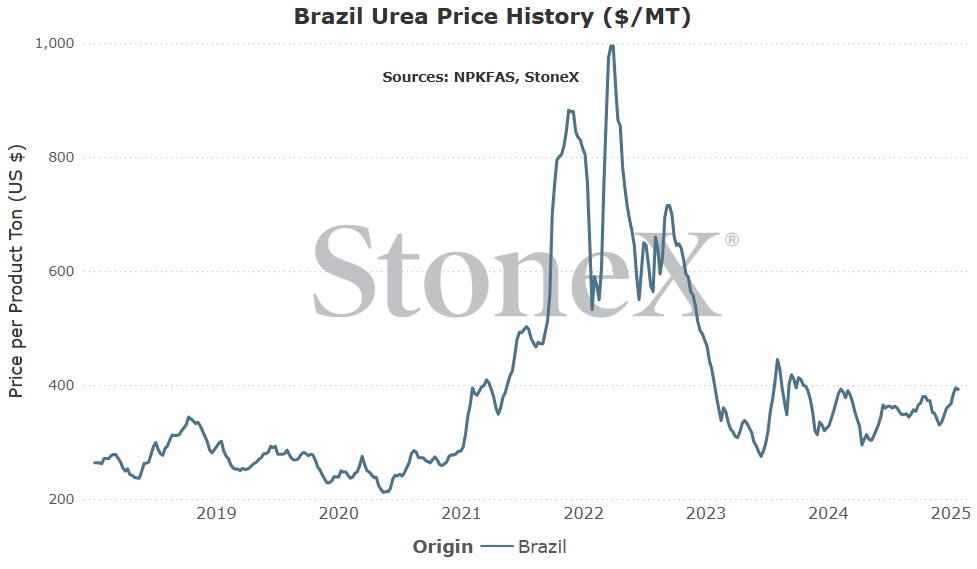
 

image-20250127090134-7
Bull/Bear Factors
Because no market is ever guaranteed to go higher/lower, we try to consider the factors that can sway values so that we are able to act when they occur rather than react.
Bullish Factors
  • Chinese exports remain near zero - it is hard for the market to ignore China when they are exporting.  They tend to be the global market boogeyman.  That also means that when their exports are stopped, the market can run and that is where we are today.  China historically represents around 10% of the global urea market.  The issue is that there is very little indicating their return.  Not impossible, but few signs so far.
  • Iranian production remains offline - years of heavy sanctions has no doubt taken a toll on Iranian infrastructures.  That and cooler winter temps which has increased public demand on gas markets have combined to shortages...and nitrogen producers are paying the price by having to stop.  This is not expected to be a long term problem, but as long as it is, it is a loss of supply in an already tight supply market.  They exported 4.8M tons in 2023, that means 400K tons are lost every 30 days.  
  • India wipes out February/early March tons - this is my main concern, especially for the west.  It appears that India is going to wipe out most excess inventories in February and the first week of March.  So western manufacturers are going to be relatively empty going into March when demand picks up.  That is a lethal combination.  Imagine what prices will do when big buying meets limited supply...
Bearish Factors
  • Chinese stockpiles are heard to be building to record levels - recently, we have started seeing reports that Chinese urea stockpiles may either be at or above record levels as a result of government export restrictions.  The problem is that operating rates are still high.  Something has to give.  It is possible that producers will be forced to slow production.  The other possibility is that the government allows exports to resume which will not be seen as a bullish event globally.  Right now, we do not expect exports to resume, but it is back in the realm of possibilities.
  • Iran should come back sooner than later - Iran's production being offline is not expected to be a long term situation.  This is just due to a short term gas shortage that should go away with repairs/warmer temps.  When they come back, the damage will have already been done but fertilizer markets are funny.  Sometimes emotion wins the day.
  • The focus of the market turns from current tightness to late Q2/Q3 price resents - this is too early in the year for this to happen, but I'm struggling with a 3rd reason for why urea could soften!!  Eventually, the market will shift away from demand/supply issues and will start to fear carrying product into the late Q2/Q3 period when values historically hit their low's.  Again, this is February.  This isn't something I expect in the next month or two, but is certainly in play after that.
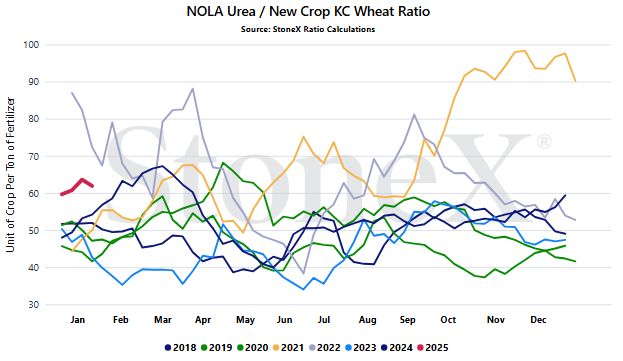
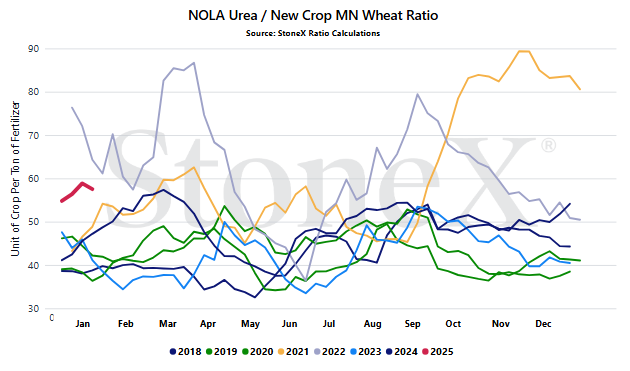
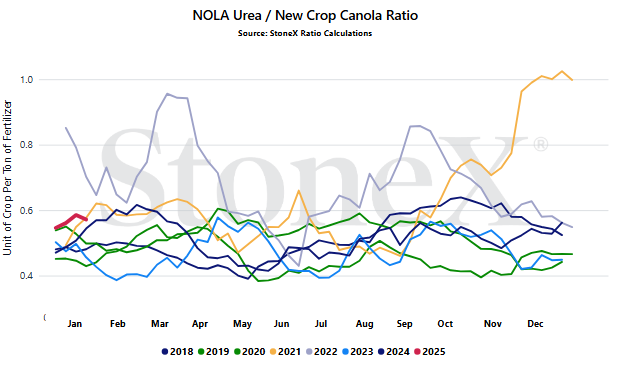
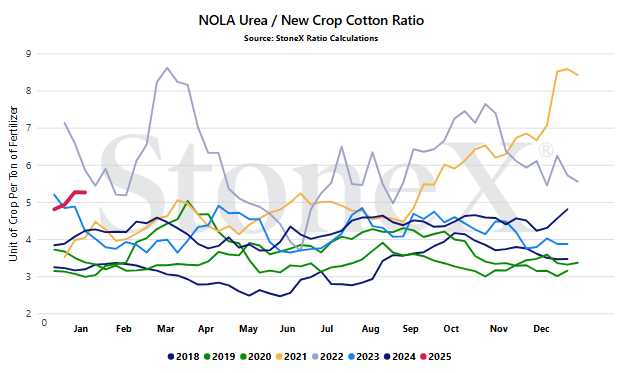
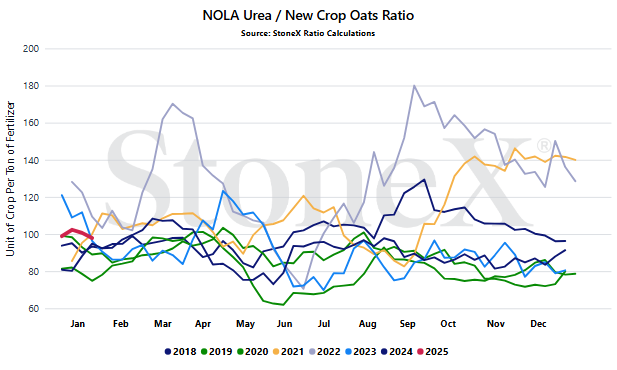
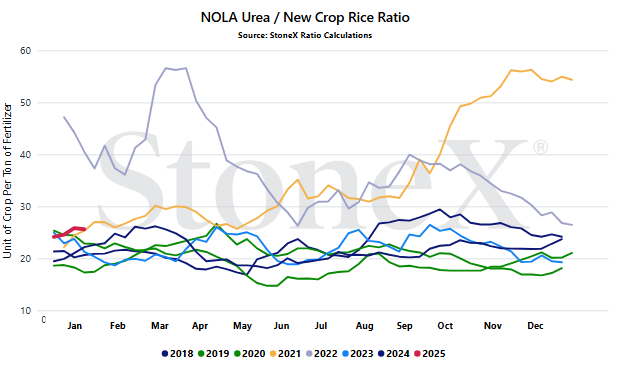
Where are the current urea/grain ratio values today

We believe that only looking at the flat price of either grains or fertilizer can be misleading:

  • Only selling grain can hurt you if fertilizer prices rise substantially
  • Only buying fertilizer can hurt you if grain prices fall

We look at the ratio "value" to get a better indication of where we are or how many bushels of X does it take to pay for 1 ton of fertilizer.

Would you rather:

  • Spend 135 bushels to pay for 1 ton of urea
  • Spend 55 bushels to pay for 1 ton of urea

When we compare the current ratio value against recent years, we start to see if we are high or low.

YOUR VALUES WILL LOOK DIFFERENT

This graph looks at the NOLA urea price vs the flat grain price. There are no logistics on either product. Your location will look different due to fertilizer logistical costs, grain basis, etc.
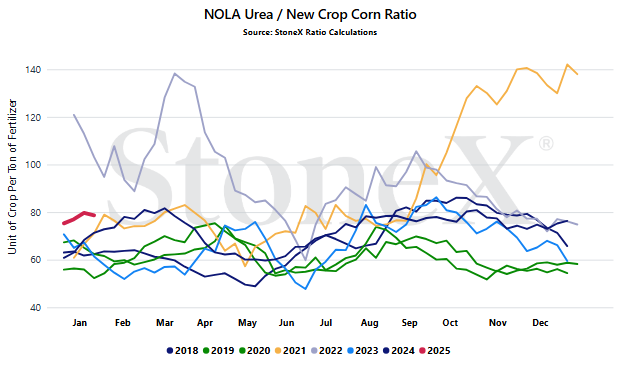
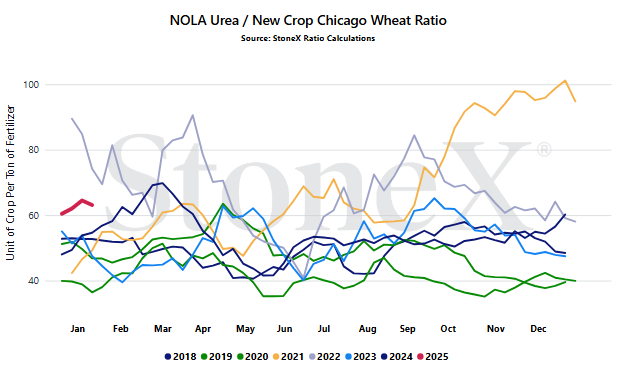
 

image-20250127090146-8


image-20250127090155-9


image-20250127090204-10


image-20250127090214-11


image-20250127090228-12


image-20250127090239-13


image-20250127090248-14


image-20250127090258-15


Josh Linville’s Focal Points
  • Iranian production rates/timing - Iranian production going offline, in partnership with the current India urea purchase tender, really helped the urea market find its footing in a bullish way.  So if Iran played that part going up, would their return to producing have negative effects?  While I do not think so, it needs to be watched because fertilizer emotions are a funny thing.
  • Chinese exports flows - Chinese urea markets are at a crossroads.  On the one hand, the governments strategy has worked.  By lowering exports, domestic stockpiles are near or above record levels and domestic prices are some of the cheapest in the world.  On the other hand, with stockpiles so high, they either need to start exporting or lower production rates.  If exports begin, the immediate global S&D effect wouldn't be huge, but there is little way to describe the emotional damage.  We do not expect them to return, but never say never.
  • How spring buyers react to India locking up February/early March shipments - at this point, it is fair to believe that the western global urea market will be tightly supplied thru to the first part of March.  India should lock everything up.  That means that countries needing supplies for their spring season will all be competing for March ship tonnages.  You know manufacturers will take advantage of this...
  • Growing N.A. demand - we were in a bad place before.  Imports of urea were lagging the 3-year average and the NOLA price continuing to be a discount to Middle East replacement values meant very few spot cargoes were heading this way.  Well, now we are dealing with a situation where global supplies are even more snug and N.A. demand is growing with increasing corn acres.  That is a bad combination...

StoneX Ratio Calculation

The ratio calculation is derived from Bloomberg historical grains values as well as fertilizer values from StoneX, NPKFAS, and Argus.

The calculation is simply dividing the fertilizer price by each grain price.

All data was sourced from StoneX unless otherwise noted.

 

  • Fertilizers

This material should be construed as the solicitation of an account, order, and/or services and represents the opinions and viewpoints of the individual authors or presenters. It does not constitute an individualized recommendation or take into account the particular trading objectives, financial situations, or needs of individual customers.


The views are current only through the date stated and are subject to change at any time based upon market or other conditions, and StoneX Group Inc. (“SGI”) disclaims any responsibility to update such views. Actual results, performance, or achievements may differ materially from those expressed or implied. Information is based on data gathered from what we believe are reliable sources. Past performance does not guarantee future results.


The StoneX Group Inc. group of companies provides financial services worldwide through its subsidiaries, including physical commodities, securities, exchange-traded and over-the-counter derivatives, risk management, global payments and foreign exchange products in accordance with applicable law in the jurisdictions where services are provided.


References to certain OTC products or swaps are made on behalf of StoneX Markets, LLC (SXM), a member of the National Futures Association (NFA) and provisionally registered with the U.S. Commodity Futures Trading Commission (CFTC) as a swap dealer. SXM’s products are designed only for individuals or firms who qualify under CFTC rules as an ‘Eligible Contract Participant’ and who have been accepted as customers of SXM.


StoneX Financial Inc. (SFI) is a member of FINRA/NFA/SIPC and registered with the MSRB. SFI is registered with the U.S. Securities and Exchange Commission (SEC) as a Broker-Dealer and with the CFTC as a Futures Commission Merchant and Commodity Trading Advisor. StoneX Financial (Canada) Inc. (SFCI) is registered in Canada and is a member of CIRO and CIPF. References to certain securities trading are made on behalf of the BD Division of SFI and are intended only for an audience of institutional clients as defined by FINRA Rule 4512(c). References to certain exchange-traded futures and options are made on behalf of the FCM Division of SFI. Wealth Management is offered through SA Stone Wealth Management Inc., member FINRA/SIPC, and SA Stone Investment Advisors Inc., an SEC-registered investment advisor, both wholly owned subsidiaries of SGI.

R.J. O’Brien & Associates, LLC (RJO) is registered with the CFTC as a Futures Commission Merchant and is a member of NFA.


StoneX Financial Ltd (SFL) is registered in England and Wales, company no. 5616586. SFL is authorized and regulated by the Financial Conduct Authority (FCA) (registration number FRN:446717) to provide services to professional and eligible customers including: arrangement, execution and, where required, clearing derivative transactions in exchange traded futures and options. SFL is also authorized to engage in the arrangement and execution of transactions in certain OTC products, certain securities trading, precious metals trading and payment services to eligible customers. SFL is authorized and regulated by the FCA under the Payment Services Regulations 2017 for the provision of payment services. SFL is a category 1 ring-dealing member of the London Metal Exchange. In addition SFL also engages in other physically delivered commodities business and other general business activities which are unregulated and not required to be authorized by the FCA.


This communication is issued in the European Economic Area by StoneX Financial Europe GmbH (SFEG). StoneX is the trade name used by STONEX GROUP INC. and all its associated entities and subsidiaries. StoneX Financial Europe GmbH (“SFEG”) is a securities trading firm registered in Germany under Company No. HRB 80844.


StoneX Financial Pte Ltd (Co. Reg. No 201130598R) (“SFP”) is regulated by the Monetary Authority of Singapore and is a Capital Markets Service Licence holder (for dealing in capital market products), an Exempt Financial Adviser (for advising on investment products and issuing or promulgating analyses/ reports on investment products) and a Major Payment Institution (for domestic and cross-border money transfer services).


SFP may distribute analysis/report produced by its respective foreign affiliates within the StoneX Group of companies pursuant to an arrangement under Regulation 32C of the Financial Advisers Regulations Recipients should contact SFP at (65) 6309 1000 for any matters arising from, or in connection with, this webinar.


StoneX APAC Pte. Ltd. (“SAP”) (Co. Reg. No 200616676W) is regulated as a Dealer (PS20190001002) under the Precious Stones and Precious Metals (Prevention of Money Laundering and Terrorism Financing) Act 2019 for purposes of anti-money laundering and countering the financing of terrorism.


StoneX Financial (HK) Limited (CE No.: BCQ152) (“SHK”) is regulated by the Hong Kong Securities and Futures Commission for Dealing in Securities and Dealing in Futures Contracts.


StoneX Financial Pty Ltd (ACN 141 774 727) holds an Australian Financial Service License (AFSL: 345646) for Dealing in Securities, Exchange-Traded Derivatives Contracts, OTC Derivatives Contracts and Foreign Exchange Contracts, and is regulated by the Australian Securities and Investments Commission.


StoneX Securities Co., Ltd. (“SSJ”) (Co. Reg. No 010401047199) is regulated by the Japanese Financial Services Agency as a Type-I Financial Instruments Business Operator (Kanto Local Finance Bureau (FIBO)No.291’), is a member of the Financial Futures Association of Japan for dealing and broking FX and FX Option transactions, and is a member of the Japan Securities Dealers Association for dealing and broking stock indices and option transactions.


Trading swaps and over-the-counter derivatives, exchange-traded derivatives and options and securities involves substantial risk and is not suitable for all investors. Past performance of any futures or option is not indicative of future success. Indicators are not a trading system and are not published as a specific trade recommendation. The information herein is not a recommendation to trade nor investment research or an offer to buy or sell any derivative or security. It does not take into account your particular investment objectives, financial situation or needs and does not create a binding obligation on any of the StoneX group of companies to enter into any transaction with you. You are advised to perform an independent investigation of any transaction to determine whether any transaction is suitable for you. No part of this material may be copied, photocopied or duplicated in any form by any means or redistributed without the prior written consent of StoneX Group Inc.


The report/analysis herein is not directed to, or intended for distribution to or use by, any person or entity who is a citizen or resident of or located in any locality, state, country or other jurisdiction where such distribution, publication, availability or use would be contrary to law or regulation.


© 2026 StoneX Group Inc. All Rights Reserved.

Satellite view of Earth at night showing illuminated cities across Asia and the Middle East

Discover more insights

Our subscribers have access to comprehensive market analysis from StoneX spanning commodities, equities, currencies and more.

StoneX: We open markets

Our market expertise, advanced platforms, global reach, culture of full transparency and commitment to our clients’ success all set us apart in the financial marketplace.

Reach

With access to 40+ derivatives exchanges, 180+ foreign exchange markets, nearly every global securities marketplace and numerous bi-lateral liquidity venues, StoneX’s digital network and deep relationships can take clients anywhere they want to go.

Transparency

As a publicly traded company meeting the highest standards of regulatory compliance in the markets we serve, our financials and record of accomplishment are matters of public record. StoneX’s commitment to “doing the right thing over the easy thing” sets us apart in the industry and helps us build respect, client trust and new partnerships.

Expertise

From our proprietary Market Intelligence platform, to “boots on the ground” expertise from award-winning traders and professionals, we connect our clients directly to actionable insights they can use to make more informed decisions and achieve their goals in the global markets.