FX Weekly Overview: The week's main events
- Bearish Factors
- COPOM's decision is expected to have a firmer tone and sharply signal the risks of inflation expectations diverging, potentially partially easing risk perceptions in Brazil and contributing to strengthening the BRL.
- The Brazilian government outlines a reaction to the worsening of the credibility of economic policies and begins to suggest a possible adjustment of public expenses, which may partially alleviate the risk premium demands by investors and contribute to strengthening the BRL.
- Milder data for retail and the American industry may slightly increase investors' bets on Fed interest rate cuts, contributing to weakening the USD.
- Bullish factors
- Soft data for the retail and industry in China may reinforce the perception of a slowdown in domestic demand and harm the performance of risky assets, such as commodities and currencies of countries that export primary products, like the BRL.
The week in review
The week was marked by the Federal Reserve's firm stance on its interest rate decision and by soft inflation data for the US, while Brazil's perception of fiscal risks remained high.
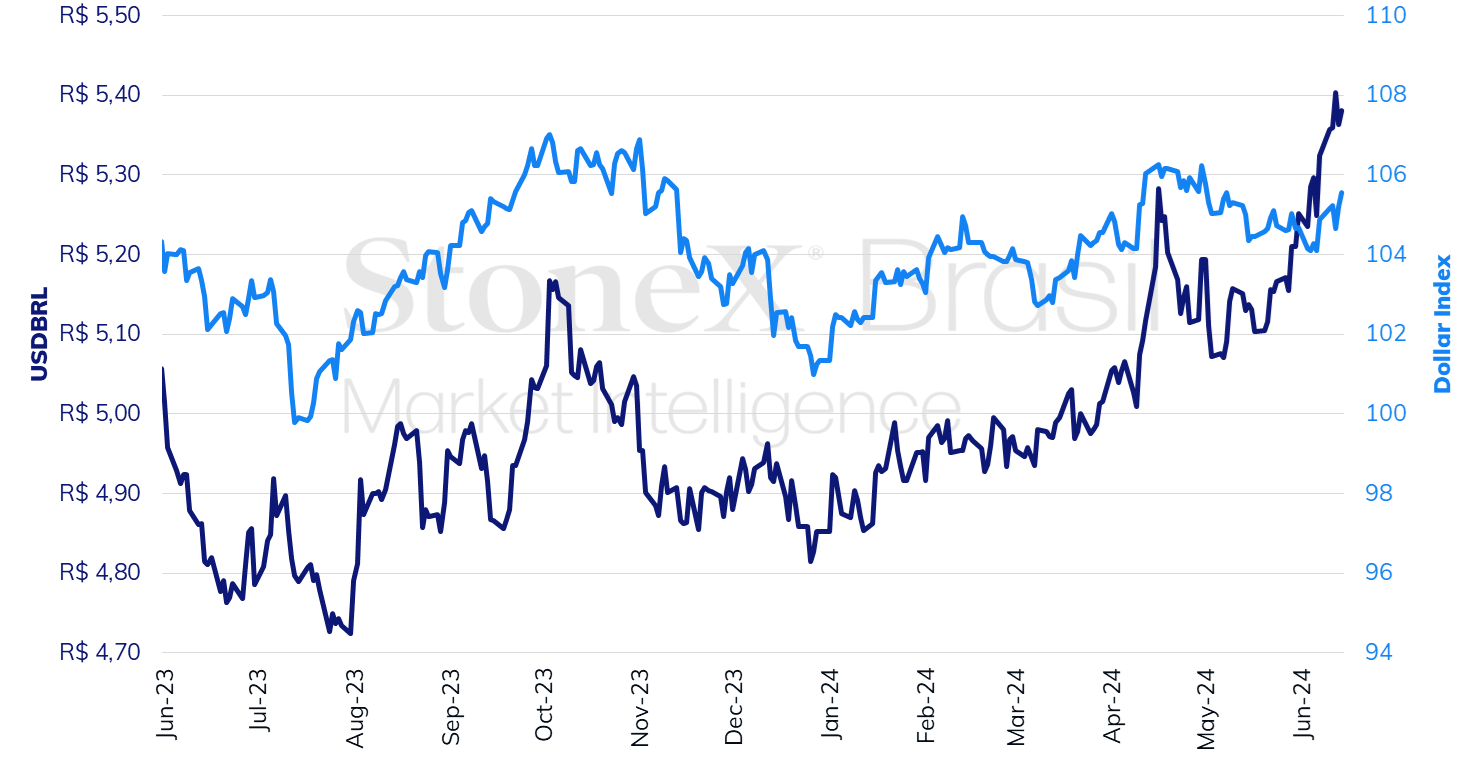
The USDBRL ended the week higher, closing Friday's session (14) at BRL 5.325, a weekly increase of 1.1%, a monthly increase of 2.5%, and an annual increase of 10.9%. The dollar index closed Friday's session at 105.5 points, a change of +0.6% for the week, +0.8% for the month, and +4.2% for the year.
USDBRL and Dollar Index (points)
Source: StoneX cmdtyView. Design: StoneX.
THE MOST IMPORTANT EVENT: Copom interest rate decision
Expected impact on USDBRL: bearish
In a week with few national indicators, investors will focus their attention on the decision of the Central Bank of Brazil's Monetary Policy Committee (Copom). In the last two months, the credibility of fiscal and monetary policy has been questioned by investors, primarily due to the relaxation of the federal government's budget targets between 2025 and 2027 and the recent Copom decision on May 8. This decision was the first without consensus since August of last year. The statement removed the forward guidance paragraphs, a move not seen since March 2021, and the Committee worsened its inflation estimates for the end of 2024 (from 3.5% to 3.8%) and 2025 (from 3.2% to 3.3%). Furthermore, the clear division among Copom members, with those appointed by the previous administration advocating for a stricter stance against inflation and those appointed by the current administration advocating for a more lenient stance, raised concerns among investors about a possible change in Copom's conduct after the next members appointed by the current government assume their positions in 2025. As a result, projections for inflation and interest rates in the country worsened, negatively impacting the performance of Brazilian assets, including the BRL.
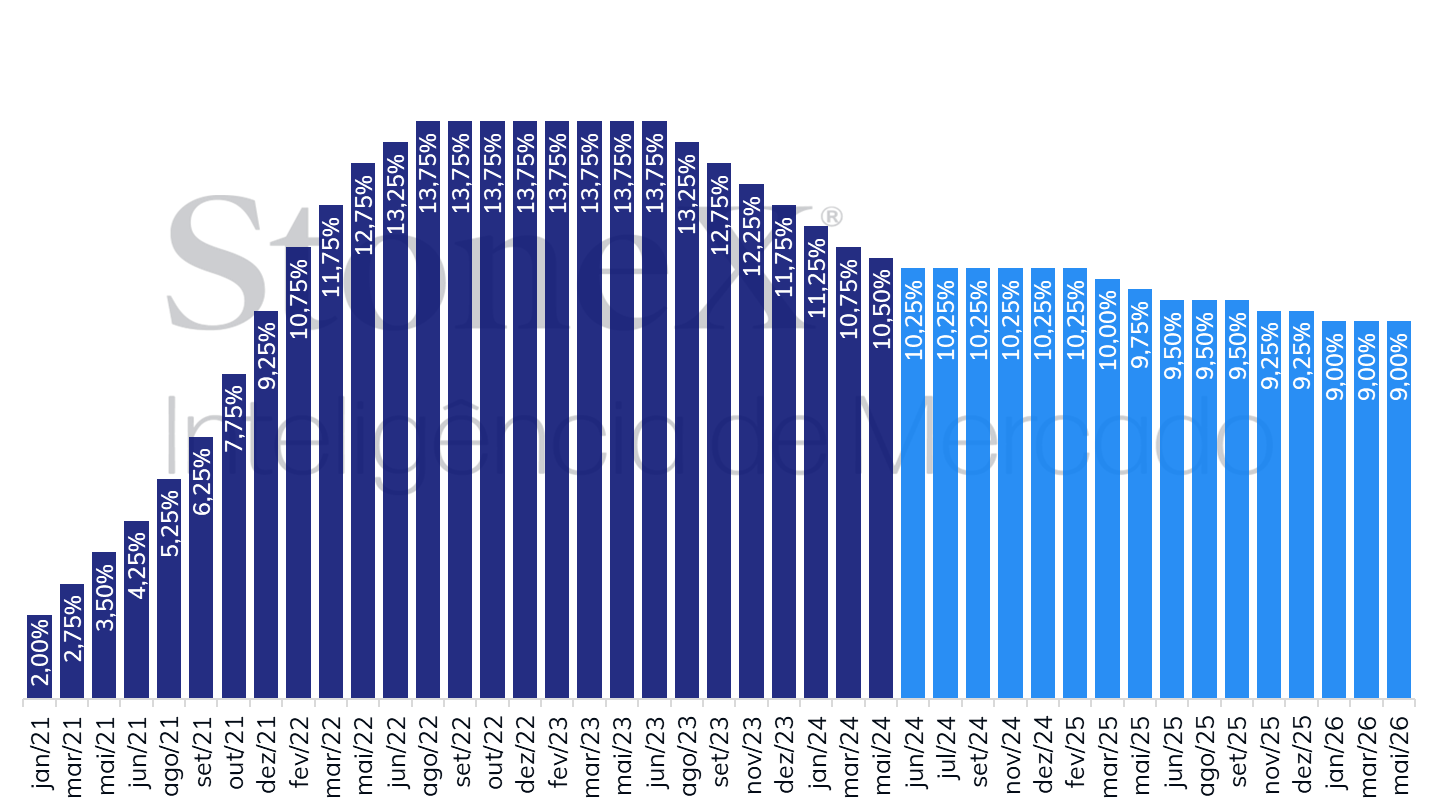
For this week's meeting, there is once again uncertainty about how the Committee will decide. After reducing the basic interest rates by 3.25 percentage points since August, the median projections in the latest Focus Bulletin still point to a cut of 0.25 percentage points, likely the last one of this year. The Interbank Deposit (DI) future interest rate curve was pricing in that the basic interest rate (SELIC) will be maintained at 10.50% per annum, with 91.5% of bets on June 13 in the Copom options market at B3 supporting this outcome. If there are doubts about the interest rate decision, there is a greater consensus that the decision should be consensual and that the statement should signal a deterioration in inflation expectations. Consequently, monetary policy will need to be more restrictive for a longer period. If confirmed, a stronger statement by Copom may partially alleviate risk perceptions in Brazil, contributing to the strengthening of the BRL.
Brazil: History and expectation for the interest rate
Source: Central Bank of Brazil (Focus Survey 06/07/2024). Design: StoneX. *Refers to the median of the estimates indicated by the Focus report on the specified date.
Reaction to the loss of credibility of fiscal policy
Expected impact on USDBRL: bearish
After a week of worsening risk perceptions for Brazilian assets due to political news in Brasília, financial market operators should continue monitoring statements from authorities for reassurances about public accounts, particularly regarding the perception that fiscal balance would depend exclusively on increasing tax revenues. For example, last week, the President of Brazil defended his Minister of Finance, Fernando Haddad, while Haddad and the Minister of Planning and Budget, Simone Tebet, stated that they are intensifying efforts to conduct a "broad, general, and unrestricted" review of public spending for the 2025 Budget. If confirmed, comments about a possible adjustment in public expenses may partially alleviate investors' risk premium demands, contributing to the strengthening of the BRL.
Retail and industry in the US
Expected impact on USDBRL: bearish
After a week full of important indicators, this week will bring only the figures for manufacturing and retail sales in the US for May, complementing the reading of American macroeconomic performance for the month. For retail sales, it is expected that the indicator will expand by 0.3% in May after surprising negatively in April when it remained flat (0.0%). Similarly, it is projected that manufacturing will grow by 0.2% in the period, after also remaining flat (0.0%) in the previous month. If confirmed, these data should reinforce the perception that the United States remained in modest expansion in May, consistent with interpretations of a "soft landing" of the economy, which implies price stabilization without excessive penalization of economic activity.
Retail and industry in China
Expected impact on USDBRL: bullish
In China, the most recent figures reinforce analysts' perception that the country's domestic demand continues to grow less than expected, while exports are recovering beyond forecasts, particularly in industrial segments related to artificial intelligence and electric vehicles. Nevertheless, manufacturing is expected to decrease over the accumulated 12 months, declining from 6.7% in April to around 6.0% in May. Conversely, retail sales are projected to increase slightly, from 2.3% on an annual basis to around 2.6%, aided by services related to tourist activity due to the extended Labor Day holiday at the beginning of May. If confirmed, this data should not change the pessimistic outlook for the growth of the second-largest global economy, which could worsen expectations for commodity demand and negatively impact the performance of currencies from countries that export primary products, such as the BRL.

INDICATORS