FX Weekly Overview: The week's main events
- Bearish factors
- US PCE Index for May: Predicted to show the smallest monthly increase since November, increasing bets on Fed interest rate cuts, thus weakening the USD globally.
- Bullish factors
- COPOM Minutes, Quarterly Inflation Report, and Fiscal Statistics for May: Expected to question the credibility of Brazilian economic policies, leading to higher investor risk premiums and a weaker real.
- IPCA-15 for June: Anticipated to rise, maintaining high inflation expectations in Brazil and further weakening the BRL.
The week in review
The week was marked by a high perception of fiscal risks in Brazil, negatively impacting Brazilian assets. A unanimous and firm decision by the Monetary Policy Committee (COPOM) failed to alleviate investor distrust.
The USDBRL ended the week higher, closing Friday's session (21) at BRL 5.441, a weekly increase of 1.1%, a monthly increase of 3.6%, and an annual increase of 12.1%. The dollar index closed Friday's session at 105.8 points, a change of +0.2% for the week, +1.1% for the month, and +4.4% for the year.
USDBRL and Dollar Index (points)
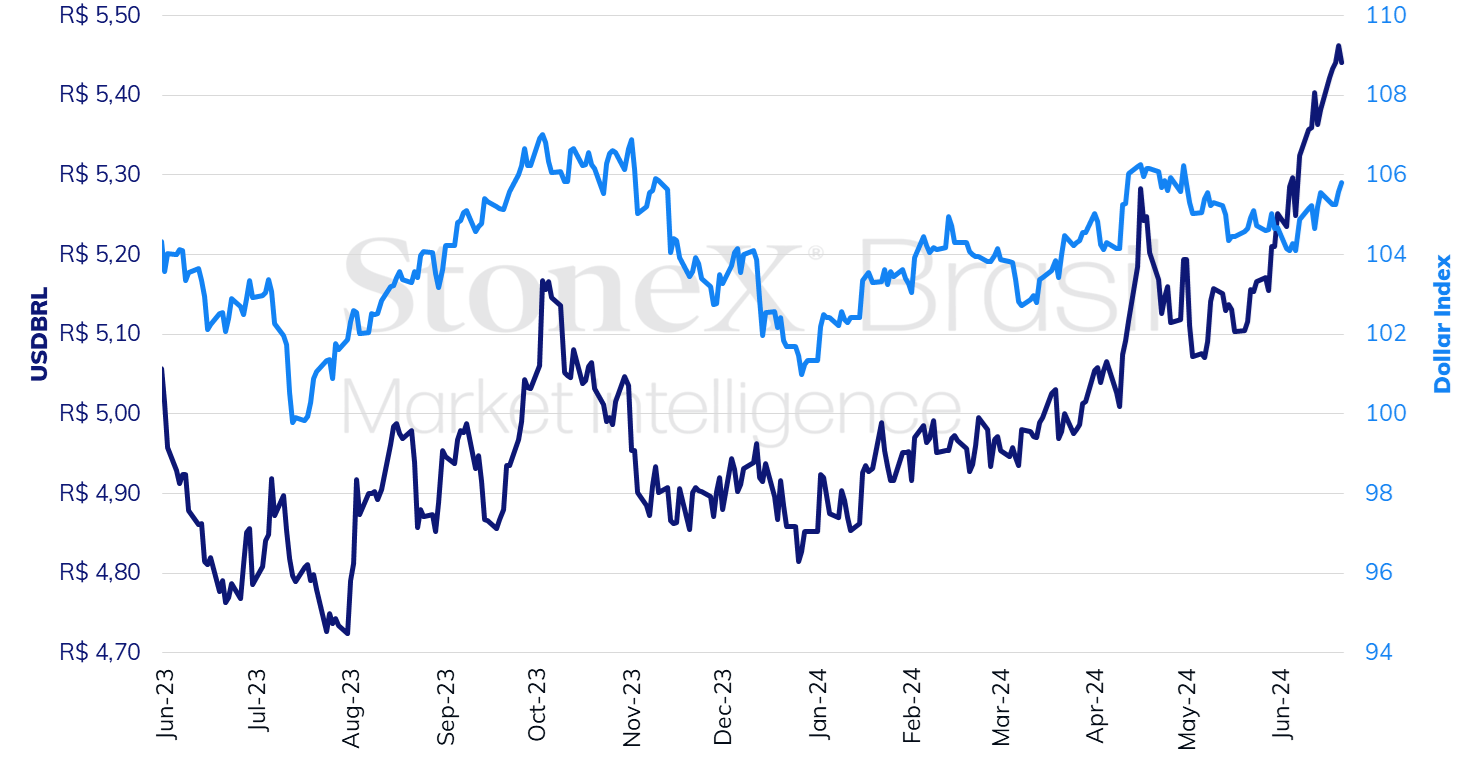
Source: StoneX cmdtyView. Design: StoneX.
KEY EVENTS: Credibility of Brazilian economic policies
Expected impact on USDBRL: bullish
The conduct of fiscal and monetary policies in Brazil, and its credibility among investors, should be the focus of agents during the week. In the last two months, the negative performance of Brazilian assets has been more associated with domestic factors than external ones, and there are doubts about the possibility of a reprieve in demand for risk premiums by investors without concrete measures from the federal government to alleviate fiscal concerns, which should keep the real weakened this week. After a unanimous and firmer decision by the Monetary Policy Committee (COPOM), the Focus bulletin on Monday (24) should reveal whether COPOM was enough to stop the recent trend of worsening forecasts for Brazilian macroeconomic variables. On Tuesday (25), the COPOM decision minutes may complement the financial market operators' understanding of the meeting, informing whether topics such as a change in the institution's inflationary risk balance or a possible increase in the basic interest rate (SELIC) were discussed. On Wednesday (26), the National Monetary Council (CMN) meets to deliberate, as every June, on the inflation targets in Brazil. On June 07, the Minister of Finance, Fernando Haddad, told journalists that the decree regulating the continuous inflation target (instead of a goal at the end of each year) would be published still in June, possibly before the CMN meeting, and that the value of 3% accumulated in 12 months would be maintained. On Thursday (27), the Central Bank will release its Quarterly Inflation Report, the most comprehensive publication of the institution analyzing the national macroeconomic environment and projecting the main variables for the coming years. The decision will be followed by a press conference with the agency's president, Roberto Campos Neto, and the director of economic policy, Diogo Guillen. Finally, on Friday (28), the BC will release the fiscal statistics for May, in a context of slightly worse performance than anticipated for revenues and expenses in the year and a high perception of fiscal risks for the country.
June IPCA-15
Expected impact on USDBRL: bullish
Additionally, the Brazilian Institute of Geography and Statistics (IBGE) will announce, this Wednesday (26), the National Consumer Price Index 15 (IPCA-15) for June, which is expected to show an increase of around 0.45%, just like in May. After two months of mild readings, the IPCA accelerated again in May and raised concerns among members of the Central Bank that the warmer job market is increasing pressure on price indices. Therefore, if the estimate for June is confirmed, inflation expectations should remain on the rise and contribute to a cautious stance by investors, weakening the real.
US May PCE
Expected impact on USDBRL: bearish
The focus of global investors should remain on the monetary authorities of the main economies and the uneven pace of the interest rate cut process among them. In the last few weeks, the central banks of Europe, Switzerland, and Canada have reduced their interest rates, while the Federal Reserve (Fed) and the Bank of England have kept their interest rates stable. In the United States, after readings that were quite benign for both the Consumer Price Index (CPI) and Producer Price Index (PPI) in May, analysts also expect a significant slowdown for the Personal Consumption Expenditures Price Index (PCE), a metric used by the Federal Reserve to track consumer inflation. The median of estimates points to a growth of 0.1% in May in both the full indicator and its core, which excludes the volatile components of food and energy, compared to an increase of 0.3% and 0.2%, respectively, in April. The data should be influenced by a drop in prices of some volatile items, such as airfares and costs of legal and financial services. The sequence of figures favorable to the American economic situation in May partially recovered investors' bets on interest rate cuts by the Fed, anticipating reductions of 0.25 p.p. in the decisions of September, December, January, and April. Therefore, if the forecasts for the PCE are confirmed, these bets should be reinforced and contribute to a widespread weakening of the USD against other currencies.
End-of-month PTAX rate
Expected impact on USDBRL: undefined
After a cumulative depreciation of 7.7% since April, the USDBRL is expected to remain volatile and under stress in the last week of the month. On Friday (28), the volume of trades and volatility is expected to be higher within the time windows used by the Central Bank of Brazil to calculate the end-of-month PTAX rate, that is, between 10:00 AM and 1:10 PM. The PTAX rate is a reference published daily by the Central Bank, and its end-of-month value is widely used in foreign exchange and derivatives contracts. Accordingly, traders intensify their operations during these intervals, competing for their definition.

INDICATORS