FX Weekly Overview: The week's main events
- Bearish factors
- The market must follow the release of indicators of activity level and inflation in the United States in search of more signs of the slowdown in the pace of economic growth and the increase in consumer prices, reinforcing the chances of interest rate cuts by the Fed starting in September.
- Bullish factors
- Fiscal risk in Brazil and investor distrust about the government's ability to ensure greater balance in public accounts.
- Perception of geopolitical risks with a possible victory of Donald Trump in the American elections. Uncertainties about Joe Biden's withdrawal and uncertainty about his replacement by the Democratic Party.
The week in review
The Brazilian currency and assets were heavily penalized this week, marked by high distrust among agents in the government's commitment to achieving fiscal targets and by a greater perception of geopolitical risks abroad, following statements from former President Donald Trump and his vice president, J.D. Vance, in the race for the White House. Despite the consolidation in bets for an interest rate cut by the Federal Reserve in September, a factor that contributes to the depreciation of the USD, the political scenario in the US and the movement of USD pairs, such as the euro, the British pound, and the yen, ended up being dominant elements in the formation of quotes in the currency market.
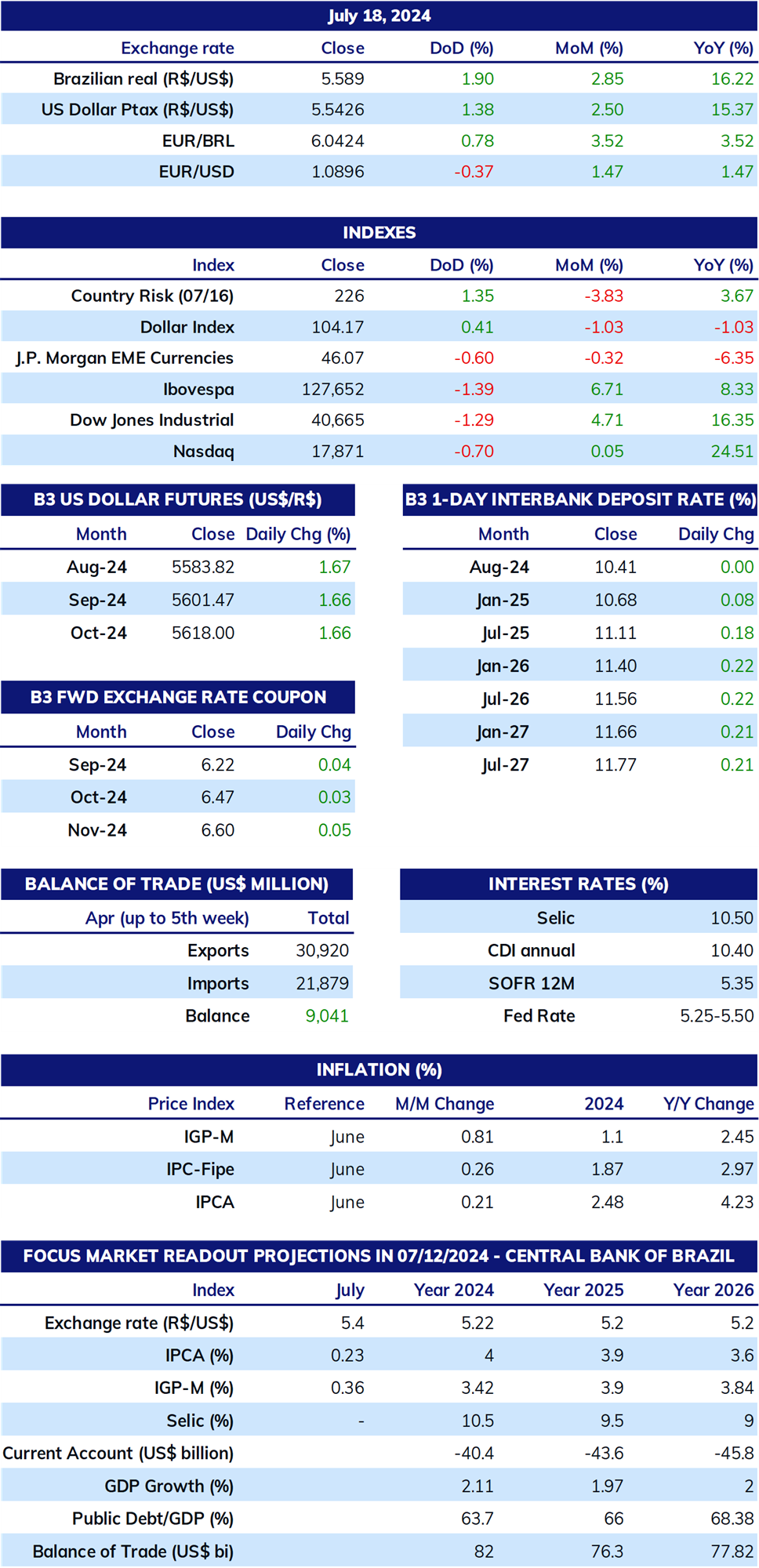
The USDBRL ended the week higher, closing Friday's session (19) at BRL 5.605, a weekly increase of 3.2%, a monthly increase of 0.25%, and an annual increase of 15.5%. The dollar index closed Friday's session at 104.38 points, a change of +0.3% for the week, -1.4% for the month, and +3.0% for the year.
USDBRL and Dollar Index (points)
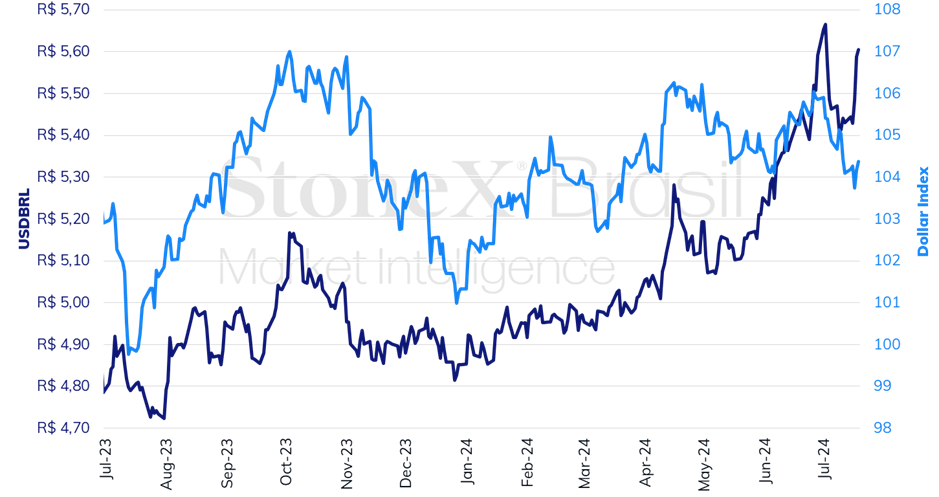
Source: StoneX cmdtyView. Design: StoneX.
KEY EVENTS: Crisis of fiscal confidence
Expected impact on USDBRL: bullish
The fiscal issue remains a point of special concern for traders, fueling volatility for the exchange rate and assets of the Brazilian economy. This became evident throughout the last week after the sharp reaction of the USDBRL quotes to President Luiz Inácio Lula da Silva's interview on TV Record. In excerpts leaked during the afternoon of Tuesday (16), Lula's speeches reinforced the uncertainties regarding the Executive's commitment to fiscal goals. When asked about the projection of budget cuts between R$ 15 and R$ 20 billion to comply with the fiscal framework, the president stated that he would need to "be convinced whether there is a need to cut or not" and that he has a "conceptual divergence with market people" regarding what is understood as spending.
After the noises caused during Tuesday, the Minister of Finance, Fernando Haddad, tried to reverse the impression left by Lula's apparent skepticism about the need to cut expenses and stated that the president's statements were taken out of context. Regarding the excerpt released on Tuesday, in which Lula says, "This country has no problem if it is zero deficit, if it is 0.1% deficit if it is 0.2% deficit," the minister stated that the head of the Executive was referring to the primary result range provided for in the fiscal framework and not to the intention of revisiting fiscal targets in favor of an increase in spending.
Haddad's attempt to undo the malaise with the market was followed by other ministers, who in the same way were unable to stop the trend of devaluation of the Brazilian currency between Wednesday (17) and Thursday (18). On Wednesday, the Minister of Institutional Relations, Alexandre Padilha, reaffirmed the president's "non-negotiable fiscal commitment" and recalled Lula's statements after his last meeting with the Budget Execution Board (JEO), when he told the ministers that they should do whatever was necessary to comply with the fiscal framework. On Thursday, it was the Minister of Planning and Budget's turn, Simone Tebet, to convey confidence that the Executive remains committed to promoting the balance of public accounts. "We have a commitment to the country, by determination of the president and the economic team, not to spend more than it collects," Tebet told on a morning program on CanalGov. Despite the joint effort of the ministers to undo the impression that the government would maintain a more expansionist fiscal stance after Lula's interview, the market received the message with skepticism. At Thursday's close, the real/dollar pair was trading at BRL 5.589, the current level that corresponded to the highest exchange rate since July 2, and a weekly advance of 2.9%.
The weakening of the Brazilian currency was only temporarily contained after the government's economic team’s speeches materialized into actions. On the morning of this Friday (19), the BRL managed to recover in response to the announcement by Minister Fernando Haddad that the government will implement a spending cut of around R$ 15 billion still in 2024 to achieve the zero-deficit target. After the meeting between members of the Budget Execution Board (JEO), held on Thursday, Haddad announced the blocking of BRL 11.2 billion in excess expenses, and the withholding of BRL 3.8 billion, due to outstanding issues in the STF that affect revenue. "The block is the amount that needs to be withheld to avoid exceeding the limit set by the complementary law that established the new fiscal framework for expenses. Since we agreed on a 2.5% ceiling above inflation, it is exceeding that amount." By how much? At BRL 11.2 billion. Regarding revenue, you calculate the contingency account," explained the minister.
According to calculations by the Federal Revenue Service, with the freezing of BRL 15 billion, the deficit should be at the upper limit of the band provided in the fiscal framework, at 0.25% of GDP, which would amount to around R$ 28 billion. This result would not include possible compensatory measures that are being analyzed by Congress, which could help reduce the expected deficit. The detailed figures finalized in the JEO meeting are expected to be released next Monday (22) with the publication of the Revenue and Primary Expenditure Evaluation Report for the 3rd bimester.
In general, the announcement of the containment was well received by the market, but considered insufficient by analysts, who predict that the frustration in the collection will be greater, requiring a substantially broader contingency than the BRL 3.8 billion announced. When looking at the ceiling of the band allowed by the fiscal framework, the government's economic team avoids a more significant tightening at this moment but postpones the need for new adjustments in the coming first two months if revenue expectations do not materialize. Thus, Monday's disclosure will be crucial to bring clarity to the market as to whether the correction of the trajectory in public accounts is sufficient to achieve fiscal commitments.
Uncertainties in the race for the White House
Expected impact on USDBRL: bullish
The week started very busy also in the external scenario, reflecting the environment of higher uncertainty after the assassination attempt suffered by former US President Donald Trump last Saturday (13). After the episode, analysts' perception of Trump's chances of victory in the November presidential election increased, while the event increased unpredictability in an already complex American political landscape. Despite the increase in risk perceptions regarding the American economy, scenarios like this tend to strengthen the dollar through the "flight to quality" phenomenon, when investors seek to reduce their exposure to risks and look for liquid and safe assets like the US dollar, harming the performance of riskier investments, such as currencies from emerging economies like the Brazilian real.
On Monday (15), the Republican Party officially announced Donald Trump's candidacy for the presidency as well as the selection of Ohio senator J.D. Vance as his running mate for the November elections. In one of his first interviews after being appointed to the Republican ticket, Vance emphasized that China is the main threat to the US, reinforcing the perspective that a second term for Trump would maintain a more severe stance towards the Asian giant. The American vice-presidential candidate is also in favor of raising the country's import tariffs to 10% for all products brought from outside the US, penalizing especially goods imported from China. In the same context, on Wednesday (17), Trump questioned the US's geopolitical position regarding Taiwan's military defense, amid growing tension between the two countries with China. After his speeches, the shares of some technology companies, such as Nvidia and Apple, suffered sharp losses and resulted in a sharp drop in the American stock market, contributing to the dollar depreciation.
If, on the one hand, the definition of the Republican candidate for the presidential race in the US impacted the market during the week, especially through indications of how the Republican ticket, if elected, will address geopolitical issues, on the other hand, the uncertainty of the Democratic ticket may also continue to impact risk perceptions for investors in the coming weeks. Major donors of the Democratic party have been pressuring the party to review Joe Biden's candidacy for reelection, and more and more important party leaders have been positioning themselves in favor of the president's withdrawal, under the risk that Democrats may forfeit their majority in the Senate and reduce their chances of rebounding the majority in the House. Additionally, the Washington Post published news that former President Barack Obama told allies that he believes Biden's chances of winning the race have dropped significantly, and that the president should reconsider his candidacy. In this scenario, some news outlets have aired the possibility that Biden may confirm his withdrawal this weekend. If the event materializes, the beginning of the week may see significant volatility, especially if there is uncertainty about the replacement of the president in the race to the White House.

INDICATORS