FX Weekly Overview: The week's main events
- Bearish Factors
- Re-acceleration of the September IPCA and strong data for retail and services in Brazil should keep expectations for an interest rate hike cycle by the Central Bank high, which may attract foreign capital and strengthen the real.
- Bullish Factors
- Mild CPI and FOMC decision minutes should reinforce the perception of a “soft landing” for the US economy, reducing bets on Fed rate cuts and strengthening the dollar.
- Potential escalation in armed conflicts in the Middle East could increase global risk aversion, favoring the performance of “safe-haven” assets and strengthening the dollar.
The week in review
The US dollar interrupted four consecutive weeks of decline and showed its strongest rally in two years due to better-than-expected performance in economic activity and labor market data in the US, as well as global concerns about conflict in the Middle East. In Brazil, an unexpected improvement in the country’s credit rating by Moody’s helped mitigate losses for the real.
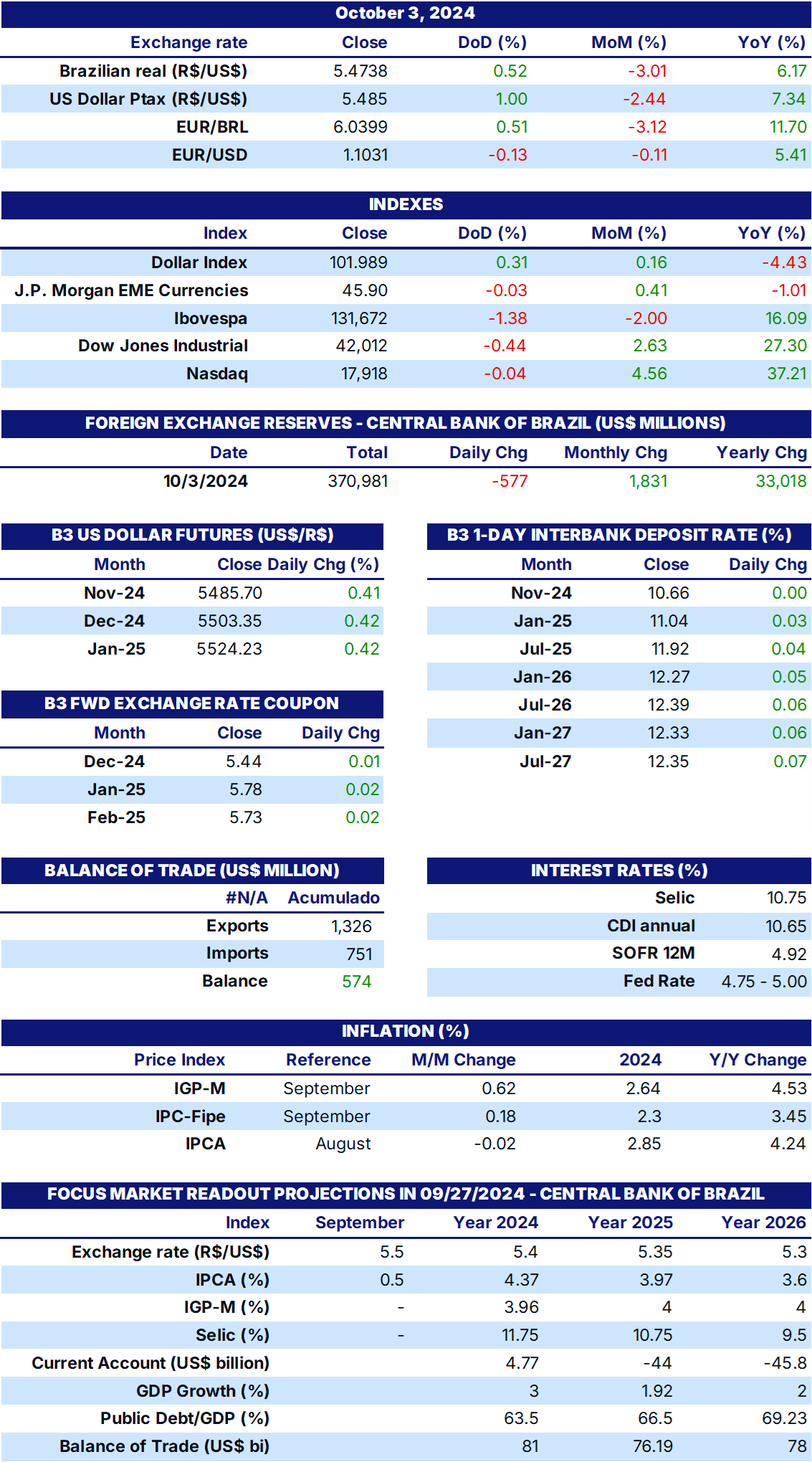
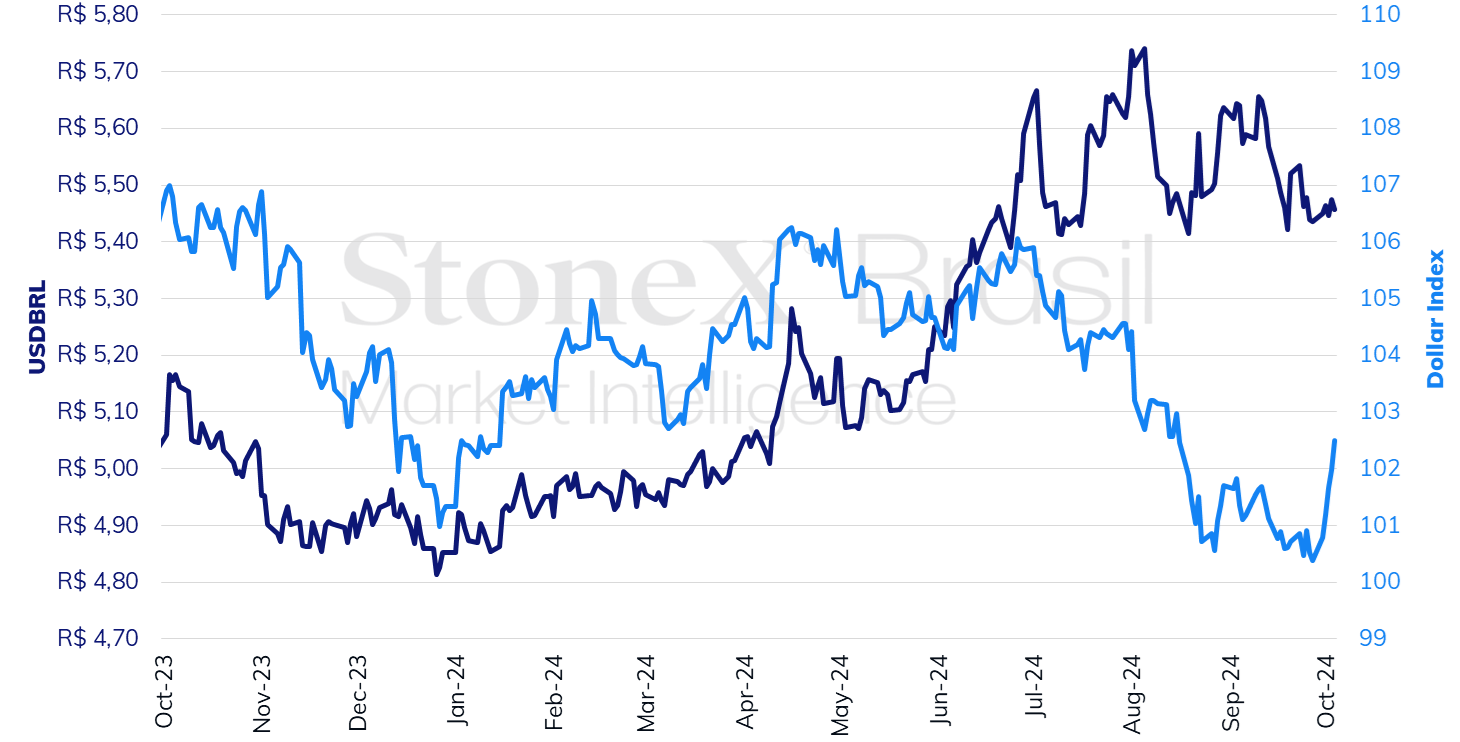
The USDBRL ended Friday's (04) session higher, quoted at BRL 5.4564, with a weekly gain of 0.4%, monthly gain of 0.1%, and annual gain of 12.5%. The dollar index closed the same day at 102.5 points, a +2.1% change for the week, 1.7% for the month, and +1.1% for the year.
USDBRL and Dollar Index (points)
Source: StoneX cmdtyView. Design: StoneX.
KEY EVENTS: CPI and FOMC Minutes
Expected Impact on USDBRL: Bullish
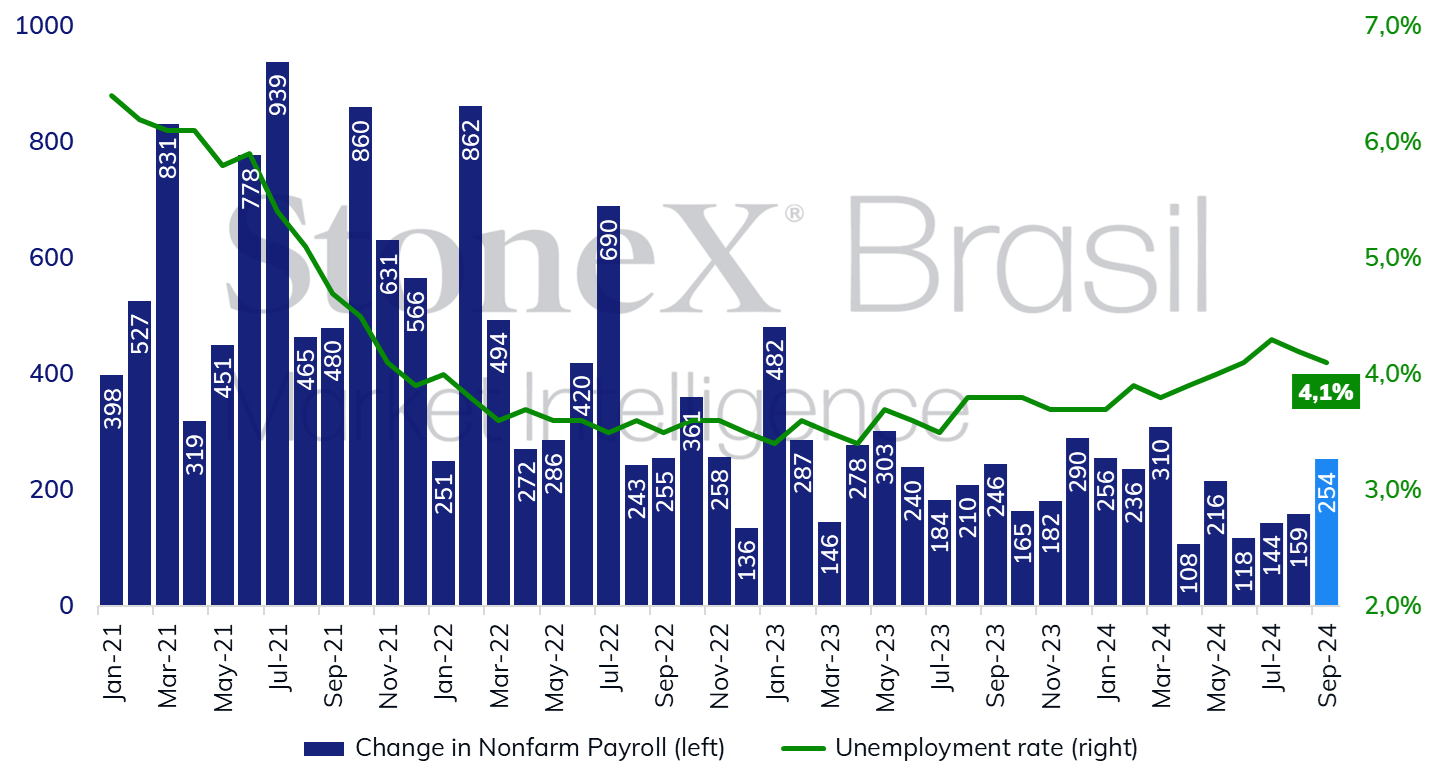
Investor expectations for the trajectory of US interest rates have changed significantly in a week, following last week’s data indicating a warmer and more resilient economy than anticipated. Although the September Purchasing Managers' Index (PMI) for the industrial sector fell more than expected (47.2 points versus a median projection of 47.6 points), job openings in August, the September services PMI, and job creation in September exceeded analyst estimates, reinforcing the interpretation of a soft landing for the economy. As a result, the odds of more aggressive rate cuts by the Federal Reserve (Fed) have been significantly reduced, and investors now anticipate a slower pace of monetary easing. This, in turn, has reduced expectations for losses in yields on dollar-denominated bonds, favoring the dollar's global strengthening.
US: History and Expected Interest Rate – October 4, 2024
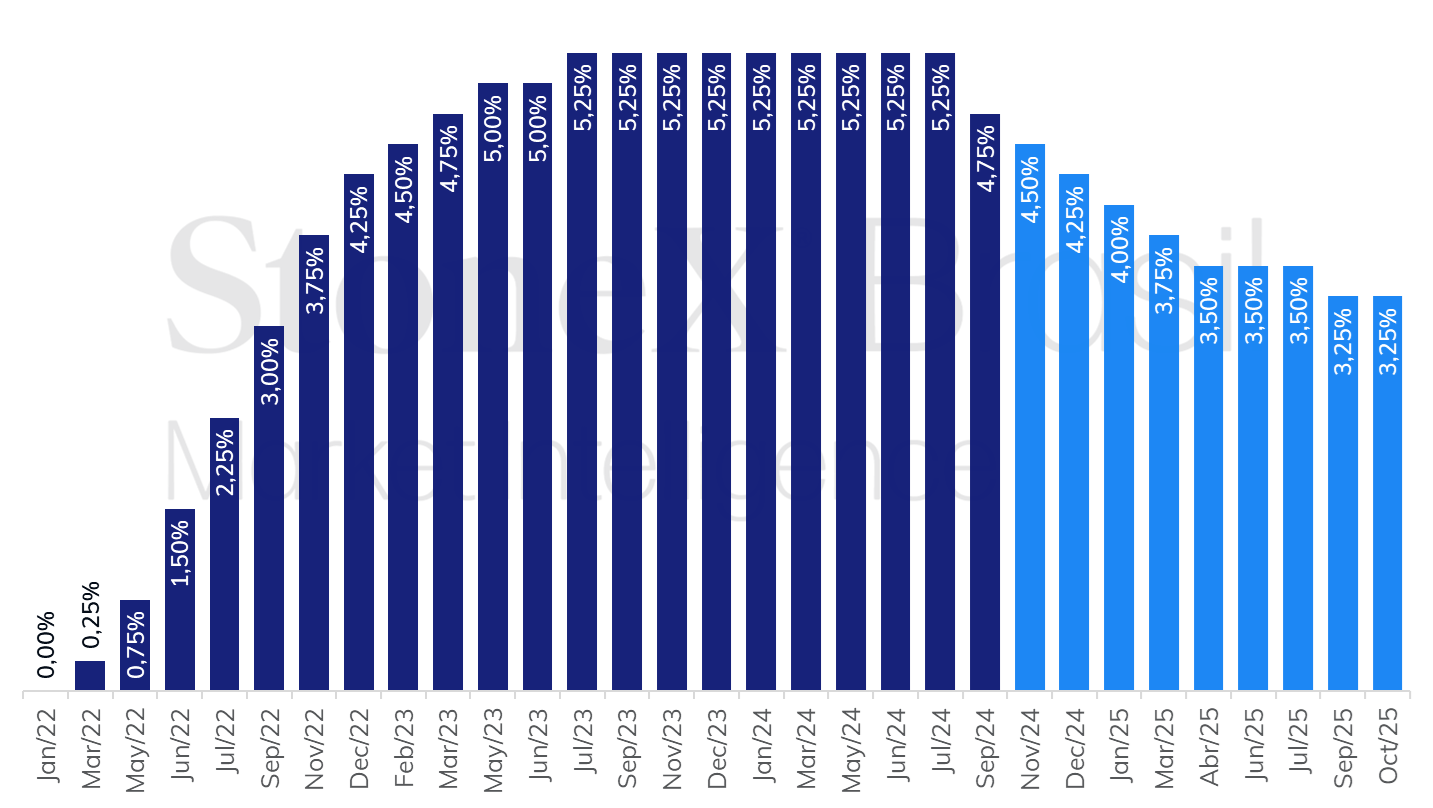 Source: CME FedWatch Tool. Design: StoneX. Refers to the market's most probable bet for the indicated date.
Change in Total Urban Employment (in thousands) and Unemployment Rate (%) in the US
Source: U.S. Bureau of Labor Statistics (BLS), Federal Reserve Bank of St. Louis. Design: StoneX.
This volatility is largely a result of the Federal Reserve's actions, which surprised markets by cutting interest rates by 50 basis points at its September 18 policy meeting, expressing, in various communications, a significantly heightened concern with labor market weakening compared to inflationary resilience. In this sense, the release of the minutes of this decision, on Wednesday (09), should help clarify the debate within the Federal Open Market Committee (FOMC), the degree of consensus for the 0.50 percentage point reduction, and the arguments for and against it. It may also provide clues as to what criteria could lead the Committee to repeat another more aggressive cut.
It is also worth noting that, after last week’s strong labor market numbers, the Consumer Price Index reading gains importance and should prove relevant for investors’ bets on the Fed's interest rate trajectory. The median projections point to another mild reading, with a 0.1% increase in the headline indicator and a 0.2% rise in its core, excluding volatile food and energy components. If the estimate is confirmed, it should support the “soft landing” interpretation of the US economy and indicate no urgency to lower US interest rates, strengthening the dollar globally.
IPCA, Retail, and Services in Brazil
Expected Impact on USDBRL: Bearish
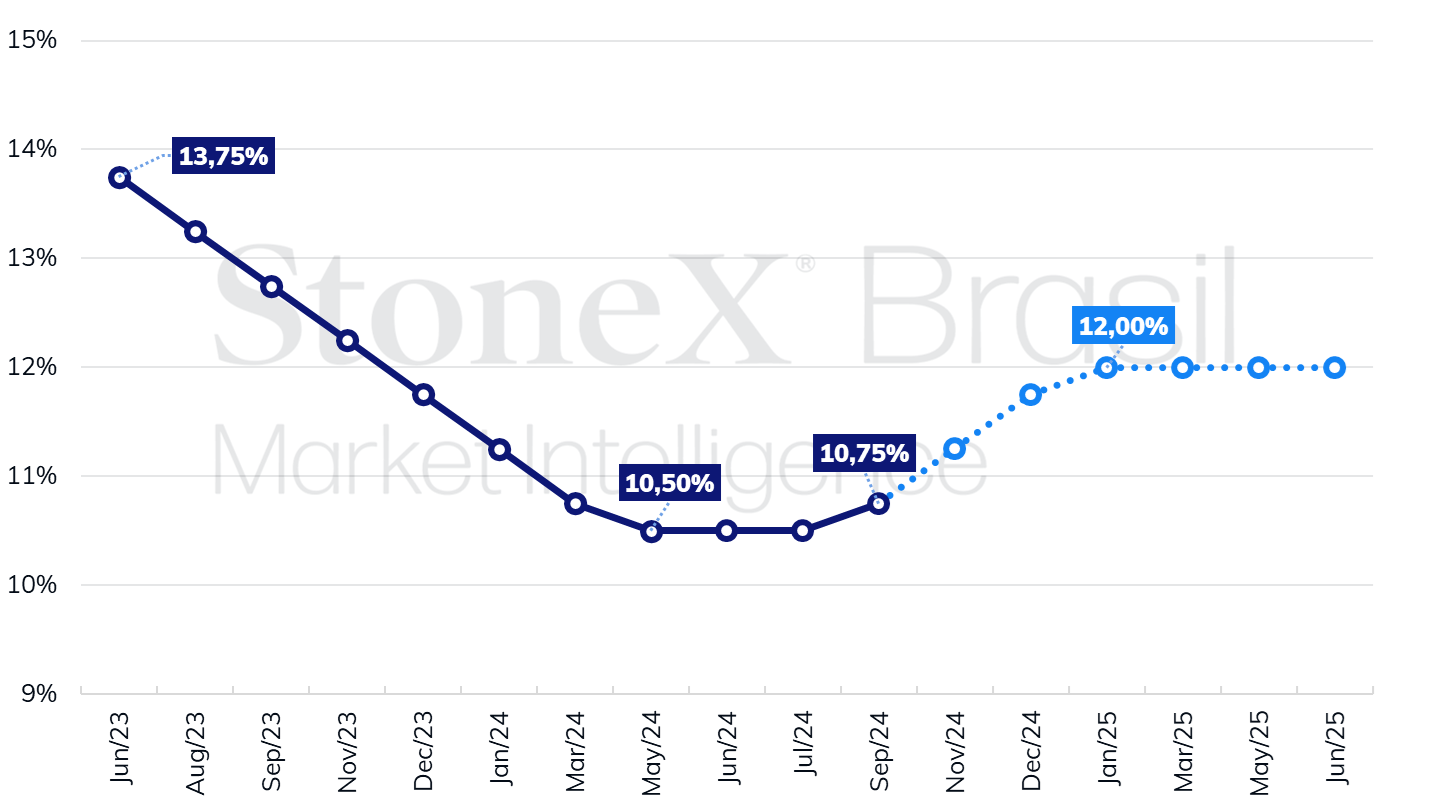
After remaining practically stable (-0.02%) with a rather benign composition in August, the Broad National Consumer Price Index (IPCA) is expected to accelerate in September to around a 0.50% increase, mainly driven by the adoption of the red tariff flag level 1 for electricity due to the severe drought in the country – in October, the tariff will be the red flag level 2. Additionally, retail sales and services activity are expected to show further expansion in August. The re-acceleration of the IPCA and robust data for productive activity are expected to keep both inflation expectations and bets on a rapid pace of monetary tightening by the Central Bank's Monetary Policy Committee (Copom) high. The prospect of higher interest rates in Brazil, on the other hand, makes domestic bonds more profitable and contributes to attracting foreign investments, strengthening the real.
Brazil: History and Expected Interest Rate – Focus September 27, 2024
Source: Central Bank of Brazil. Design: StoneX. Refers to the median estimates provided by the Focus report on the indicated date.
Tensions in the Middle East
Expected Impact on USDBRL: Bullish
Last week, geopolitical tensions in the Middle East increased, prompting defensive and risk-averse stances from global investors at times. Engaged in war against Hamas in Gaza and Hezbollah in Lebanon, Israel was targeted by an attack from Iran, which fired about 180 ballistic missiles at the country in retaliation for Israeli killings of Iranian soldiers and allied forces, including a Hamas leader in Tehran. The episode heightened fears of a direct military confrontation between the two countries, fears that were further amplified after US President Joe Biden stated that the American government "is discussing" whether it would support an Israeli attack on Iran's oil facilities. Although the scenario is quite complex and highly uncertain, investors remain vigilant and wary of the potential escalation of conflicts in the region, which could increase risk aversion and drive the search for "safe-haven" assets, strengthening the dollar.

INDICATORS