The most important: Voting on the framework by the National Congress
Expected impact on USDBRL: bearish
The investors' attention should turn to the passage of the fiscal framework bill (PLP 93/23) through the Chamber of Deputies. After managing to approve the urgency regime in the Chamber with a significant score of 367 votes against 102, the text of the project goes directly to the Plenary, probably on Wednesday (24), according to the president of the Chamber, Congressman Arthur Lira (PP-AL). As anticipated, the substitute text brought changes to improve compliance with primary budget targets and reduced the number of spending categories excluded from calculating the spending limit. Despite initial expectations, the response to the vote was not overwhelmingly positive. Reports indicate that the text being voted on includes two provisions allowing for increased federal government spending of approximately BRL 80 billion within the next two years. These provisions include compensation for changes in inflation calculations and reimbursement for fuel exemptions granted by Jair Bolsonaro's administration in 2022. The project's rapporteur in the Chamber, congressman Cláudio Cajado (PP-BA), did not dispute the existence of the devices, only the size of the budgetary impacts calculated by economist Jeferson Bittencourt, former secretary of the National Treasury. Additionally, at least 40 amendments to the text will be considered in the Plenary, which brings some uncertainty to investors that the fiscal framework can still be changed. It is believed that the probability is low because of the number of votes the Presidential Administration managed to get through the urgent request, but Brasilia has produced surprises in the past.
FOMC Minutes
Expected impact on USDBRL: bearish
The minutes of the Federal Reserve's (Fed) latest Federal Open Market Committee (FOMC) monetary policy decision are expected to provide more details on what criteria the Committee will consider when determining whether to continue to adjust its interest rate or to stop the cycle of rate hikes at its next decision on June 14. In its latest decision, the FOMC did indeed appear to be ending the monetary tightening cycle by changing its statement on the possibility of additional rate hikes to a statement that the FOMC seeks to "determine the extent to which additional policy tightening may be appropriate" and by revealing at the press conference that "several members have commented on the possibility of pausing [the tightening cycle]. At the same time, Fed Chairman Jerome Powell reinforced that the central bank would consider reading economic data until the meeting, leaving the Committee's decision open.
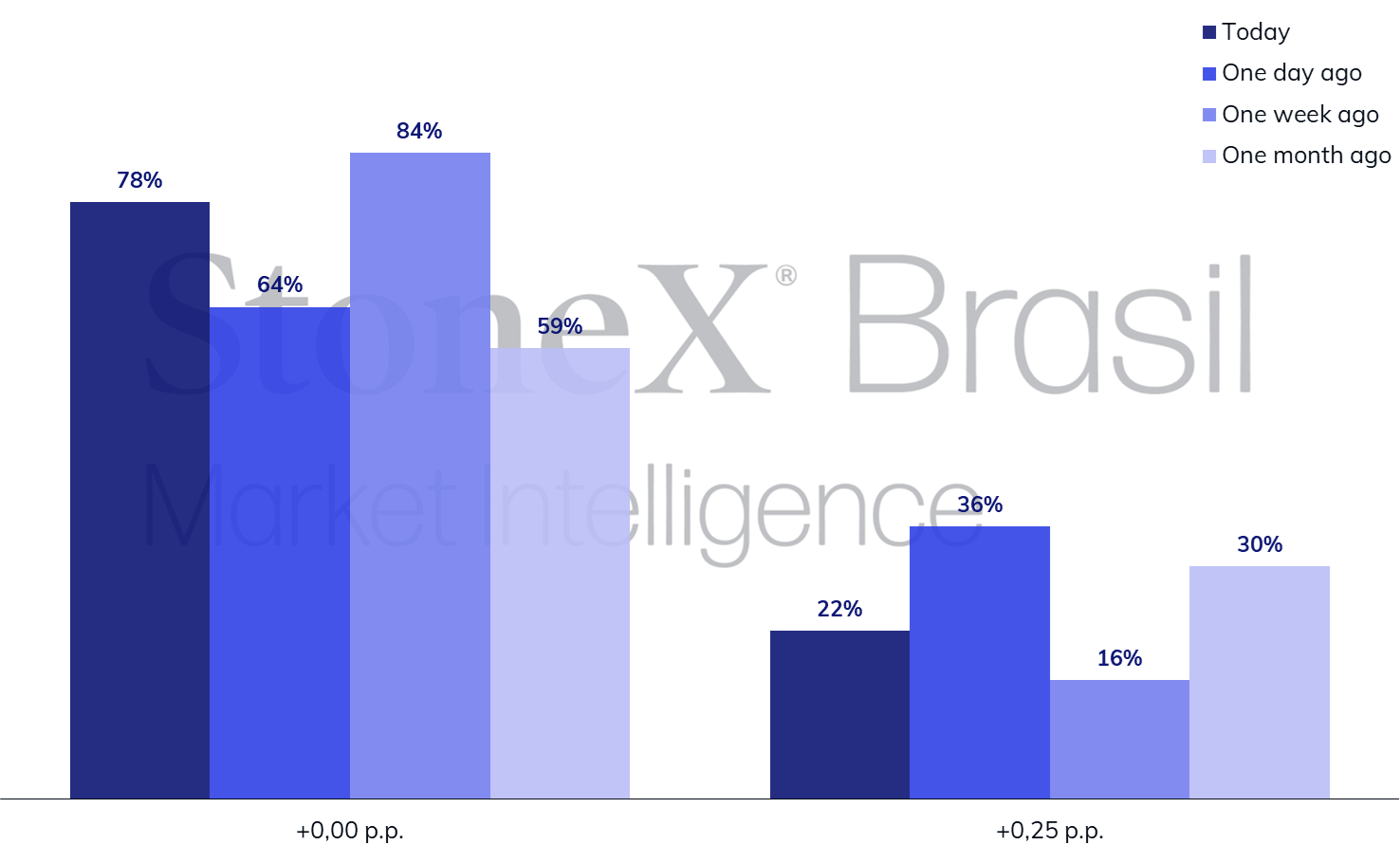
The communiqué and statements from various Fed officials leave no doubt that recent price developments, particularly in so-called core inflation (when the volatile food and energy components are excluded), do not recommend stopping interest rate hikes. However, the balance of risks for the next interest rate decisions has become more complex due to the uncertainty of how the recent stresses on the banking sector will affect credit to the economy, how the monetary tightening itself will feed back into the difficulties of some poorly positioned banking institutions and even how the lagged effects on economic activity and prices will be transmitted. Therefore, most bets on the interest rate futures market believe that the FOMC will keep the rate unchanged on June 14, between 5.00% and 5.25% p.a.
Bets for the Federal Reserve's interest rate decision on June 14
Source: CME FedWatch Tool. Design: StoneX. Probabilities in the interest futures market, May 19, 2023
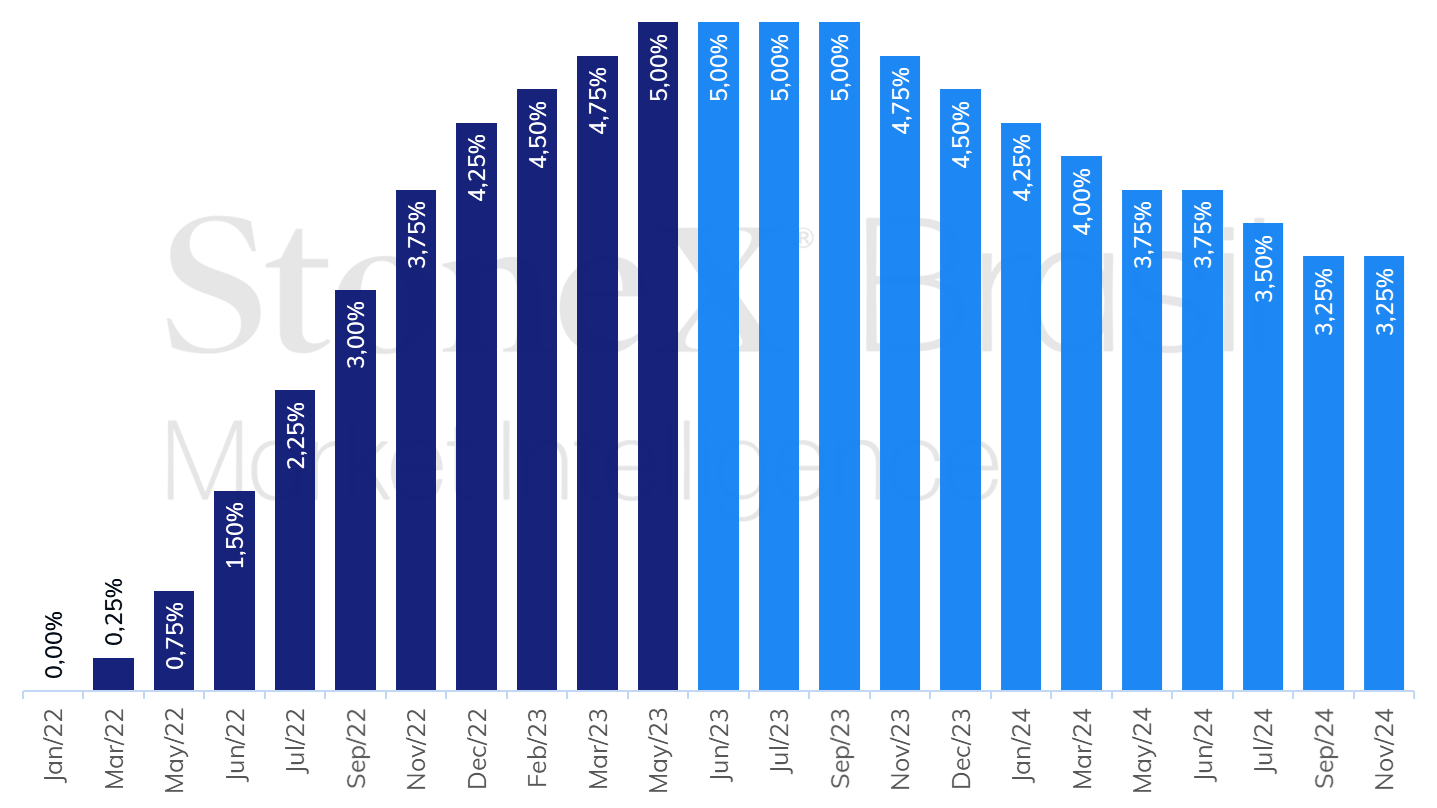
US interest rate history and higher probability bets on the futures market
Source: CME FedWatch Tool. Design: StoneX. Probabilities in the interest futures market, May 19, 2023
Risk of a US Debt Default
Expected impact on USDBRL: Bullish
In the last two weeks, the main factor that has driven the price of the American currency globally has been the evolution of negotiations between officials of both parties regarding the need to extend the public debt limit in the United States. The effects of this impasse have been diverse, depending on the context. The possibility that the US Treasury will exhaust its resources to pay its commitments and default for the first time in history is reducing risk appetite and increasing the search for quality assets, which has contributed to strengthening the dollar. Still, most analysts believe that the materialization of the default scenario would be negative for dollar-denominated assets and promote their weakening. Much of the difficulty in reaching an agreement lies in the vagueness of the "x-date," the day the US government would effectively run out of funds to pay its commitments. According to the country's Treasury Secretary Janet Yellen, such an event could occur "as soon as June 1," and Yellen has repeatedly warned that there is no reasonable alternative to the problem other than to suspend or raise the country's debt limit and that a default would be "an economic and financial catastrophe."
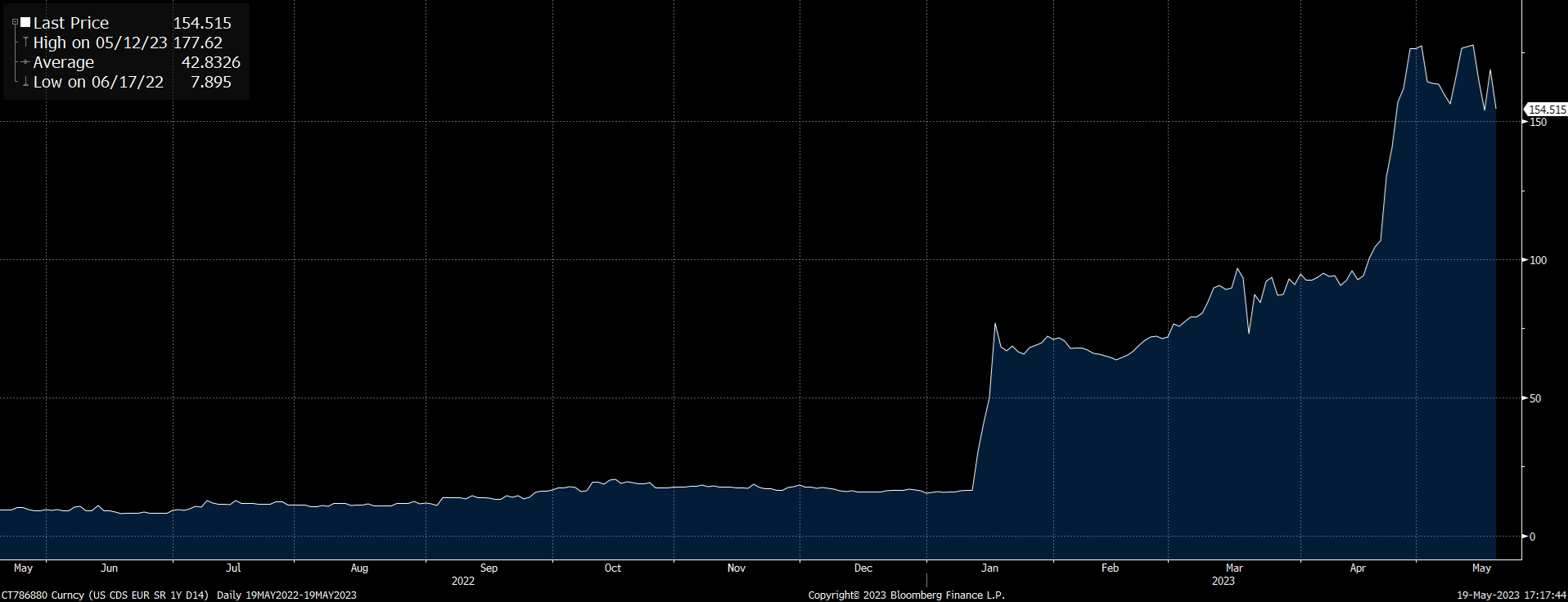
Additionally, with back and forth, Democrats (in particular the President, Joe Biden) and Republicans (in particular the leader of the House of Representatives, Kevin McCarthy) have made progress in negotiating an agreement that the debt limit will soon be raised, avoiding financial catastrophe. Although an agreement has not yet been reached, the mere progress in the talks has also contributed to investor optimism regarding US assets, with a slight drop in the spread of the Credit Default Swap (CDS) contracts for US Treasury bonds (a thermometer for their risk) and also contributing to the appreciation of the US currency. Last Friday (19), a payment of 1.54% of the value of the bond each year was required as a premium for the CDS. Now, should an agreement be reached this week, the agents' attention will probably shift to the concessions each party has accepted and the budget reductions negotiated.
Spread of the 1-year US Credit Default Swap (CDS) contracts (basis points):
US Economic Data
Expected impact on USDBRL: Bullish
The week will be loaded with economic indicators relevant to the American economy. Of particular note is the April reading of the Personal Consumption Expenditure (PCE) Price Index, a metric used by the Federal Reserve to track consumer prices. After a moderate rise in the Consumer Price Index (CPI), the average estimate point to a 0.3% increase in the core of the PCE, which would keep the accumulated growth in 12 months practically unchanged at 4.6%, and which would continue to suggest that the country's price trend is still resistant and resilient, particularly in prices for household services. Additionally, there will be preliminary readings of the May Purchasing Managers' Indexes (PMI) estimated by S&P Global, which can help understand how the manufacturing sector is evolving. Until April, the trend was downward in industry and mild service expansion. Finally, some regional Federal Reserves will release some local indexes of productive activity, which has had a considerable effect on the foreign exchange market recently.