- Copom minutes may fail to ease past credibility problems and perception of divergence in last week's decision, worsening agents' future expectations and weakening the real.
- Copom minutes can ease credibility problems and perception of past divergence in last week's decision and contribute to stabilizing future expectations of agents, strengthening the real.
- Consumer inflation in the US may remain a gentle slowdown, consolidating expectations that the Fed's interest rate hike cycle has ended, weakening the USDBRL.
- Economic data in Brazil may reinforce the perception that economic activity remains better than expected and inflation continues to moderate, favoring an optimistic reading of Brazilian assets and strengthening the real.
The week in review
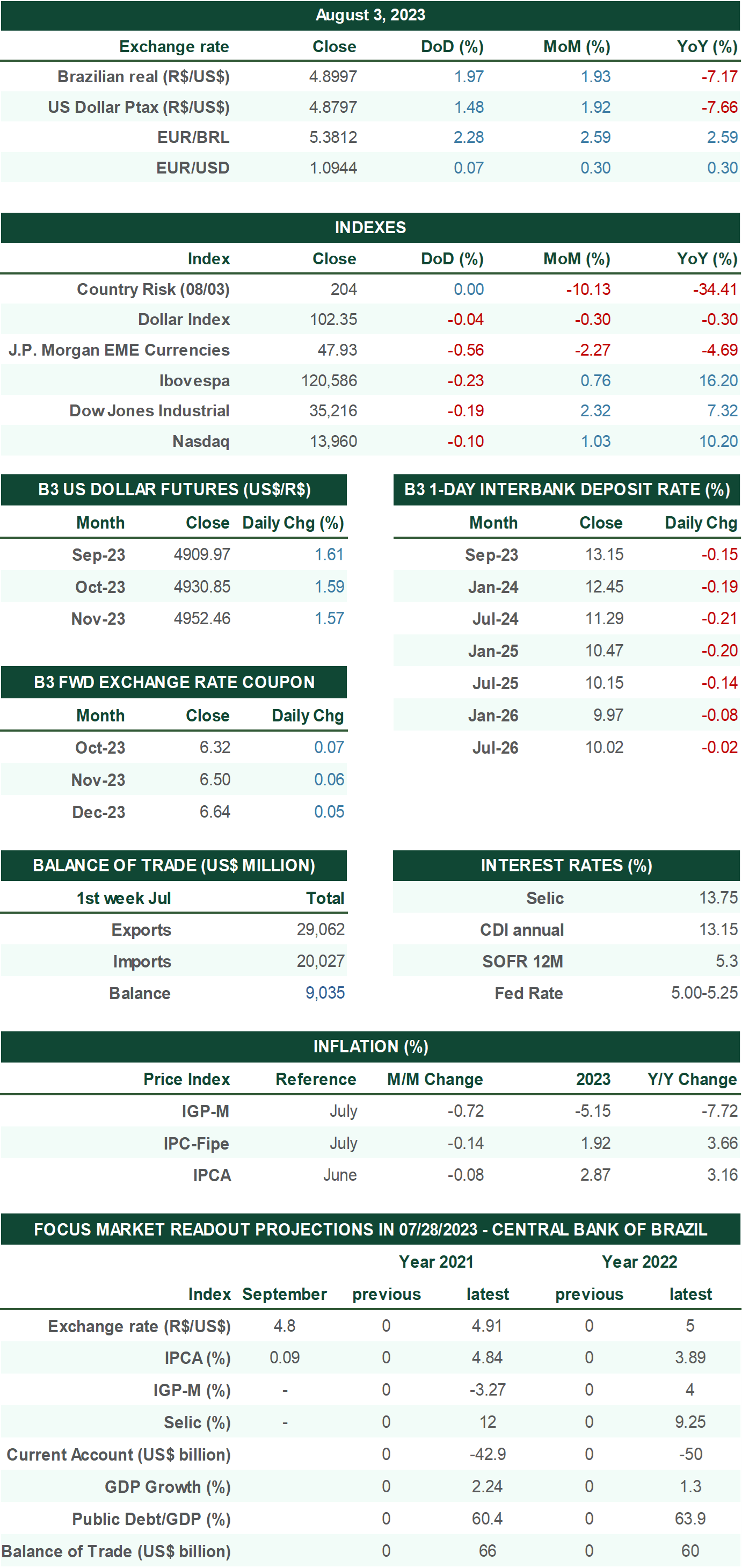
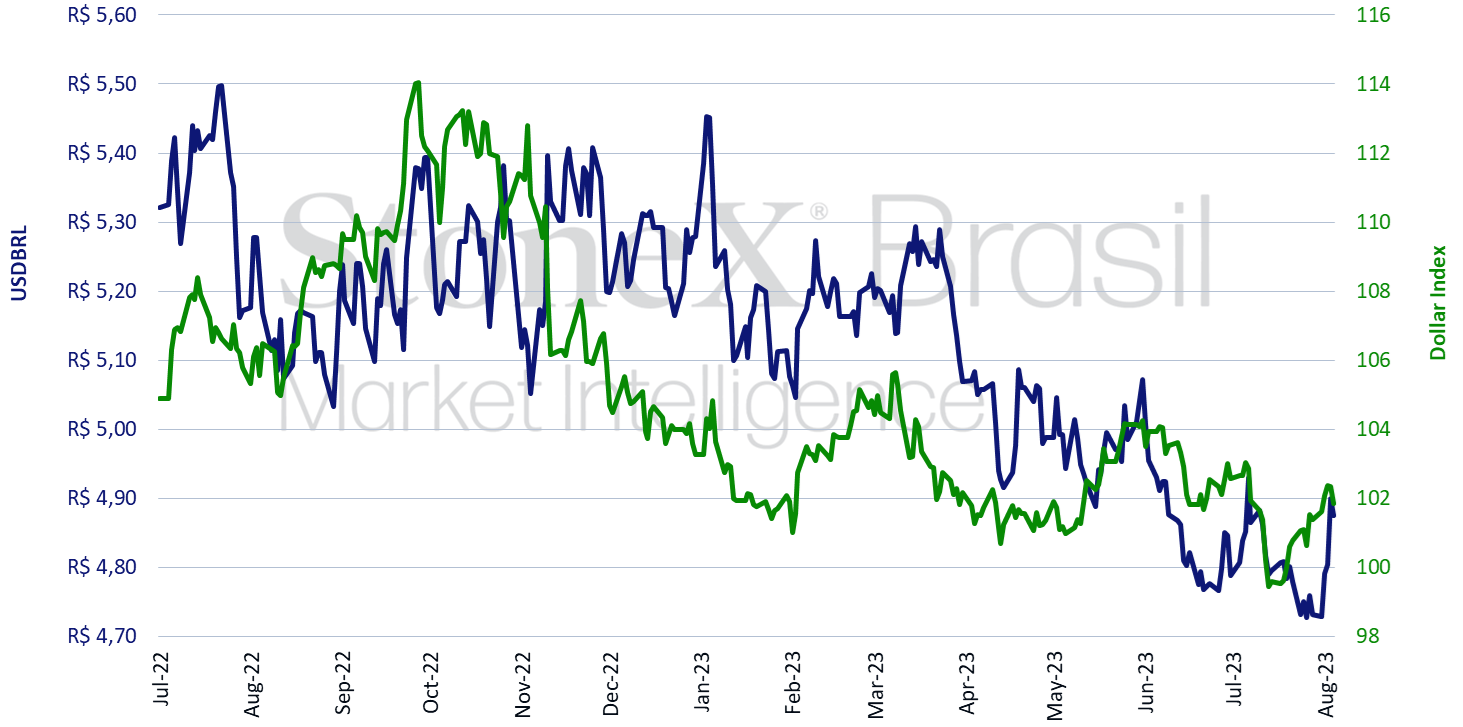
The USDBRL ended the week higher, ending Friday's session (04) at BRL 4.875, a variation of +3.0% in the week, +3.1% in the month and -7.7% in the year. The dollar index closed the session at 101.9 points, a weekly gain of 0.5% and monthly 0,2%, but an annual decline of 1.4%. The foreign exchange market reflected the decision of the Central Bank of Brazil's Monetary Policy Committee (Copom), which caused a strong devaluation of the BRL amid expectations of a reduction in interest rates in Brazil. Additionally, weak economic data in Europe and China contributed to weekly gains in the US currency abroad.
Expected impact on USDBRL: uncertain
The investors' attention this week should be on the Copom minutes. Last week, Copom's decision to reduce the basic interest rate (Selic) from 13.75% p.a. to 13.25% p.a. as well as to signal a new readjustment of the same magnitude for the September meeting provoked an intense weakening of the BRL, which was attributed by some to a lack of credibility of the committee's stance.
Initially, the tight scoreboard for the decision caught the attention of analysts, with five votes in favor of a 0.50 p.p. cut in Selic and four votes in favor of a 0.25 p.p. cut, with the tie-breaking vote given by the president of the institution, Roberto Campos Neto. On the other hand, there was consensus among the committee members to signal the intention of a further reduction of 0.50 p.p. in September if the conjuncture evolves according to projections. The minutes bring risks for both a strengthening and a weakening of the BRL depending on how this division is explained, what arguments were considered by each group of votes and how this impacts the reading of the inflation and interest trajectory by the committee.
Another frequent question this week was the change in stance between June when the Copom statement did not even mention the possibility of reducing interest rates and the minutes only mentioned the possibility of a “parsimonious process” of easing, and August, when its members opted for the fastest pace in its reduction. Similarly, the absence of mentions of fiscal policy in the balance sheet of inflationary risks for the first time since 2017 also caught the attention of analysts. The minutes can contribute significantly to more efficient and transparent communication about the Copom decision-making process and how market players should anticipate future analyses and decisions.
Expected impact on USDBRL: bearish
The release of the Consumer Price Index (CPI) for July should influence the reading of other macroeconomic data throughout August. Analysts' projections point to a moderate reading for the third consecutive month in both the overall index and its core (which excludes the volatile food and energy components), with a median monthly increase expectation of 0.2% for both – which would represent an annualized rate of less than 2%, a target sought by the Federal Reserve. If these forecasts are confirmed, the data should reinforce the interpretation that inflationary pressure in the country is easing and that the Fed's interest rate hike cycle should have ended, which could weaken the US currency.
Expected impact on USDBRL: bearish
Investors will also follow the release of the National Broad Consumer Price Index (IPCA) for July, which is expected to come close to zero for the second consecutive month, reinforcing the perception that price pressure in Brazil is moderating and there is room for monetary easing by the Central Bank. In addition, the Central Bank's Economic Activity Index (IBC-Br) for June will be released, showing slight growth after an unexpected contraction in May.