- An increase in the PCE index in January should reinforce the perception of cautious behavior from the Federal Reserve in 2024, consolidating bets for interest rate cuts starting in June and strengthening the USD.
- Moderation of the IPCA-15 core in February and the slowdown in the growth of the GDP in the fourth quarter should reinforce the perception that COPOM will maintain its pace of interest rate cuts (SELIC), which reduces the Brazilian yield differential with the foreign market and may weaken the BRL.
- Rebound in services and consolidated PMI in China may increase investors' appetite for risky assets, such as commodities and currencies of emerging countries, strengthening the BRL.
The week in review
The week was marked by the release of the minutes from the last Federal Open Market Committee (FOMC) decision, which showed a distrust among its members about continuing the price moderation process in the US and concern about starting an interest rate cut process prematurely.
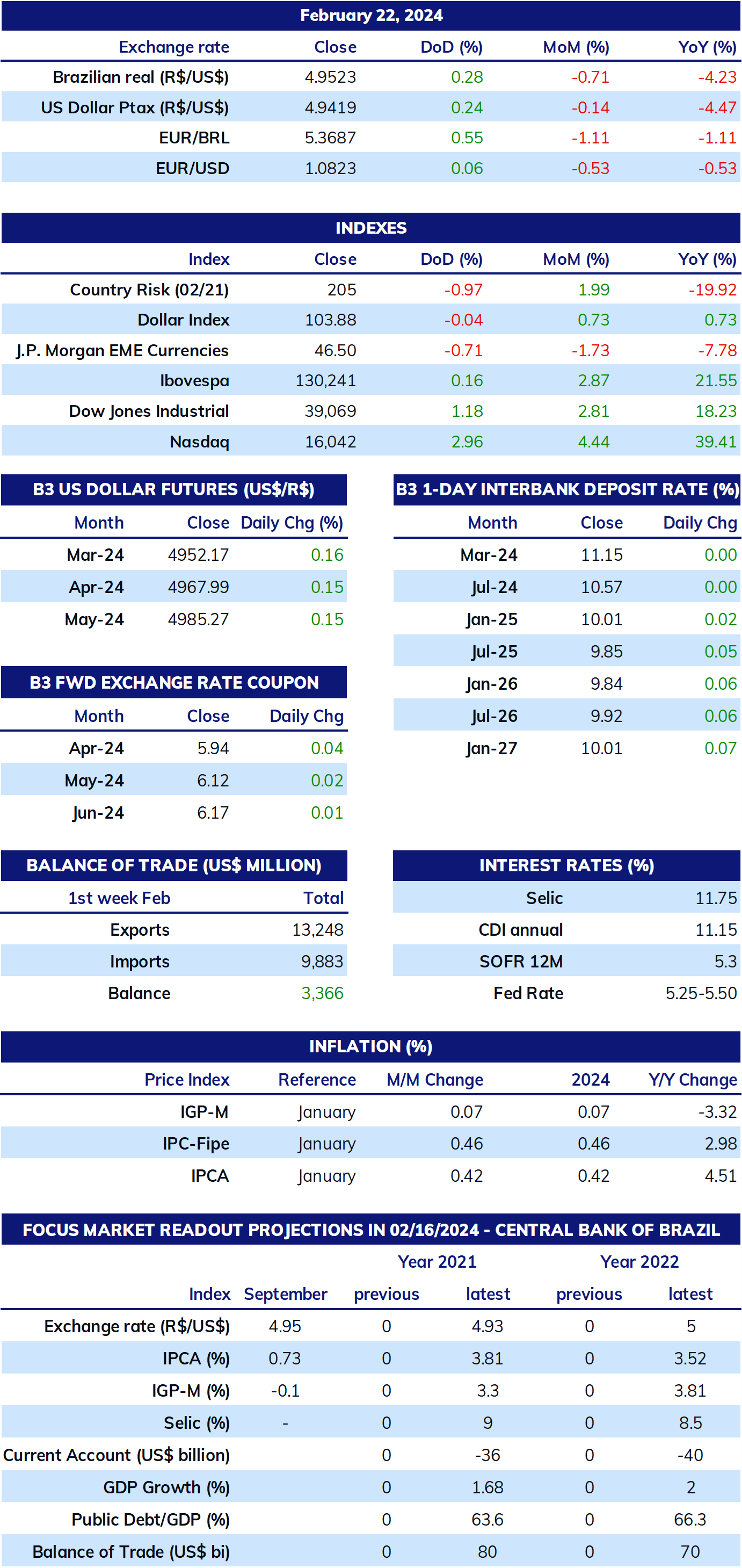
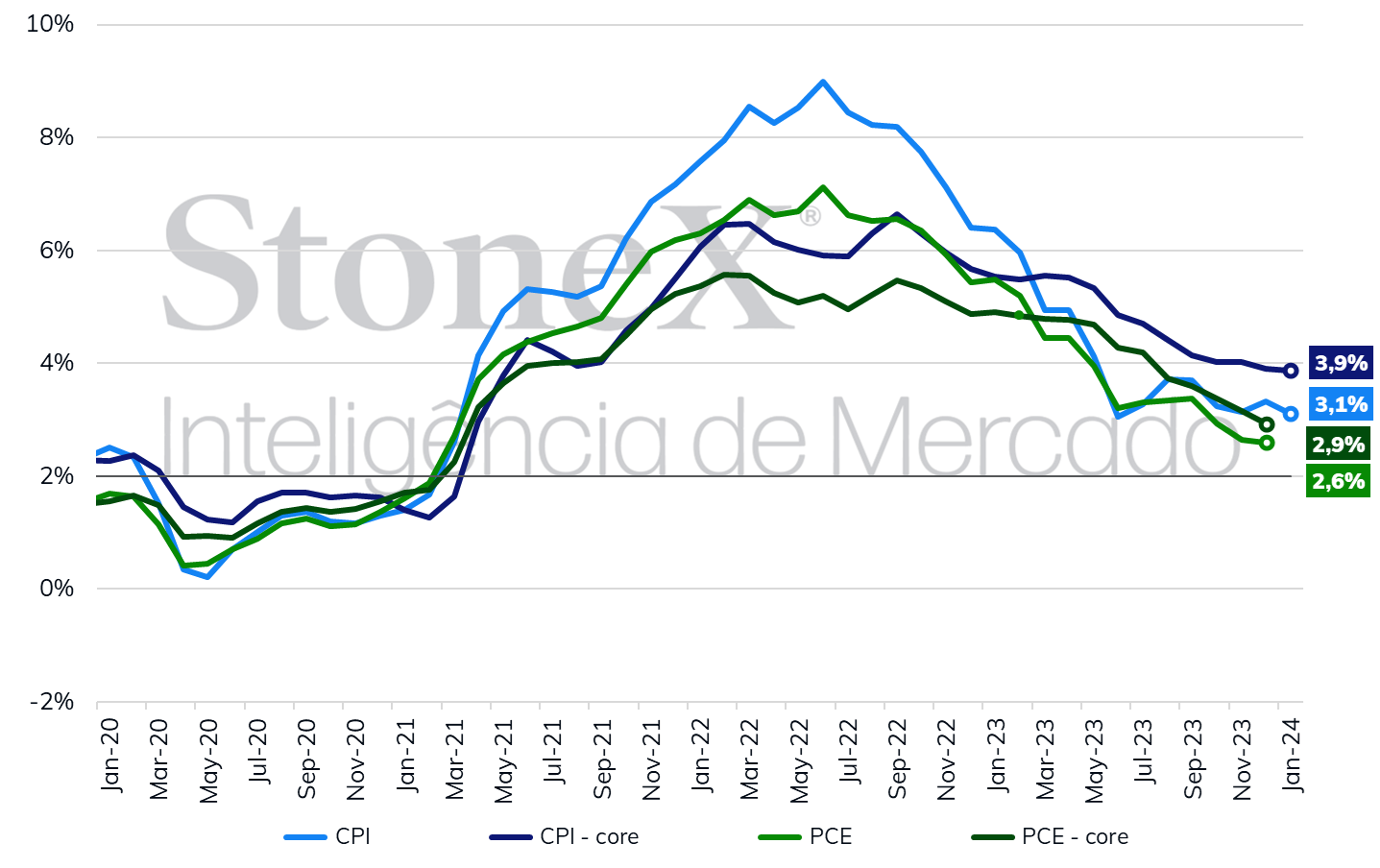
The USDBRL ended the week higher, closing Friday's session (23) at BRL 4.994, a weekly gain of 0.5%, a monthly gain of 1.1%, and an annual gain of 2.9%. The dollar index fell for the first week in 2024, closing Friday's session at 103.9 points, a change of -0.3% for the week, +0.7% for the month, and +2.8% for the year.
THE MOST IMPORTANT EVENT: Inflation in the US
Expected impact on USDBRL: bullish
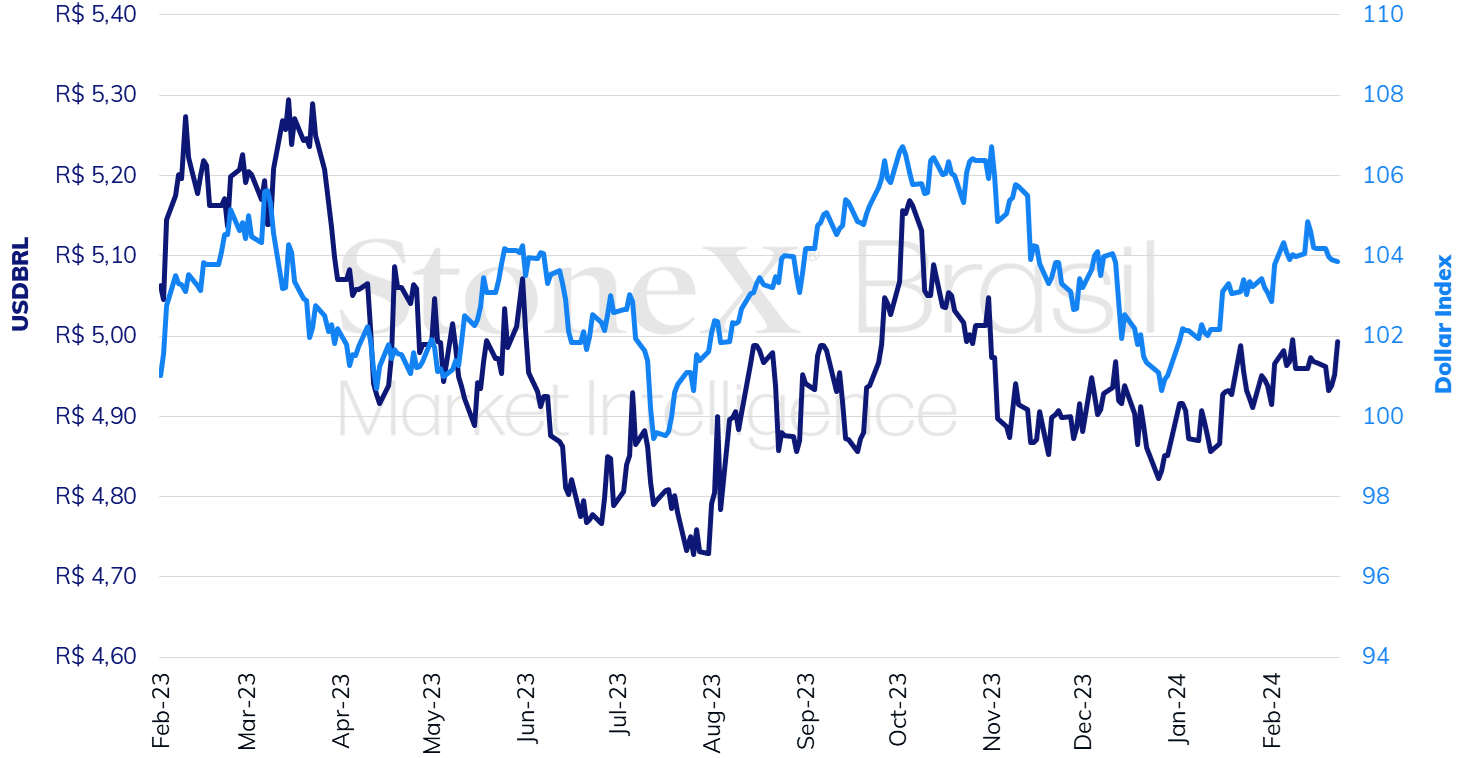
Investors' attention should focus on the release of the Personal Consumption Expenditures (PCE) Price Index, the metric preferred by the Federal Reserve (Fed) to track consumer prices. After the Consumer Price Index (CPI) and Producer Price Index (PPI) surprising reading in January with a higher hike than expected, the expectation is that the Personal Consumption Expenditures (PCE) will also accelerate versus December, from a 0.2% increase in the overall indicator and its core, which excludes volatile components of food and energy, to a 0.3% increase in the overall indicator and 0.4% in its core, driven by price hikes in healthcare services and financial services. Even though January is typically more volatile, the data should reinforce the uncertainty of Fed members who want "greater confidence" in the trend of price stabilization in the US towards the target sought by the authority of 2% annually.
In this sense, the economic data calendar and meetings of the Federal Open Market Committee (FOMC) itself should reinforce the trend that an interest rate cutting cycle will only begin in June. Before the decision on March 20, there will be no more PCE readings and only one CPI from February. And before the decision on May 1, there will be readings of February and March PCE and March CPI. After two months of moderate inflation and above the estimates (December and January), two inflation readings may prove insufficient for Committee members to achieve "greater confidence" in price stabilization, indicating that the decision on June 12 should be considered as the minimum timeframe for a possible start of monetary easing.
IPCA-15 and GDP in Brazil
Expected impact on USDBRL: bullish
The National Broad Consumer Price Index 15 (IPCA-15) for February is expected to show a result similar to the IPCA for January, with an increase of approximately 0.4% in the full indicator but a smoother growth in the core prices. El Niño and the unfavorable seasonality are expected to continue contributing to the rise in the food sector. Still, prices for services and energy are expected to remain more stable during this period. Additionally, the Gross Domestic Product (GDP) for the fourth quarter of 2023 is expected to maintain the trend of slowing pace and expand by only 0.1% compared to the third quarter, resulting in a cumulative increase of 3.0% for the year. After showing quite a resilience in the first semester, and with a fundamental contribution from the agricultural sector, economic activity begins to show the negative effects of the sharp monetary tightening carried out by the Central Bank (BC), with a slowdown in household consumption and credit volume in the country. Economic growth and inflation indicators should reinforce the readings that the Monetary Policy Committee should maintain its pace of cuts to the basic interest rate (SELIC) of 0.50 p.p. in the next meetings.
PMI in China
Expected impact on USDBRL: bearish
The recent performance of the Chinese economy has disappointed analysts, and even a substantial cut in the five-year benchmark interest rate last week, from 4.2% p.a. to 3.95% p.a., was able to reverse investors' pessimism with the slowing pace of growth. Still, the Purchasing Managers' Index (PMI), published by the National Statistics Office, is expected to show a pick up in the services sector in January as a result of the increased travel during the extended Lunar New Year holiday, which may temporarily recover investors' appetite for risky assets.
PTAX rate at the end of the month
Expected impact on USDBRL: undefined
The foreign exchange market had a month of unusually low fluctuations in February. Still, the definition of the end-of-month Ptax rate on Thursday (29) is expected to increase trading volume and volatility within the time windows used by the Central Bank for its calculation. The PTAX rate is a reference published daily by the Central Bank, and its end-of-month value is widely used in foreign exchange and derivatives contracts. Therefore, traders intensify their operations during these intervals, competing for their definition.