FX Weekly Overview: Key events of the week
- Bearish factors
- End of the deadline for the “truce” on US import tariffs increases uncertainty about American trade policy, which may hinder the attraction of financial investments to the country and contribute to the global weakening of the dollar.
- Bullish factors
- Clash between the Executive and Legislative over the increase in the IOF may increase the perception of fiscal risks for Brazilian assets and harm the performance of the real.
- Moderation of the June IPCA may increase expectations of a cut in the basic interest rate (Selic) later this year, which may harm the attraction of foreign investment and weaken the real.
- FOMC minutes should reinforce expectations of a cautious stance by the Federal Reserve, which tends to reduce bets on interest rate cuts this year and foster the attraction of financial investment in the country, strengthening the dollar.
The week in review
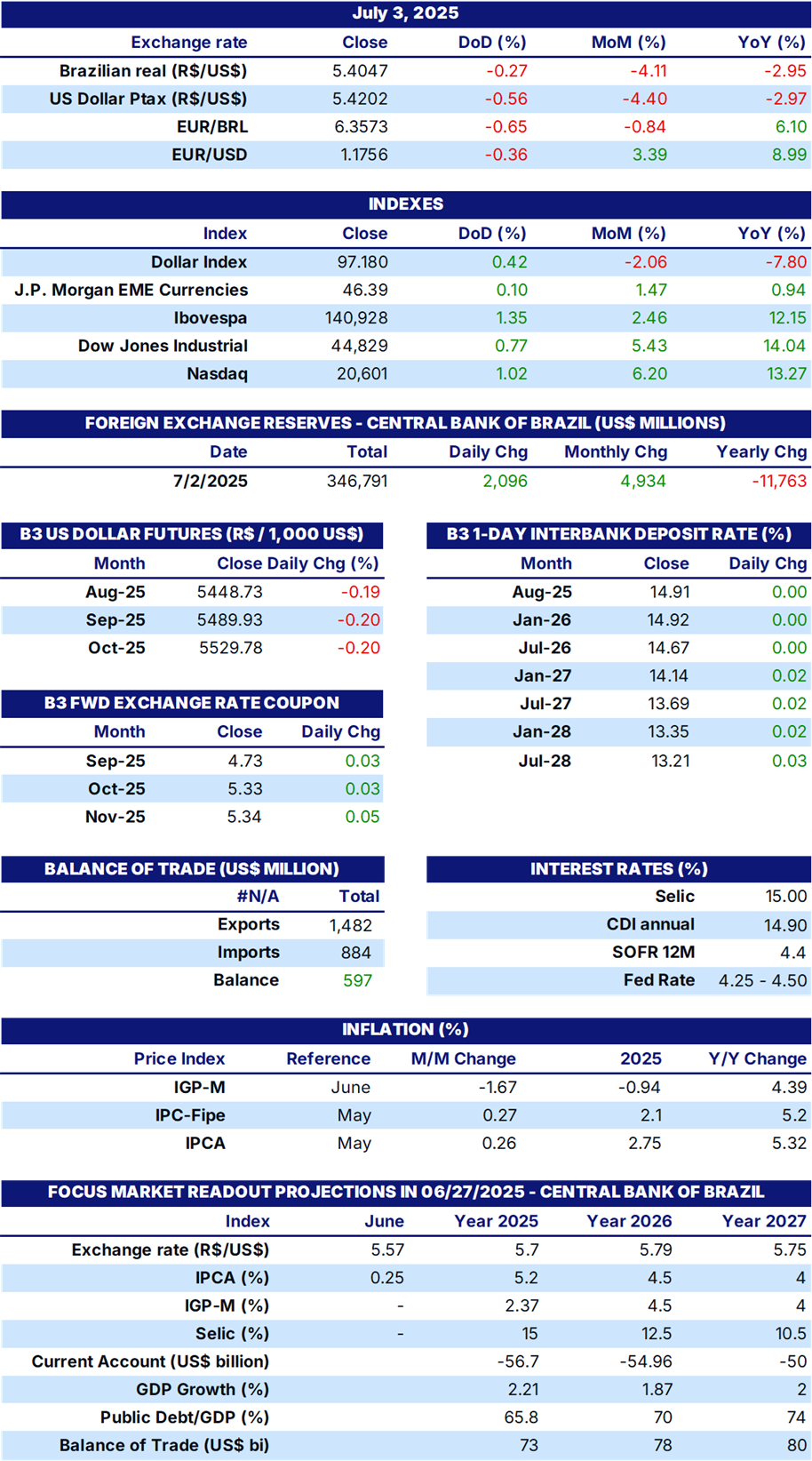
The week was marked by the release of stronger data for the American labor market and by the continuation of the clash between the Executive and Legislative branches regarding the increase in the IOF. Even so, the USDBRL fell to the lowest level since June last year, driven by the wide Brazilian interest rate differential.
The USDBRL closed Friday's session (04) at BRL 5.4245, a weekly decrease of 1.1%, a monthly decrease of 0.2%, and an annual decrease of 12.2%. The Dollar Index (DXY) closed the week at 97.3 points, a change of -0.4% for the week, +0.1% for the month, and -10.3% for the year.
USDBRL and Dollar Index (points)
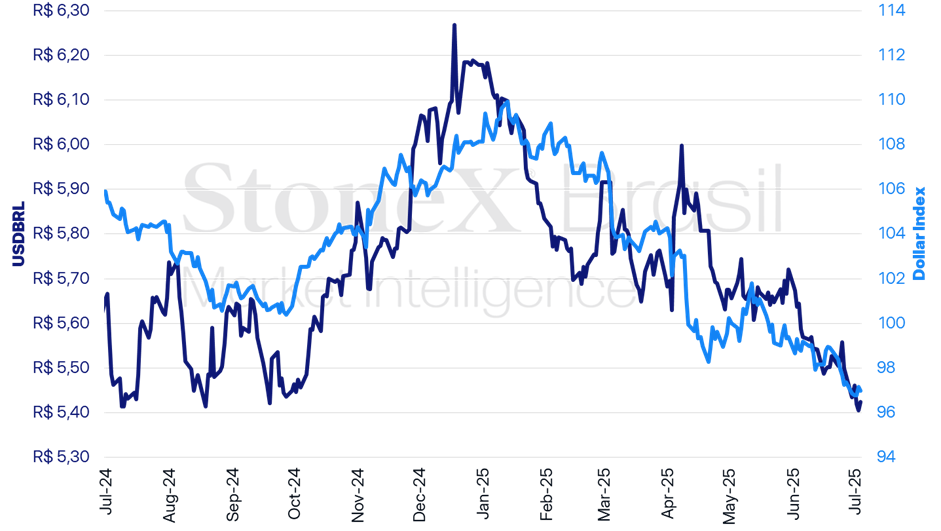
Source: StoneX cmdtyView. Design: StoneX.
KEY EVENT: End of the "tariff truce” period on American imports
Expected impact on USDBRL: bearish
The unpredictability and uncertainty regarding American trade policy remain high, even almost six months into Donald Trump's administration.
Why this is important: The unpredictability and the shortage of consistency in the guidelines of US import tariffs can increase the perception of risk among investors and foster the outflow of capital from the country, contributing to a global devaluation of the dollar.
Overview: The period for the temporary reduction of most American import tariffs to a tariff of 10% ends this Wednesday, July 9.
- An exception applies to China, whose tariff will remain reduced to 30% until August 12, and to products in the steel and aluminum chain, whose tariff was raised to 50% on June 3.
What now? The White House has indicated that it will raise the import tariffs on its trading partners again after the deadline.
- Trump told reporters that he will unilaterally notify all nations about his new tariffs before July 9, starting from last Friday (04).
- According to Trump, these tariffs will take effect on August 1 and may range from 10% to 70%.
- Treasury Secretary Scott Bessent, on the other hand, stated that “about” 100 countries will have tariffs of 10%.
- Even with statements from American authorities, some analysts still bet on a lengthening of this deadline in order to foster the trading of commercial agreements with other countries.
Slow pace: The U.S. has made little progress in reaching new trade agreements with other countries.
- This was widely anticipated, since trade agreements usually take years to be formalized because they cover a huge diversity of products and many points of interest to nations.
- The White House released a more formal understanding only with the United Kingdom and Vietnam, but these agreements maintained rather high import tariffs.
- While most British products continued with a tariff of 10%, Vietnamese products will have a tariff of 20% and 40% in the case of re-export.
- Additionally, the US and China negotiated terms to maintain bilateral trade during a temporary reduction of tariffs for 90 days.
- Bessent, on the other hand, believes that dozens of new agreements can be formalized before September 1.
Impact of tariffs: Although there was almost consensus among analysts that the increase in tariffs should accelerate inflation and slow down growth in the US, these impacts have proven to be almost imperceptible in the indicators available so far.
- There is no simple explanation for this contradiction: while some understand that the impacts may have been overestimated initially, others believe that they will still manifest themselves, albeit later than expected.
In summary: The environment of uncertainty about American tariffs and the possibility of a new widespread increase in tariffs after July 9 should reinforce the trend of global dollar depreciation, which tends to foster the performance of other currencies, such as the real.
Judicialization of IOF tax decrees and meeting between government and Congress
Expected impact on USDBRL: bullish
Last week, the government filed a lawsuit in the Supreme Federal Court (STF) against the Congress decision that overturned the increase of the tariffs of the Tax on Financial Operations (IOF).
- On Friday (04), Supreme Federal Court (STF) minister Alexandre de Moraes decided to suspend all decisions, both from the Executive and the Legislative.
Why this is important: The prolonged clash between the executive and legislative branches over the topic, now with the involvement of the Judiciary, increases uncertainties regarding the achievement of fiscal targets, as it hinders an increase in revenues for the government.
- Additionally, it reveals that the government's capacity for political articulation is impaired, which may hinder the advancement of other priority agendas of the Planalto Palace in Congress.
Overview: The government's economic team argues that the approval by Congress of Legislative Decree Bill (PDL) No. 314/2025, which annulled the increase of the IOF tariffs, exceeded constitutional limits.
- According to this argument, the Constitution reserves to the federal government the right to institute taxes on "credit, exchange, and insurance transactions, or those related to securities or financial assets."
What now? Moraes' decision considered the current context "undesirable", especially because it contradicts the Constitution, which preaches the harmony and independence of the Powers.
- Therefore, a conciliation meeting was scheduled for July 15 between the Executive Branch, represented by President Luiz Inácio Lula da Silva (PT), and the Legislative Branch, under the leadership of Senator Davi Alcolumbre (União-AP).
In summary: The uncertainty about the IOF tariffs and the impasse among the three branches of government may increase the perception of fiscal risks of Brazilian assets and contribute to a weakening of the real.
Inflation and economic activity data in Brazil
Expected impact on USDBRL: bullish
Investors direct their attention to the release of the Broad National Consumer Price Index (IPCA) for the month of June, as well as to the monthly service survey (PMS) and trade survey (PMC) for May.
Why this is important: Both the release of the IPCA and the economic activity data throughout the week can influence expectations regarding the trajectory of Brazilian interest rates, which may impact the performance of the real.
Overview: The median expectation for the IPCA is that the index slowed down in June, with a median projection of a 0.25% increase, after a 0.26% rise in May.
- Even so, this result would keep the cumulative inflation in 12 months at 5.33%, above the ceiling of the target of 4.50% per year established by the Central Bank.
- At the same time, the most recent economic activity indicators, such as the Q1 2025 GDP, have shown a robust performance of the economy, which, in turn, may increase inflationary pressures.
- Thus, as highlighted in the minutes of the last meeting of the Central Bank, this week's data should help in the assessment of the "accumulated impacts of the monetary adjustment already carried out, yet to be observed, (...) [ and if they are] sufficient to ensure the convergence of inflation to the target."
In summary: If a greater moderation in the pace of inflation is confirmed, it should increase bets that the Central Bank may cut the basic interest rate (Selic) sooner than expected, which tends to hurt the performance of Brazilian bonds and depreciate the real.
- On the other hand, if the slowdown of the IPCA is not confirmed and economic activity data remain strong, the effect may be the opposite, with renewed expectations of higher interest rates for a longer period and strengthening of the Brazilian currency.
FOMC Minutes
Expected impact on USDBRL: bullish
USA: History and expectation for the interest rate - updated on July 4, 2025
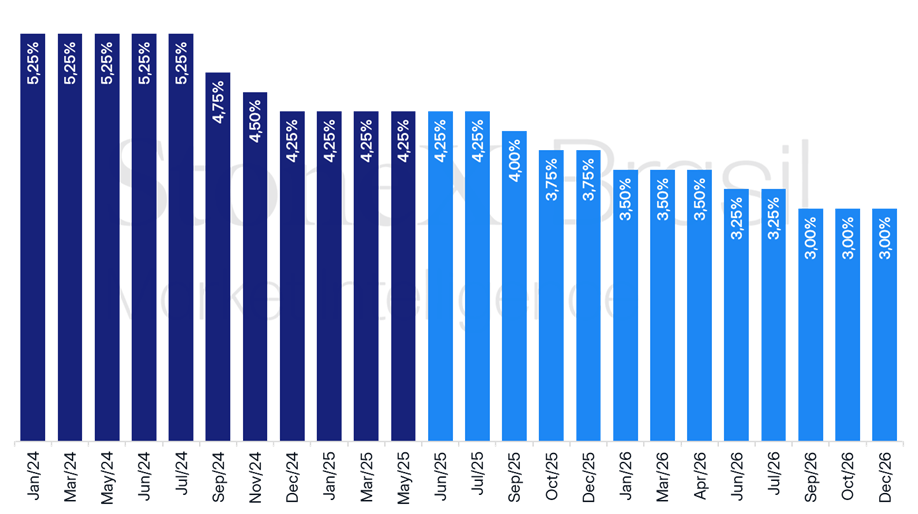
Source: CME FedWatch Tool. Design: Refers to the bet with the highest probability in the future interest rate market on the indicated date.
Investors should follow the release of the minutes from the last monetary policy decision of the Federal Reserve's Federal Open Market Committee (FOMC).
- The document should reinforce the cautious tone of the monetary authority in its decision, when it kept its interest rate unchanged between 4.25% and 4.50% p.a. for the fourth consecutive decision.
Why this is important: The cautious stance of the Fed should increase bets that US interest rates will remain stable for a longer period, which favors the yield of the country's bonds and contributes to a global strengthening of the dollar.
Overview: In the statement of the decision, the Committee reiterated that its members wish to wait for the evolution of economic data to have greater clarity about the picture economic.
- The statement also highlighted that economic uncertainties have reduced since the May decision, but remain quite high.
- The median of the FOMC's Summary of Economic Projections for inflation in 2025 rose from 2.7% to 3.0%, while the median for Gross Domestic Product fell from 1.7% to 1.4%. These changes are a reflection of the expected effects from import tariffs, expected for the third quarter.
- Still, the median of the projections continued to point to two rate cuts this year.
- Commenting on the apparent contradiction, Fed Chairman Jerome Powell downplayed the importance of projections made at such uncertain times.
Context: Last week, the release of stronger-than-expected data for the U.S. labor market lowered bets for rate cuts by the Federal Reserve, especially in its next decision in July.
- The June Employment Situation Report showed a net increase of 147 thousand jobs, above the median projection of 111 thousand new positions and practically equal to the net gain of 144 thousand jobs in May.
- The unemployment rate also surprised, falling from 4.2% to 4.1% in the period.
 INDICATORS