USDBRL to reflect Trump–Lula conversation, potential U.S. government shutdown, economic data in Brazil and the U.S., and end-month Ptax fixing
- Bullish
- A potential U.S. government shutdown would delay the release of economic indicators, making it harder to read the country’s backdrop and hurting foreign investment flows.
- Bearish
- A meeting between Trump and Lula raises expectations of a commercial and diplomatic rapprochement between Brazil and the United States, which may lower perceived risks for Brazilian assets and support the real’s performance.
- September’s Employment Situation Report should reinforce the view of a weakening U.S. labor market, increasing bets on swift rate cuts in the U.S. and depreciating the dollar globally.
- Hotter-than-expected Brazilian labor data should reinforce expectations of higher interest rates for longer in Brazil, which supports foreign inflows and tends to strengthen the real.
The week in review
- The U.S. Personal Consumption Expenditures (PCE) Price Index rose in line with analysts’ estimates, with no broad inflationary pressures from import tariffs.
- U.S. second-quarter Gross Domestic Product (GDP) was unexpectedly revised up in its final reading, while personal consumption rose above expectations in August.
- Donald Trump praised Luiz Inácio Lula da Silva and unexpectedly announced a conversation between them for the following week.
- The Central Bank’s Monetary Policy Committee (Copom) minutes and Monetary Policy Report reinforced expectations that the benchmark Selic rate will stay unchanged for a long period.
- IPCA-15 accelerated in September due to higher electricity prices, but the core showed moderation.
USSBRL and Dollar Index (points)
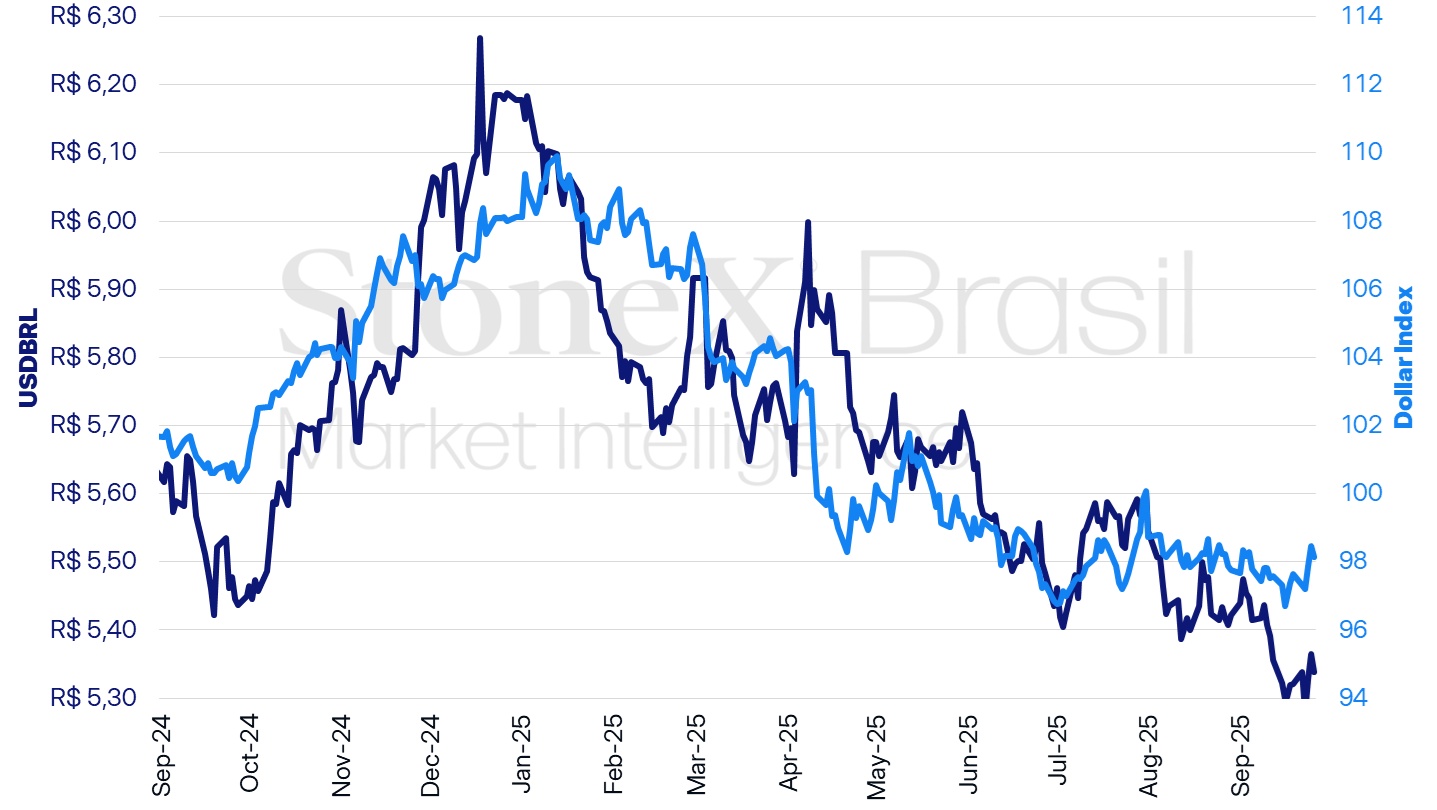
Source: StoneX cmdtyView. Prepared by StoneX.
Commercial dollar changes | Daily: -0.49% | Weekly: +0.33% | Monthly: -1.54% | YTD: -13.58% | In 12 months: -1.96% |
Dollar Index changes | Daily: -0.31% | Weekly: +0.51% | Monthly: +0.38% | YTD: -9.24% | In 12 months: -2.37% |
KEY EVENT: Trump–Lula conversation
Expected impact on USDBRL: bearish
On Tuesday (23), U.S. President Donald Trump surprised investors by saying he would meet this week with the President of the Republic, Luiz Inácio Lula da Silva.
- Both presidents attended the 80th United Nations General Assembly, and Trump said he had “excellent chemistry” in a brief chat with Lula.
Why this matters: Although it is early to assess the outcome, the expectation of a meeting raises hopes of easing tensions between the two countries, boosting the odds of a negotiated solution to the White House’s import tariffs on Brazilian products.
- This, in turn, may reduce perceived risks around Brazilian assets and support the real’s performance.
Backdrop: So far, there is little information on the format, date, and key topics. According to reports, the meeting should be remote and may address strategic issues such as critical minerals and regulation of “big techs.”
- The United States has shown interest in agreements with Brazil to access strategic minerals such as lithium, niobium, and rare earths. Lula had already acknowledged last month the possibility of negotiating these assets.
- In technology, Brazil’s government has moved to facilitate deals with large companies in the sector, as shown by the recent Provisional Measure encouraging the installation of data centers in the country.
- Brazil is interested in discussing lower import tariffs on its products or adding other segments to the exemptions list.
- Trump may wish to raise political claims, such as dissatisfaction with former president Jair Bolsonaro’s legal cases. Lula has already said such topics are entirely off the table for the Brazilian government.
U.S. government shutdown
Expected impact on USDBRL: bullish
The U.S. government is nearing another shutdown, with funding for non-essential activities set to run out on September 30, which would place hundreds of thousands of public servants on unpaid leave (“furlough”).
Why this matters: A shutdown would affect most of the U.S. public sector, including departments responsible for collecting and publishing economic statistics, potentially delaying all indicator releases from October 1 onward.
- This would impair investors’ reading of the U.S. economic backdrop amid mixed signals and risks for inflation, the labor market, and activity.
Data delays: A shutdown could delay all releases from October 1, including the Employment Situation Report on the 3rd and the Consumer Price Index on the 15th.
- These are the last inflation and labor market releases before the Fed’s October 29 rate decision.
- In the 16-day shutdown of 2013, releases were delayed by about two and a half months. In the 35-day 2018–2019 shutdown, there were no delays because Congress had previously funded the statistical agencies and they kept operating.
Opposing sides: Funding most of the U.S. public sector from October depends on Congress approving a new budget or extending the current one.
- However, Republicans and Democrats demand opposing priorities for public spending in drafting a new budget, and negotiations between the parties and their leaders are virtually nonexistent.
- Last week, the U.S. Senate rejected a House-approved extension of the current budget through November 21, while Trump canceled a meeting with Democratic congressional leaders, calling their demands “ridiculous” and saying he would not negotiate with them.
- Additionally, the White House instructed government agencies to plan federal staff layoffs if a shutdown does occur.
- If a short-term extension is approved by Tuesday (30), a shutdown would be avoided, but the budget confrontation would likely return in a few months.
U.S. economic data
Expected impact on USDBRL: bearish
U.S.: History and outlook for interest rates – updated on September 26, 2025
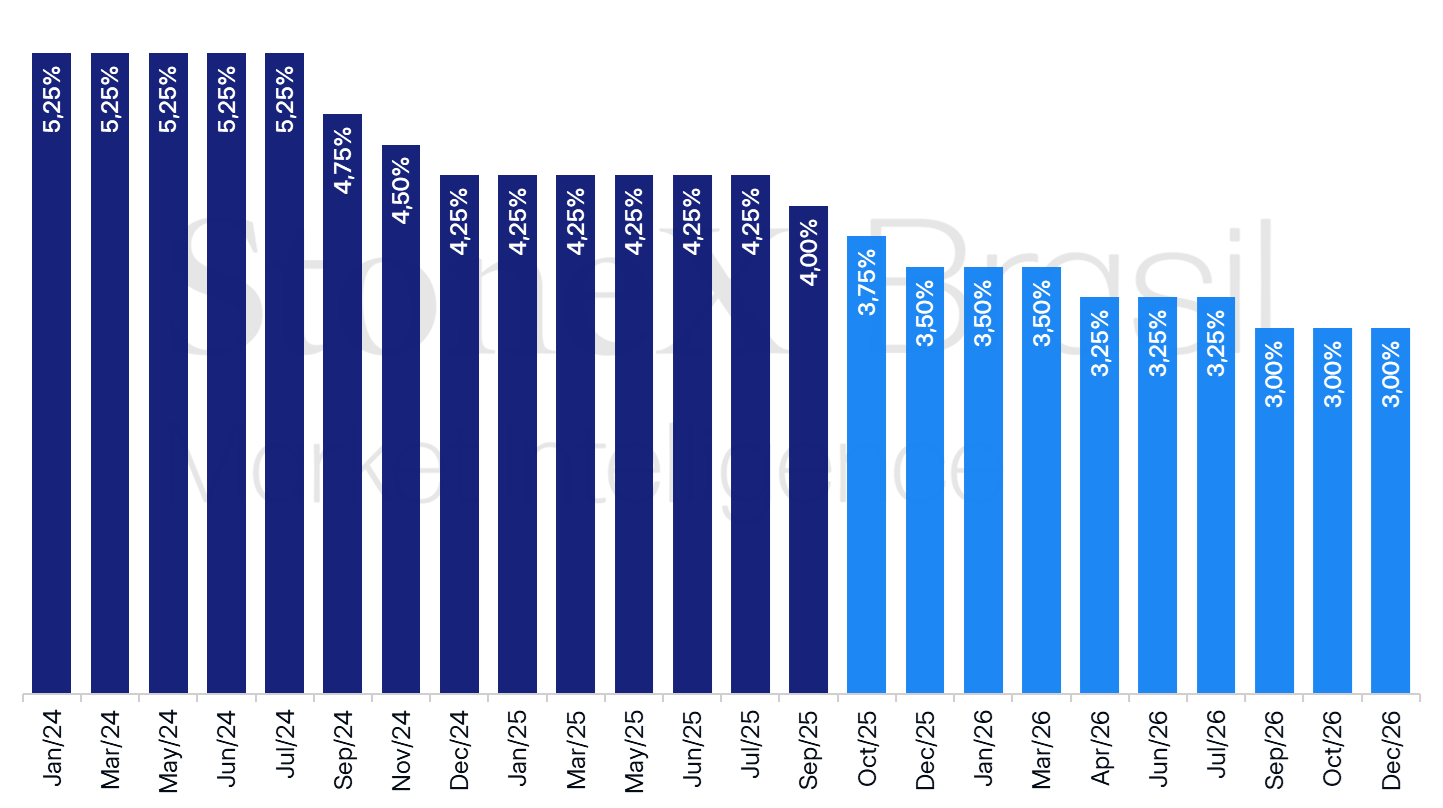
Source: CME FedWatch Tool. Prepared by StoneX. Refers to the highest-probability bet in the interest-rate futures market on the indicated date.
The week brings several important economic indicators that should help investors fine-tune expectations for the U.S. economy and, consequently, the interest-rate path.
Why this matters: On one hand, investors are betting on a fast rate-cutting cycle by the Federal Reserve due to signs of a more pronounced weakening in the labor market, which reduces expected U.S. Treasury yields and tends to weaken the dollar globally.
- On the other hand, the latest indicators for production, income, and domestic demand in the U.S. have been hotter than anticipated, suggesting inflation may stay elevated and reducing the room for Fed rate cuts.
What to watch: Among this week’s indicators, highlights include:
- Employment Situation Report: Its release, scheduled for Friday (03), may be delayed (see above). The median projection calls for a net creation of 39 thousand jobs in September, above the 22 thousand recorded in August but below this year’s 75 thousand average. The unemployment rate should hold at 4.3%. The first figure suggests a weakening labor market; the second suggests stability.
- Job Openings and Labor Turnover Survey (JOLTS): In line with payroll, job openings should keep declining in August, indicating a continued slowdown in hiring.
- Purchasing Managers’ Index (PMI): As in prior months, services activity should remain in expansion while manufacturing stays in contraction. In both cases, prices paid should accelerate sharply and employment levels pull back.
Backdrop: On the 17th, the Federal Open Market Committee (FOMC) cut rates for the first time this year by 25 bps.
- Fed Chair Jerome Powell noted the cut reflected a shift in the balance of risks—lower risks of higher, persistent inflation and higher risks of rising unemployment.
- Even so, Powell stressed the backdrop remains challenging and these risks persist, requiring opposing measures to manage them.
Conflicting signals: On one hand, firms’ hiring has slowed sharply, raising concerns about a more intense labor-market weakening.
- Net job gains in the U.S. are at their lowest since the Covid-19 pandemic, with job creation concentrated in education, health care, leisure, and hospitality, and significantly weaker elsewhere.
- Additionally, tariff effects on inflation were smaller and more short-lived than expected.
- This suggests the Federal Reserve should cut rates, as the economy would need stimulus and inflation risks would be lower.
- On the other hand, GDP, retail sales, personal income, and consumer demand have shown stronger-than-expected momentum.
- Moreover, there is no evidence of an acceleration in layoffs, and the unemployment rate has risen only slightly over the past 12 months.
- Inflation remains above the Fed’s 2% target for 54 months, driven mainly by services prices.
- This suggests the Federal Reserve should not cut rates, as the economy would not need stimulus and inflation risks would be higher.
Brazilian labor data
Expected impact on USDBRL: bearish
On the domestic agenda, the week’s highlight will be Tuesday’s (30) release of the August National Household Sample Survey (PNAD).
- The median estimate is for the unemployment rate to remain at 5.6%, a result that would reinforce the reading of a tight labor market.
Why this matters: If the unemployment rate holds steady, the reading should strengthen the perception that the Central Bank will keep the benchmark Selic rate high for longer, sustaining a wide differential relative to other economies.
- This scenario tends to draw foreign capital and favor the real against the dollar.
Backdrop: In recent communications, the Central Bank has kept a firm tone, stressing unanchored inflation expectations, resilient activity, and labor-market pressures.
- Thus, any change in the authority’s stance on the Selic path will depend on concrete data shifts, especially signs of labor-market cooling.
End-month Ptax fixing
Expected impact on USDBRL: undefined
End-month Ptax – sell (R$/US$)
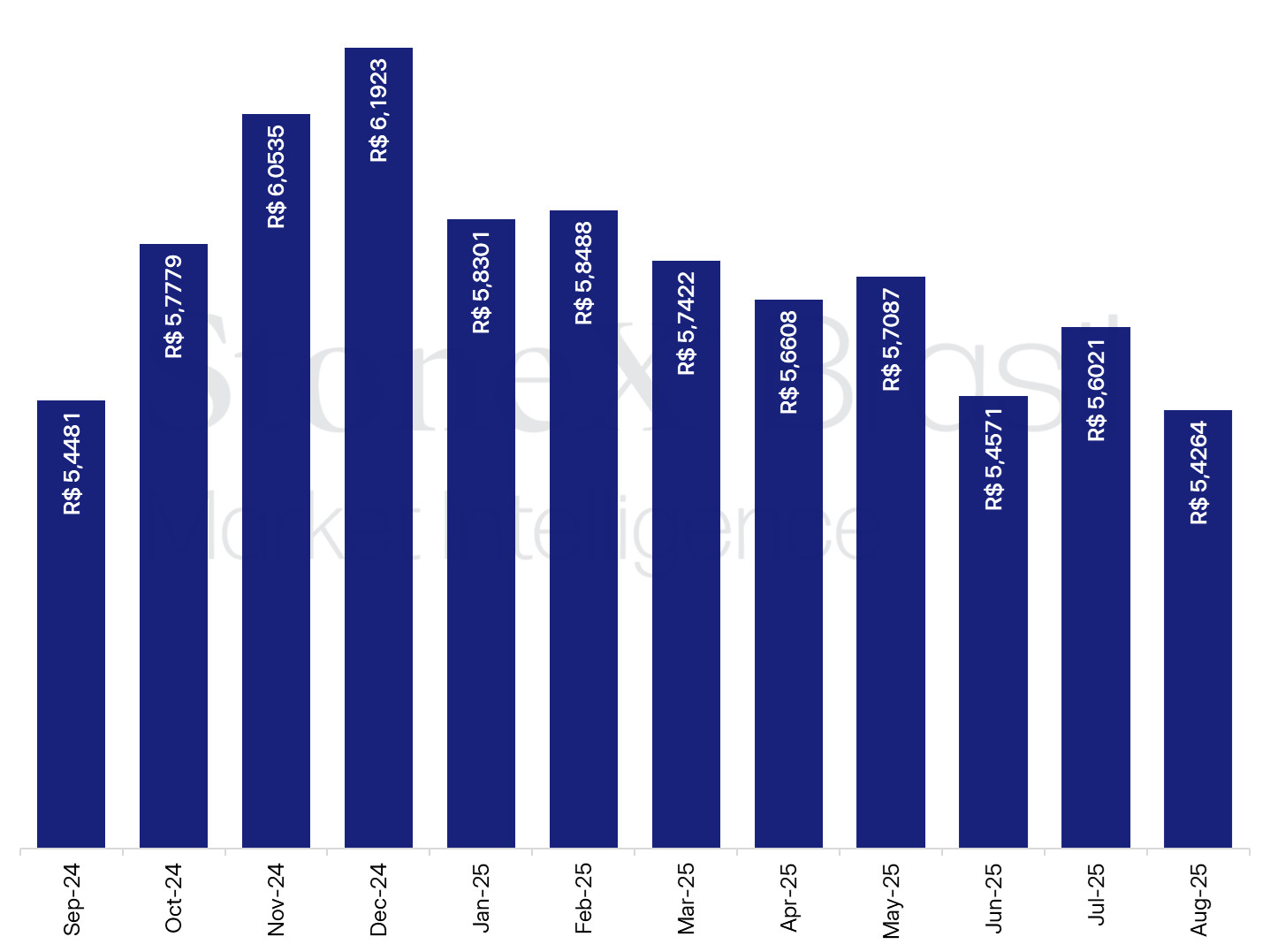
Source: Central Bank of Brazil. Prepared by StoneX.
The Ptax rate is a daily reference published by the Central Bank, and its end-month value is widely used in FX and derivatives contracts.
Why this matters: Market participants step up trading during the windows used to form the last Ptax of the month, making it harder to read the real’s moves on the day.
- Trading volume and volatility usually rise during the Central Bank’s time windows for calculating the end-month Ptax rate, between 10:00 and 13:10.

INDICATORS
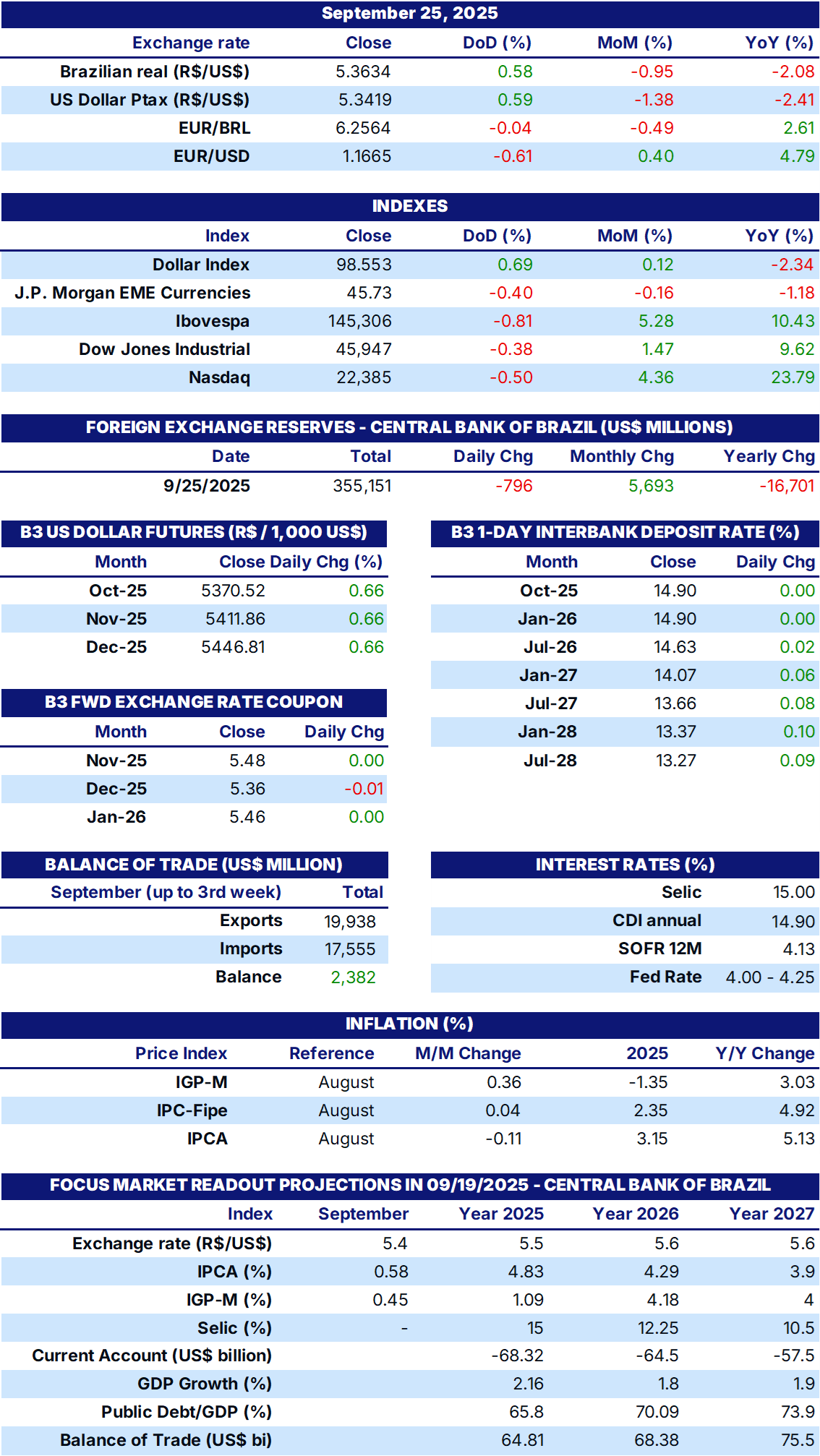
Sources: Central Bank of Brazil; B3; IBGE; Fipe; FGV; MDIC; IPEA; and StoneX cmdtyView.