USDBRL is expected to reflect the US government shutdown, the Fed minutes, the IPCA, fiscal risks in Brazil, and a potential conversation between Lula and Trump
- Bullish
- U.S. government shutdown halts the release of key economic indicators, hindering the analysis of the country's economic environment and potentially undermining the attraction of foreign investment.
- Fed’s decision minutes may indicate a more cautious stance among FOMC members and reduce expectations for faster interest rate cuts in the US, which is likely to encourage foreign investment inflows and appreciate the dollar globally.
- Vote on the provisional measure proposing alternatives to the IOF could lead to lower government revenue in Brazil and heighten perceptions of fiscal risk regarding domestic assets, which would weaken the real.
- Bearish
- Stronger-than-expected reading of the September IPCA is likely to reinforce expectations of higher interest rates for a prolonged period in the country, which supports the attraction of foreign investment and tends to strengthen the real.
- Possible meeting between Trump and Lula raises expectations of a renewed commercial and diplomatic rapprochement between Brazil and the United States, which may reduce the perception of risks for national assets and support the performance of the real.
The week in review
- The U.S. government goes into shutdown, suspending the release of official economic indicators about the country's economy.
- ADP private employment data and the ISM's manufacturing and services PMI indicate a sharper slowdown in the US economy in September.
- News regarding the possibility of the Brazilian government subsidizing universal free bus tariffs has heightened the perception of fiscal risks associated with Brazilian assets.
USDBRL and Dollar Index (points)
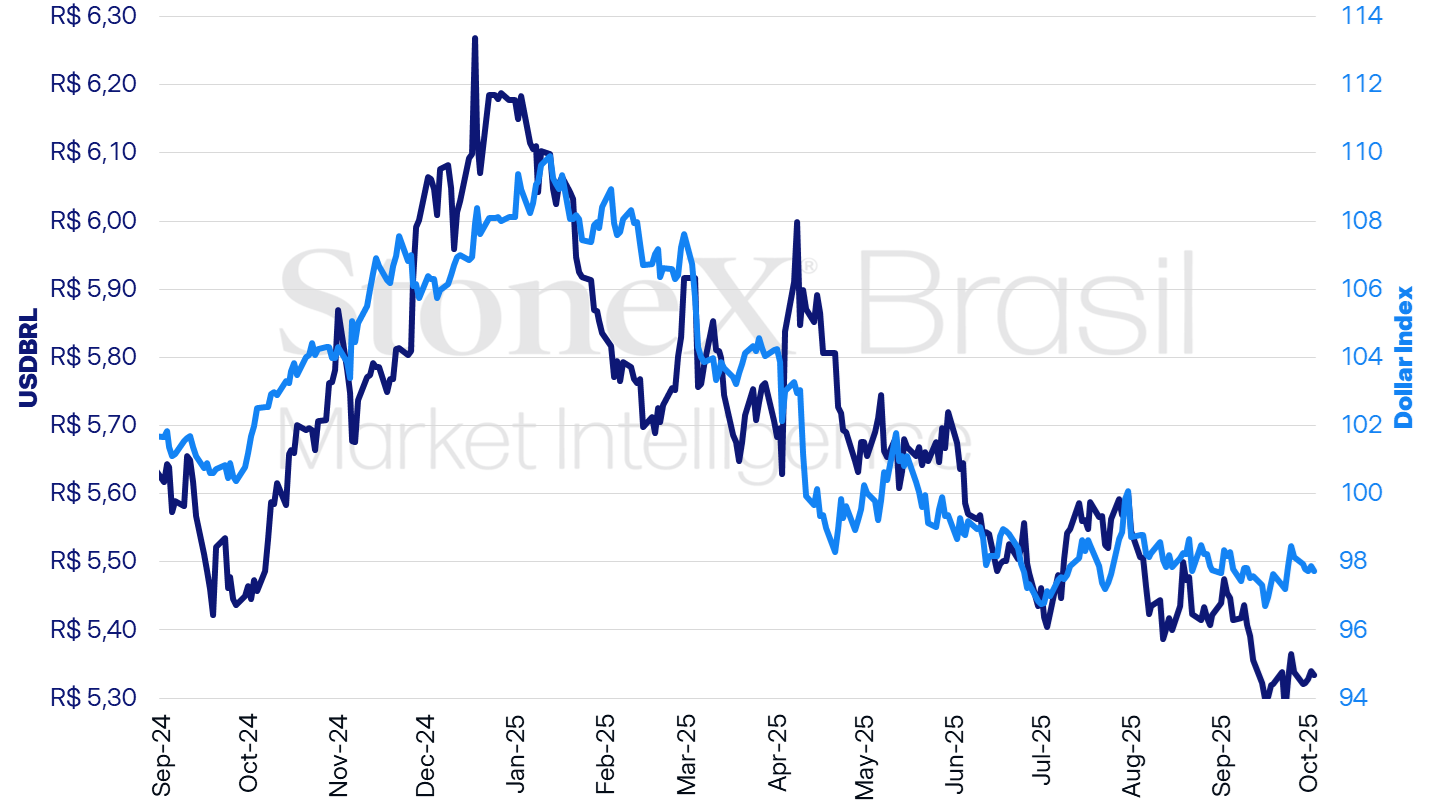
Source: StoneX cmdtyView. Design: StoneX.
Variations of the USDBRL | Daily: -0.11% | Weekly: -0.09% | Monthly: +0.21% | YTD: -13.66% | In 12 months: -2.55% |
Dollar index variations | Daily: -0.15% | Weekly: -0.42% | Monthly: -0.06% | YTD: -9.62% | In 12 months: -4.18% |
THE MOST IMPORTANT: U.S. government shutdown
Expected impact on USDBRL: bullish
Since last Wednesday (01), non-essential activities of the US government have been paralyzed and approximately 750 thousand public servants are on leave without pay ("furlough") after the legal deadline for funding these activities expires.
- A reopening of the government depends on the approval of a new Budget or extension of the previous one by the country's Congress.
- However, Republicans and Democrats present very different demands for public spending and there has been no progress so far in negotiations between them.
Why this is important: The shutdown impacts the majority of the U.S. public sector, including the departments responsible for collecting and publishing economic statistics, which have suspended all releases of indicators since last Wednesday.
- This may lead to heightened risk perception regarding American assets, as it complicates investors' ability to assess the trajectory of the U.S. economic environment, which could, in turn, depreciate the dollar on a global scale.
Data delay: The shutdown threatens the release of data for the labor market, economic activity, and inflation before the Federal Reserve's next interest rate decision on October 29.
- Therefore, investors should monitor negotiations between Republicans and Democrats for the possibility of an end to this shutdown.
- Last week, key indicators such as the weekly jobless claims and the September Employment Situation Report were not released.
- This scenario increases the importance of regional and private data on the movements of financial markets.
- In the 16-day shutdown in 2013, disclosures continued to be released with a delay for two and a half months. In the 35-day shutdown of 2018 and 2019, there was no delay, as Congress had already authorized funding for the operation of the statistics agencies, allowing them to continue functioning.
Inflation in Brazil
Expected impact on USDBRL: bearish
Investors are expected to respond to the release of the Broad National Consumer Price Index (IPCA), for which the median forecast anticipates an increase of 0.54% in September following a contraction of 0.11% in August.
- In annual terms, the index should reach 5.24%, well above the target of 3%, which highlights the challenge of inflation stabilization by the Central Bank.
- In addition to the headline index, investors will closely monitor the behavior of service prices and the core indicator—which excludes the most volatile food and energy components—as these showed a more moderate increase than expected in the IPCA-15 for the same month.
Why this is important: The increase in the IPCA is expected to contribute to a reduction, at least for now, in expectations of potential short-term cuts to the benchmark interest rate (Selic). This outlook, in turn, tends to support the yield of Brazilian bonds and the performance of the real.
- On the other hand, if the services components and the core inflation exhibit a more contained behavior similar to what was observed in the IPCA-15, expectations for earlier interest rate cuts in Brazil may gain strength, amid the perception of greater price control.
Overview: The IPCA-15 resumed its upward trajectory in September following a contraction in August, posting an increase of 0.48%, driven primarily by a sharp rise in electricity prices (+12.17%).
- This increase was driven by the expiration of the Itaipu bonus, which had previously lowered tariffs in August, as well as the implementation of the level 2 red tariff flag, the highest and most expensive tier on the scale.
- On the other hand, core inflation, which excludes volatile items such as food and energy, decelerated from 0.40% in August to 0.05% in September, while services, which are more sensitive to demand, fell from 0.62% to 0.08% in the same period.
- These figures suggest that the inflationary pressure in September was concentrated in one-off and volatile items, indicating signs of stabilization.
- Even so, a single month of reprieve is unlikely to be sufficient to alter the Central Bank's stance, which typically requires confirmation of this trend over several consecutive months before considering cuts to the Selic.
FOMC Minutes
Expected impact on USDBRL: bullish
USA: History and expectation for the interest rate - updated on October 3, 2025
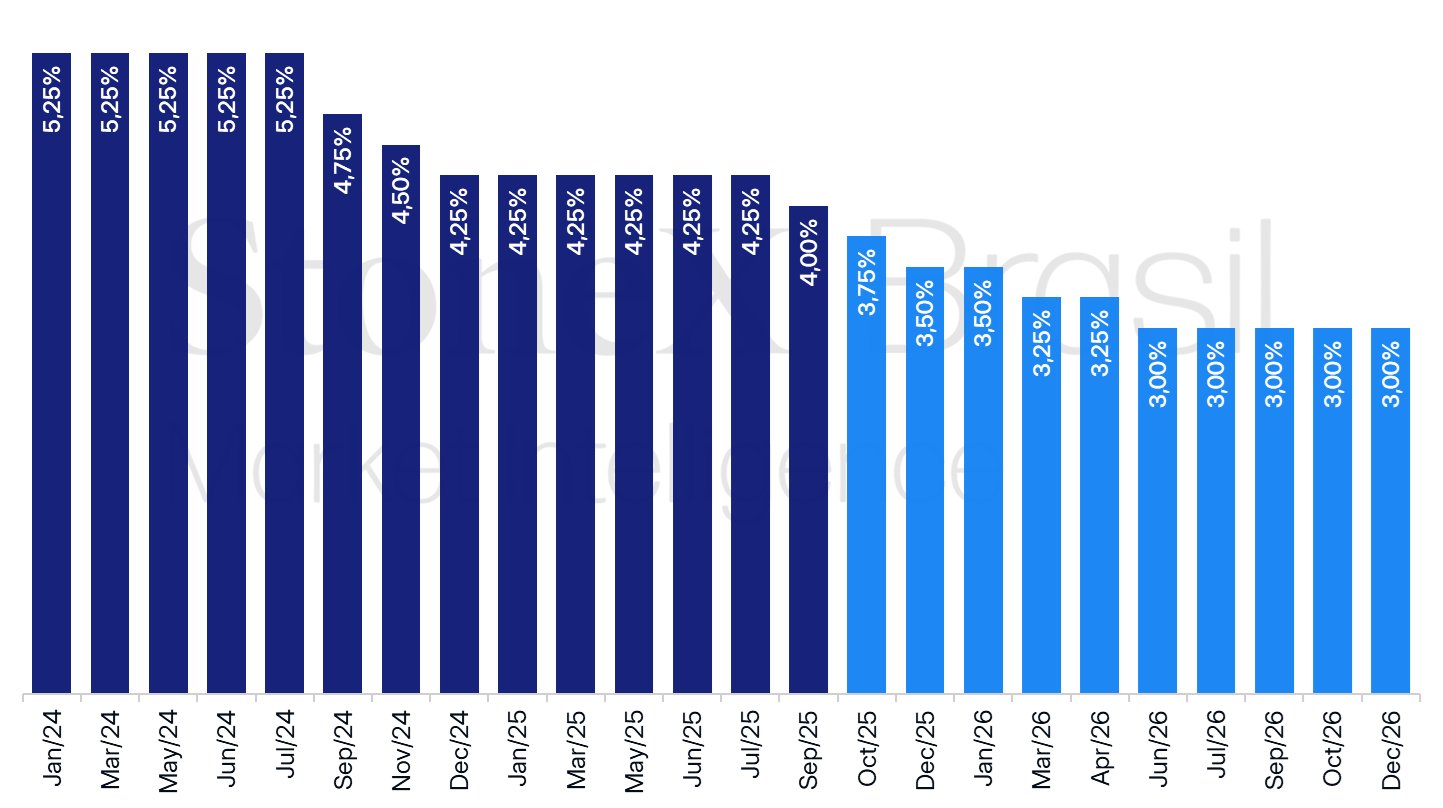
Source: CME FedWatch Tool. Design: StoneX. Refers to the bet with the highest probability in the future interest rate market on the indicated date.
While the government shutdown hampers the release of economic indicators in the United States, investors are expected to look for clues regarding the path of U.S. interest rates in the minutes from the most recent Federal Open Market Committee (FOMC) meeting of the Federal Reserve (Fed).
- Despite referring to a meeting held three weeks ago, the document gains relevance in view of the lack of unanimity among the leaders in the decision, and may give more indications about the degree of alignment of other members of the committee with the proposal of Stephen Miran, who advocated a more aggressive cut of 0.50 p.p.
Why this is important: If the minutes reinforce the expectation of more gradual interest rate cuts in the coming months, it tends to increase the attractiveness of U.S. bonds, favoring the inflow of foreign capital and strengthening the dollar in the global market.
FOMC lowers its interest rates: At its meeting on September 17, the Federal Open Market Committee reduced its interest rate by 0.25 p.p., from the range between 4.25% and 4.50% p.a. to the range between 4.00% and 4.25% p.a.
- Fed Chair Jerome Powell noted that the rate cut was a result of the shift in the balance of risks, which presents lower risks of higher and more persistent inflation and higher risks of worsening unemployment.
Just in case: However, Powell stressed that the scenario remains challenging and that these risks remain present and require opposite measures for their management.
- In his words, “[this was] a cut for risk management, since inflation accelerated less than anticipated and with little evidence of the effects of import tariffs, while the labor market slowed down more sharply than expected.
- In addition, Powell stated that "there wasn't widespread agreement for a significant 0.50 percentage point interest rate cut at a recent FOMC meeting, signaling the central bank does not feel compelled to rush further rate reductions".
Contradictory projections: The Summary of Economic Projections released after the decision showed that 10 out of the 19 FOMC members foresee at least two more cuts in the two remaining decisions this year, while 7 did not see any further reductions.
- In addition, the 2026 projections for inflation and economic growth were revised slightly upwards, while the unemployment projection was revised slightly downwards. In theory, this scenario would suggest fewer interest rate cuts, as it indicates a warmer economy.
- Additionally, there is a high degree of dispersion in expectations for interest rates in 2026 and 2027, which imply a low level of confidence among the members regarding the evolution of the economy in the coming years.
- Powell's comments and the dispersion of economic projections resulted in a slight decrease in investor bets on rate cuts by the Fed.
Changes on the horizon at the Fed? Contrary to expectations, only the newest FOMC member, Stephen Miran, diverged from the other members of the committee.
- He technically remains tied to the Executive, since he only took a leave from his position as head of the White House Council of Economic Advisers while he does not know if he will be nominated to continue at the Fed for the 14-year term that begins in February.
- On the one hand, the unified vote of the other members of the Committee, especially those of Christopher Waller and Michelle Bowman, members appointed by Donald Trump in his first term, eased investors' fears about possible interference by the White House in the conduct of monetary policy.
- On the other hand, Miran argued that the FOMC should carry out three consecutive interest rate cuts of 0.50 p.p., a position quite at odds with his peers and difficult to justify based on the current economic scenario and risk balance.
- This position, however, is consistent with the view of Donald Trump and other economic authorities in the White House, such as the Secretary of the Treasury and the director of the National Economic Council, who argue that American interest rates are excessively high.
Fiscal concerns in Brazil
Expected impact on USDBRL: bullish
Investors should monitor the progress of the Provisional Measure (MP) that raises a series of taxes in compensation for a smaller increase in the Tax on Financial Operations (IOF).
- The Provisional Measure will forfeit its validity if it is not approved by Wednesday (08).
Why this is important: If the provisional measure is approved with significant changes, it may lead to an increased perception of fiscal risks for Brazilian assets and hinder the attraction of foreign investment, which would weaken the real.
Overview: Last week, reports that the Brazilian government was considering subsidizing a universal exemption from bus fares heightened concerns about the fiscal risks associated with Brazilian assets.
- Last week, the Chamber of Deputies also unanimously approved the bill that expands the income tax exemption for individuals earning up to R$ 5,000 per month and increases taxation on taxpayers with income above R$ 50,000 per month.
- The Secretary of Economic Reforms, Marcos Pinto, believes that the economic team will need to make concessions on certain points in order to secure approval of the provisional measure, such as reducing tax benefits and imposing taxes on incentivized securities, including Agricultural and Real Estate Credit Bills (LCA and LCI, respectively).
- This, in turn, would reduce the government’s projected revenue and hinder the achievement of the primary surplus targets established by the fiscal framework.
Conversation between Trump and Lula
Expected impact on USDBRL: bearish
Investors are waiting for more information about a conversation between the presidents of Brazil and the United States, Luiz Inácio Lula da Silva and Donald Trump.
- At the end of September, both reconnected during the United Nations General Assembly and suggested the possibility of a conversation soon.
Why this is important: Although it is still too early to assess the outcome of the discussion, the prospect of a meeting raises expectations for a reduction in trade and diplomatic tensions between the two countries.
- This, in turn, may reduce the perceived risks associated with Brazilian assets and support the performance of the real.
Overview: Initially, there was an expectation that the conversation would take place last week, which did not occur due to the shutdown of the US government's activities.
- There is still no definition on the date or format of this conversation.
- Press reports say that diplomatic teams from the two countries are working to arrange a face-to-face meeting of the two presidents during the ASEAN summit on October 26 in Kuala Lumpur.
- Last Wednesday (01), Foreign Minister Mauro Vieira stated that the Brazilian government is seeking to open a trading dialogue to ease import tariffs and does not intend to conflate trade with politics.
- The United States has shown interest in signing agreements with Brazil for access to strategic minerals, such as lithium, niobium, and rare earths. Lula had already acknowledged, in an interview last month, the possibility of negotiating these assets.
- In the field of technology, the Brazilian government has been taking steps to facilitate agreements with major companies in the sector, as demonstrated by the recent Provisional Measure that encourages the installation of datacenters in the country.

INDICATORS
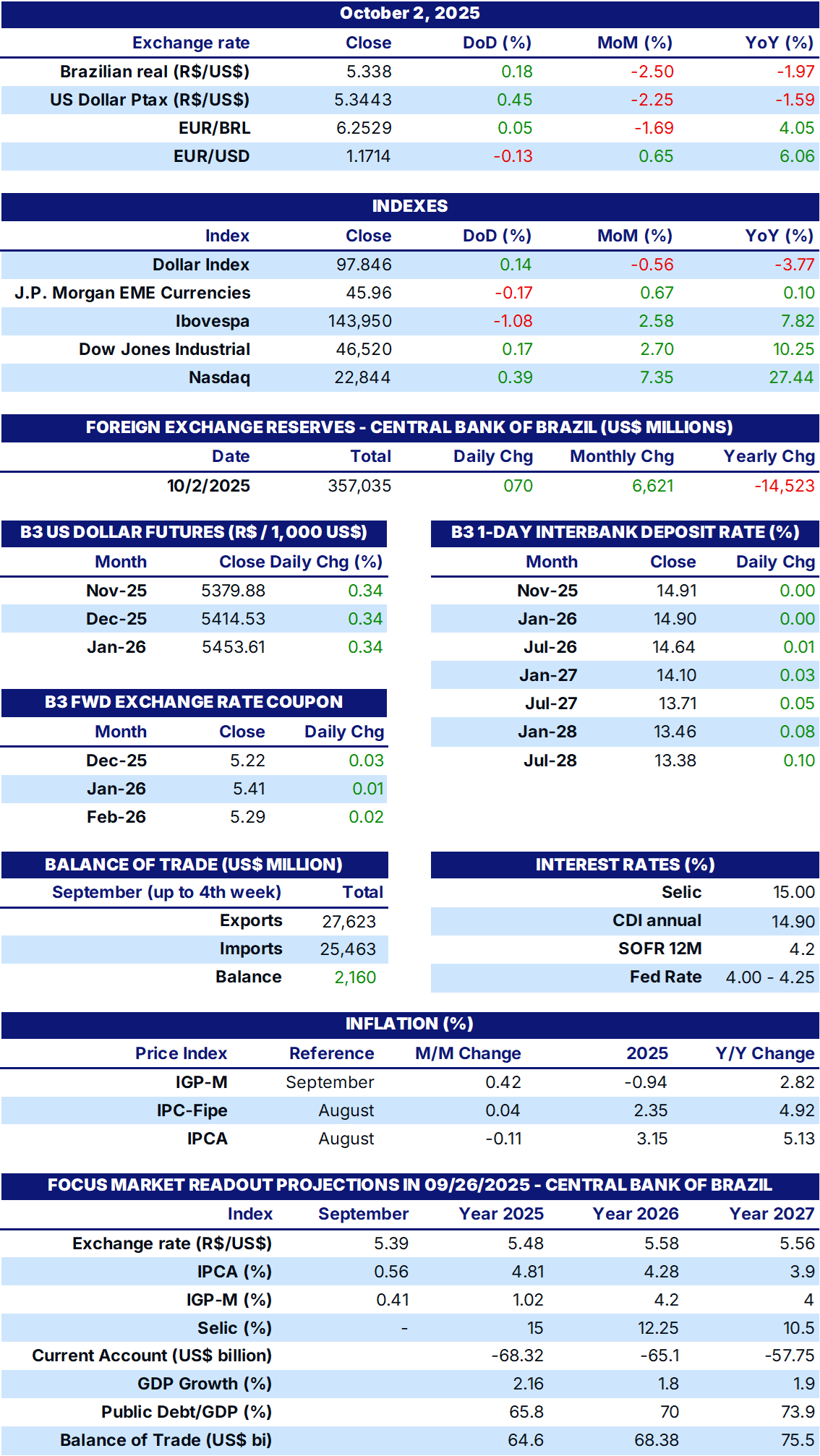
Sources: Central Bank of Brazil; B3; IBGE; Fipe; FGV; MDIC; IPEA and StoneX cmdtyView.