USDBRL Likely to Reflect U.S. Data, Copom Minutes, RPM, and ECB Rate Decision
- Bullish
- U.S. labor market and inflation data are expected to reduce bets on Federal Reserve rate cuts in the coming months, attracting foreign capital and boosting the dollar globally.
- Bearish
- The release of Copom's minutes and the Monetary Policy Report may reduce expectations of Selic rate cuts in January, attracting foreign investment and strengthening the Brazilian real.
- The European Central Bank is expected to keep its interest rates unchanged this week, which could strengthen the euro against the dollar and indirectly boost the Brazilian real.
The week in review
- The Federal Reserve reduced its benchmark interest rate by 0.25 percentage points and maintained flexibility for future rate cuts in the near term.
- The Central Bank of Brazil held its Selic rate steady at 15.00% per year and also kept a flexible stance regarding potential rate cuts in the short term.
- The potential candidacy of Flávio Bolsonaro for the 2026 presidential elections heightened perceived risks for Brazilian assets and brought significant volatility to the currency market.
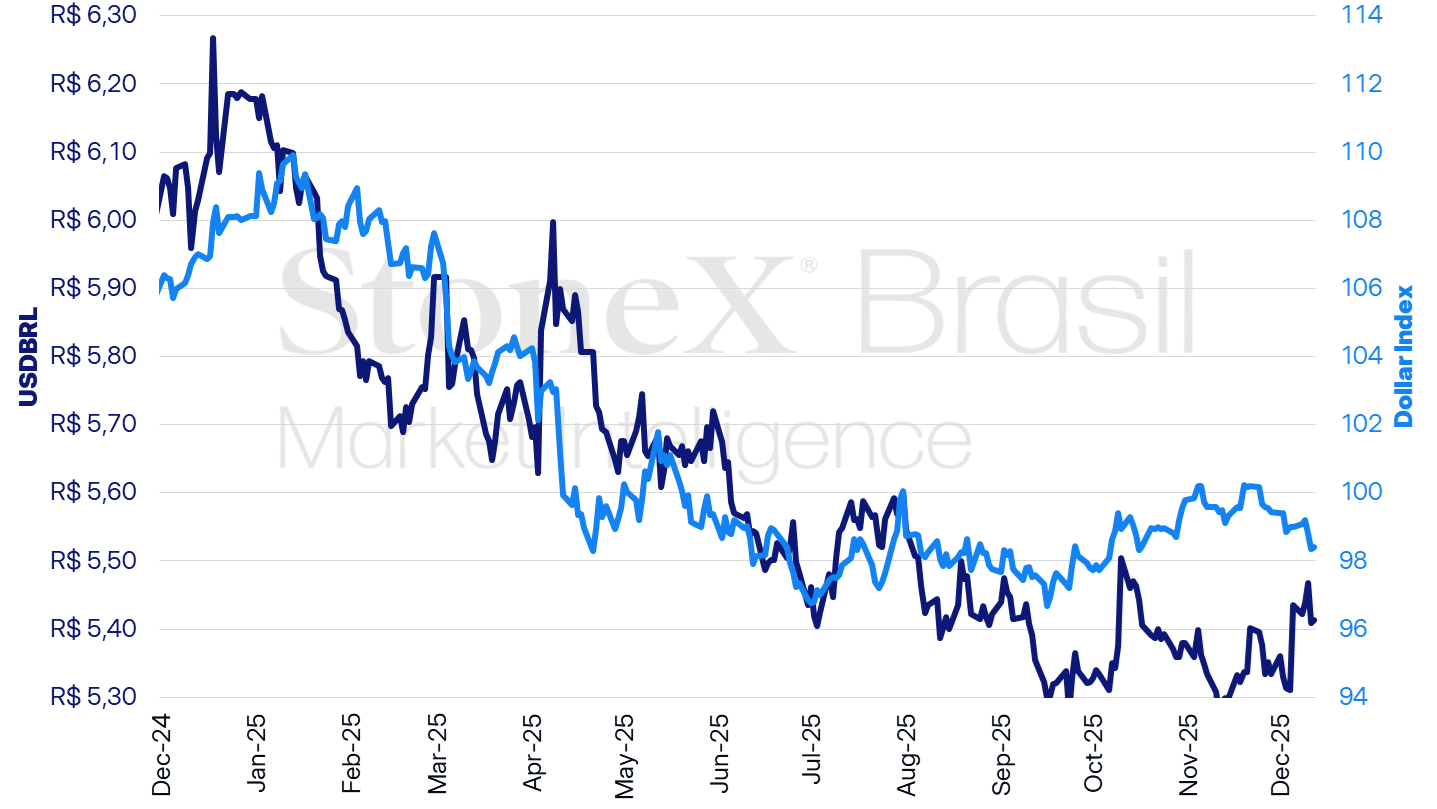
USDBRL and Dollar Index (points)
Source: StoneX cmdtyView. Prepared by: StoneX.
USDBRL Variations | Daily: +0.08% | Weekly: -0.40% | Monthly: +1.47% | Year-to-Date: -12.38% | Last 12 Months: -9.98% |
Dollar Index Variations | Daily: +0.05% | Weekly: -0.60% | Monthly: -1.03% | Year-to-Date: -8.99% | Last 12 Months: -7.97% |
Key Focus: U.S. Economic Data
Expected Impact on USDBRL: Bullish
U.S.: Historical and Forecast Interest Rate – Updated December 12, 2025
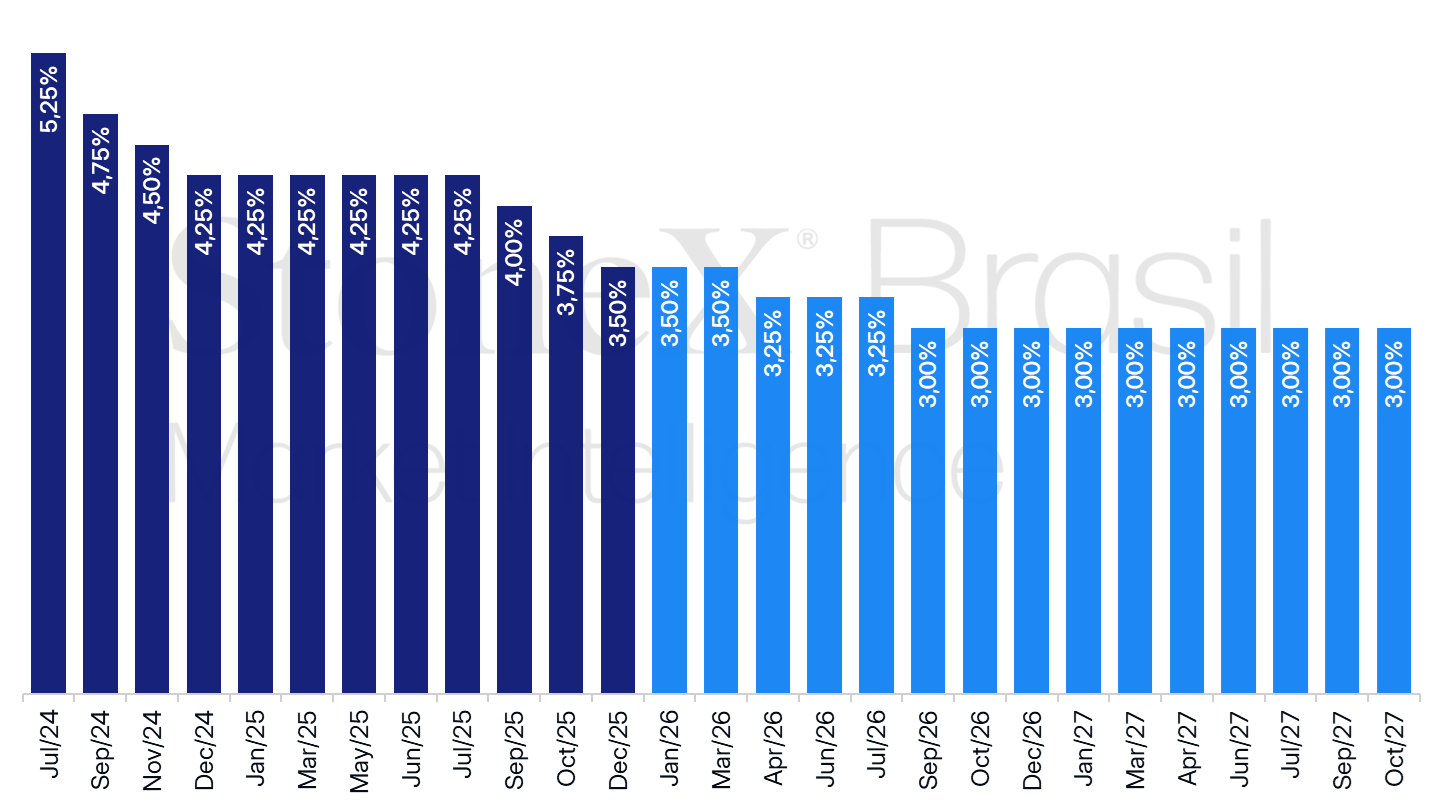
Source: CME FedWatch Tool. Prepared by: StoneX. Refers to the market's highest-probability forecast for interest rates on the indicated date.
Investors are expected to react to the release of U.S. labor market and inflation indicators, aiming to adjust expectations for the trajectory of American interest rates.
- Analyst projections indicate a slight moderation in labor market data and stability in inflation above the Federal Reserve's annual 2% target.
Why This Matters: If these projections are confirmed, the data should reinforce the view that there is no urgency for further rate cuts, prompting a more cautious stance from the Federal Reserve in upcoming monetary policy decisions.
- This could increase yields on U.S. Treasury securities, attract foreign capital, and strengthen the dollar globally.
Uncertainty Around Rate Cuts: In its decision last Wednesday (10), the Federal Open Market Committee (FOMC) reduced interest rates by 0.25 percentage points, shifting from a range of 3.75%-3.50% to 3.50%-3.75% annually.
- Despite the reduction, the Committee expressed caution about future rate decisions, with three dissenting votes—a rare occurrence since September 2019.
- Additionally, the Summary of Economic Projections revealed that six Fed members considered holding rates steady as the most appropriate decision. It also showed significant dispersion in expectations for interest rates in 2026 and 2027, highlighting the uncertainty among officials regarding economic trends in the coming years.
- The high degree of dispersion stems primarily from contradictory U.S. economic data, with some indicators suggesting stronger-than-expected performance and others pointing to weaker outcomes.
Delayed Data: This week, the U.S. Bureau of Labor Statistics (BLS) will release the Employment Situation Report on Tuesday (16) and the Consumer Price Index (CPI) on Thursday (18), covering October and November.
- The release of these reports was delayed due to a 43-day government shutdown.
- The inflation data's reliability may be lower than usual for these months, as about two-thirds of the 100,000 prices surveyed for the CPI are collected in-store visits.
- Furthermore, the household survey for the October Employment Situation Report will not be published, as the shutdown prevented approximately 60,000 phone interviews from being conducted.
What to Expect:
- Employment Situation Report: The median forecast suggests net job creation will decrease from 119,000 in September to 45,000 in November, indicating a gradual slowdown in the U.S. labor market without a sharp deterioration.
- CPI: The median projection points to a 0.3% increase in the headline index and a 0.2% rise in the core index (excluding volatile food and energy components), matching September's figures. Industrial goods prices are expected to remain under pressure, offsetting slower service price increases. If confirmed, the CPI's 12-month cumulative gain would rise from 3% in September to 3.1% in November, while the core index would remain at 3.0%.
Copom Minutes and Monetary Policy Report (RPM)
Expected Impact on USDBRL: Bearish
Brazil: Historical and Forecast Interest Rate – Focus Bulletin, December 5, 2025
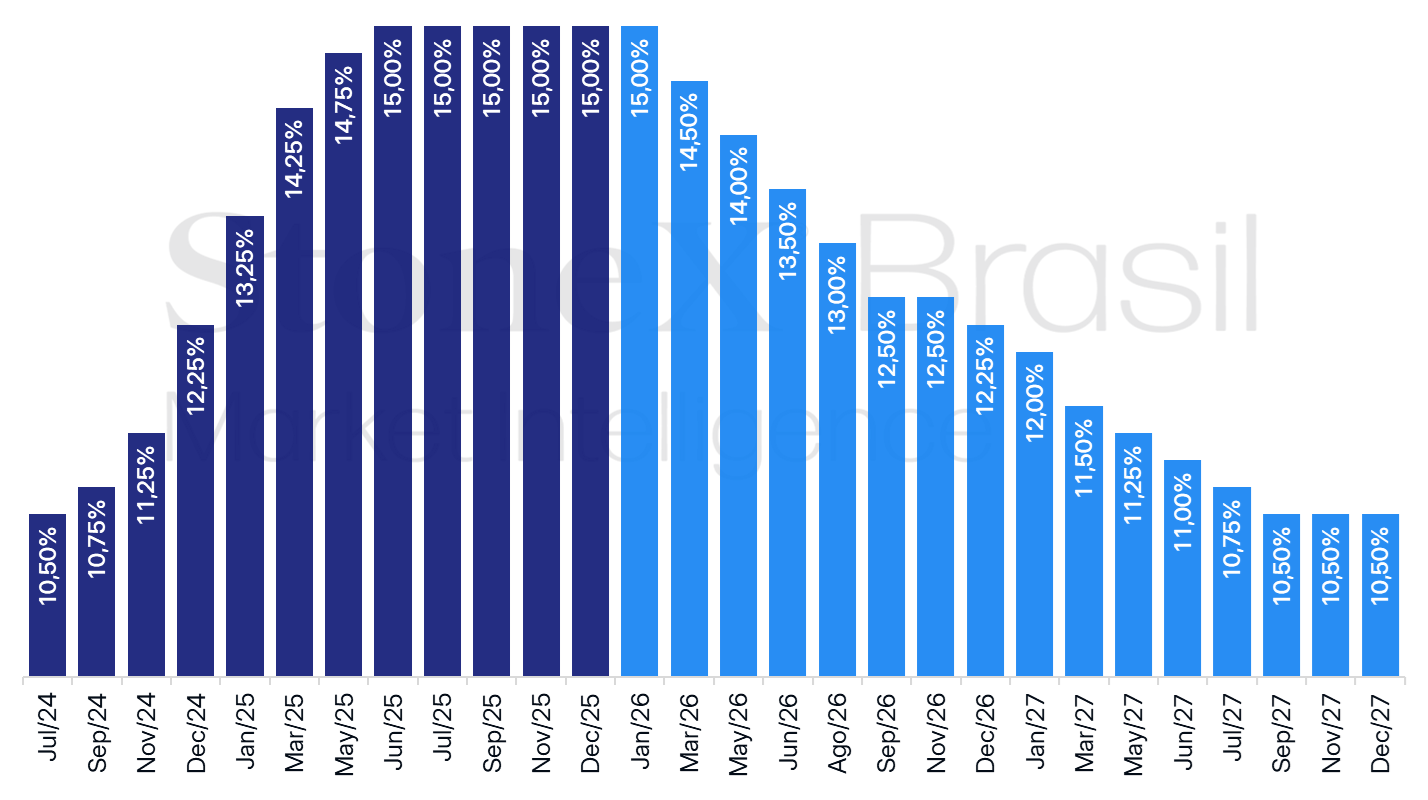
Source: Central Bank of Brazil. Prepared by: StoneX.
Investors are expected to analyze the minutes from the Central Bank of Brazil’s Monetary Policy Committee (Copom) meeting last Wednesday (10), which held the Selic rate steady at 15.00% per year for the fourth consecutive decision.
- Specifically, investors are looking to refine expectations for a possible rate cut in the January 29 decision, following only subtle changes in the Committee’s statement.
- Additionally, the Central Bank will release its fourth-quarter Monetary Policy Report (RPM), followed by a press conference with the institution’s president, Gabriel Galípolo, and Director of Economic Policy, Diogo Guillen.
Why This Matters: Signals that the Central Bank may adopt a more cautious approach to initiating rate cuts in Brazil could increase yields on domestic bonds, attract foreign capital, and strengthen the Brazilian real against the dollar.
Subtle Changes in the Statement: Contrary to analysts' expectations, the section emphasizing the strategy of maintaining high interest rates for a “prolonged period” remained in the statement.
- In previous weeks, Central Bank officials indicated that this “prolonged period” started in June when the Selic rate was raised to 15.00% per year, with cumulative effects on the economy since then.
- As a result, investors anticipated that the Copom would remove references to maintaining rates at 15% for a “prolonged period” to signal the approach of a rate-cutting cycle, which did not occur.
- However, the Committee added the term “ongoing” and replaced “sufficient” with “adequate” in the phrase: “The Committee assesses that the ongoing strategy of maintaining the current interest rate level for a prolonged period is adequate to ensure inflation convergence to the target.”
- This suggests that the prolonged period began in the past and remains in effect, potentially signaling its nearing end, though the meaning of the change from “sufficient” to “adequate” remains unclear.
Uncertainty Around Rate Cuts: Although these changes lean toward the possibility of rate cuts, they were so subtle that investors interpreted a higher likelihood of cuts occurring in March.
- The Copom minutes' detailed description of discussions and analyses from the meeting may provide key insights to help investors gauge the timing of rate-cut cycles.
Monetary Policy Report (RPM): The RPM is the Central Bank's most comprehensive analysis of the domestic and international macroeconomic environment, including projections for Brazil's key macroeconomic indicators in the coming years.
- Investors will particularly focus on inflation and GDP projections, which could impact expectations for the Selic trajectory.
- Statements from Galípolo and Guillen will also be closely monitored for indications of the next steps in monetary policy.
ECB Rate Decision
Expected Impact on USDBRL: Bearish
This Thursday (18), the European Central Bank (ECB) is likely to keep its benchmark interest rate unchanged at 2.00% annually, amid positive signs for economic growth and inflation aligning with its target.
Why This Matters: The ECB’s decision to maintain rates may strengthen the euro against the dollar, especially following the Fed’s recent rate cut. This, in turn, could indirectly benefit the Brazilian real by weakening the dollar.
Context: Despite the eurozone’s Consumer Price Index (CPI) rising from 2.1% in October to 2.2% in November, expectations for falling energy prices reduce concerns about inflationary pressures within the bloc.
- Additionally, GDP growth accelerated from 0.1% in the second quarter to 0.3% in the third quarter, boosting optimism about the region's economic dynamics.

ECONOMIC INDICATORS TABLE
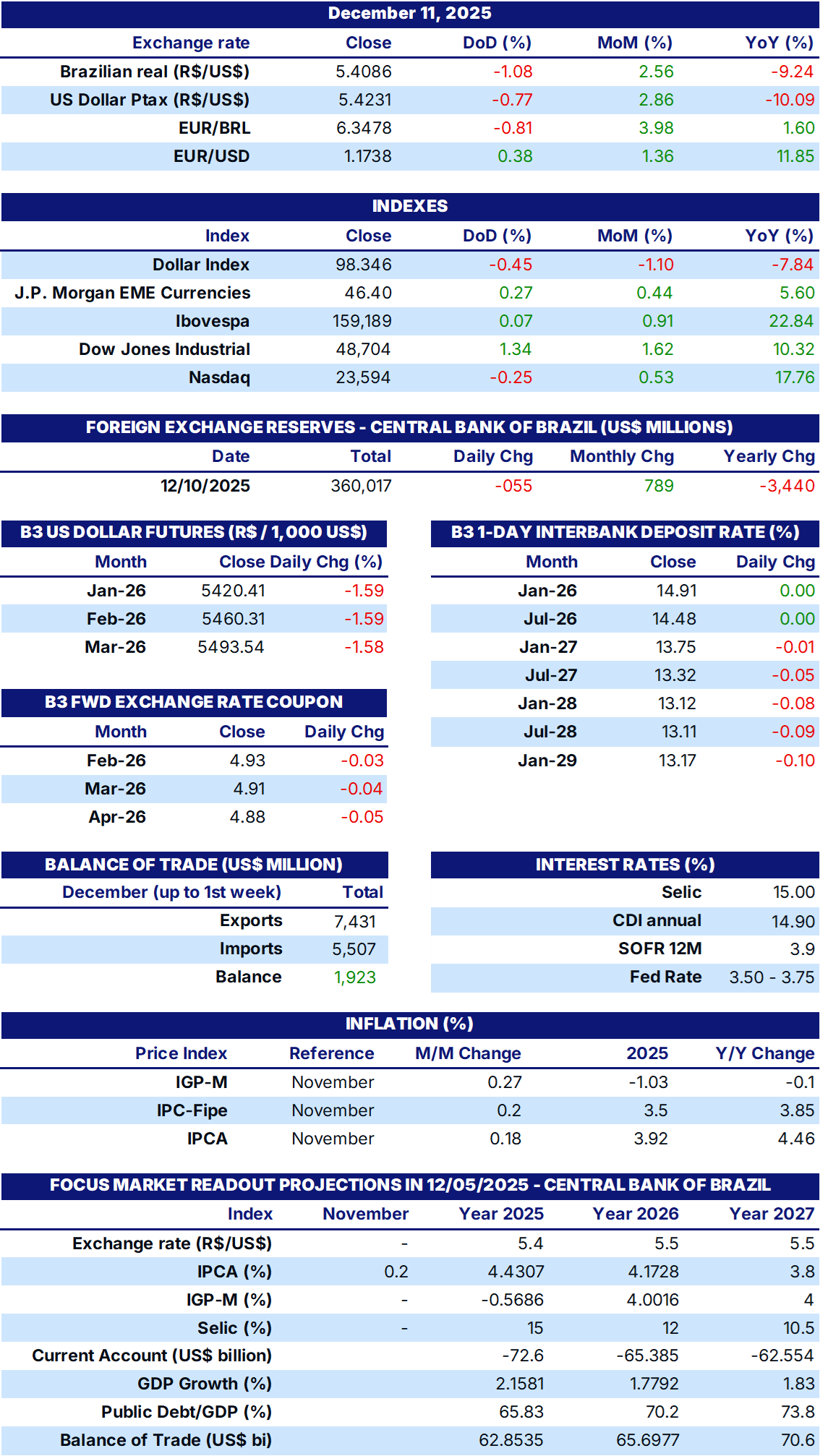
Sources: Central Bank of Brazil; B3; IBGE; Fipe; FGV; MDIC; IPEA; and StoneX cmdtyView.