USDBRL to Reflect U.S. Inflation, Geopolitical Tensions, EU-Mercosur Agreement, and Brazilian Data
- Bullish
- The release of December’s CPI report is expected to show price acceleration, reducing bets on interest rate cuts by the Federal Reserve and sustaining high Treasury yields, which could strengthen the dollar globally.
- Heightened global geopolitical tensions and signs of increased U.S. intervention in Latin America raise regional risk perception, potentially favoring safe-haven assets and putting pressure on regional currencies.
- Potential indications of a slowdown in Brazilian economic activity could reinforce expectations for Selic rate cuts in the first half of the year, potentially reducing the attractiveness of domestic bonds and weakening the real against the dollar.
- Bearish
- Progress in approving the trade agreement between the European Union and Mercosur is expected to boost Brazilian export expectations and attract financial inflows into the country, supporting the Brazilian real’s appreciation.
The week in review
- The financial markets showed a muted reaction to the U.S. attack in Venezuela last Saturday (03) and Trump’s statements regarding his interest in annexing Greenland. Despite increased global geopolitical risks, risk appetite remained resilient abroad, which supported the real’s performance.
- U.S. labor market data revealed a moderately weakening scenario, although the market remains in apparent balance. These data contributed to reduced expectations for interest rate cuts in the U.S., which supported the dollar during the period.
- The ISM services activity index recorded a more significant rise in December, suggesting that the most critical sector of the U.S. economy remains resilient.
- In Brazil, December’s Broad National Consumer Price Index (IPCA) reported growth below the median estimate. This outcome slowed the 12-month cumulative increase to 4.26%, below the Central Bank’s target ceiling.
USDBRL and Dollar Index (points)
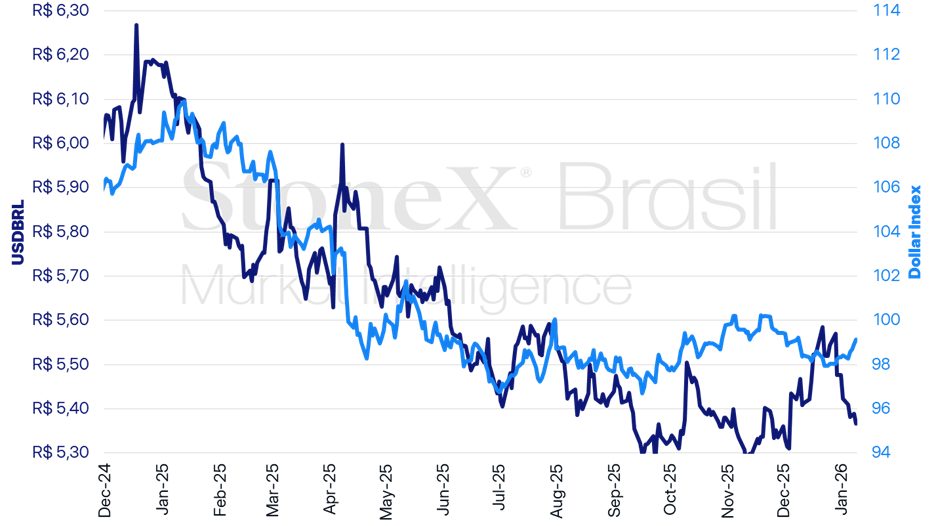
Source: StoneX cmdtyView. Prepared by: StoneX.
USDBRL Variations
Daily: +0.05% | Weekly: -0.61% | Monthly: -1.60% | Annual: -12.77% | Over 12 months: -11.81% |
Dollar Index Variations
Daily: +0.26% | Weekly: +0.51% | Monthly: +0.62% | Annual: -8.51% | Over 12 months: -9.32% |
Key Focus: U.S. Inflation Data
Expected Impact on USDBRL: Bullish
12-Month Variation of the U.S. Consumer Price Index (CPI)
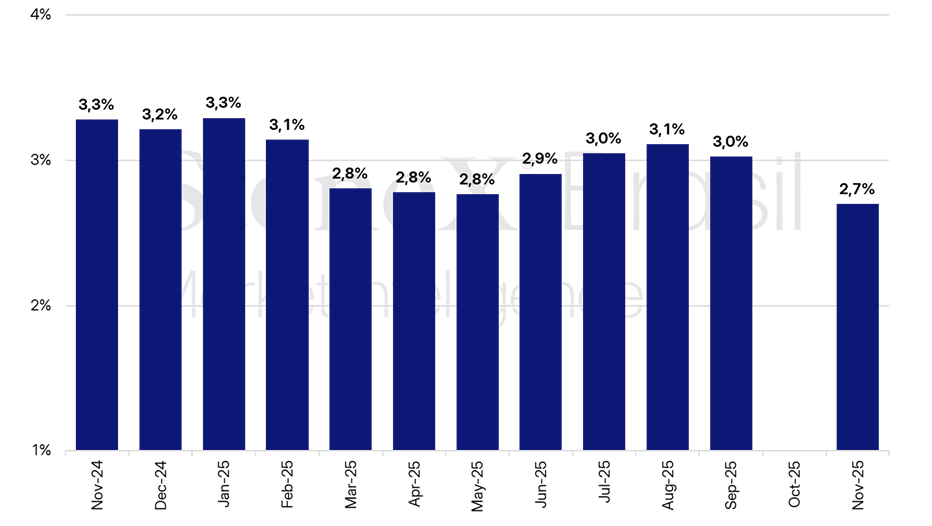
Source: U.S. Bureau of Economic Analysis (BEA), U.S. Bureau of Labor Statistics (BLS), Federal Reserve Bank of St. Louis. Prepared by: StoneX.
The Consumer Price Index (CPI) set for release this Tuesday (13) is expected to show accelerated inflation in December after two months in which data collection was hindered by the U.S. government’s 43-day shutdown.
Why This Matters: A likely hotter CPI reading could reduce bets for Federal Reserve rate cuts and bolster expectations for American bond yields, which could strengthen the dollar globally.
Context: During October and November, the Bureau of Labor Statistics (BLS) assumed no variation for numerous components due to lack of data, potentially leading to a sharper rise in this release as a correction.
- Additionally, seasonal factors typical of the holiday period tend to push prices higher in December.
- For the period, the median estimate projects a monthly increase of 0.45%, above the last available reading from September, where it rose by 0.3%.
- While November's monthly variation wasn’t published, the BLS reported that prices rose by 2.7% over the 12 months to November. The surprising slowdown in the last release was attributed by analysts to an unusual drop in rental prices and other housing costs, high-weight items in inflation calculations that have been a source of concern for many families.
- As such, the previous strong performance could have been more momentary, stemming from distortions caused by the shutdown.
Relatively Stable Employment Data: This week, various U.S. labor market indicators showed moderate signs of weakening, but overall remained largely balanced, with no significant acceleration in hiring but also no notable rise in layoffs.
- The most critical data, "Payroll," showed slight deceleration in non-agricultural job creation, dropping from 56,000 in November to 50,000 in December. Meanwhile, the unemployment rate fell to 4.4%, below the 4.6% reported in November.
- Given this still-unclear scenario, investors are closely monitoring new data to better understand the trajectory of the U.S. economy and try to anticipate future interest rate movements.
Pause in Rate Cuts: In this context of persistent inflation and stable economic activity data, market expectations largely point to maintaining interest rates in the next three meetings, with cuts resuming only in June 2026.
- This outlook is reinforced by the end of Jerome Powell’s term, scheduled for May 15. President Donald Trump, who will appoint Powell’s successor, has repeatedly stated his intention to choose a leader inclined toward less restrictive monetary policy, potentially paving the way for rate cuts later on.
- However, as long as inflation data remain resilient and there are no clear signs of economic deceleration, rate cuts are expected to remain on hold.
Rising Geopolitical Tensions
Expected Impact on USDBRL: Bullish
This week, U.S. President Donald Trump announced the successful capture of Venezuelan President Nicolás Maduro during an operation in Caracas.
- The event marked a significant turning point in regional geopolitical relations, with Trump giving further indications throughout the week of heightened efforts to expand U.S. political influence.
- Besides Venezuela, Trump reiterated his intention to intervene in the governments of other countries, including Mexico and Colombia, and once again discussed options to annex Greenland, an autonomous region of Denmark.
Why This Matters: Despite limited market reaction so far, escalating geopolitical tensions in Latin America are likely to pressure regional currencies, which could be particularly negative for the real as investors globally seek out “safe-haven” assets like gold and developed-market currencies.
Muted Market Reaction: While greater volatility was expected in global financial markets, the Venezuela invasion has had limited repercussions, primarily affecting oil futures prices.
- The subdued reaction, at least initially, appears tied to perceptions that no significant further attacks will occur in the region, given the success of the operation against Maduro, reducing the likelihood of military escalation.
European Union - Mercosur Agreement
Expected Impact on USDBRL: Bearish
The European Union approved a trade agreement with Mercosur on Friday (9) aimed at reducing and eliminating tariffs and implementing measures to facilitate trade between the countries.
- The support was formalized during a meeting of EU ambassadors in Brussels and approved by the European Council.
- The text will now move to the European Parliament, and if validated, Ursula von der Leyen, President of the European Commission, is expected to travel to Paraguay to sign the document with the South American bloc.
- Reports suggest Mercosur will sign the agreement with the EU on January 17.
- This will be the largest trade agreement ever finalized by the EU, ending 26 years of negotiations and creating the world’s largest free trade zone.
Why This Matters: If validated, the agreement could boost Brazilian export levels, attracting financial inflows into Brazil, which would likely support the real’s performance.
However: Despite support from several sectors, the text faces strong resistance from European farmers, particularly in France and Ireland.
- Reports indicate Austria, France, Hungary, Ireland, and Poland voted against the agreement, while Belgium abstained. A minimum of 15 countries representing 65% of the bloc’s total population was required for approval.
Economic Data in Brazil
Expected Impact on USDBRL: Bullish
With a quieter domestic agenda, investors are expected to react to the release of Brazilian economic activity data, focusing on the Central Bank's Economic Activity Index (IBC-Br), which fell by 0.20% in October, matching September’s decline.
- In addition to the IBC-Br, the week includes monthly data releases for services and retail sectors.
Why This Matters: A slowdown in Brazil’s economy may reinforce expectations for the Central Bank to initiate a cycle of Selic rate cuts as early as January’s decision, potentially reducing domestic bond yields and hampering external capital inflows, weakening the real against the dollar.
Context: After conducting an intense cycle of interest rate hikes and maintaining the Selic at 15.00% p.a. since June, the Central Bank has indicated plans to lower rates throughout 2026, though the start and pace of this cycle remain uncertain.
- Investors believe these reductions could begin with the interest rate decision on January 29 or March 18.
- While the Central Bank has emphasized inflation dynamics in determining the timing of rate cuts, the moderation in economic growth simultaneously reduces inflationary risks due to weakened demand and increases the risks of a sharper GDP contraction if interest rates remain highly restrictive.
- As such, recent economic contraction supports expectations for Selic cuts in January.

INDICATORS
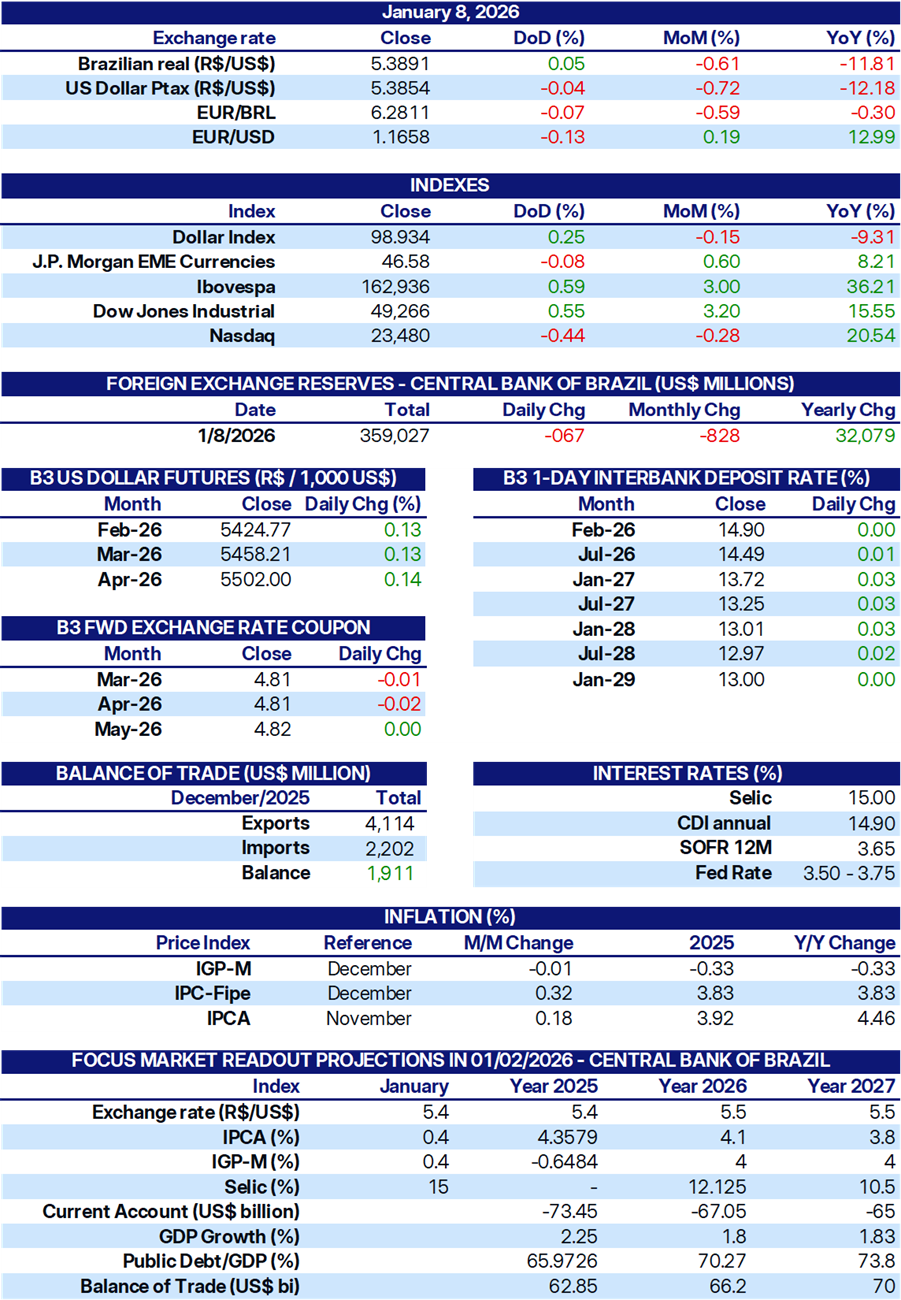
Sources: Central Bank of Brazil; B3; IBGE; Fipe; FGV; MDIC; IPEA; and StoneX cmdtyView.