USDBRL likely to reflect FOMC and Copom interest rate decisions, global geopolitical tensions, and economic data from Brazil
- Bullish
- Expectations of steady U.S. interest rates, combined with the possibility of signaling a prolonged pause in rate cuts, are likely to sustain Treasury yields and favor the dollar globally.
- A potential rhetorical opening for the start of Brazil’s Selic rate cut cycle as early as March could lower expectations for the Brazilian interest rate differential, reducing the relative attractiveness of domestic assets and putting depreciation pressure on the real.
- Bearish
- Increased U.S. involvement in external disputes has heightened perceptions of political instability in the country, driving a flight from U.S. assets and favoring currencies with higher interest rate differentials, such as the real.
- Domestic indicators continue to point to gradual inflation deceleration and a heated labor market, reinforcing expectations of a slower Selic cut pace and sustaining yields on national securities, which tends to favor the real.
The week in review
- The week began with new threats from U.S. President Donald Trump regarding additional tariffs on countries opposing the annexation of Greenland by the U.S., which triggered a widespread flight from U.S. assets and contributed to the strengthening of the real and “safe-haven” assets like gold.
- However, throughout the week, Trump softened his stance and withdrew threats of military force and additional tariffs against countries opposing the annexation. Despite partial relief from tensions, negotiations involving NATO and U.S. access to Greenland remain unresolved.
- On the economic front, the final reading of the third-quarter GDP and November’s Personal Consumption Expenditures (PCE) Price Index in the U.S. were released. The indicators showed results of 4.4% (annualized rate) and 0.2%, respectively, in line with projections. This scenario reinforced the view that the U.S. economy remains resilient and contributed to reducing bets on additional rate cuts in the short term, including at the next Federal Reserve meeting.
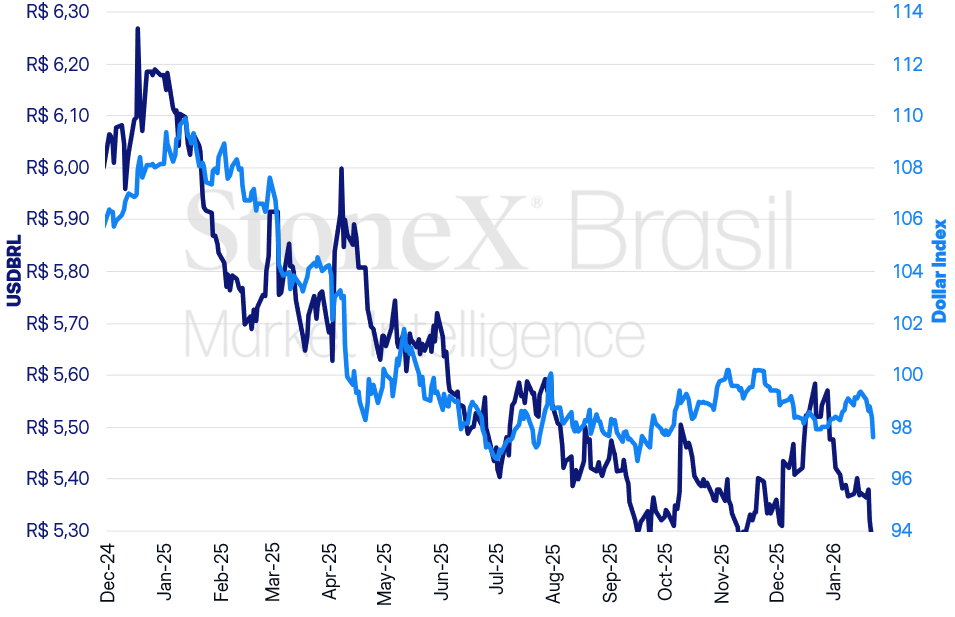
USDBRL and Dollar Index (points)
Source: StoneX cmdtyView. Prepared by: StoneX.
USDBRL Variations
Daily: +0.08% | Weekly: -1.59% | Monthly: -3.46% | Annual: -14.41% | 12-Month: -10.76%
Dollar Index Variations
Daily: -0.76% | Weekly: -1.79% | Monthly: -0.71% | Annual: -9.72% | 12-Month: -9.66%
Key Highlight: Brazil’s Interest Rate Decision
Expected Impact on USDBRL: Bullish
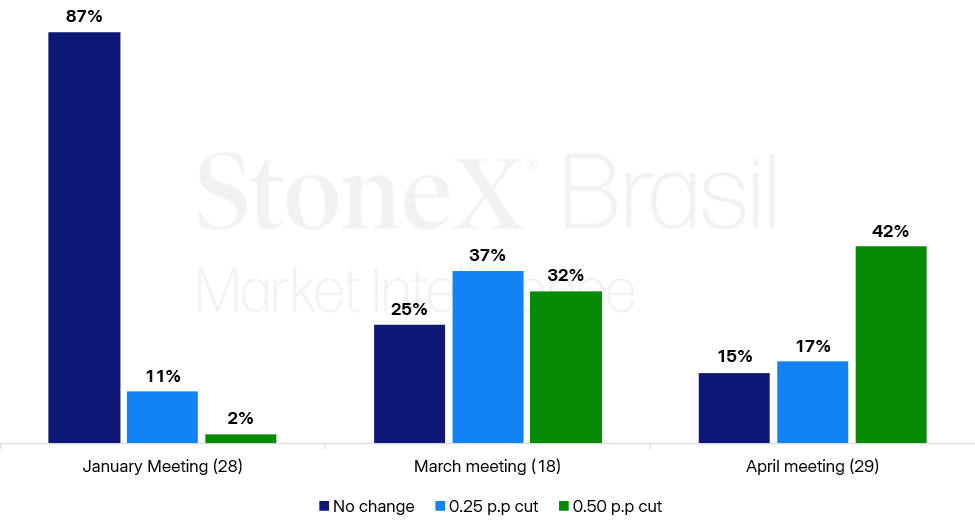
Probabilities for Upcoming Central Bank Meetings (updated on 01/23/2026)
Source: B3. Prepared by: StoneX.
The Central Bank’s Monetary Policy Committee (Copom) is expected to keep the Selic rate at 15.00% per year during its meeting next Wednesday (28), preserving the current level of monetary tightening.
- More than the decision itself, investors’ focus should be on the signals within the statement, particularly any indications of factors that could lead the Committee to start a rate-cut cycle as early as the March meeting.
- Most market projections suggest that the start of monetary easing is approaching, and expectations are growing that Copom may rhetorically pave the way for this possibility at the next meeting.
Why This Matters: Should the statement signal more clearly the possibility of cuts starting in March, it could reduce the relative attractiveness of domestic assets by compressing the interest rate differential between Brazil and other economies, exerting depreciation pressure on the real.
- Conversely, if Copom reiterates the narrative that cuts are still far off, yields on domestic securities could remain high or even increase, helping to sustain or strengthen the Brazilian currency in the short term.
Outlook: If confirmed, this will be the fifth consecutive meeting where Copom keeps the Selic rate unchanged, maintaining financial conditions in clearly restrictive territory.
- The Committee has based this strategy primarily on persistently high inflation expectations, resilient economic activity, and a consistently heated labor market, despite initial signs of economic slowdown and gradual improvements in current inflation trends.
- During the last decision in December, the statement highlighted “unanchored expectations, high inflation projections, resilient economic activity, and labor market pressures,” reinforcing that there is no urgency to start the monetary easing cycle.
- Nevertheless, the progressive easing of inflation indicators and initial signs of economic deceleration increase the likelihood that the Central Bank will start preparing the market for cuts in the near term.
Economic Monitoring: Copom is also likely to emphasize data dependency in its monetary policy approach, noting the lack of concrete evidence of labor market cooling to justify a more aggressive rate-cut cycle.
- In this context, some indicators to be released during the week gain additional relevance, particularly labor market data from the Continuous PNAD and CAGED for December, as well as January’s IPCA-15.
U.S. Interest Rate Decision
Expected Impact on USDBRL: Bullish
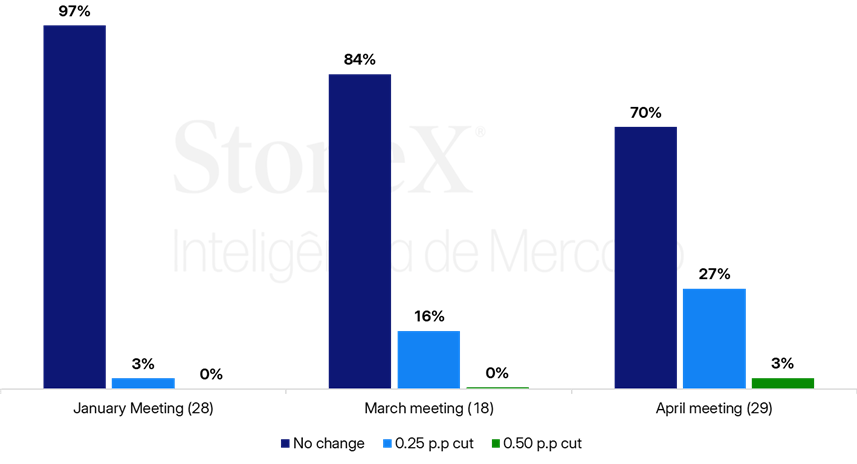
Probabilities for Upcoming Federal Reserve Meetings (updated on 01/23/26)
Source: CME FedWatch. Prepared by: StoneX.
For the next Federal Open Market Committee (FOMC) meeting on January 27–28, consensus points to maintaining U.S. interest rates within the range of 3.50–3.75% per year.
- Given the consensus on the decision, the focus will likely be on the tone of the post-meeting statement and remarks by Federal Reserve Chair Jerome Powell.
Why This Matters: The press conference following the meeting could shed light on the monetary authority’s approach to U.S. interest rates in 2026. If it reinforces expectations of a prolonged pause in the rate-cut cycle, it could boost yields on U.S. assets, favoring the dollar globally.
- It’s worth noting that in May, a new Fed Chair aligned with Donald Trump’s stance—advocating for significantly lower rates—will take over.
Outlook: Based on current information, many agents expect the next U.S. rate cut might not occur until mid-year, as the labor market shows mixed signals and inflation remains above target.
- Recent data on U.S. unemployment claims for the week ending January 17 showed a smaller-than-expected increase, hitting 200,000. This outcome reinforced perceptions of relative stability in the country’s labor market.
- Meanwhile, November’s Personal Consumption Expenditures (PCE) Price Index showed a 0.2% increase compared to October. Over the 12 months until November, the index rose by 2.8%, exceeding the 2.7% recorded in October and surpassing market expectations.
- Additionally, recent GDP data revealed better-than-expected growth of 4.4% in the economy during the third quarter of 2025.
- On the other hand, some labor market surveys suggest challenges for workers in finding new jobs, signaling weaker demand for labor and a cooling job market.
The subsequent release of the meeting minutes is expected to provide further insights into the monetary authority’s next steps. After the December meeting, the document revealed a split in votes, with 9 of the 12 authorities supporting the last rate cut. Beyond the voting patterns, there was a subtle indication of uncertainty about when the next rate cut could occur.
Geopolitical Tensions Involving the U.S.
Expected Impact on USDBRL: Bearish
Throughout this week, the U.S. engaged in new geopolitical discussions amid heightened tensions with the European Union over Greenland and renewed threats of military intervention in Iran.
Why This Matters: While the situation influences the search for “safe-haven” assets, U.S. involvement in external agendas has reinforced investor insecurity regarding political stability in the country, resulting in a flight from U.S. assets, including the dollar, and favoring other currencies, notably the Brazilian real.
Outlook: Beyond threatening military action in Greenland, President Donald Trump suggested imposing new tariffs on EU exports to the U.S.
- Following pressure, Trump ruled out the possibility of forcibly taking Greenland, stating he discussed an agreement with the European Union to meet Washington’s interests, which boosted risk appetite in the market mid-week.
- By the end of the week, however, Trump returned to the geopolitical spotlight, announcing the deployment of military planes to U.S. bases near Iran in response to new executions of protesters and the lack of transparency regarding enriched uranium stocks.
- Next week, investors are likely to balance the search for safer assets with assessing risks associated with U.S. assets.
- In a scenario of heightened tensions between the U.S. and other nations, the dollar could continue losing ground against other currencies, with the Brazilian real standing out due to its interest rate differential.
- Conversely, reduced U.S. involvement in external discussions coupled with increased geopolitical and macroeconomic risks could lead to dollar appreciation against other currencies.
IPCA-15 and Employment Data in Brazil
Expected Impact on USDBRL: Bearish
In Brazil, this week’s agenda features key indicators for investors to refine their expectations about the Central Bank’s monetary policy direction.
- The highlight will be the release of the National Consumer Price Index 15 (IPCA-15), published just before the Copom meeting.
- Additionally, towards the end of the week, investors will monitor Brazil’s December labor market data through the Continuous PNAD survey and CAGED’s Monthly Employment Evolution report.
- Recent data has reinforced a narrative of a resilient economy, with positive activity data, historically low unemployment rates, and inflation gradually approaching the Central Bank’s target, delaying expectations for the start of the rate-cut cycle.
Why This Matters: If inflation and unemployment data in Brazil continue suggesting moderation, Copom is likely to emphasize caution and a gradual pace in the country’s rate reductions, which would tend to strengthen the real.
Outlook: The most recent inflation data, the National Consumer Price Index (IPCA) for December, showed an acceleration of 0.33%, compared to 0.18% in the previous month.
- Despite the acceleration, the 12-month cumulative rate closed 2025 at 4.26%, marking the second consecutive month within the tolerance bands.
- In the labor market, the unemployment rate is near historic lows. November’s PNAD and CAGED data showed an unemployment rate of 5.2% and the creation of 85.86 thousand jobs, respectively.
- It is worth noting that December is seasonally a month of negative figures due to temporary year-end jobs, which could contribute to a negative balance in the creation of new formal jobs.

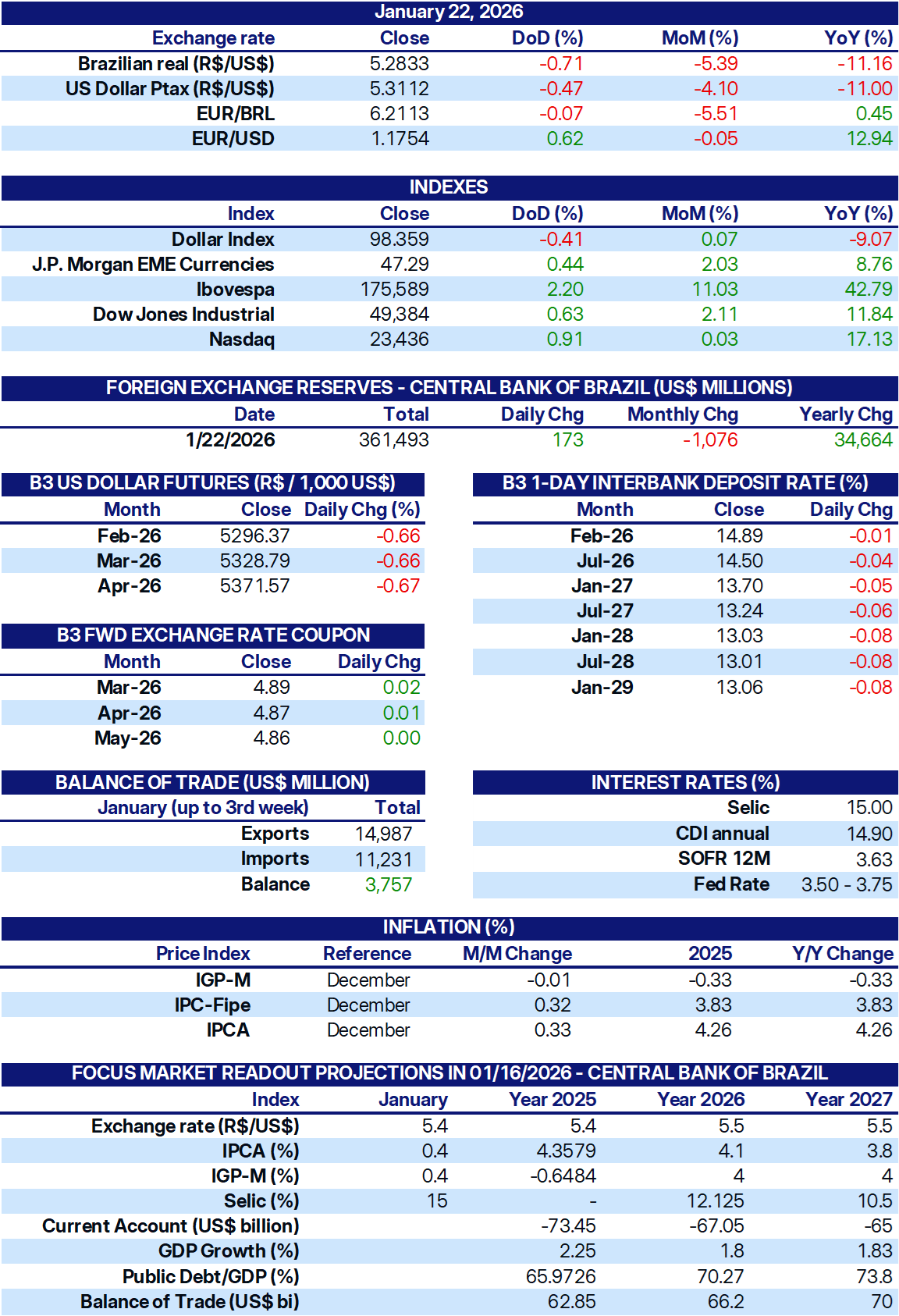
INDICATORS
Sources: Central Bank of Brazil; B3; IBGE; Fipe; FGV; MDIC; IPEA and StoneX cmdtyView.