Dollar expected to reflect geopolitical tensions in the Middle East and economic data from Brazil and the US
- Bullish
- The release of the April PCE price index is expected to reinforce the perception of inflationary pressures in the US, favoring the yield of US Treasury bonds and strengthening the dollar globally.
- The persistence of the diplomatic impasse between the US and Iran reduces the expectation of reopening the Strait of Hormuz, which may result in greater global risk aversion and contribute to the dollar's strength.
- Bearish
- The release of the IPCA-15 is expected to reinforce the perception of inflationary pressures in Brazil and reduce bets on cuts in the Selic rate, which favors attracting foreign capital and tends to strengthen the BRL.
Weekly recap
- Last week, mixed signals regarding negotiations between the US and Iran were the main source of volatility in the currency market, alternately favoring investor appetite for risk and risk aversion.
- On the economic agenda, the Federal Reserve's Federal Open Market Committee (FOMC) minutes reinforced the perception of inflationary risks in the USA, favoring bets on higher interest rates in the country.
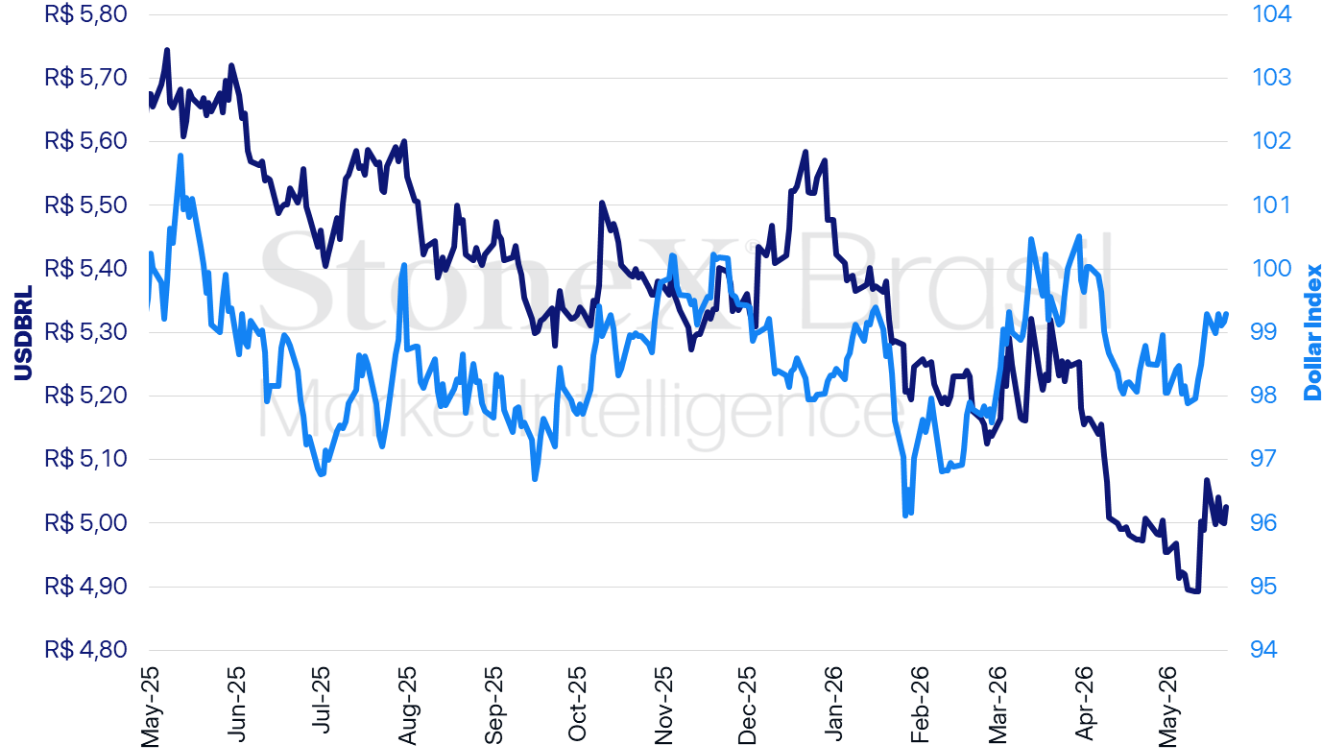
USDBRL and Dollar Index (points)
Source: StoneX cmdtyView. Decsign: StoneX.
USDBRL Variations | Daily: +0.52% | Weekly: -0.84% | Monthly: +1.43% | Annual: -8.25% | In 12 months: -11.23%
Dollar Index Variations | Daily: +0.11% | Weekly: -0.01% | Monthly: +1.26% | Annual: +0.99% | In 12 months: -0.66
KEY EVENT: American economic data
Expected impact on the BRL exchange rate: bullish
US: History and expectation for interest rates – updated on May 22, 2026
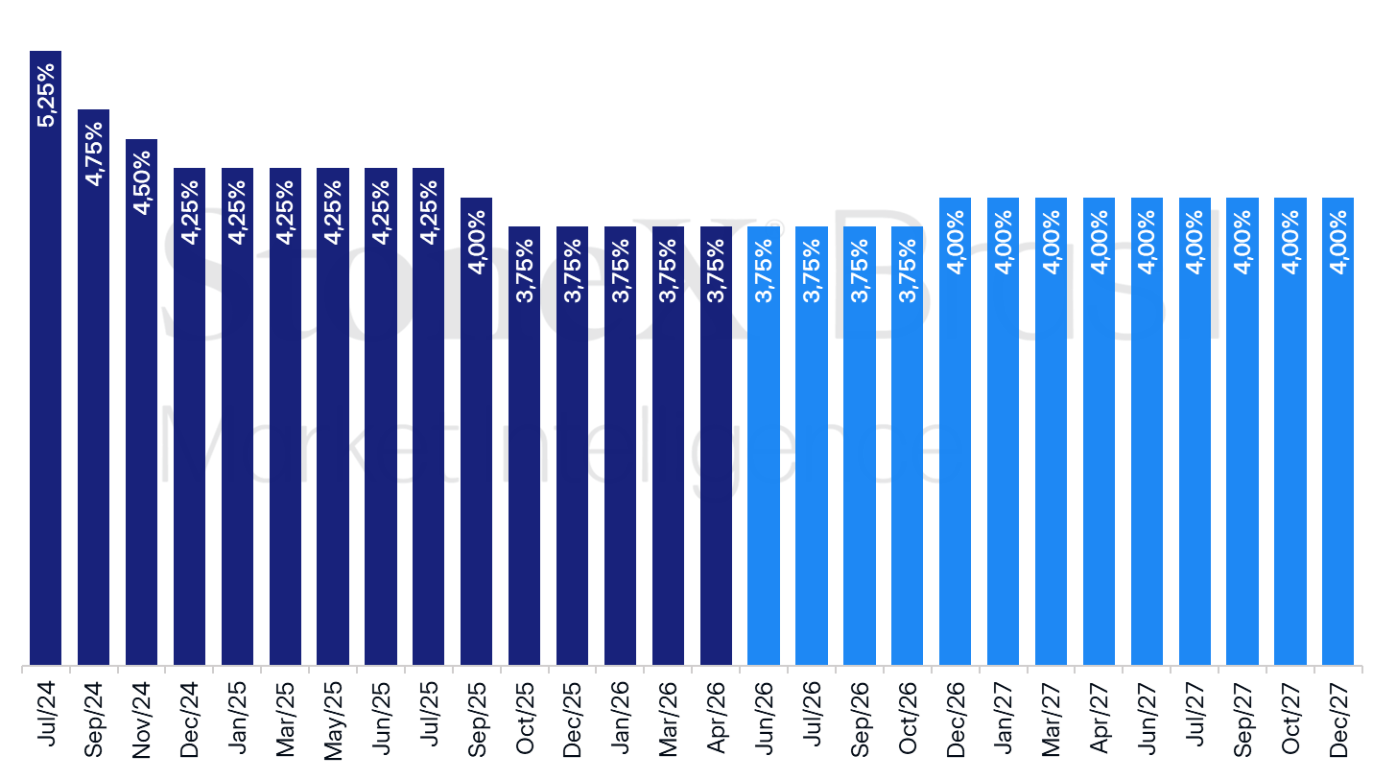
Source: CME FedWatch Tool. Design: StoneX. Refers to the highest probability bet in the futures interest rate market on the indicated date.
The foreign exchange market is expected to react to the release of US economic data amid growing concern about inflationary pressures in the country.
Why this matters: More persistent and widespread inflation in the US results in expectations of higher interest rates for longer, favoring the yield on US Treasury bonds and contributing to the attraction of external resources, strengthening the dollar globally.
Estimates for PCE: The median estimates for the Personal Consumption Expenditures (PCE) Price Index point to an increase of 0.3%, compared to 0.5% in March, and to a new growth of 0.3% in its core measure, which excludes the most volatile food and energy components.
Inflationary risks: Previously, the core Consumer Price Index (CPI) accelerated by 0.4% in April, above the median estimate of 0.3%, while the core Producer Price Index (PPI) accelerated by 1.0% in the same month, well above the median estimate of 0.3%.
- These figures showed that inflationary pressure caused by the closure of the Strait of Hormuz and fears of a global oil supply shortage spread more rapidly beyond energy prices, mainly due to increased freight costs.
- Additionally, there are signs of inflationary pressures stemming from the global semiconductor shortage, driven by the rapid acceleration in infrastructure investments related to artificial intelligence.
No room for interest rate cuts: Amid this inflationary challenge, investors have reversed their bets on the Federal Reserve's next interest rate move, shifting from anticipating a cut to predicting a hike.
- In this context, the minutes of the latest Federal Open Market Committee (FOMC) decision showed growing concern among its members about inflationary risks and thus reinforced expectations for higher interest rates for longer in the US.
In the words of the minutes: “Almost all participants [of the FOMC] observed that (...), even after the end of the conflict [in the Middle East], oil and other commodity prices could remain elevated for longer than anticipated.”
- Almost all participants predicted “continued upward pressure on inflation stemming from supply chain disruptions, high energy prices, or passing higher input costs to other prices” if crude oil prices remain high.
- “The vast majority noted a greater risk that inflation would take longer to return to 2% than previously forecasted.”
- “The majority highlighted that some tightening of monetary policy would likely become appropriate if inflation continued persistently above 2%.”
- “Many would have preferred to remove language from the post-meeting statement suggesting a bias toward monetary easing.”
Economic activity: Investors are also expected to react to the release of indicators on US economic activity, which should continue to expand and suggest that there is no need for Fed interest rate cuts in the short term.
- The median estimates for the second preview of the US Gross Domestic Product (GDP) are that it maintains its annualized growth of 2.0% in the first quarter.
- The median estimates for Personal Consumption Expenditures point to a 0.6% increase in April, after 0.9% growth in March.
Geopolitical tensions in the Middle East
Expected impact on the BRL exchange rate: bullish
Ship movements in the Strait of Hormuz (seven-day moving average)
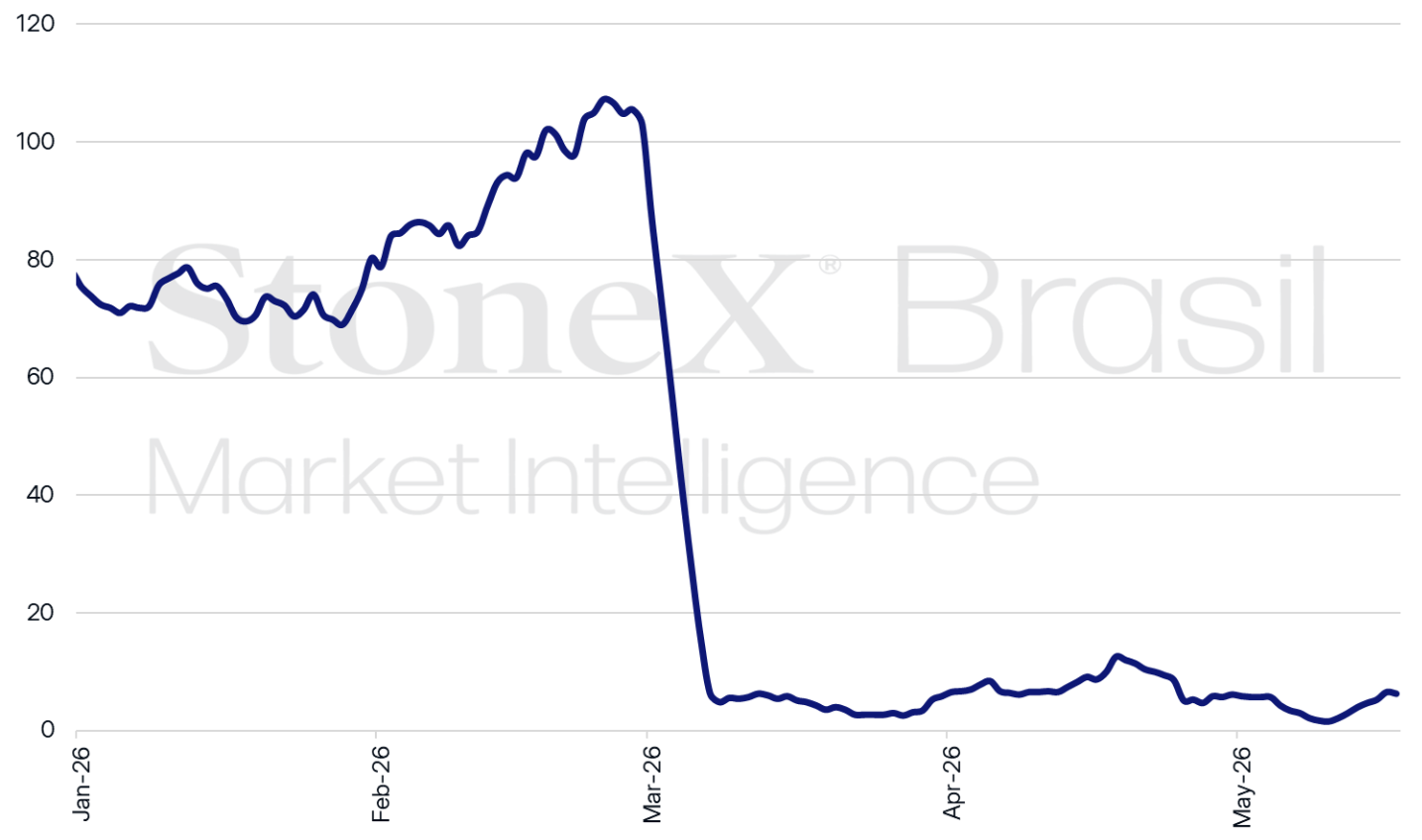
Source: IMF PortWatch. Design: StoneX.
The back-and-forth over a possible preliminary agreement between the US and Iran is expected to remain on investors’ radar. The current climate of uncertainty, with conflicting information about possible advancements or setbacks, generated volatility and fluctuations last week.
- Last week, it was reported that the countries were optimistic and close to a preliminary agreement. However, simultaneously, news emerged that Iran’s supreme leader, Mojtaba Khamenei, did not authorize the removal of enriched uranium from the country, one of Washington's demands.
- In this context, the lack of clear signals regarding the state of negotiations keeps perceptions of geopolitical risks high in financial markets.
Why this matters: The lack of clear signals about the progress of negotiations and possible normalization of flows in the Strait of Hormuz tends to increase risk perceptions among investors and harm the performance of risky assets, such as the real.
- On the other hand, an announcement about new diplomatic advancements could rekindle investors’ appetite for risk, something that seems unlikely in the short term.
Statements from Washington: The latest statement is from the US Secretary of State, Marco Rubio, who said he sees progress in the negotiations but that “we’re not there yet.”
- On the other hand, throughout the week, President Donald Trump alternately stated that the negotiations were in their “final phase” and threatened to resume attacks if the negotiations did not progress, raising doubts about the actual state of the negotiations.
Statements from Tehran: On Iran’s side, news reported that Iran’s supreme leader, Mojtaba Khamenei, had determined that enriched uranium must remain in the country, contradicting a sensitive demand from the Americans.
- Additionally, other reports stated that Iran was negotiating with Oman to create a permanent toll for navigation in the Strait of Hormuz, contradicting another sensitive demand from the US.
Possible agreement between the countries? The latest information about a possible truce between Washington and Tehran involves a preliminary agreement for the complete opening of the Strait of Hormuz while the countries discuss other topics.
- However, there has been no confirmation of this possible agreement.
- In this context, the lack of clear information has created doubt among investors.
- Additionally, the apparent lack of alignment on some topics considered sensitive by the countries, such as the permanence of enriched uranium in Iran and the charging of tolls in the Strait of Hormuz, is expected to reduce investor optimism about possible new advancements, though it does not seem impossible.
Economic data in Brazil
Expected impact on the BRL exchange rate: bearish
Investors are expected to react to the release of economic data for Brazil, seeking to calibrate expectations for the trajectory of the benchmark interest rate (Selic).
Why this matters: The prospect of more persistent and widespread inflation in Brazil tends to reduce investors’ bets on interest rate cuts by the Central Bank.
- This, in turn, would increase the yield on domestic bonds and favor the attraction of foreign capital, strengthening the BRL.
Estimates for GDP and inflation: The Brazilian economy is expected to continue showing a modest growth trajectory. After a 0.1% growth in the fourth quarter, the median estimates for Brazil’s Gross Domestic Product point to a 0.2% increase in the first quarter of 2026.
- The median projections for the IPCA-15 point to a 0.57% increase in May, after a 0.89% expansion in April.
- The data point to significant inflationary pressures due to rising international oil and derivative prices.
- Last week, the Central Bank President, Gabriel Galípolo, commented that the oil shock raised market agents’ inflation expectations up to 2028, highlighting the challenge faced in stabilizing prices in the country.
- On the other hand, he noted that the economy continues to show resilience, especially in the labor market.

INDICATORS
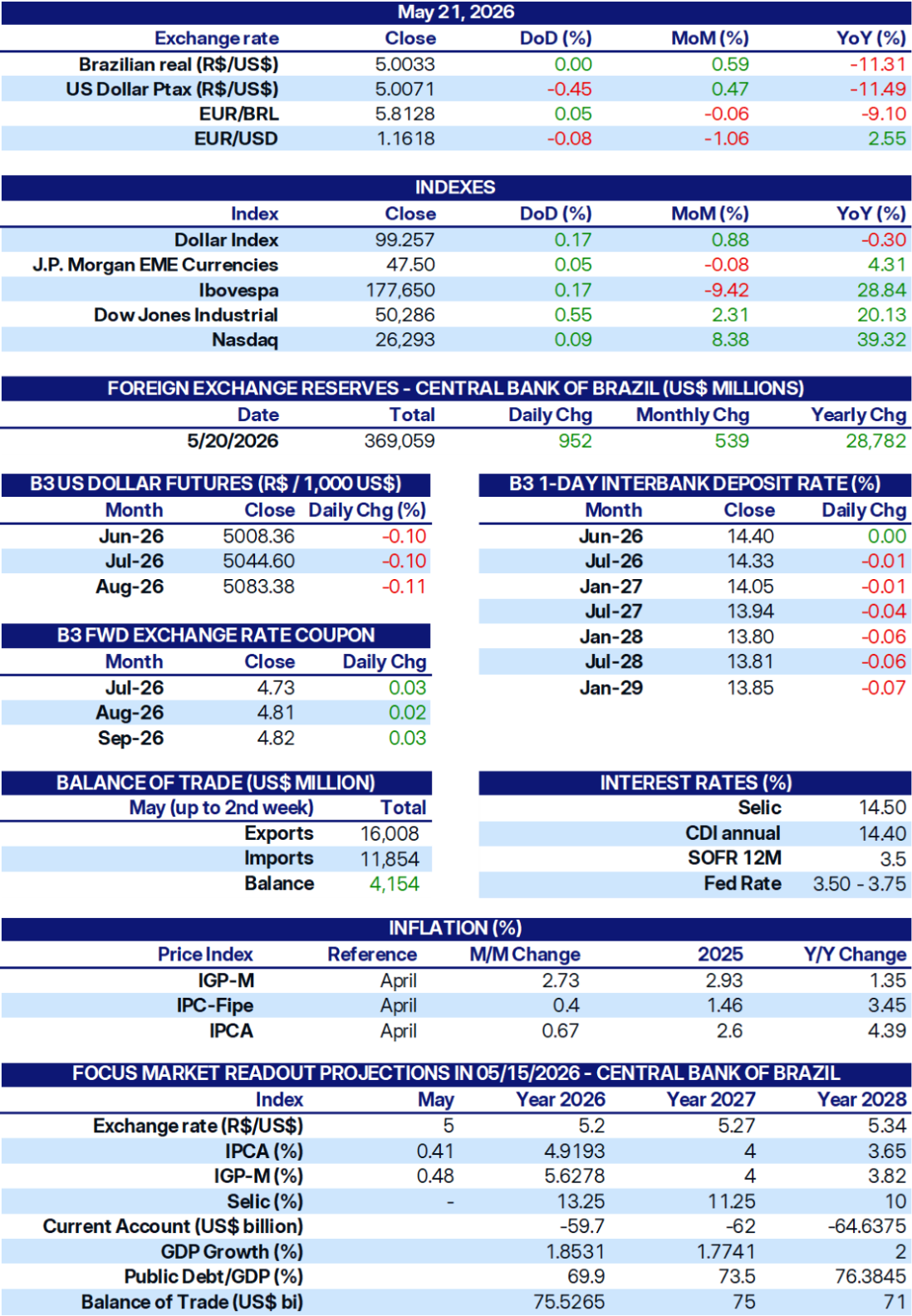
Sources: Central Bank of Brazil; B3; IBGE; Fipe; FGV; MDIC; IPEA and StoneX cmdtyView.