FX Weekly Overview: The week's main events
- Bearish factors
- A mild rise in the PCE Index should reinforce readings of a “soft landing” of the US economy and increase bets of interest rate cuts by the Federal Reserve, weakening the dollar.
- Expectations of greater alignment in the speeches of members of Brazil's Central Bank may help to reduce the perception of risks for domestic assets and contribute to the strengthening of the Brazilian real.
- Moderation of the August IPCA-15 in Brazil may reduce fears about the country's inflationary performance and contribute to a reduction in investors' demand for risk premiums, strengthening the BRL.
- Bullish Factors
- The breakdown of Brazil's 2025 budget will be accompanied by projects to increase tax revenue and could fuel fears that the Executive Branch may not be able to balance the public accounts, which would result in a greater perception of fiscal risks and could weaken the Brazilian real.
The week in review
The week was marked by strong volatility in the exchange rate, caused by a fluctuating appetite for risk among investors both in Brazil and abroad. Internationally, the mood fluctuated between strong pessimism, after a periodic review of US labor market figures reduced the number of employees by 818,000, and strong optimism, after the minutes of the Federal Reserve's latest decision and a speech by its chairman, Jerome Powell, clearly signaled an interest rate cut for September. In Brazil, ambiguous statements by Central Bank authorities about the path of the basic interest rate (Selic) generated a perception of misalignment among its members and encouraged a more cautious stance among financial market agents.
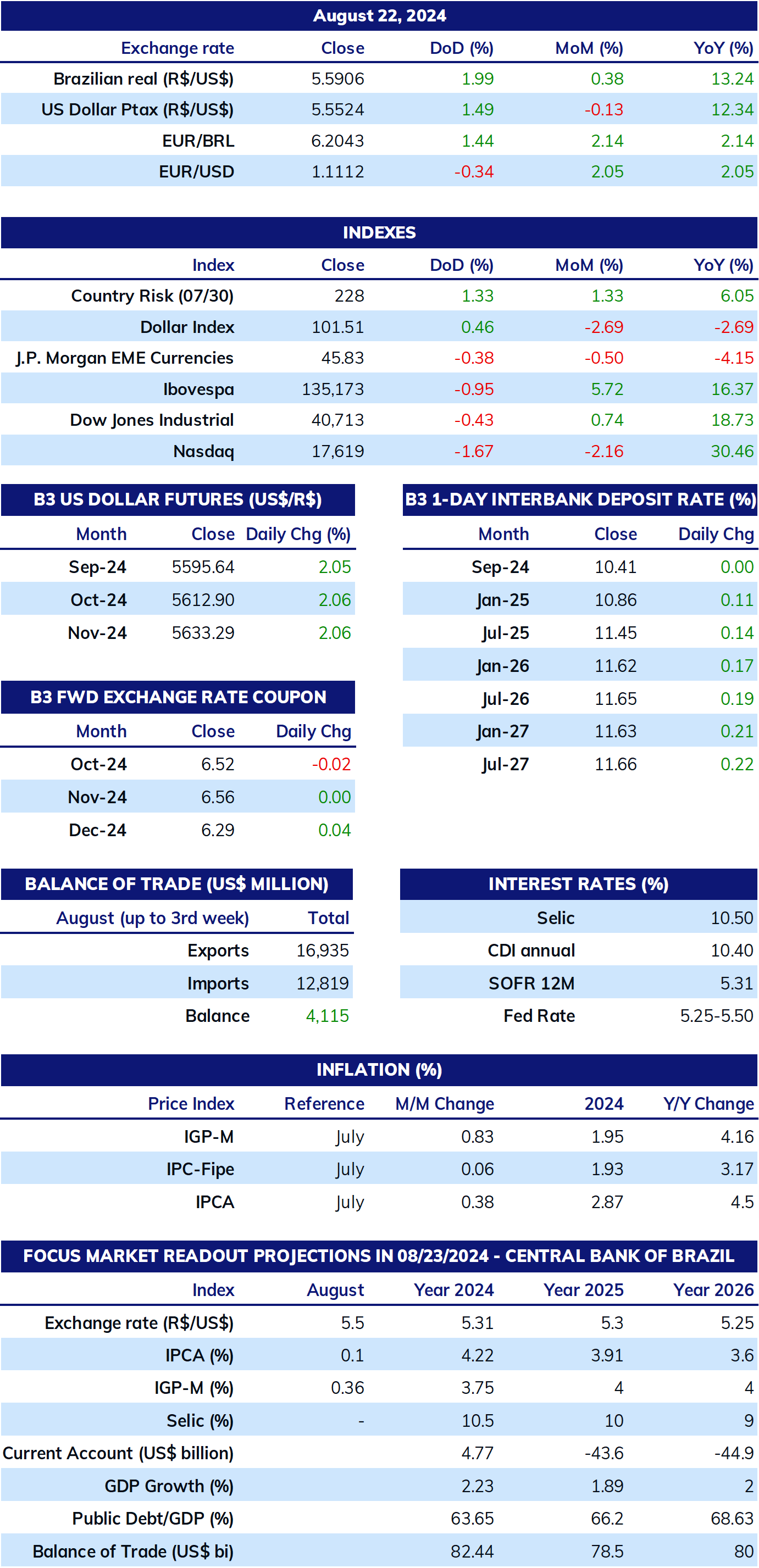
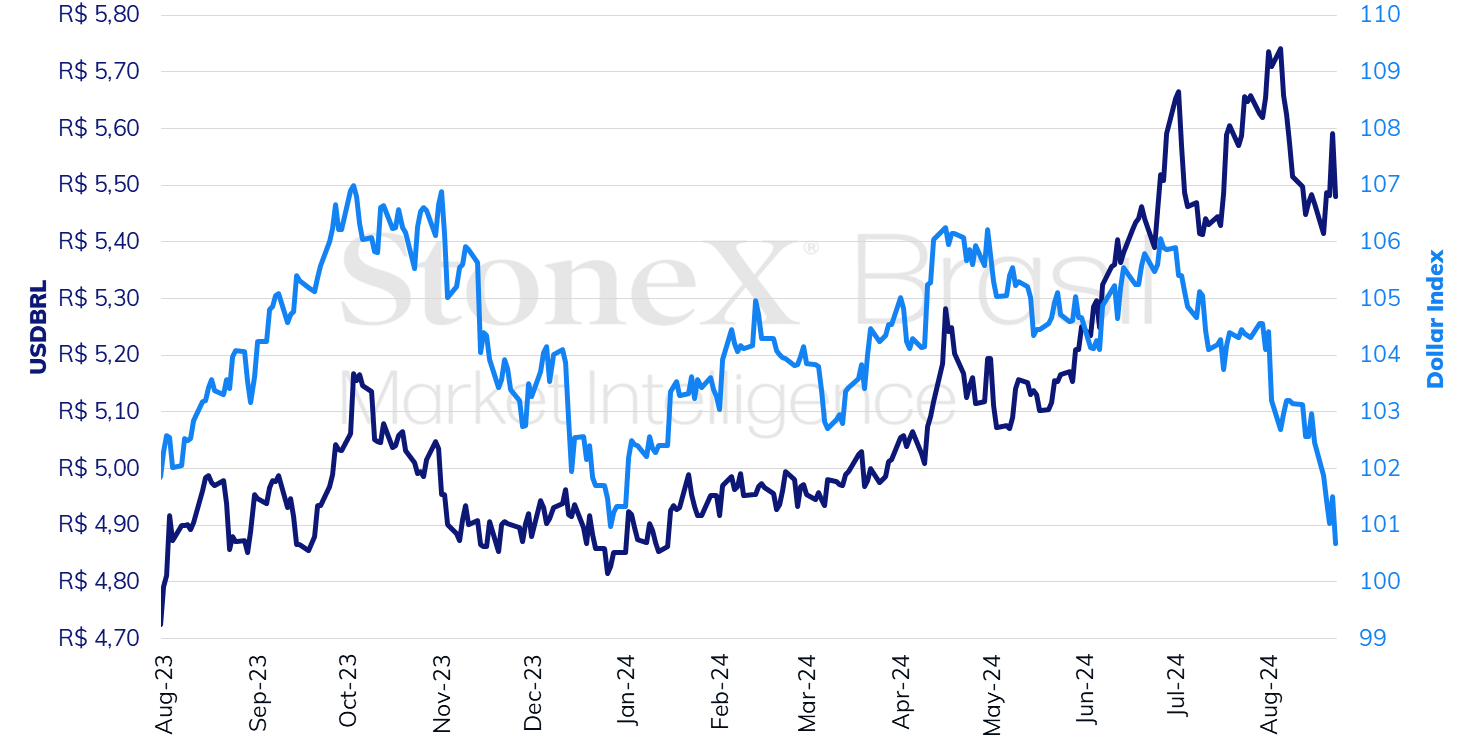
The dollar traded on the interbank market ended the week down, closing this Friday's session at BRL 5.4795, a variation of +0.2% for the week, -3.1% for the month and +12.9% for the year. The dollar index closed Friday's trading session at 102.67 points, down 1.8% for the week, 3.3% for the month and 0.7% for the year.
USDBRL and Dollar Index (points)
Source: StoneX cmdtyView. Design: StoneX.
KEY EVENT: Inflation in the US
Expected impact on USDBRL: bearish
The July Personal Consumption Expenditure Price Index (PCE) in the US is expected to perform similarly to the Consumer Price Index (CPI), with a monthly rise of 0.2% in both the full indicator and its core, which excludes the volatile food and energy components. This reading is compatible with an interpretation of a “soft landing” of the economy, with gradual and consistent moderation of inflation along with a slight slowdown in productive activity and the labor market. Last week, investors consolidated their bets on a rapid cycle of interest rate cuts by the Federal Reserve (Fed), expecting eight reductions (-2.00 p.p.) in eight meetings, after clear signals that the Fed should make a cut in its next decision, in September, both in the minutes of the last meeting of the Federal Open Market Committee (FOMC) and in the speech by its chairman, Jerome Powell, at the Jackson Hole Economic Symposium. Therefore, if the estimates are confirmed, the PCE reading should reinforce the prospect of a decrease in US interest rates and contribute to a global weakening of its currency.
US: Interest rate history and expectations - August 23, 2024
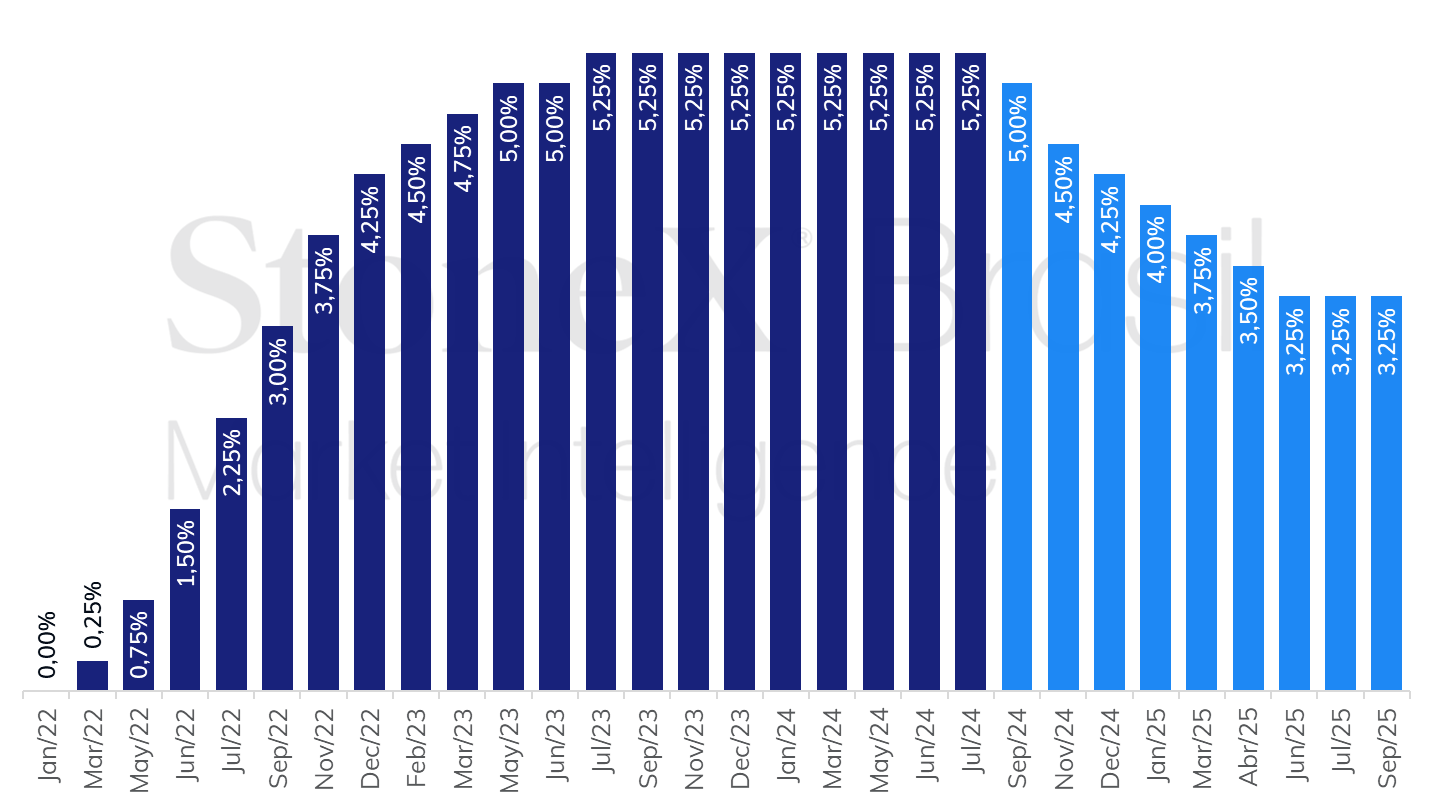
Source: CME FedWatch Tool. Design: StoneX. Refers to the most likely bet on the interest rate futures market on the date indicated.
Communication from the Central Bank
Expected impact on the USDBRL: bearish
Last week, the BRL/USD exchange rate fluctuated widely, with an intraday low of BRL 5.3780 and a high of BRL 5.5956, largely driven by a perception of misalignment and ambiguity in the statements made by members of Brazil's Central Bank, which, in turn, ended up increasing investors' uncertainties and resulted in increased risk perception of Brazilian assets. Two weeks ago, firmer statements from the director of Monetary Policy, Gabriel Galípolo, helped strengthen the Brazilian real by highlighting the “discomfort” with the rise in inflation and interest rate expectations in the country, suggesting to investors a possible rise in the basic interest rate (Selic) in the short term. Last week, however, there was an opposite movement after the Central Bank's president, Roberto Campos Neto, the director of Economic Policy, Diogo Guillen, and Galípolo himself suggested greater doubt for the Selic's trajectory, indicating a less “uncomfortable” reading. Campos Neto, for example, said that “there are divergent opinions in the group [Monetary Policy Committee] about the balance of risks” and that “economists are not predicting a rise [in interest rates] this year, but the market is. It is important to be calm and cautious at times of high volatility”. The perception is of misalignment and ambiguity in the statements made by Copom members. As such, the communication of the institution's members, especially that of its president at events on Wednesday (28) and Friday (30), will be crucial in trying to realign investors' expectations regarding the trajectory of the Selic rate and therefore contain the loss of credibility of monetary policy and reduce the demand for risk premiums for national assets.
Inflation in Brazil
Expected impact on the USDBRL: bearish
In a week full of domestic indicators, the highlight was the release of the National Broad Consumer Price Index 15 (IPCA-15) for August, which is expected to have slowed its rise from 0.30% in July to 0.20% this month. The index is expected to show a drop in food and electricity prices as opposed to a rise in fuel prices. If the forecast is confirmed, the accumulated increase over 12 months should fall from 4.45% to 4.36%, slightly easing fears of a return to inflationary pressures in the country.
Brazilian fiscal policy
Expected impact on the USDBRL: bullish
This week, the conduct of fiscal policy also comes back into focus due to the deadline for the Executive Branch to send the 2025 Annual Budget Bill (PLOA) to Congress on Friday (30). The bill and a press conference by the Government's economic team are scheduled for that day. It is worth remembering that the steady deterioration in the credibility of Brazil's fiscal and monetary policies began on April 15, when, in submitting the Budget Guidelines Bill (LDO), the federal government relaxed the proposed targets for the years between 2025 and 2027. Last week, Finance Minister Fernando Haddad said that the government would be submitting bills to raise taxes on Interest on Equity (JCP) and Social Contribution on Net Profit (CSLL) together with the PLOA. The two measures were not accepted by the Federal Senate to compensate for the payroll tax exemption this year, but, according to the minister, they may be necessary for 2025 and will therefore be included in the budget. In addition to the budget for next year, the week will also include consolidated fiscal statistics for July, detailing income, expenditure and public debt for that month.

INDICATORS