FX Weekly Overview: The week's main events
- Bearish drivers
- Moderate rise in US employment may reinforce perception of “soft landing” of its economy and contribute to global appetite for risk, which would favor the Brazilian real.
- Brazilian GDP growth in the second quarter should maintain a scenario of “discomfort” for the Central Bank and consolidate bets of a rise in the basic interest rate (Selic), strengthening the BRL.
- Bullish drivers
- An environment of stress and skepticism among investors about the conduct of fiscal and monetary policies in Brazil could keep the demand for risk premiums high and contribute to the weakening of the Brazilian real.
- The breakdown of the 2025 budget could fuel fears that the Executive Branch will tighten control of public accounts, which would result in a greater perception of fiscal risks and weaken the BRL.
Last week in review
The week was marked by a notable weakening of the Brazilian real, which led to two consecutive interventions by the Central Bank on Friday (30). The currency's performance was influenced by investor fears over the conduct of Brazilian monetary and fiscal policies and by technical factors, such as a larger outflow following a rebalancing of the EWZ iShares MSCI Brazil index. Abroad, the dollar also strengthened after US GDP and inflation data reinforced the perception of a “soft landing” in the economy.
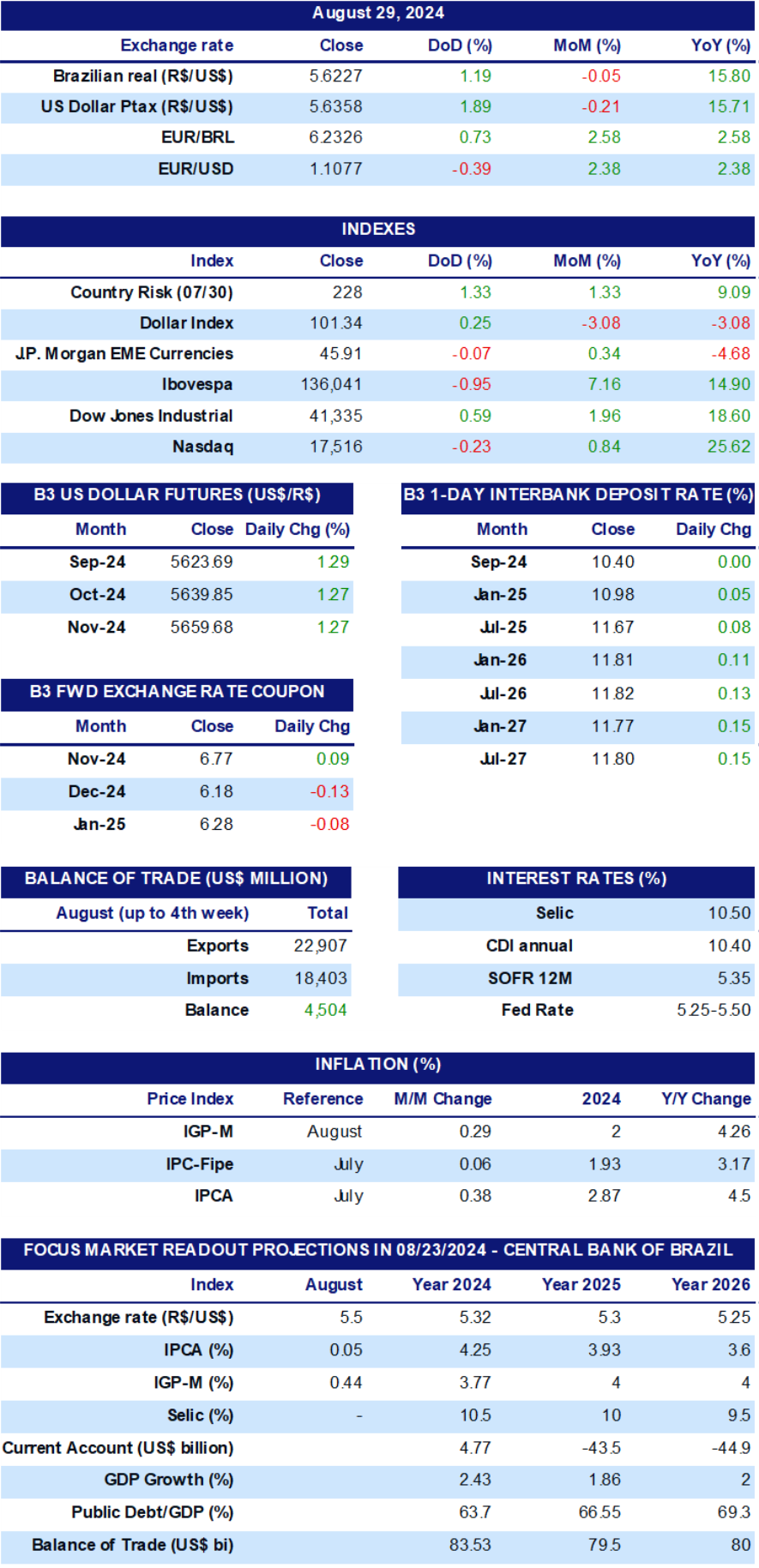
The dollar ended the week higher, closing Friday's (30) session quoted at BRL 5.6363, a change of +2.8% for the week, -0.3% for the month and +16.2% for the year. The dollar index closed Friday's trading session at 101.7 points, up 1.0% for the week and 0.3% for the year, but down 2.3% for the month.
USDBRL and Dollar Index (points)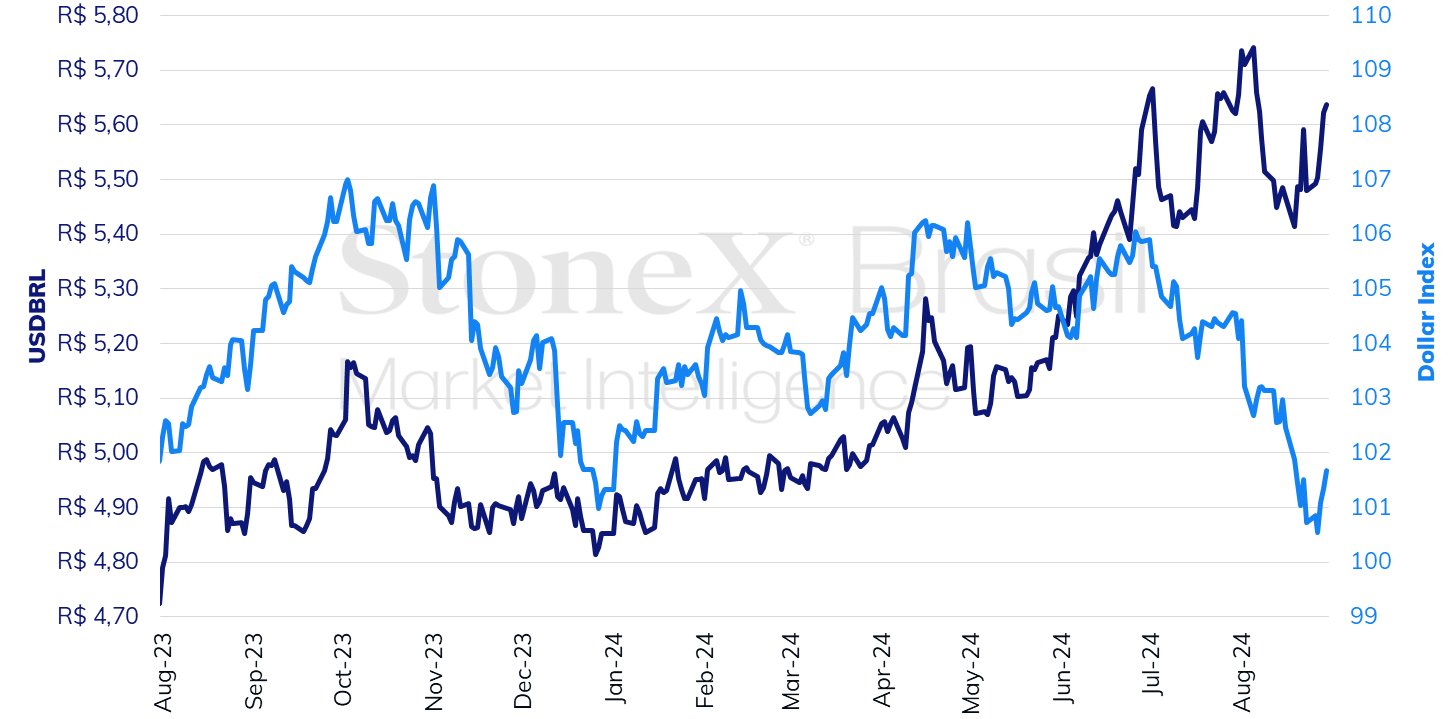
Source: StoneX cmdtyView. Design: StoneX.
KEY EVENT: Volatility of the BRL and the Central Bank's actions
Expected impact on USDBRL: bullish
The focus of attention in the coming week should remain on the performance of the exchange rate, which rose consistently over the past week. Last Friday (30), the Brazilian currency showed strong volatility, fluctuating between BRL 5.5756 and BRL 5.6926, and ended the trading session with the Brazilian real weakening even after two interventions in a row by the Central Bank, something that is fairly rare. The Central Bank sold USD 1.5 billion on the spot market and then issued another USD 765 million in currency swap contracts (15,300 contracts). On that day, before the announcement of the second intervention, the president of the Central Bank, Roberto Campos Neto, had said at an event that the monetary authority had identified an “atypical” currency flow during the week, probably influenced by the rebalancing of the EWZ iShares MSCI Brazil index, the main Brazilian ETF (Exchange Traded Fund) traded on the US capital market. Campos Neto had also warned that the Central Bank's aim was to act only in the event of “dysfunctionality”, i.e. when there is a disproportionate imbalance between offers to buy and offers to sell (bid and ask) and that “if we need to intervene further, we will do so”. As such, amid the sudden stress in the business environment and the worsening of future expectations, investors should remain attentive to communications from members of the agency and continue to monitor the possibility of new interventions in the foreign exchange market.
August Payroll
Expected impact on USDBRL: bearish
The release of lower-than-expected job creation figures for July, an unexpected rise in the unemployment rate, and a significant reduction in the number of people employed in the US after the annual periodic review showed that the US labor market is slowing down and losing momentum, which in turn generated fears that the US economy could be weakening faster than expected and led to a global decrease in risk appetite. These fears were reduced after data for production and inflation in the US suggested that the country's economy still remains healthy and resilient. As a result, investors will follow the release of labor market data in August in order to calibrate expectations for the country's economic performance and, consequently, for the trajectory of the US interest rate. The median estimate points to the creation of 165,000 jobs in the month, which would reinforce the interpretation of a “soft landing” for the country and favor the behavior of risky assets, such as stocks, commodities and currencies of emerging countries, like the Brazilian real.
Fiscal risks in Brazil
Expected impact on the USDBRL: bullish
Fears about Brazil's fiscal performance hampered the BRL's performance last week, and the issue may resurface again on Monday (02). The Ministry of Planning and Budget is expected to send the 2025 Annual Budget Bill (PLOA) only on the evening of the 30th (the legal deadline is midnight on Saturday the 31st), postponing the press conference until 11am (Brasília time) on Monday the 2nd. Despite several statements by authorities seeking to emphasize that the 2025 Budget will be “compatible” with meeting the targets stipulated by the fiscal framework, investor concern about the details and projections of expenses, revenues and public debt remained high throughout the week and worsened after the announcement that the public sector's primary deficit in July was worse than anticipated, at BRL 21.3 billion. Also on Friday (31), the Executive Branch sent bills to Congress proposing an increase in income tax rates levied upon interest on own capital (JCP) and the Social Contribution on Net Profits (CSLL), measures that should form part of the federal government's legislative effort to raise revenue by 2025.
2nd quarter GDP
Expected impact on USDBRL: bearish
Brazil's Gross Domestic Product (GDP) is expected to have accelerated its growth rate slightly, from a quarterly rise of 0.8% in the first quarter of 2024 to around 1.0% in the second quarter. If confirmed, the data should reinforce the perception of the economy's robust performance for the second consecutive quarter, surpassing initial expectations, with a boost from all categories of demand, such as personal consumption, business investment, and exports. Although most of the worsening in inflationary expectations can be attributed to a higher level of distrust among investors regarding the conduct of fiscal and monetary policies, the higher-than-expected dynamism of productive activity and the labor market contribute to keeping inflationary expectations higher in Brazil, as they represent the possibility of greater pressure on prices in the future. This, in turn, could contribute to the Monetary Policy Committee's “discomfort” and help to solidify bets of an increase in the basic interest rate (Selic) in its next decision, on September 18.

INDICATORS