Foreign Scenario
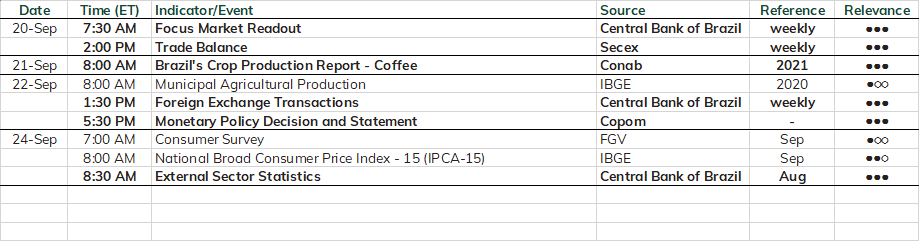
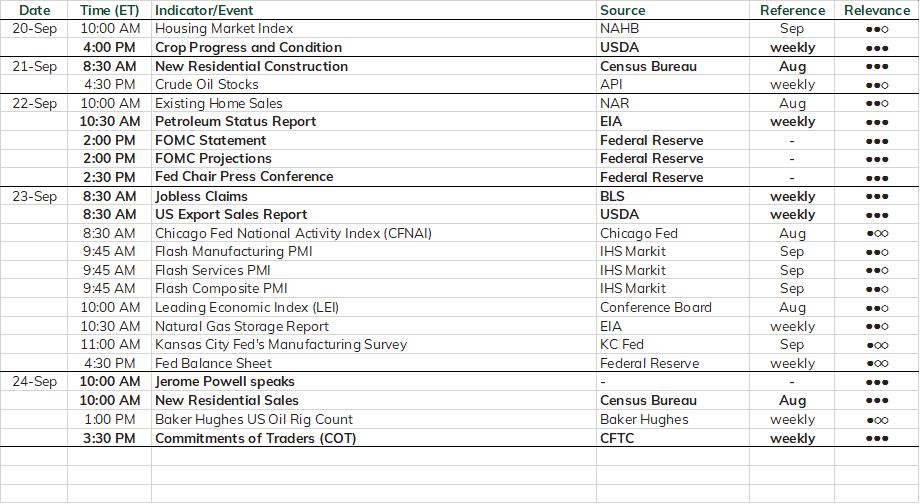
This week, the Federal Reserve's Federal Open Market Committee (FOMC) meeting should inspire caution in the international market. In addition, agents should monitor Jerome Powell's official statement on Wednesday (22) for clearer signs about when Fed's asset purchase program reduction will begin since recent mixed economic data did not show whether the "substantial progress" sought by the Committee for the activity level and employment would have been achieved before tapering.
On the one hand, lower than expected August consumer inflation, released last week, strengthens the thesis that the price acceleration is of transitory nature, with concerns about the advancing delta variant of Covid-19 in the United States, fuel bets that the tapering start will be postponed until the end of the year. On the other hand, still high producer inflation, better-than-expected results for the retail sector, and activity and employment indicators contribute to bets that monetary policy tightening may start at a closer moment.
In this context, the uncertainty of what will be discussed and decided in the FOMC meeting and the Copom in Brazil should promote a volatile week in the currency markets. The meeting will also include the disclosure of the collegiate members' quarterly projections for the American economy until 2024, which will allow a more detailed reading of the consensus - or dissent - among its members. Normally, the release of the projections and interviews and speeches to the press after the release of the monetary policy decision contribute to adjusting market expectations and estimates regarding the pace of recovery of the American economy in the foreseeable future.
Another factor of instability and search for safer assets is the crisis of the Chinese property developer Evergrande. According to Bloomberg, representatives of the Chinese Ministry of Housing and Urban-Rural Development (MOHURD) informed creditors that the property developer Evergrande should not pay interest on debt installments due on Monday (20), only the principal, evaluating, also, the possibility of extending deadlines or refinancing some of these loans. Last week, in a statement sent to the Hong Kong Stock Exchange, Evergrande said that although reports of its possible bankruptcy are unfounded, it is under "tremendous pressure" and that there are no guarantees that it will be able to meet its financial obligations. In total, China's second-largest property developer has a debt of over USD 300 billion, making it one of the most indebted companies in the world. The company's complex web of debts to banks, bondholders, suppliers, and homeowners has become one of the main risks to China's financial system. Analysts fear the contagion effect that could be caused if the developer goes bankrupt. On September 17, seeking to calm market sentiment, the People's Bank of China (PBoC) injected 50 billion yuan (approximately USD 7 billion) with seven-day reverse contracts and another 50 billion yuan with 14-day contracts, which had not been used since February.
Domestic Scenario
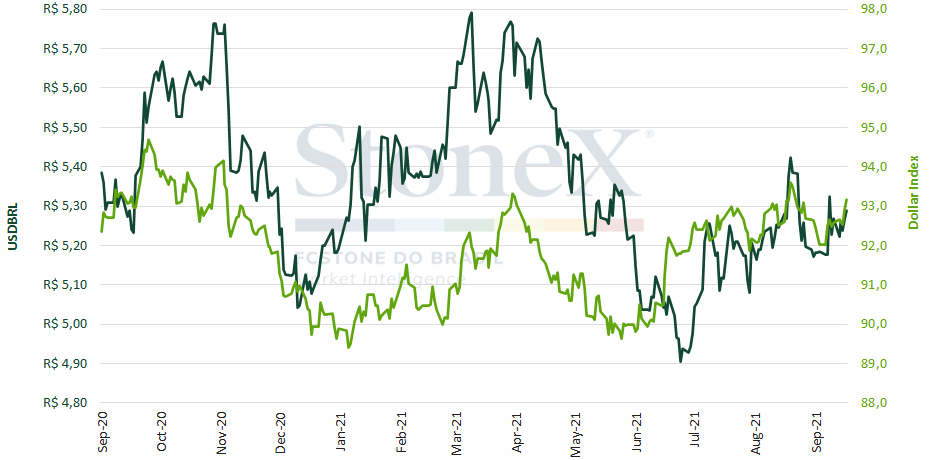
The real/dollar pair appreciated on Monday, ending the day at BRL 5.329, an increase of 0.8% compared to Friday's close (17). The foreign exchange market reflected caution and a global search for safer assets due to the possibility of the Chinese property developer Evergrande failing to pay some of its financial obligations or, worse, declare bankruptcy.
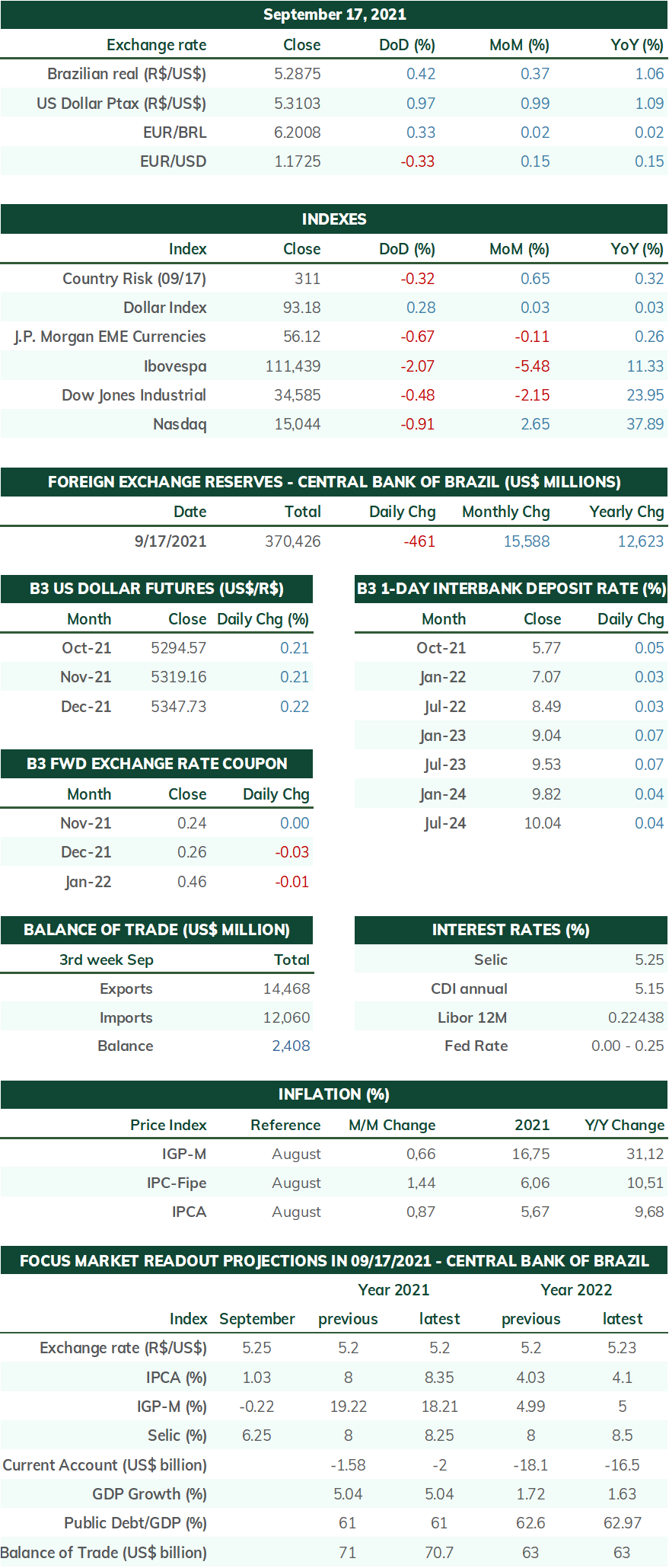
This week, there is a great expectation about the Monetary Policy Committee (Copom) decision about the benchmark interest rate (Selic) due to the increase in price levels. According to the Focus Bulletin published earlier this Friday, the median of economists' projections consulted by the Central Bank of Brazil started pointing to the IPCA at 8.35% at the end of 2021, up from 8.00% a week earlier and 7.11% last month. Furthermore, according to the Brazilian Institute of Geography and Statistics (IBGE), the extended consumer price index (IPCA) accumulated in 12 months for August 2021 registers an acceleration of 9.68%. For the period, the highlights were the increase in automotive fuels (+41.33%), electrical energy (+21.08%) and domestic fuels, such as LPG (+30.22%).
Given the prospect of persistent inflation, analysts have once again revised their expectations for the next Copom decisions for the Selic rate. Since last week, the projection for the benchmark interest rate at the end of the year has been raised to 8.25%, which would be reached by a sequence of three adjustments of one percentage point in the September, October and December meetings. Last week, the Central Bank of Brazil's president (BC), Roberto Campos Neto, stated that the monetary authority would do whatever is necessary to converge inflation rates with the autarky's targets "within the relevant horizon," and anticipated that the BC would carry out foreign exchange interventions at the end of this year, due to the seasonal flow in the period. Campos Neto also stated that the perception of fiscal and political risks raised the risk premium demanded by the agents and, consequently, influenced the exchange rate.
This week, the judiciary bonds subject and the government's commitment to fiscal responsibility, in general, remain in the spotlight. Last week, Brazil's President, Jair Bolsonaro, issued a decree raising the rate of the Tax on Operations of Credit, Exchange and Insurance (IOF), both in credit operations carried out by companies (from the current annual rate of 1.50% to 2.04%), and for individuals (from the current annual rate of 3.0% to 4.08%). This increase takes effect from September 20 to December 31, 2021, and will generate an expected increase in tax collection of BRL 2.14 billion, according to a note from the Presidency's General Secretariat. "This amount will allow the expansion of the amount allocated to the Auxílio Brasil social program, whose new value will come into force in 2021. The measure will directly benefit about 17 million families and is intended to mitigate part of the harmful economic effects caused by the pandemic," says the note.
This decision to raise the IOF tax to finance the increase of the Auxílio Brasil benefit in 2021 comes after the disclosure that Bolsonaro's assessment is at its worst levels since the beginning of his government. However, funding sources for 2022 depend on the Annual Budget bill approval and are hindered by discussions with the other powers. The main proposal of the Ministry of Economy was the proposed constitutional amendment (PEC 23/21) that would allow the payment in ten annual installments of certain judiciary bonds and their payment with extraordinary funds, which would be accounted for outside the spending cap. The judiciary bonds are payment requisitions issued by the courts after final defeats suffered by the government in lawsuits. However, the articulation of the government's economic team was seriously affected after the president's speeches during the anti-democratic demonstrations on the Independence Day of Brazil on September 7.
On August 16, the economic team sent to Congress the PEC of judiciary bonds. According to the proposal, until 2029, judiciary bonds worth more than 60,000 minimum wages, or BRL 66 million, can be paid with a 15% down payment followed by nine annual installments. In addition, it allows the creation of a fund of extraordinary revenues for the settlement of these debts, which would be accounted for, due to its extraordinary nature, outside the government's spending cap. However, the measure was widely criticized by market analysts, who stated that the government would not be committed to fiscal stability when seeking an alternative to not paying its due commitments, even more so with the possibility of circumventing the spending cap. Furthermore, the savings foreseen with the PEC, of approximately BRL 35 billion, would be destined to another expense, increasing the Auxílio Brasil benefit. In late August, the president of the STF, Minister Luiz Fux, began to articulate a solution through the National Council of Justice (CNJ) that would limit the payment of such debts in 2022 according to the same dynamics of the spending cap rule, i.e., government debts could not grow more than the inflation measured by the IPCA in the 12 months to June of the previous year. Fux also chairs the CNJ. According to Reuters, the formal proposal is that the calculation basis is retroactive to 2016, when the ceiling rule came into force, which would lead the maximum payment of judiciary bonds in 2022 to about USD 40 billion, a cut of USD 49.1 billion from the USD 89.1 billion expected for next year. On August 31, Fux and the presidents of the Chamber and Senate, Arthur Lira (PP-AL) and Rodrigo Pacheco (DEM-MG), met to advance the legal text of the proposal.
However, after Bolsonaro's aggressive statements at the September 7 protests, Fux has indicated that he will no longer cooperate with the government. During a speech last week, Economy Minister Paulo Guedes stated that the government would "work [both] through the Judiciary, [and] through the Legislative" in the search for an alternative to the judiciary bonds in 2022. Fux argued, however, that the judiciary must develop the passive virtue of not getting involved in matters that did not concern it and ironized that "Guedes is such a friend that he puts the son that is not mine in my lap. Guedes, on the other hand, emphasized that it was "only a desperate cry for help. In no way put the son, the responsibility, in your lap. It's just that when we are desperate, we run to the Presidents of the Powers asking for protection".
Putting an end to the alternative via CNJ, the president of the Chamber of Deputies, Arthur Lira (PP-AL), articulated so that PEC 23/21 had its opinion on the admissibility of the proposal approved by the Chamber of Deputies' Commission on Constitution, Justice and Citizenship (CCJC). Last Thursday (16), there were 32 votes in favor and 26 against it. Commenting on the measure, the special secretary of the Treasury and Budget, Bruno Funchal, said the government will resolve the uncertainties related to judiciary bonds and the funding of the Bolsa Família for the 2022 Budget within 30 days.