Foreign scenario
After much negotiation, Democrats and Republicans reached an agreement to expand the government's spending capacity and the public debt limit for a short term until early December. Both parties are aware of the fragility of the agreement and that an ideal alternative will be needed to finance the US government. Therefore, the negotiations restarted from this point on to avoid another disaster in December. The stalemate scenario has changed little with this agreement. The Democrats argue that this is a long-standing bipartisan tradition. Because of the fiscal stimulus for the recovery from the Covid-19 pandemic and other measures adopted under the Trump administration, the government needs a new extension to adjust the public budget. The Republicans, on the other hand, are resistant to approving the suspension of the public debt limit until December 2022 because they argue that the Democrats will use the measure to unilaterally approve their infrastructure stimulus package of up to USD 3.5 trillion over ten years. For the resolution to take effect, it must be passed in the House, where the Democrats have enough votes to pass the measure, and in the Senate, where 60 votes will be needed in an equally divided assembly of 50 Democratic and 50 Republican senators. There are no indications that ten Republican senators will support such a resolution. The Democratic senators requested Republicans not to use their filibuster, which would allow them to pass the spending capacity extension and the suspension of the debt ceiling with only 50 votes. However, Republican senators demand that the Democrats use budget "reconciliation," a bureaucratic maneuver, which takes one to two weeks to accomplish, and which can only raise (but not suspend) the government's debt ceiling temporarily.
President Joe Biden's party intends to use the budget reconciliation process. However, this process has bureaucratic limitations that limit it to a maximum of three annual reconciliations, one for each area of the budget – spending, revenue, and debt. The Democrats want to use it to pass the infrastructure and welfare bill, for which they have already released a budget of up to USD 3.5 billion for future "reconciliation." However, internal disputes in the party, more precisely the resistance of Joe Manchin and Kyrsten Sinema, senators with a more centrist position, have hindered the advancement of the president's economic agenda.
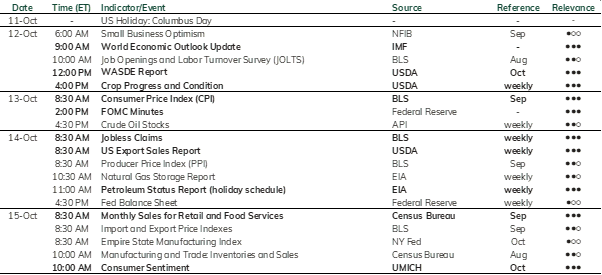
The foreign exchange market is awaiting the release of the Federal Open Market Committee (FOMC) monetary policy decision minutes to learn more about the Federal Reserve's (Fed) plan to start reducing its monetary stimulus, starting with its asset purchase program. The statement of the FOMC decision, as well as the press conference given by Fed Chairman Jerome Powell, suggests a reduction in the pace of asset purchases "soon." The minutes may provide further context on the debate among members about the appropriate speed of the cut in asset purchases. Some analysts believe that the Committee could begin this process as early as its next meeting in November. The US central bank is currently buying USD 120 billion of securities from market players, USD 80 billion of Treasury bonds and USD 40 billion in mortgage-backed securities monthly. Although it has only indicated that such a reduction will begin "soon," many analysts believe that the Fed should begin this cut as early as its next monetary policy meeting in November, reducing purchases of Treasury bonds by USD 10 billion and USD 5 billion in mortgage-backed securities. It will be interesting to see, also, if the minutes mention any debate about the US Central Bank raising interest rates, when these increases will start and the pace seen by the FOMC members.
This week, the foreign exchange market will follow the release of the Consumer Price Index (CPI) and the Producer Price Index (PPI), both in the United States. Finally, it is important to note the recent acceleration in the prices of energy commodities, such as oil and natural gas. Strong demand amid the post-pandemic economic recovery, coupled with a slow evolution of supply and, in the case of natural gas, low inventory volumes on the eve of the Northern Hemisphere winter, are driving a rapid increase in the prices of these inputs. Thus, global price levels are being pressured, forcing central banks in several countries to adopt restrictive monetary policies to contain inflationary acceleration, even though these policies may reduce economic growth in their respective countries.
Domestic scenario
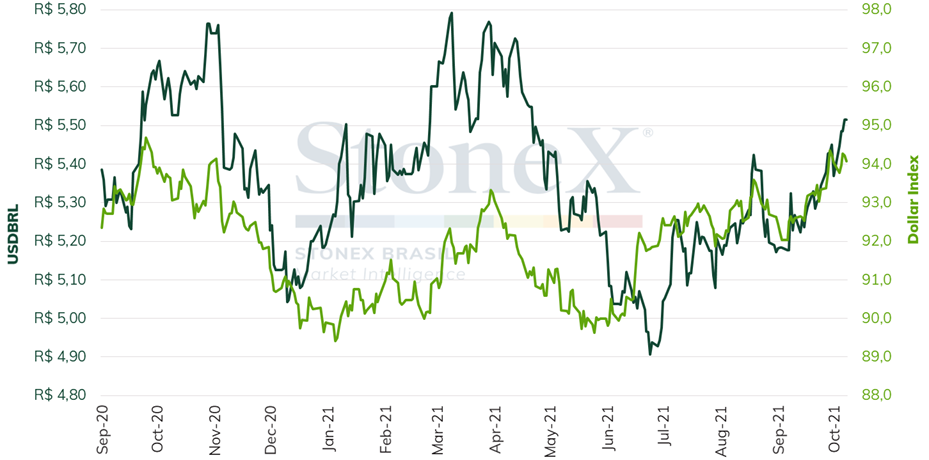
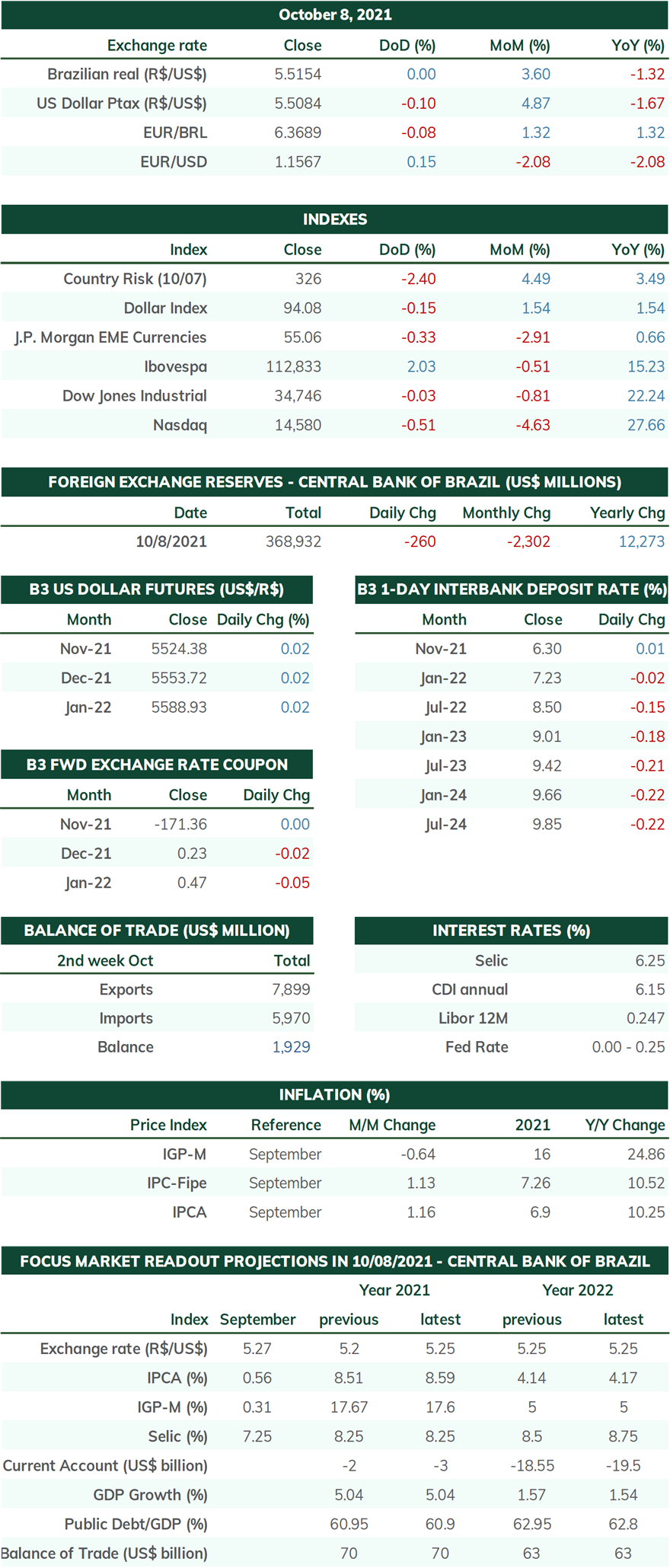
The USDBRL appreciated on Monday, ending the day at BRL 5.538, an increase of 0.4% compared to Friday's close (08). The foreign exchange market reflects the more cautious international scenario on a day marked by high prices of energy commodities abroad, but with a lower volume of transactions than usual due to a holiday in the United States and holiday eve in Brazil. It is noteworthy that the Chinese property developer Evergrande did not pay a dollar-denominated bond due on Monday to international creditors, the third case in three weeks. Under local rules, there is a 30-day grace period before a bond is considered in default, but the Chinese company appears to be very close to default.
Last week, Deputy Hugo Motta (Republicans-PB) presented his opinion for the proposed constitutional amendment (PEC) 23/21 to the Special Committee for the bill, which reformulates the payments of court orders. The judiciary bonds are payment requisitions issued by the courts after final defeats suffered by the government in lawsuits. The Committee's president, Deputy Diego Andrade (PSD-MG), has granted collective access to the opinion, which, in practice, postpones the vote on the proposal until Tuesday, October 19. The new text removed several aspects of the original proposal, such as the possibility of paying the judiciary bonds in installments, the possibility of settling judiciary bonds with a fund of extraordinary revenues – which, by its characteristic, would remain outside the spending cap – and the modification of the "golden rule," which tried to allow the government to pay current expenses through financing (debt).
According to this opinion, there would be the imposition of an annual limit for expenses with the settlement of legal debts recognized by the Union, obeying the same dynamics of the spending cap, i.e., the government debts could not grow more than the inflation measured by the IPCA in the 12 months to June of the previous year. The amounts exceeding this limit would prioritize payment in the following years, which will be subject to the same dynamics. Thus, within the framework of the approximately BRL 89 billion that the government has in obligations in 2022, only BRL 40 billion would be effectively paid, freeing up almost BRL 50 billion to finance other government priorities. One of the priorities of the Minister of Economy Paulo Guedes' economic team is to find alternatives in the 2022 budget to make it possible to increase the average benefit of the Auxílio Brasil income transfer program, which will replace Bolsa Família. One of President Jair Bolsonaro's main bets to improve his approval ratings before the 2022 election, Guedes estimated in late July that an increase in the benefit to BRL 300 would imply an additional cost "between BRL 25 billion and BRL 30 billion" for the public budget.
The Independent Fiscal Institution (IFI) of the Federal Senate released a commentary on the text of the rapporteur in which it concludes that this proposal "should produce an increase in the perception of risk by economic agents, with non-negligible effects on interest rates [Selic] and the average cost of public debt. The public accounts analysis body warned that the credibility of the government's fiscal policy is associated with its zeal for fiscal rules and that limiting the annual payment of debts recognized by the courts, with the postponement of the surplus, is to ignore the responsibility with the accomplishment to its commitments. "Court sentences, especially at the federal level, have always been taken as obligatory primary expenditures, which must be paid on demand," argues the institution. Furthermore, the commentary continues, making an exception for judiciary bonds at this time "may lead to discussions about [the deferral of] other obligatory expenditures, such as social security and personnel.
The IFI also criticizes that the justification for postponing judiciary bonds is precisely the financing of another mandatory expense. "Promoting changes that make it easier to observe the spending cap and increase the space for new expenses, especially in an election year" threatens "the transparency and logic of the spending cap."
It is also important to highlight that last week, the Brazilian Institute of Geography and Statistics (IBGE) showed that the Broad Consumer Price Index (IPCA) increased by 1.16% in September, the highest mark for the month since 1994. The price index has accumulated an increase of 6.90% year-to-date and 10.25% in 12 months. The last time the 12-month accumulated index registered double-digit inflation was in February 2016. Eight of the nine segments that make up the index showed an increase in the month - only Education showed a variation of -0.01%. Once again, the main component that pressured price levels was electricity (+6.47%). In September, the "water shortage" tariff flag went into effect, adding BRL 14.20 to the electricity bill for every 100-kWh consumed. Other administered prices which continued their acceleration were cylinder gas (+3.91%), ethanol (3.79%), gasoline (+2.32%) and diesel (+0.67%). Also worthy of note is the increase in airfares (+28.19%), even though its weight in the index composition is small. The expectation for inflation until the end of this year is to remain at a high level, given that Petrobras recently readjusted the value of diesel, gasoline, and cylinder gas (LPG) and that the "water shortage" flag remains in force until at least April.
The continuous acceleration of price levels is demanding a contractionary monetary policy on the part of the Central Bank, which has been increasing the basic interest rate (Selic) since February of this year, to contain these pressures on price levels. Currently, at 6.25%, the monetary authority has already indicated that it visualizes the maintenance of Selic rate readjustments until the beginning of next year in increases of one percentage point each. Furthermore, in its quarterly inflation report, the Central Bank describes inflation as "intense and disseminated," warning that the cycle of Selic hikes to tame it will affect activity next year.
Along the same lines, Petrobras, after 58 days without readjustment, raised the average price of gasoline and cooking gas at refineries by 7.2%. Year-to-date, Petrobras' gasoline prices have risen by more than 60%. In addition, diesel increased last week and accumulated an appreciation of more than 50%. The company said in a statement that the increase reflects the international levels of oil prices, "impacted by limited supply in the face of growing global demand," and the exchange rate, "given the dollar strengthening globally." According to the company, these adjustments "are important to ensure that the market continues to be supplied on an economic basis and without risks of shortages by the different players responsible for serving the various regions of Brazil.