Foreign scenario
Last week the International Monetary Fund (IMF) adjusted its forecast for world economic growth for 2021 and 2022. In the October update, the IMF visualizes that the world economy will grow 5.9% in 2021 (versus the estimate of 6.0% in March) and 4.9% in 2022 (versus 4.4% in March). The GDP growth forecast for Brazil was raised for 2021, from 3.7% to 5.2%, but reduced for 2022, from 2.6% to 1.5%. In the same week, the International Monetary and Financial Committee warned that central bankers should closely monitor the acceleration of global prices and take "decisive action to maintain price stability." In the Committee's view, the roots of the current inflationary growth are transitory, caused by pent-up demand, logistical bottlenecks, the upward cycle in food and energy commodity prices, and extreme weather events. IMF Chief Economist Gita Gopinath warned that monetary authority leaders must be prepared to act quickly if inflationary growth becomes too aggressive.
On Monday, the National Bureau of Statistics of China reported that the country's GDP advanced by 4.9% in the third quarter of this year compared to the same period last year, below the median of analysts' expectations, which pointed to a growth of 5.2%.
This was the first time that the country's quarterly GDP grew less than 5% a year, except for the first three quarters of 2020. The country's economic activity was impacted by electricity rationing, logistical bottlenecks and shortages of feedstocks, sporadic coronavirus outbreaks, and regulatory restrictions in some sectors, such as technology and real estate construction. Industrial production in the country was also up by only 3.1% in the quarter, the lowest result since March 2020, the start of the pandemic.
Domestic scenario
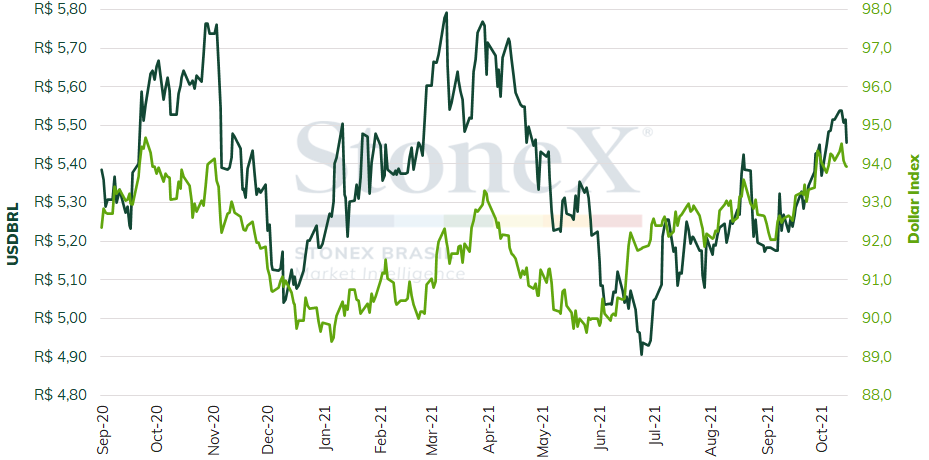
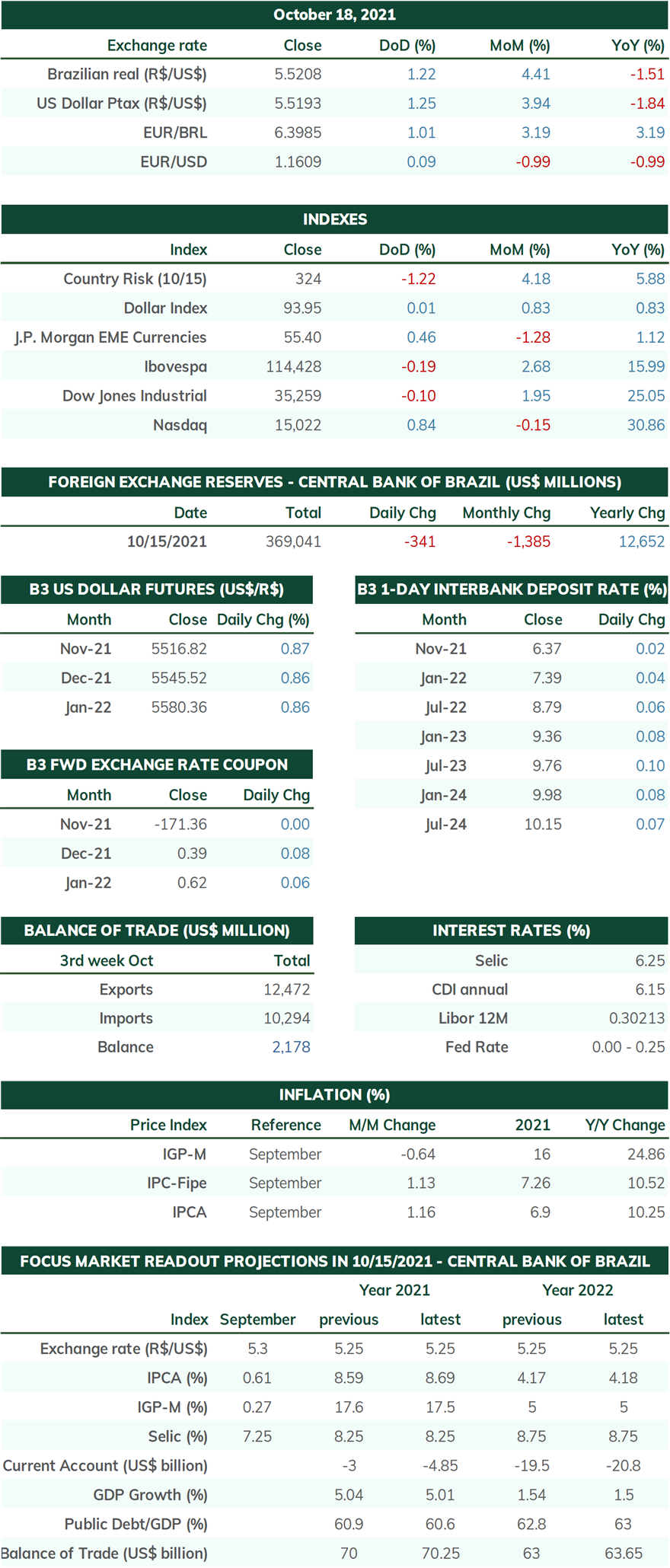
The USDBRL appreciated on Monday, ending the day at BRL 5.521, increasing 1.2% compared to Friday's close (15). Not even a fourth consecutive auction of traditional FX swap contracts to supply the dollar futures market managed to prevent the BRL depreciation amid a cautious international environment.
During the day, China reported GDP and industrial production growth below the market's expectations, raising uncertainties about the pace of global growth amid cost pressures and production imbalances.
The political agenda should guide the domestic scenario this week. Next Wednesday, the Special Committee for the proposed constitutional amendment of judiciary bonds (PEC 23/21) will vote on the opinion of the project made by congressman Hugo Motta (Republicans-PB). The judiciary bonds are payment requisitions issued by the courts after final defeats suffered by the government in lawsuits. In Motta's opinion, an annual limit would be imposed on expenses with the settlement of judicial debts recognized by the Union, following the same dynamics of the spending cap, i.e., government debts could not grow more than the inflation rate measured by the IPCA in the 12 months ending in June of the previous year. The amounts exceeding this limit would prioritize payment in the following years, subject to the same dynamics. Thus, within the framework of the approximately BRL 89 billion that the government has in obligations in 2022, only BRL 40 billion would be effectively paid, freeing up almost BRL 50 billion to finance other government priorities.
The President of the Chamber of Deputies, Arthur Lira (PP-AL), praised the proposal as "well consolidated" and said it should go to a vote in the House Plenary still this week.
However, this scenario of partial payment of Justice's obligations can create a cumulative problem for the creditors. A report in the newspaper Valor Econômico states that congressional experts estimate that the amount of postponed - and unpaid - judicial sentences may reach BRL 346.7 billion by 2030. However, the projection is "conservative," considering that only 10% of the debts above the annual spending limit for judiciary bonds will accept to immediately receive the amount due with a 40% discount in favor of the government.
One of the priorities of the Minister of Economy Paulo Guedes' economic team is to find alternatives in the 2022 budget to make it possible to increase the average benefit of the Auxílio Brasil income transfer program, which will replace Bolsa Família. One of President Jair Bolsonaro's main bets to improve his approval ratings before the 2022 election, Guedes estimated in late July that an increase in the benefit to BRL 300 would imply an additional cost "between BRL 25 billion and BRL 30 billion" for the public budget.
The government is also counting on the Federal Senate to approve the income tax reform still in October, releasing, in turn, more resources for the new program, namely through the tax on dividends. However, given the difficulty in moving forward with this reform in the Senate, the economic team and the government's allied base in Congress are seeking alternatives to increase the government's social policies and, fundamentally, the popularity of the President of the Republic. Last week, Arthur Lira mentioned again the possibility of extending the emergency aid to fight the pandemic together with a smaller adjustment of the Auxílio Brasil income transfer program. However, he characterized the project as "embryonic" in nature. One of the proposals discussed is to characterize the aid as temporary within 12 to 24 months. On Monday (18), President Jair Bolsonaro said that the government should resolve details about the extension of emergency aid and measures relating to diesel prices in the country this week. However, to expand the emergency aid, it is necessary to approve the PEC of judiciary bonds anyway to stay within the spending cap.
This week, the Chamber of Deputies may also convene the Minister of Economy, Paulo Guedes, to explain his partnership with family members in an offshore tax haven. The House Plenary approved, by 310 votes in favor and 142 against, a request to convene the Economy Minister, Paulo Guedes, clarify the partnership of a company abroad with assets of USD 9.55 million (about BRL 51 million). However, due to his schedule at the IMF meeting last week, Guedes did not attend the House. With his return to Brazil, a date for his visit to the Chamber may be set.
Another issue being dealt with as a priority is the costs of automotive fuels, such as diesel, gasoline, and ethanol. Last week, the President of the Chamber articulated in two consecutive sessions the presentation of the rapporteur's substitute opinion on the Complementary Law (PLP) 11/20, which establishes a fixed value for the collection of the Tax on Operations relating to the Circulation of Goods and Provision of Interstate and Intercity Transportation and Communication Services (ICMS) on fuels, and its approval in Plenary by 392 votes to 71, with two abstentions. The bill now goes to the Federal Senate. Its text obliges the states and the Federal District to specify a rate (tariff) for each fuel per unit of measurement adopted, which can be liter, kilogram or volume, and no longer on the value of the goods. These rates will be fixated annually based on the average prices practiced in the market considered over the two immediately preceding years and will be in effect for 12 months as of the date of publication. Accordingly, it provides more stability to the amount collected in the state tax, which is invariable in the face of fuel price variations or short-term exchange rate changes.
Together with this project, the Chamber of Deputies Committee on Finances and Taxation approved the Complementary Law 10/20 last week, limiting the ICMS collection on the main fuels.
According to the proposal, the maximum tax rate in operations within the state would be 20% for gasoline, 10% for diesel oil, and 15% for ethanol (anhydrous and hydrous). Before going to the House Plenary, this PLP still needs to be examined by the Commission on Constitution, Justice and Citizenship (CCJC).
Finally, it is worth noting that the President of the Chamber said in an interview last week that the processing of the project that extends until 2026 the payroll exemption for the 17 sectors that employ the most in the country is completed in the CCJ, which may take the text straight to the Senate if there are no requests from members for a vote in Plenary. Lira said it is necessary to find a permanent way to discuss the payroll tax exemption in defense of the measure. On Monday (18), the project's rapporteur, Jerônimo Goergen (PP-RS), should meet with representatives of productive sectors and other parliamentarians to discuss the proposal's progress.