Foreign scenario
Monetary policy decisions by several monetary authorities, such as the Central Bank of Brazil (Copom), the European Central Bank, the Canadian Central Bank, and the Bank of Japan, will be released next week. It also marks the beginning of the quiet period for Federal Reserve (Fed) officials, as the Federal Open Market Committee (FOMC) meets the following week for its monetary policy decision.
Fed Chairman Jerome Powell argued that the US central bank should start tapering soon. However, it should not raise interest rates because employment is still too low, and high inflation will likely cool next year as pressures from the Covid-19 pandemic ease. "I do think it's time to taper; I don't think it's time to raise rates," Powell said. "We think we can be patient and allow the labor market to heal," he said.
As for fiscal stimulus, Congress Democrats hope to agree on the infrastructure package before the end of October. The prospect is that the new deal will be much reduced from the original proposal, reaching consensus on something close to USD 2 trillion in investments over ten years, rather than the USD 3.5 trillion originally proposed. However, the negotiation process has been slow due to disagreements between the progressive and conservative wings within the party itself. There is still vagueness in terms of the total size of the package and the priority areas to be included.
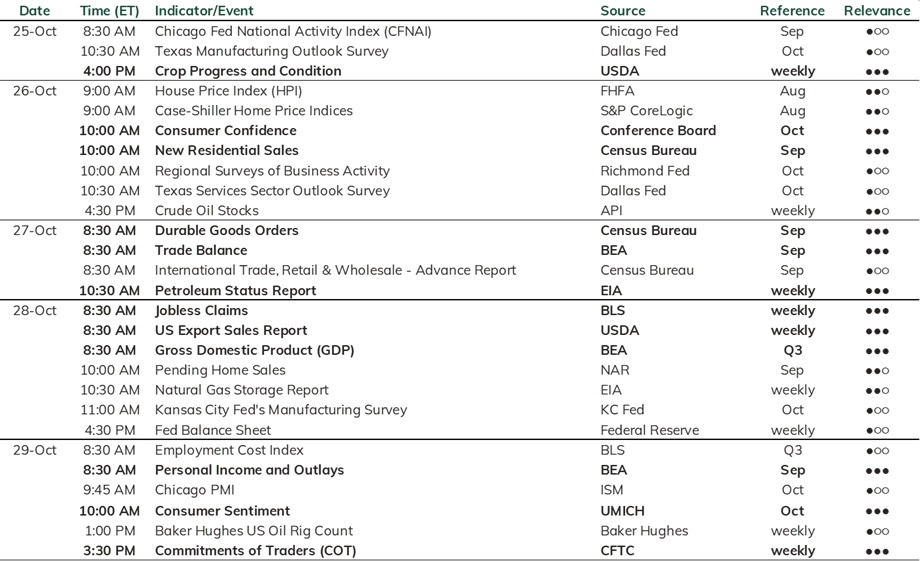
Important indicators will be released next week, such as the PCE (Private Consumption Expenditures) price index, which is the indicator followed by the Fed. The median of analysts' expectations points to a slight drop in price acceleration, from +0.3% in August to +0.2% in September. However, this relief should be temporary since the increase in prices of used cars and the worsening of logistics bottlenecks should accelerate the "core" PCE in the last months of the year. The employment cost indicator for the third quarter will also be released, whose median expectation points to a growth of 0.9%, consistent with a heated labor market. The salary growth is expected to reduce with the normalization of economic activity throughout 2022, with a lower rate of job openings and layoffs (voluntary or not). But until then, it will still be a difficult environment for employers who have indicated difficulties filling open positions.
Finally, the University of Michigan's latest report on US consumer sentiment is noteworthy. Preliminary data released earlier this month indicate that expectations for price acceleration next year stand at 4.8%, the highest for the index since September 2008. Moreover, expectations for inflation over five years point to 2.8%, a slight retreat from September's 3%, which was the highest since May 2011.
Domestic scenario
Substantial uncertainty coming from the government's economic area and a certain improvisation, given that the central topics of debate were different every day, marked the week. As a result, the Administration spent the last few days looking for alternatives that would allow the government to accommodate its wishes for higher temporary social spending in an election year. However, the main proposal discussed throughout the week was the temporary increase of the Auxílio Brasil income transfer program (which will replace Bolsa Família) from BRL 191 to BRL 400, valid until December 2022, an election year.
Roughly speaking, two principles regulate public spending in the country: the Fiscal Responsibility Law (LRF) and the constitutional spending limit (spending cap). The LRF requires that every expenditure indicate a revenue to finance it (or an expenditure that will no longer be executed), except for temporary expenses. Since the government is proposing a temporary increase - until December 2022 - there is no violation of the LRF. The spending cap imposes that all government expenses obey a maximum limit, adjusted annually by inflation, i.e., there is no real growth. The possibility of such an adjustment being accounted for "outside" the spending cap was debated throughout the week, but another solution was suggested.
Finally, the economic team found a way to extend the constitutional spending limit by anticipating its review, which would only take place in 2027, and changing the adjustment period for the inflation index (IPCA) used. The justification for this change would be the "synchronization" between the adjustment periods of the amount allowed by the spending cap and government spending. Currently, the period used to correct the spending limit considers the IPCA index accumulated over 12 months until June of the previous year. On the other hand, government expenses, such as social security and social programs, are corrected by the IPCA accumulated over 12 months from January to December. With the change visualized by the economic team, the correction periods of the ceiling and the government budget would be synchronized. It is worth noting, however, that the definition of each value occurs at different times. The inflation from January to December is known when defining indexed expenses. When setting the spending cap, inflation will be estimated.
Since the spending cap is constitutional, it is necessary to use a proposed constitutional amendment (PEC) to make such a change. Thus, congressman Hugo Motta (Republicans-PB) presented a new opinion for the PEC of judiciary bonds (PEC 23/21). In addition, he inserted a new period for calculating the correction of the spending cap. In Motta's new opinion, the text of article 107 of the Federal Constitution, which regulates spending text, will be changed from "the twelve months ended in June of the previous fiscal year" to "the value of the limit referring to the immediately previous fiscal year, corrected by the variation of the Broad National Consumer Price Index - IPCA." As the projected inflation for this year should be higher than the inflation accumulated in June (8.35% in 12 months), this would imply greater spending freedom for next year.
As PEC 23/21 already stipulates the extension of the payment of a substantial portion of the government's judicial debts, two measures that expand the government's spending capacity are combined. In the calculations of the government's economic team, the two changes will generate a space of BRL 83.6 billion for additional expenses in 2022. According to the calculations of the executive director of the Independent Fiscal Institution (IFI), Felipe Salto, the hole in the spending cap in 2022 could reach BRL 94.4 billion, of which BRL 47 billion resulting from the "synchronization" of inflationary corrections and BRL 47.7 billion derived from the postponement of the government's judicial obligations.
It is to be seen what expenses the government intends to incur with the release of this budget. On Tuesday, the government indicated that it intends to raise the Auxílio Brasil average benefit from BRL 191 to BRL 400/month. According to Felipe Salto, such an adjustment will require about BRL 47 billion from the budget. Meanwhile, President Jair Bolsonaro promised to present "in the coming days" a temporary diesel aid for "around 750 thousand truck drivers" to compensate for the recent diesel increase. Deputy Hugo Motta, in turn, told reporters that the PEC 23/21 would serve to readjust the average benefit of the Auxílio Brasil program by 20% and pay temporary complementation from January to December so that the value of the benefit reaches BRL 400. In addition, it would also be used to buy vaccines and for "emergency and temporary actions of a socioeconomic nature."
Without presenting any calculations, Motta filed his substitute text on Thursday (21) in the Special Committee of the Chamber of Deputies, and, afterward, it was approved by 23 votes to 11. The text now goes to the Plenary, where it needs to be approved by at least 308 votes in the Chamber and 49 votes in the Senate, in two rounds each, to become valid. In reaction to the PEC approval – a suggestion of the economic team – four secretaries requested to resign from the Ministry of Economy, the special secretary of the Treasury and Budget, Bruno Funchal, and the secretary of the National Treasury Jeferson Bittencourt.
On Friday, after a negative reaction from the domestic asset market, President Bolsonaro held a press conference with the Minister of Economy, Paulo Guedes, to state that "there is no change in the fiscal framework," after changing two fiscal rules in the constitution to expand spending in an election year.
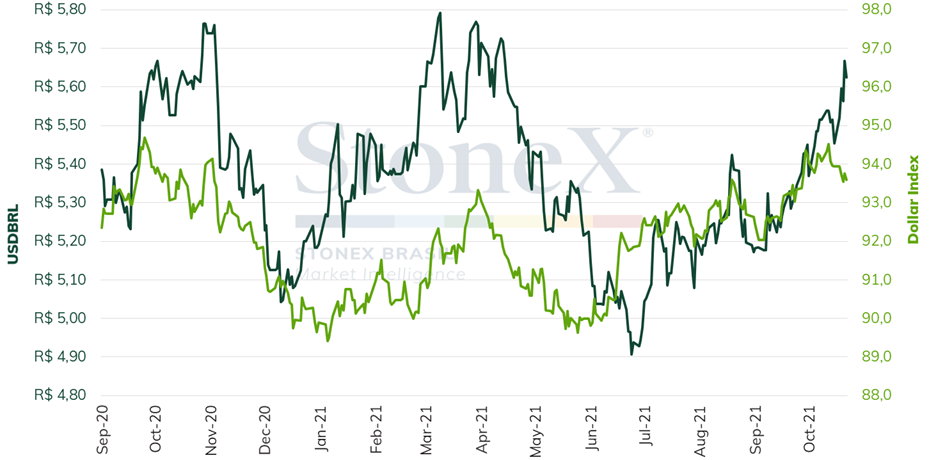
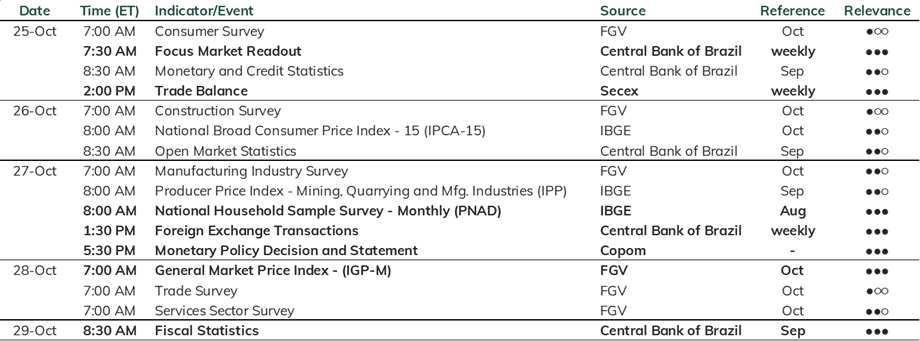
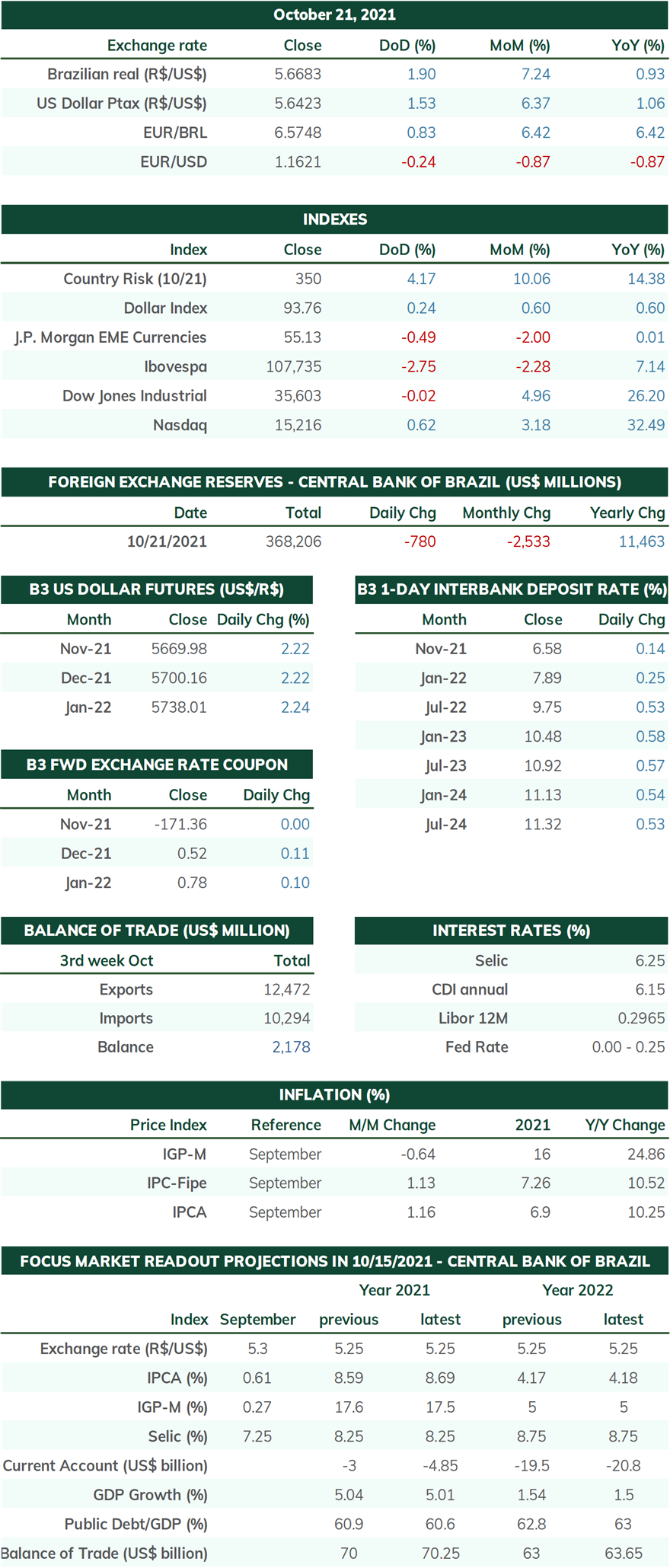
Next week, the Monetary Policy Committee's decision may reflect the intense exchange rate volatility and its more devalued level. In September, Copom predicted an increase in the basic interest rate (Selic) by one percentage point (6.25% to 7.25%). However, there is uncertainty about this scenario with the change in the fiscal year regime observed this week. It is also worth mentioning that next week, indicators about the labor market will be released through the Continuous National Household Sample Survey and the General Cadastre for Employed and Unemployed (Caged).