Foreign Scenario
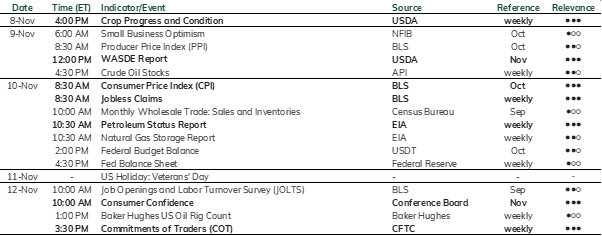
The focus of the week will be United States October inflation data, with the release of the Producer Price Index (PPI) on Tuesday and the Consumer Price Index (CPI) on Wednesday. Analysts estimate an acceleration of the CPI “core” in Q4, i.e., the price measurement without volatile components of energy and food, mainly due to used vehicles. It will be important to observe whether the PPI will maintain its marked upward trajectory in relation to the CPI, since research indicates relevant cost pressures for US producers.
The week will also feature publication of the Job Openings and Labor Turnover Survey (JOLTS). Last week, numbers for the both the October employment situation report and the weekly unemployment aid orders suggested a more vigorous recovery of the US labor market, with some sectors lacking labor and with growth above the average for wage income, which, in turn, represents another source of cost pressure to producers.
In addition to important indicators, several members of the Federal Open Market Committee (FOMC) are scheduled to speak publicly this week, such as Michelle Bowman, Mary Daly, John Williams, Patrick Harker, Charles Evans, Richard Clarida and Jerome Powell. It will be interesting to note comments from FOMC members on the debate about interest rate increases for the US economy in 2022, particularly on what criteria are necessary for this increase, how many readjustments the members see and what the magnitude of these increases should be. Likewise, it will also be worthy to note comments by the authorities on their views of price acceleration, whether it is due to more temporary or permanent factors, and what the most appropriate economic policy measures would be at this time.
Meanwhile, Democrats have not yet succeeded on moving forward in Congress within the party to get approval on the fiscal stimulus package promised by President Joe Biden, the Build Back Better, owing to the lack of consensus among moderate and progressive MPs. Biden made a priority the approval of the package of approximately USD 3 trillion, which would promote significant expansions in access to health and day care centers, as well as investment in infrastructure and global warming combating, a priority of its economic agenda. An unexpected victory by Republicans in the governor election in Virginia has increased the pressure for Democrats to move forward with the proposal while still holding a subtle majority.
Domestic Scenario
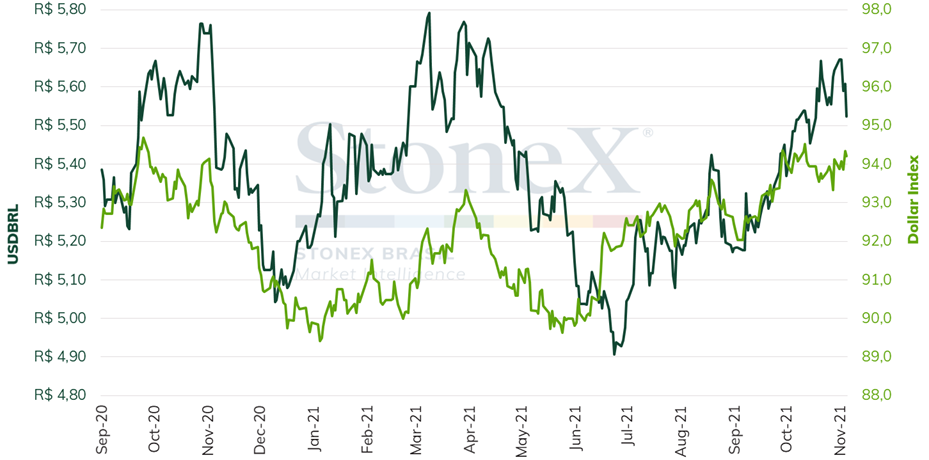
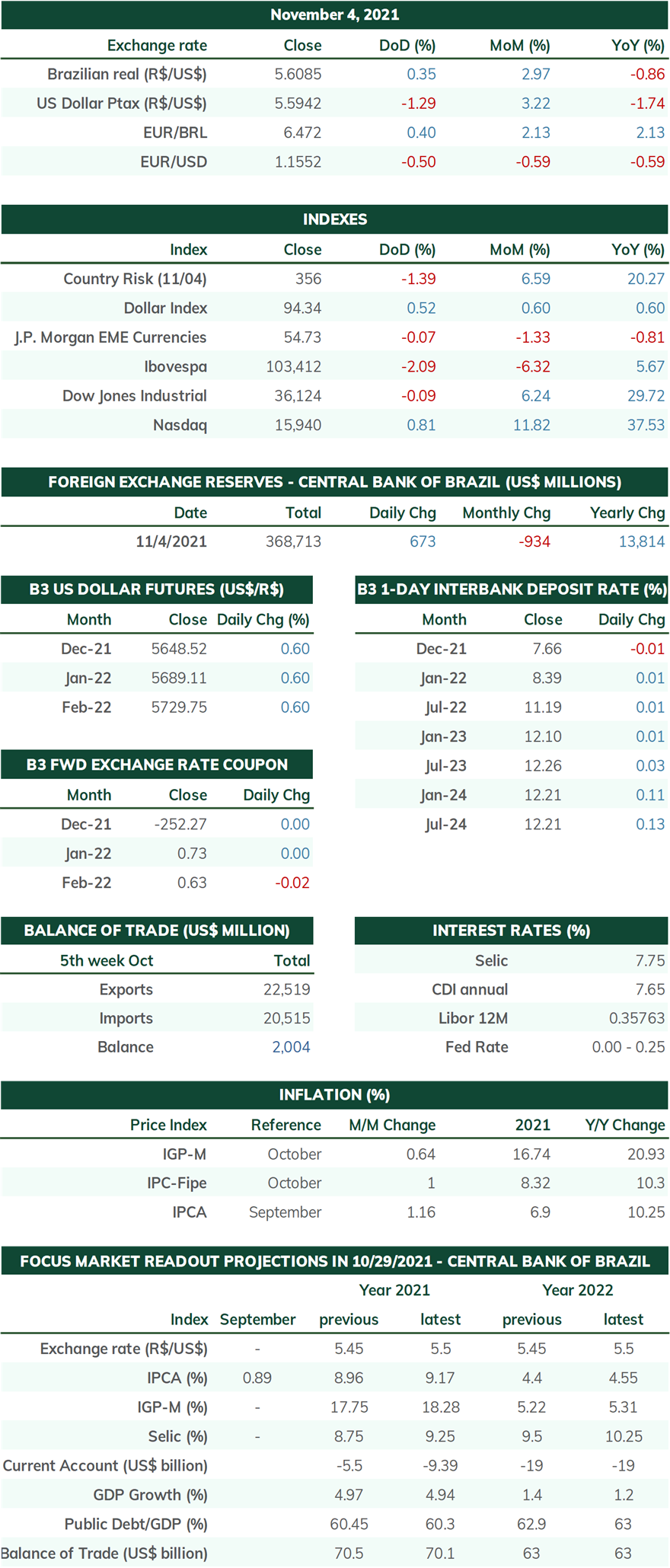
Once again, the question of the country’s fiscal responsibility was the central theme of the domestic scenario influencing exchange rates last week. In the minutes disclosed by Brazil’s Central Bank (BC), the Copom was firm to warn that “recent questions regarding the fiscal framework” by the government are resulting in a higher risk premium from investors, which may require higher returns on assets in order to invest in Brazil. This fact, in turn, can contribute to lower demand for the national currency, resulting in its devaluation. Moreover, the minutes pointed out that the country’s lower fiscal credibility could raise inflation expectations for the economy, “increasing the bullish asymmetry in the risk balance” and “increasing the probability for alternative scenarios that consider higher neutral interest rates.” Therefore, the Committee considered readjusting the basic interest rate (Selic) by over 1.5 p.p. at its meeting last week, when it raised it from 6.25% p.a. to 7.75% p.a., although it decided that consecutive adjustments by 150 basis points would be a “more appropriate interest rate increase.” Finally, the Copom reiterated that the process of reforms and adjustments needed in the Brazilian economy is essential for the sustainable growth of the economy. “The slowdown in the effort of structural reforms and permanent changes in the process of adjustment of public accounts can raise the structural interest rate of the economy”, it assured.
Despite the alerts from the monetary authority, on Thursday, the Chamber of Deputies first approved the basic text of the Precatory PEC (PEC 23/21), which, in short, allows the expansion of government spending capacity by extending the payment of a substantial portion of government judicial debts and changing the calculation period of the constitutional spending limit correction. According to estimates released by the Ministry of Economy on October 29, PEC 23/21 adds BRL 91.6 billion to the 2022 budget, with BRL 47 billion coming from the change in the spending cap calculation and BRL 44.6 billion from postponed government debts. According to the Ministry, of the BRL 91.6 billion, the Executive intends to allocate BRL 50 billion to temporarily increase the average benefit of the Auxílio Brazil assistance program (which will replace the Bolsa Família) from BRL 191 to BRL 400 until December 2022, the year of election. According to the government, at least BRL 10 billion will be set aside for “compulsory spending and society demands”, according to the “Congress’ decision”, the so-called RP9 amendments, or amendments by the general rapporteur, in which the rapporteur declares to the Executive, by means of an official letter, how he or she intends to use their budget.
In an interview last week, House Speaker Arthur Lira (PP-AL) assured that the Proposed Amendment to the Constitution of Precatories will be approved in a second round, with even more votes than in the first round. In short, the PEC allows the expansion of government spending capacity by extending the payment of a substantial portion of government judicial debts and changing the calculation period of the constitutional spending limit correction. Lira also referred to “speculations” that he had used parliamentary amendments in negotiations to approve the Precatory PEC as being “vile” and “leprous”. According to the newspaper O Estado de São Paulo, Lira personally coordinated the release of up to BRL 15 million in amendments by the general rapporteur in exchange for a vote from each MP. In total, Jair Bolsonaro’s government allegedly committed BRL 1.2 billion to rapporteur amendments since last week to seek support for the measure. The first-round vote on the highlights, which may alter its content, and the second-round vote on the PEC itself, are scheduled for Tuesday (09).
It is important to note that, also on Tuesday, the Financial Surveillance and Control and the Chamber of Deputies’ Labor, Administration and Public Service Commissions will listen to Minister of Economics Paulo Guedes, called to explain financial movements abroad through tax haven offshore. The requests for convocation were submitted by deputies Kim Kataguiri (DEM-SP), Leo de Brito (PT-AC) and Elias Vaz (PSB-GO). Among other arguments, Members argue that Guedes is part of the National Monetary Council (CMN), responsible for issuing resolutions on matters related to assets held abroad, and has access to sensitive information related to exchange rate fluctuations and interest rate variation. In addition, the High Federal Administration’s Code of Conduct prevents high-level government officials from maintaining financial applications, in Brazil or abroad, which could be affected by government policies that have privileged information, due to their position or function. In a statement released at the time of the revelation, Guedes denied that he acted in such a way as to mix public and private interests. The note indicated that there has been no remittance or withdrawal of values for the company in the British Virgin Islands since Guedes took office as Minister of Economics. Moreover, he denied that he had benefited privately from any decision regarding the Brazilian economic policy.
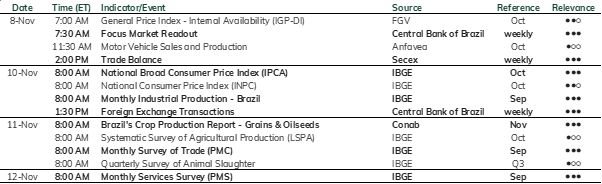
On the week’s agenda, in addition to the vote on the PEC and Guedes’ testimony, other highlights will be the disclosure of the Broad National Consumer Price Index (IPCA) on Wednesday, and monthly surveys on the Industry (Wednesday), Trade (Thursday) and Services (Friday). All indicators are from the Brazilian Institute of Geography and Statistics (IBGE). In relation to the IPCA, the analysts’ median expectations are a slight reduction, but still above 1 point in the month: from 1.16% in September to 1.06% in October. Estimates for industry and trade point to a decline, while a slight growth of 0.5% is expected for services.