Foreign scenario
This week, attention will turn to public speeches by Federal Reserve officials. If, on the one hand, the monetary policy decision statement and the subsequent press conference were widely interpreted as a firm stance by the American Central Bank in tackling high inflation rates, on the other hand, the dispersion of forecasts and expectations about the Fed's actions increased after Wednesday.
The estimates for readjustments in the US interest rate range from 1.0 percentage points to 1.75 percentage points, with some betting on a 0.50 p.p. hike in the next decision, in March. The broadening of the range of estimates is a consequence of an overly broad, and at times dubious, language, which aims to ensure the Federal Reserve's flexibility to act in the face of the different contexts and scenarios that may arise at each meeting for monetary policy decision but fail to consolidate the expectations of agents about the performance of one of the most important regulatory bodies of the world economy.
In its statement, the Federal Open Market Committee (FOMC) informed that it "expects an increase in interest rates to be appropriate soon," and in the interview, the chairman of the institution, Jerome Powell, stated that "the mindset" of the members of the Committee is to make the first adjustment in the next decision, in March, provided current economic conditions continue until then. Powell did not commit to any date or trajectory for the rate hikes, saying that it is difficult to predict how the economic data will behave and that decisions will be made at each meeting. Still, when asked, he did not rule out the possibility of consecutive rate hikes. In his opinion, the vigorous economic recovery in the US, the "tight" labor market, and high and deteriorating inflation would hypothetically allow for increases in consecutive monetary policy decisions. Committee members will remain "humble and agile" in assessing data and information regarding macroeconomic variables to make each monetary policy decision.
Thus, the speeches, statements and interviews of regional presidents and other Federal Reserve authorities next week should be highlighted as they seek to smooth out rough edges and indicate more clearly what the degree of consensus within the FOMC is regarding the anticipated interventions for 2022 and contains the potential to influence the currency market.
Market analysts continue to monitor the geopolitical situation between the heightened tensions in Eastern Europe due to the Russian troop buildup near the lengthy Ukrainian border, despite intense diplomatic negotiations involving Russia and Ukraine and the United States, Britain, France, and Germany. While Western forces warn of "enormous consequences" for Russia in the case of an invasion, the Slavic country continues to denounce the North Atlantic Treaty Organization (NATO) for promoting an "information hysteria" against Russia, spreading lies about the country and its demands in the region, while concentrating troops and conducting military exercises on the Ukrainian side of the border to provoke a reaction from the country.
This week will also see the release of some important economic indicators for January, such as the ISM economic activity index and data for the labor market. However, due to the strong wave of coronavirus cases caused by the omicron variant, analysts estimate a one-off drop in the month in these indicators, particularly in the services activity index and the creation of new job openings.
This effect should dissipate in February and should not affect the more forceful action of the Federal Reserve.
It is also worth noting that the Central Banks of England and Europe have monetary policy decisions this week, and it will be interesting to see if the aggressive stance of the Fed will force its European partners to alter their plans and also raise interest rates or if they will remain firm in continuing with lower rates.
Domestic Scenario
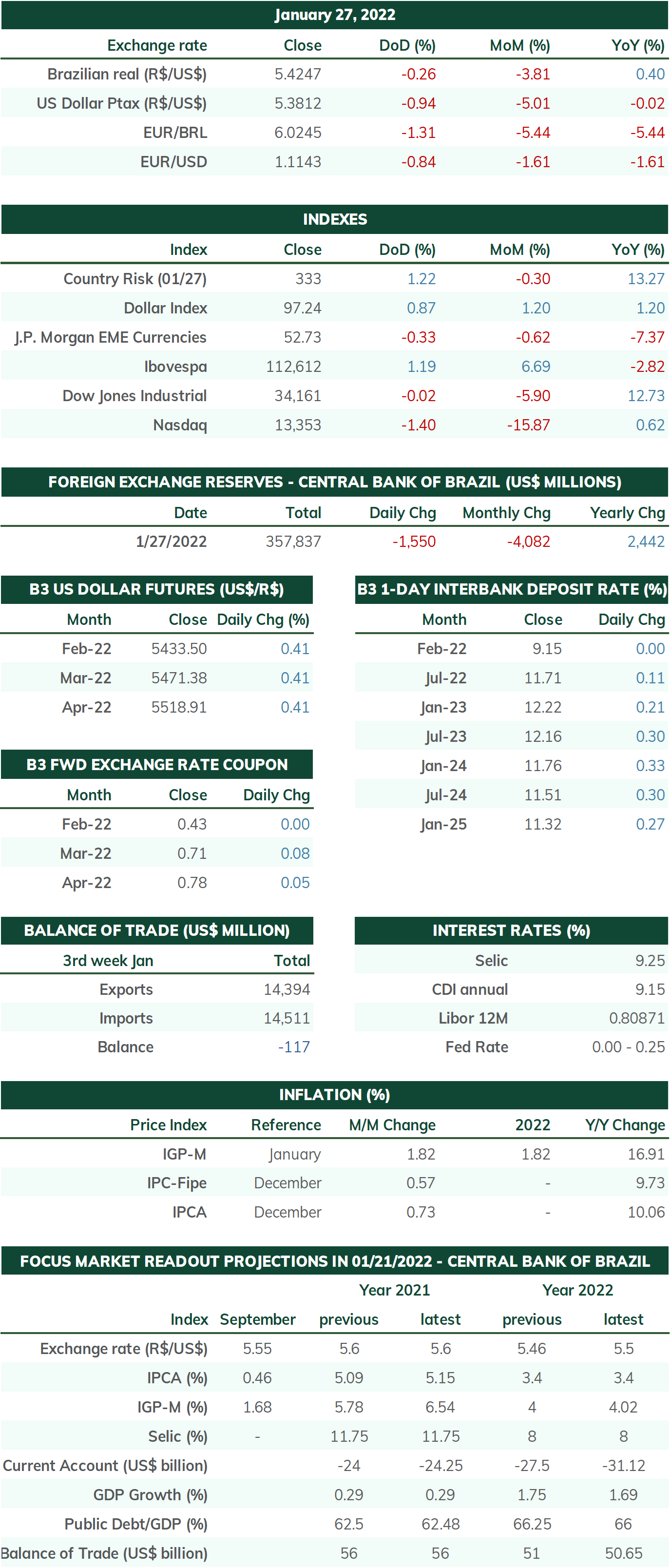
This week's highlights will be the first meeting of the Central Bank of Brazil's Monetary Policy Committee (Copom) for 2022. After the National Broad Consumer Price Index (IPCA) ended 2021 in double digits (10.06%) and the January IPCA-15 did not show any appreciable slowdown (it rose 0.58%, against the growth of 0.73% in the December IPCA), expectations are that the Copom will increase the basic interest rate (Selic) by 1.5 percentage point, from 9.25% a year to 10.75% a year. The Central Bank Chair, Roberto Campos Neto, has repeatedly stated that he will take the Selic to a significantly contractionary level until inflation rates converge to the monetary authority's target. In the February meeting, another 1.0 percentage point increase is expected.
The possibility of an institutional crisis sparked by Brazil's President, Jair Bolsonaro, with the Supreme Court (STF), should also be highlighted. On Friday, Bolsonaro decided to skip a summons issued by STF Minister Alexandre de Moraes to testify in person about an investigation into the leaking of a secret investigation allegedly carried out by Bolsonaro. Moraes subpoenaed the president after Bolsonaro requested 60 days to schedule a date for the deposition, but he still had not done so one day before that deadline. In practice, by failing to do so, the president of the Republic failed to comply with an order from the country's highest court.
The Attorney General of the Union (AGU) tried to appeal today, requesting that Bolsonaro not make the statement. However, today the minister has already denied the appeal, noting that the deadline for appealing the decision closed on December 6 - therefore, no further appeal is possible - and that when requesting the first extension of 60 days, the AGU itself stated that "the President of the Republic, in honor of the principles of cooperation and good procedural faith, will attend the personal appearance" - therefore, it would not be proper to request that no testimony be given. Moraes also concludes that anyone has the right to silence and the privilege of not answering questions, but "prior refusal to comply with legal determinations" is not permitted. With the impasse created, it is up to Moraes to analyze the next steps taken.
Finally, it is worth noting the release of fiscal statistics by the Central Bank next Monday, after the Minister of Economy, Paulo Guedes, stated that Brazil should present its first primary surplus for the consolidated Public Sector since 2013. Although the federal government accounts still show a deficit of approximately BRL 40 billion, according to data from November, municipalities and state companies should show a positive balance, making the balance positive by a few billion reais. This is an excellent performance, given that the 2020 deficit was more than 10% of GDP.