Cenário Externo
This week, the focus will be on the publication of the minutes of the Federal Open Market Committee (FOMC) monetary policy decision on Tuesday. The document should bring more information about the degree of domestic concern with inflation acceleration and details about how the monetary authority visualizes its monetary tightening path for this year. In addition, after the Consumer Price Index (CPI) presented an accumulated growth of 7.5% in January, beyond analysts' expectations and the highest level since February 1982, it will also be important to observe the public speeches of Fed officials to assess the degree of consensus around the FOMC's next steps. Since the release of the indicator, the interest rate futures market has raised its bets that the Committee may increase interest rates by 0.50 percentage points in the March decision.
This week also reserves the release of important data about economic activity in the United States, such as retail sales and industrial production, both for January. Estimates are that the production of industrial goods and retail sales of these products accelerated last month, highlighting the strong demand in the US economy driven by household consumption.
Another topic in the foreground is the geopolitical tensions between Russia and Ukraine, with the number of troops amassed on both sides continually on the rise. The situation alternates between diplomatic blitzes that momentarily calm tempers, followed by barbs and threats of imminent concrete action. The fact is that there is no clear sign of either a diplomatic breakthrough or a reduction in the military presence, prolonging tensions for another week and exacerbating market volatility.
Domestic Scenario
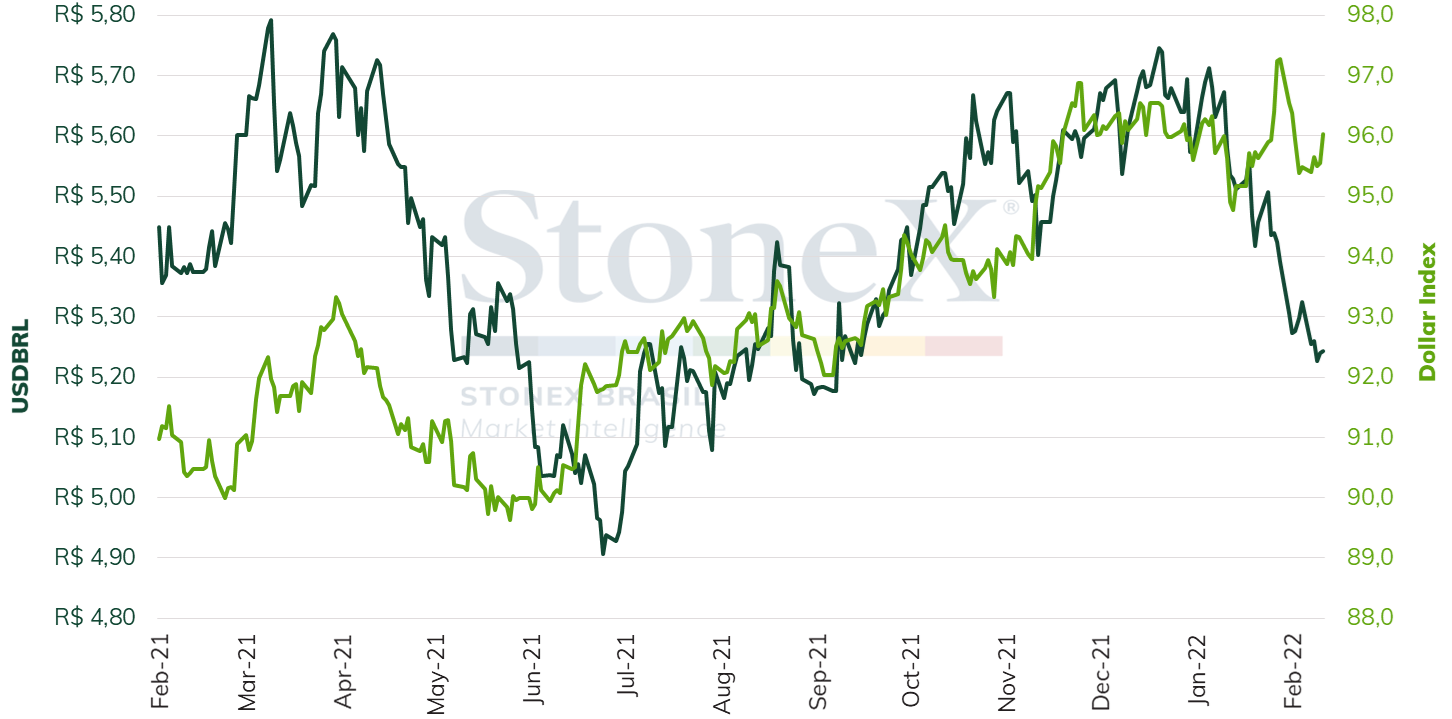
This week is empty of indicators and events for Brazil. The first indicator of note will be the GDP Monitor from the Getúlio Vargas Foundation, released on Tuesday. The second important indicator to follow will be the weekly update of the currency flow data on Wednesday afternoon. The strong inflow of foreign funds into the country has driven the Brazilian currency's appreciation against the dollar for weeks. On the one hand, the prospect of consecutive increases in Brazil's basic interest rate (Selic) widens the country's yield differential and facilitates the inflow of capital seeking "carry trade" strategies, i.e., strategies of borrowing in a foreign currency at low interest rates to invest in countries with high interest rates.
Another determining factor for strengthening the real is the inflow of foreign investment into the São Paulo Stock Exchange. After the net inflow of BRL 32.491 billion in January, the highest value since November 2020, the balance between February 1 and 8 showed BRL 8.238 billion. The most benefited sectors have been the oil and gas sector due to the increase in the price of energy commodities, the mining sector, the rise in iron ore prices, and the banking and financial sector due to the increase in interest rates.
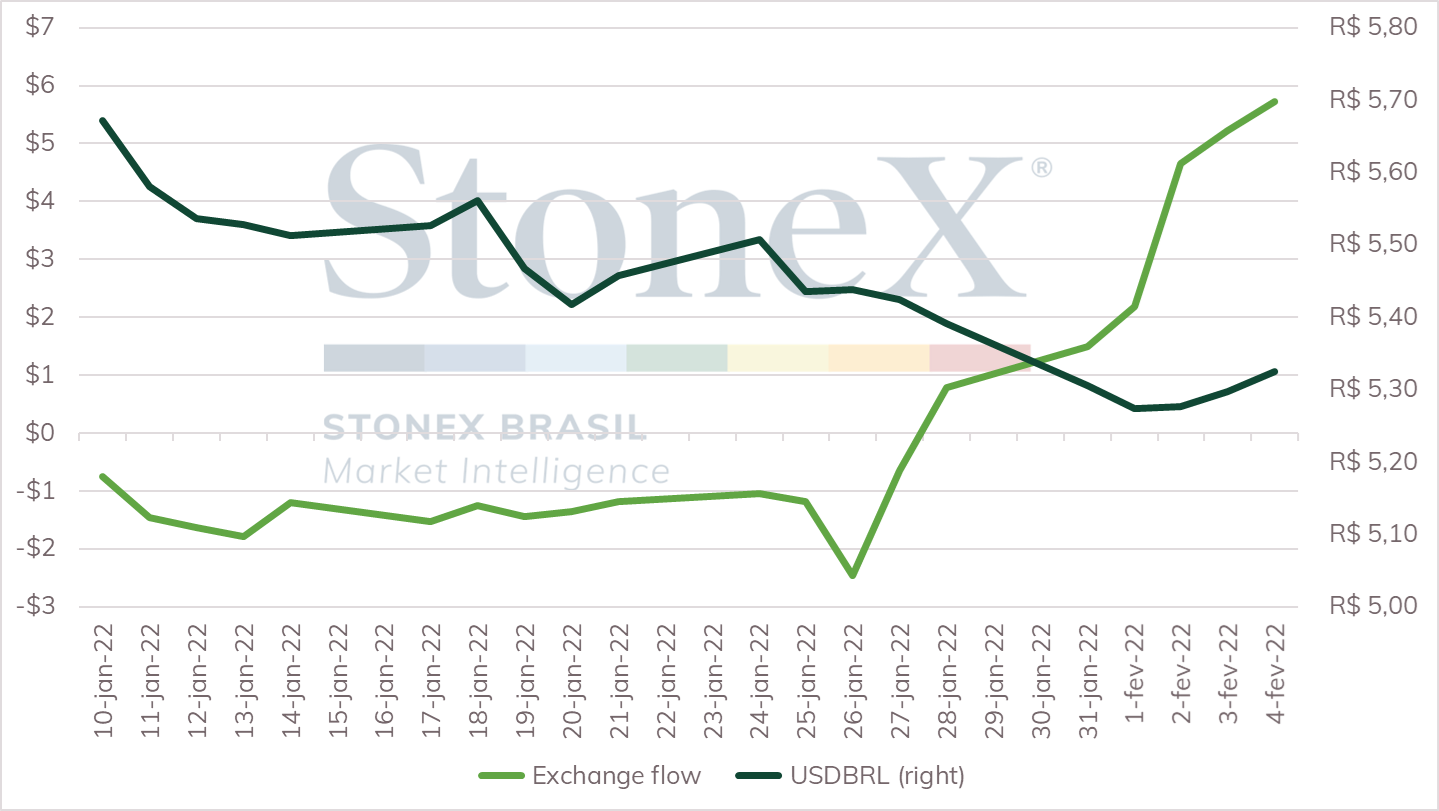
It is possible to observe this good performance weekly, on Wednesdays, with the release of the exchange flow by the Central Bank. In the last publication, only the financial account accumulated a positive balance in 2021 of USD 9.465 billion. However, the foreign exchange flow intensified as of 01/27, in a sequence of seven days of total positive balance (latest data available on February 4).
ACCUMULATED EXCHANGE FLOW (USd BI) AND usdbrl
Source: Central Bank and CommodityNetwork Traders' Pro. Elaboration: StoneX.
On the other hand, after the proposed constitutional amendment (PEC) of Senator Carlos Favaro (PSD-MT) reached 31 signatures of senators and was filed with the Federal Senate as PEC 1/22, the president of the Senate, Senator Rodrigo Pacheco (PSD-MG), said that its processing should be left for a "second moment." The PEC seeks to reduce the increase in items that most contribute to the recent price acceleration by allowing the reduction of taxes on fuel, bottled gas, electricity, among others, without requiring another revenue or expense cut to offset the drop in tax collection.
According to Pacheco, the Senate will focus on advancing two bills already in the House dealing with the same issue, PL 1472 and PLP11. Both are under the rapporteurship of Senator Jean-Paul Prates (PT-RN). The 2021 PLP 1472 was recently approved by the Economic Affairs Commission (CAE) and acts on three points, according to Prates: the reference price, the price policy in Brazil, and fuel taxation. Thus, a new "Petroleum derivatives pricing policy for distributors and trading companies" is proposed, establishing a stabilization fund for the oil and its derivatives prices, and creating an export tax on these products. The PLP 11, also from last year, proposes a monophase in collecting ICMS on fuels.
"These are two lines of work, two projects. We intend to put them on the calendar next week when I believe we will have conditions to face the subject. The PEC that already has 27 signatures [the minimum required] ends up being an instrument that we need to consider, but the focus, at this moment, is on these projects. Eventually, if some constitutional issue requires a change in the Constitution, we will already have the PEC that can eventually be processed," said Pacheco.