Foreign scenario
This week, the focus is likely to remain on the war between Russia and Ukraine, which has sent shockwaves through the financial markets. Since the start of the war, the United States, European Union, Britain and Canada have retaliated to the Kremlin's aggressions with a string of economic sanctions designed to severely damage the Russian economy, holding out tiny hope of trying to convince the country's president, Vladimir Putin, to negotiate a ceasefire or other alternative to the geopolitical crisis. The country's largest commercial banks have been prevented from using the Swift international payment notification system, increasing transaction costs and possibly creating delays for operations at these banks, which could be passed over for international business. The Central Bank of Russia's financial assets have been frozen in the United States, England, and Belgium, limiting most of the country's international reserves and contributing to the sharp devaluation of the Russian ruble. Dozens of "oligarchs" - businessmen, politicians, and people related to the Muscovite regime - have suffered the same asset freezes in these countries. At least thirty countries banned Russian airlines from flying over their airspace, deepening the country's isolation from the West and certainly implying an increase in the cost of routes. And finally, several companies have announced temporary breaks or permanent divestments in Russia, such as Nike, Netflix, Meta (owner of Facebook), Ford, Adidas, Walt Disney, and energy companies like BP, Shell, and ExxonMobil. The rating agencies Moody's and Fitch have classified Russia's government debt securities as "junk," and the Morgan Stanley (MSCI) and FTSE Russell institutions have removed all Russian assets from their emerging stock and currency indices. In addition, there is a general discouraging effect on trade with Russia for fear of future sanctions, reputational damage, or fear of non-payment.
Ukraine has already closed its airspace and ports for commercial purposes. Further sanctions in the future may make it forbidden, or inadvisable, to use routes through Ukraine or Russia, forcing the use of alternative means longer, riskier, or both. The duration of the war itself will influence the impacts on financial markets. World commodity prices are still trending upward due to the importance of Russia, Ukraine, and Belarus and the forecast of serious global supply disruptions for various inputs such as oil, natural gas, wheat, corn, aluminum, and nickel. Ukraine has already closed its airspace and ports for commercial purposes.
Further sanctions in the future may make it forbidden, or inadvisable, to use routes through Ukraine or Russia, forcing the use of alternative means longer, riskier, or both. In addition, the duration of the war itself will influence the impacts on financial markets. These increases are likely to translate into higher costs globally, resulting in faster inflation rates. Monetary authorities, in turn, would likely adopt contractionary monetary and fiscal policies to contain rising prices, which may result in lower economic growth.
In this sense, the publication of the US Consumer Price Index (CPI) one week before the Federal Reserve's monetary policy meeting is important. Before the Russian-Ukrainian war, there was intense debate about how aggressive the Fed should be in containing the biggest price acceleration in the US in decades. However, with the high uncertainty about the potential developments and impacts of the conflict in Eastern Europe, the bets are almost unanimous in pointing out that the initial interest rate increase will be 0.25 percentage points. In any case, the macroeconomic context for the American Central Bank has become much more challenging, with the prospect of supply shocks increasing inflation and less room for maneuvering for monetary policy due to the international scenario. The challenge for the European monetary authorities will be greater, who are witnessing a flight of capital from the continent and further reducing their room for maneuver. Too little growth, too much inflation, the ills of 2022 will be.
Domestic Scenario
In Brazil, the focus should be on the actions expected by the Executive regarding the repercussions of the Russian-Ukrainian confrontation on the national economy. According to the newspaper O Globo, the government intends to release this week a package of measures to stimulate the economy worth BRL 150 billion, such as the release of withdrawals from the FGTS, reduction of the tax on industrial products (IPI) and reopening of credit programs launched during the pandemic aimed at micro and small businesses. Meanwhile, Agriculture Minister Tereza Cristina said she would travel to Canada on March 12 to discuss potash supplies with local business people.
In addition, two bills that seek to curb increases in fuel prices to the final consumer are scheduled to go to the Senate Plenary next Tuesday (08). The first bill (PL 1472/2021) proposes the creation of a Fuel Price Stabilization Fund, which a new oil export tax would finance, and changing the Petrobras price policy to its national costs instead of the international parity. However, the Ministries of Economic and Mines and Energy criticized the measure, which feared a loss of foreign investments. The second bill (PLP 11/2020) changes the format of the State Tax on the Circulation of Goods and Services (ICMS) on fuels. It proposes the existence of a single-phase rate (that is, a single taxpayer has responsibility for collecting over the entire chain) of ICMS for fuels. In this case, the measure is resisted by governors and mayors, who fear losing tax autonomy.
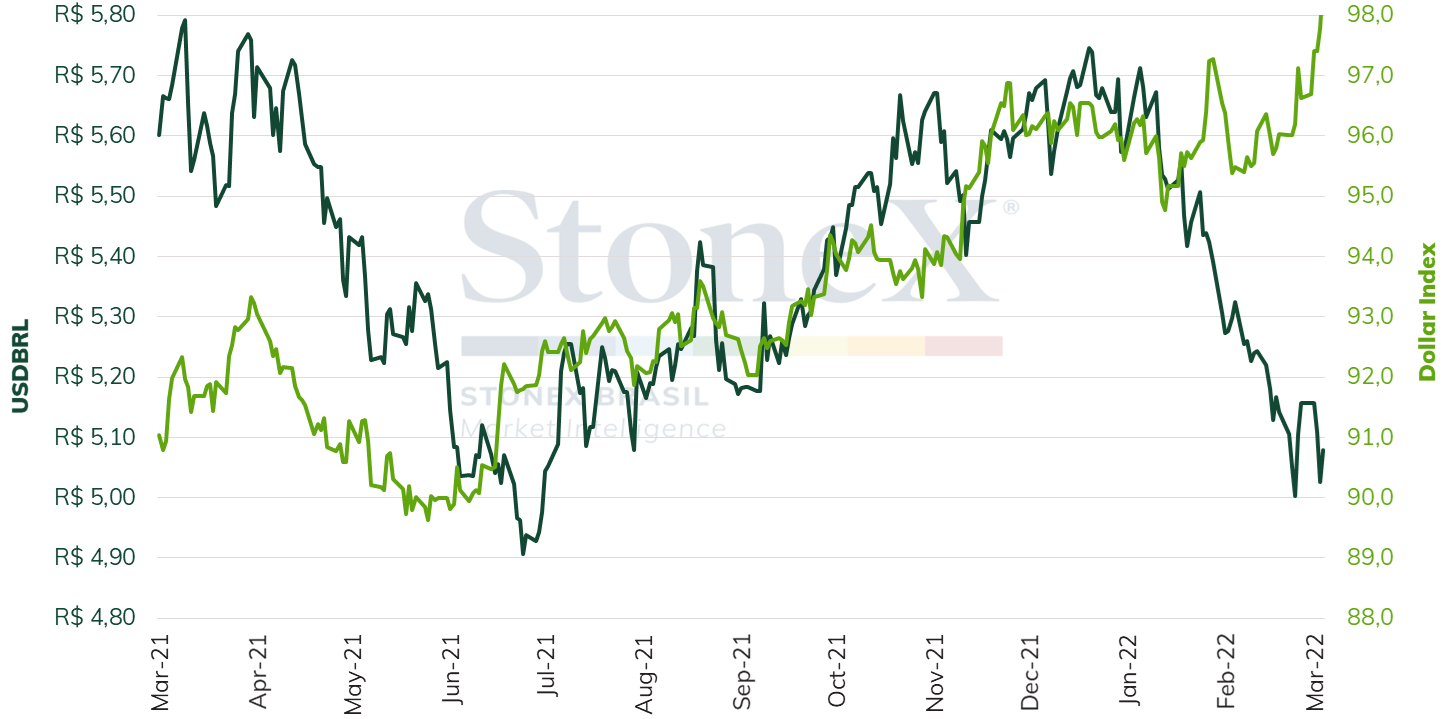
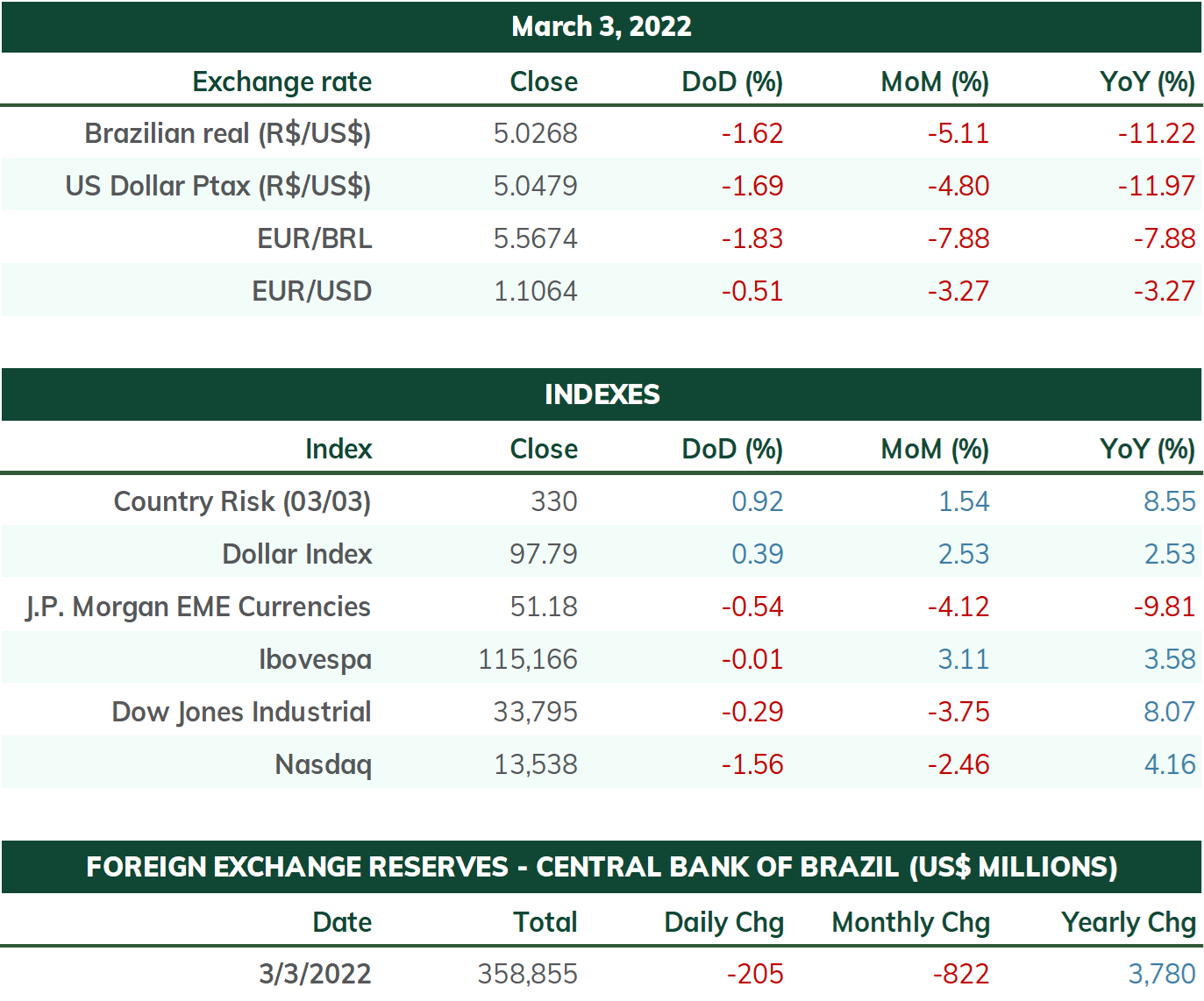
This was yet another week of strong foreign capital inflows into the country, even in a more cautious international scenario. It will be very important to observe how foreign investments will behave during the conflict since military conflicts usually stimulate caution and risk aversion, which tends to damage risky assets and emerging currencies, as is the case of Brazil. However, due to the rise in commodity prices, the commodity-exporting countries are receiving voluminous inflows of foreign resources, both from productive and financial investments related to the area.
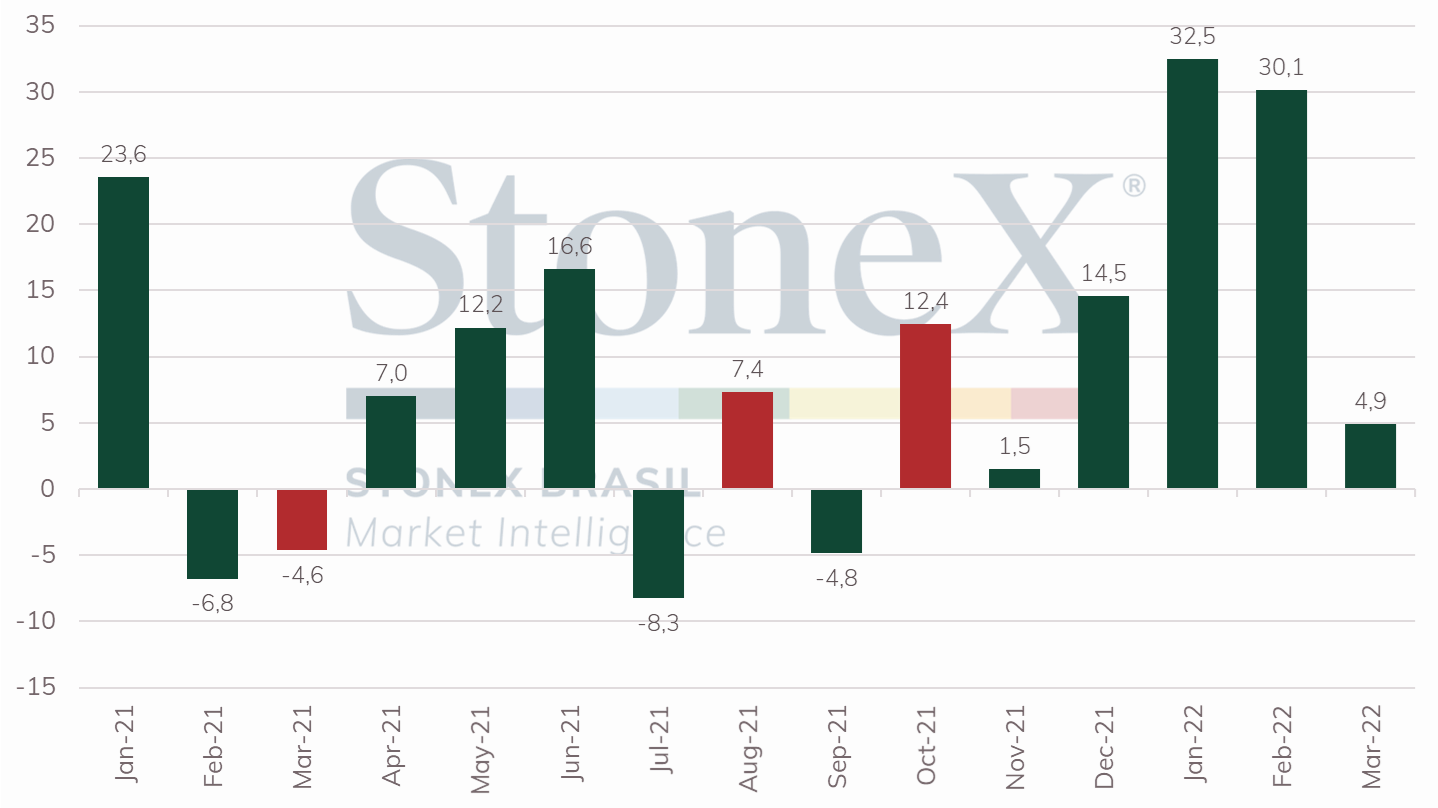
According to B3, in 2022, both January and February show a net inflow of foreign resources that is higher than any month in 2021, namely, a balance of BRL 32.491 billion in January and BRL 30.129 billion in February, and in 2022, the Ibovespa index accumulates an increase of 9.87%.
BALANCE OF FOREIGN CAPITAL FLOW ON THE B3 - AS OF MARCH 2 (BRL BILLION)
Source: B3. Design: StoneX.
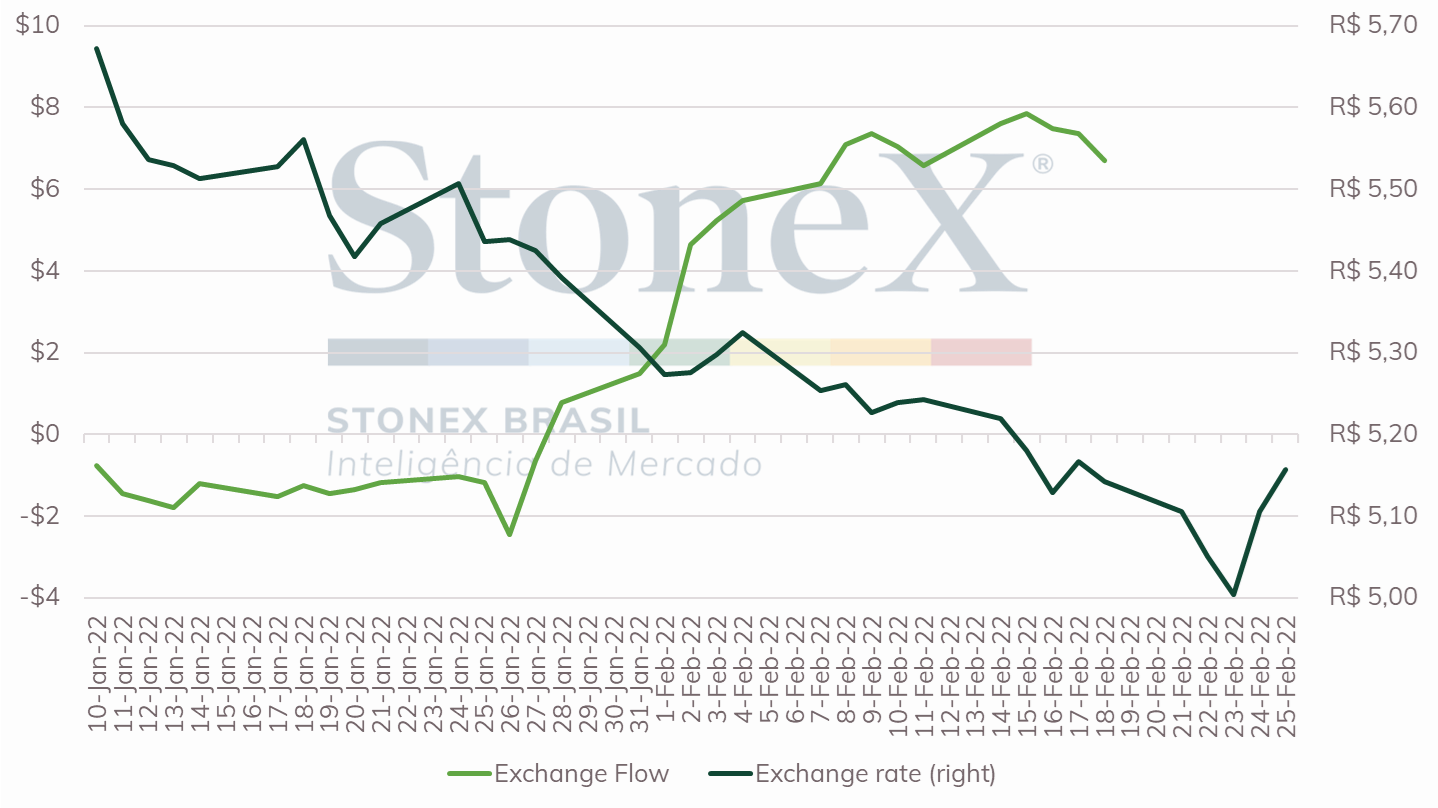
On Wednesday (03), the Central Bank of Brazil updated the country's foreign exchange flow weekly data as of February 25. If the trading account presents a negative balance in 2022 of USD -1.125 billion, the financial account presents a strong surplus of US$ 8.958 billion due to the inflow of foreign capital into the country. Thus, the total exchange flow for the year is positive by USD 7.833 billion. However, it is necessary to point out that there is a net financial inflow of USD 8.575 billion only between January 27 and February 18, coinciding with the greatest exchange rate appreciation period.
ACCUMULATED FOREIGN EXCHANGE FLOW (USD BI) AND EXCHANGE RATE (USDBRL):
Source: Central Bank of Brazil and CommodityNetwork Traders' Pro. Design: StoneX.