Foreign Scenario
After another week of the conflict, financial markets should continue to pay attention to the evolution of the war and especially the diplomatic negotiations between Russia and Ukraine. The volatility and the risk appetite were more favorable this week after the start of another face-to-face round of talks in Ankara, mediated by Turkey. However, like its predecessors, there are still few concrete results. Some officials view Moscow's willingness to seek a diplomatic way out with skepticism after the Kremlin repeatedly broke its word. Ukrainian President Volodymyr Zelenskyy said this week "the Ukrainian people are not innocent" and that "the only thing we can rely on is a concrete outcome," while US Secretary of State Anthony Blinken told journalists that Washington sees "no signs of real seriousness" on the part of Russian diplomacy in seeking a peaceful solution and North Atlantic Treaty Organization (NATO) head Jens Stoltenberg said Moscow "has repeatedly lied about its intentions." Despite Russia saying that it will redirect its efforts toward the Donbas region or saying that it negotiates in good faith in search of peace, the future of the conflict remains uncertain. It will likely still bring much volatility to the financial markets.
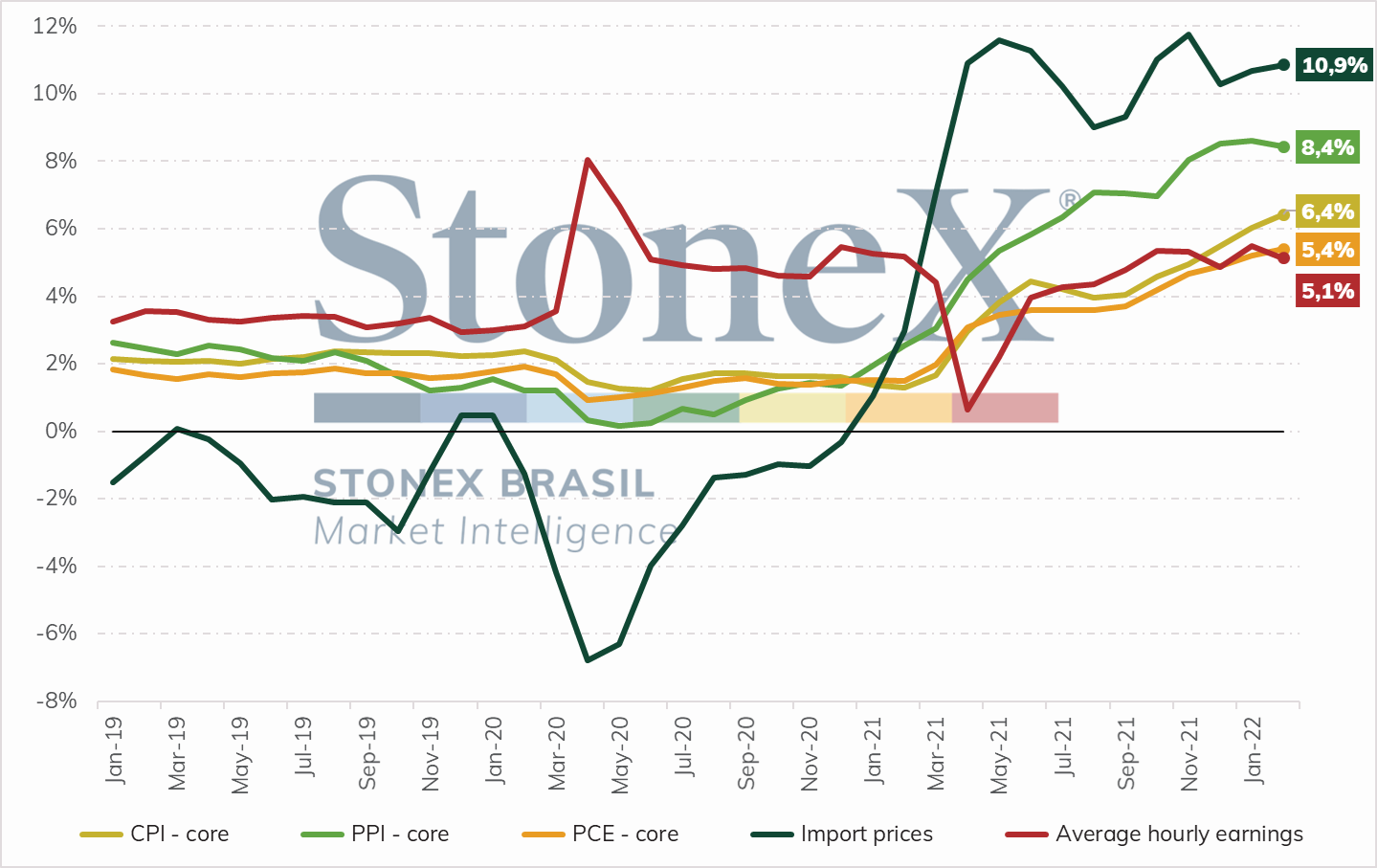
The immediate result of the war for most global economies has been the rapid rise in commodity prices, especially energy commodities, which is expected to put pressure on these countries' already high price indexes. In the United States, there is an expectation of worsening inflation in the coming months, which should put pressure on the Federal Reserve to be more aggressive in its monetary tightening, which started in the last meeting of the Federal Open Market Committee (FOMC).
Readings of inflation for the United States (accumulated over 12 months)
Source: Federal Reserve Bank of St. Louis. Design: StoneX.
Thus, it will be important to analyze the March FOMC monetary policy decision minutes, which will be released on Wednesday (6). For example, the aim is to find out more details about the debate regarding the plans to reduce (sell) the assets on its balance sheet, such as the deadline for its start and if there is a ceiling for this monthly drop in assets. The reduction of the balance sheet is an important auxiliary instrument to reduce the economy's liquidity and contribute to the search for price stabilization. In addition, the press has given a lot of attention to the opinion of the FOMC members regarding the possibility of the Committee making interest rate adjustments above 0.25 percentage point in the basic interest rate in the United States, the federal funds rate, and the minutes may bring information about how restrictive monetary policy may be from now on and the general level of concern about inflation.
For this reason, attention should also continue to public statements from Federal Reserve (Fed) members as analysts try to gauge the degree of support for one or more 0.50 percentage point adjustments. This week, public speeches by Lael Brainard, James Bullard, Patrick Harker and Raphael Bostic are scheduled. Normally, the readjustments are made at a pace of 0.25 p.p. Still, the price acceleration that the country is going through is the biggest in four decades, with the prospect of worsening (increasing) in the short term due to the appreciation of international prices of agricultural, metal and energy commodities, with few exceptions. This rise in the prices of so many products simultaneously should make the production chains of several segments of goods and services more expensive, which, to a greater or lesser extent, will be passed on to consumer prices and may raise the inflationary level. Thus, the authorities that make up the Fed are often taking firmer positions in defense of a tight monetary policy that pursues price stabilization.
Finally, investors will also follow news about the Covid-19 wave that China is going through and the containment measures being implemented. Shanghai remains shut down until next Tuesday (5), overloading the logistics chain of the country's industrial hub and site of the world's largest port terminal. Although the port remains in operation, businesses and cargo sheds have been forced to close during the confinement, causing delays and hampering port operations.
Domestic scenario
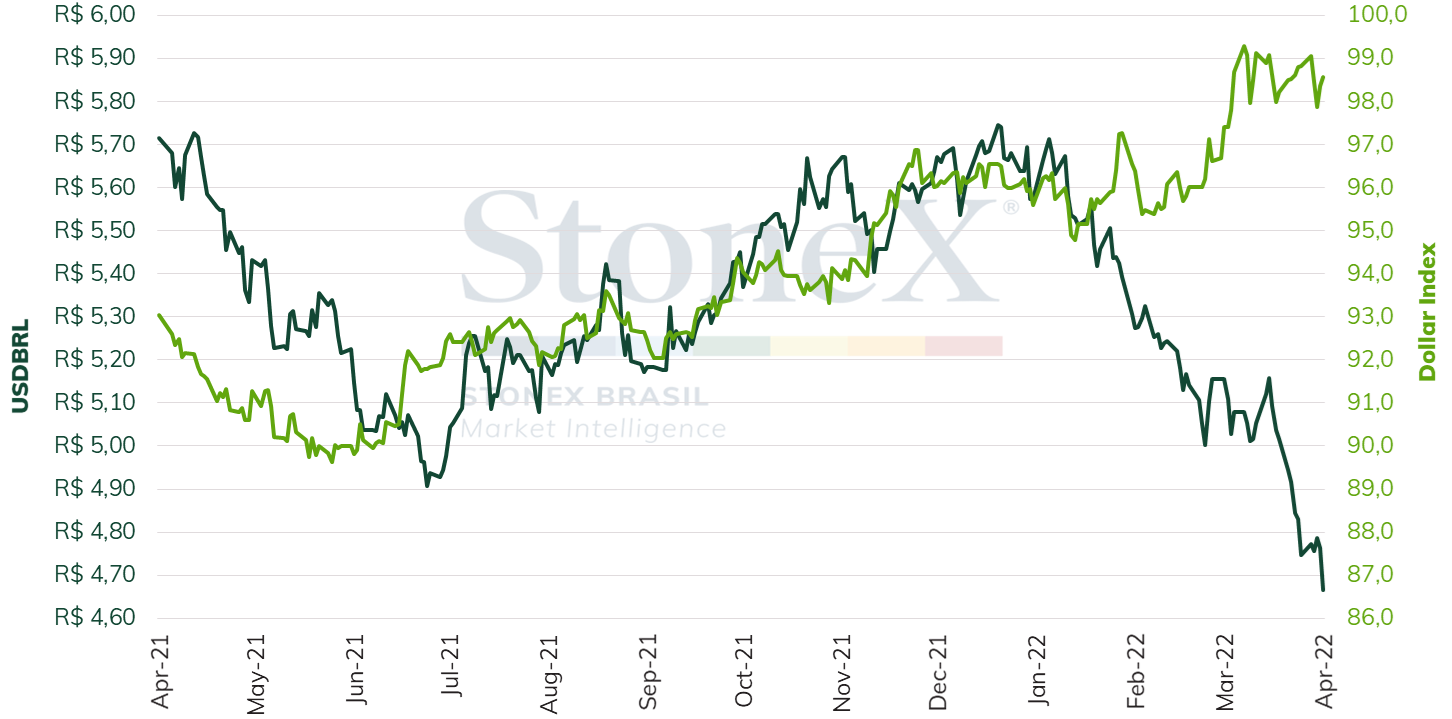
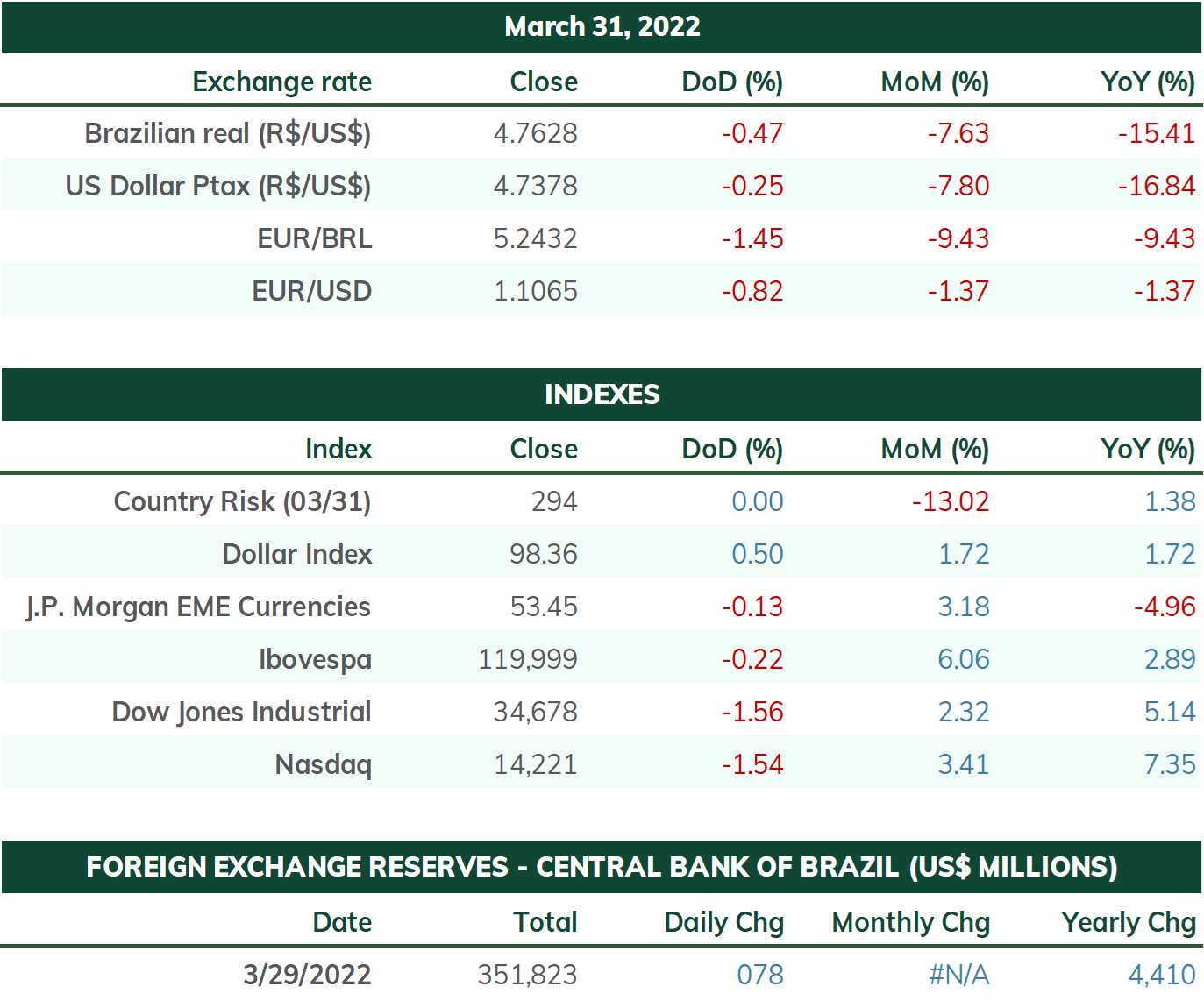
This week, attention should again turn to the strong foreign appetite for Brazilian assets, sustained since the end of January amid a general panorama of appreciation in the international prices of food, metal and energy commodities. As a result, the Thomson Reuters / CoreCommodity CRB Total Return Index accumulated a 27.1% increase in the first quarter, and the Bloomberg Commodity Index accumulated a 25.5% increase in the same period. In this context, the diversified export capacity of primary products expands the value of Brazilian exports and increases foreign exchange inflow through the trading account. Two weeks ago, the Central Bank revised the estimate for the Brazilian trade surplus this year from USD 52 billion to USD 83 billion. On Friday, the Economy Ministry's revised its expectation for the year's trade balance from USD 79.4 billion to USD 111.6 billion. In 2021, Brazil had the largest surplus in the historical series that began in 1989, amounting to USD 61.2 billion.
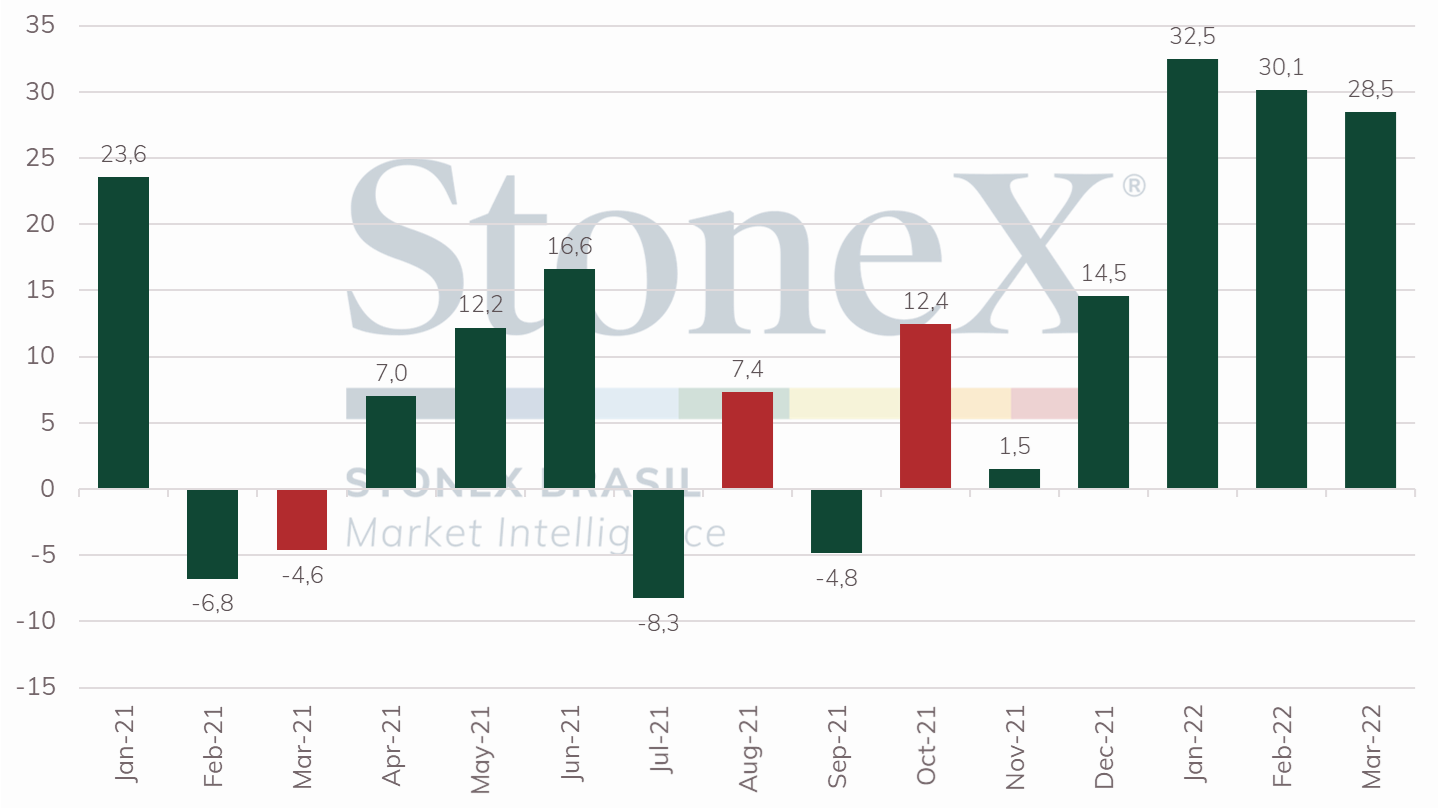
Furthermore, in relative terms, the low exposure to the risks posed by the Russian-Ukrainian conflict and the low price of Brazilian assets in terms of foreign currency have attracted foreign funds through the financial account. It is possible to glimpse this inflow of capital through the B3 stock market, whose net inflow of foreign funds is close to BRL 90 billion in 2022, the highest value in three months since 1994, the beginning of the historical series. The balance of investments stood at BRL 32.491 billion in January, BRL 30.129 billion in February and BRL 28.506 billion up to March 30.
BALANCE OF FOREIGN CAPITAL FLOW ON THE B3 - AS OF MARCH 30 (BRL BILLION)
Source: B3. Design: StoneX.
Besides the commodities effect, the country also attracts foreign capital due to its high interest rates. Facing a rapid acceleration in inflation, the Central Bank of Brazil is carrying out an intense monetary tightening process that has readjusted the basic interest rate (Selic) from 2.0% p.a. to 11.75% p.a. in just twelve months (and which should be raised to 12.75% p.a. in May). On Friday, the real interest rate, which is the difference between the nominal interest rate minus inflation, in Brazil is only lower than that of Russia. This country faces difficulties in attracting foreign investors. This wide Brazilian interest differential helps attract investors looking for "carry trade" strategies – taking financing in a low-interest country to invest in a high-interest country.
The trend of inflow of these foreign funds should remain in the coming weeks since the Russia-Ukraine conflict does not appear to be close to a solution, thus maintaining the pressure on commodity prices, and the cycle of high basic interest rates (Selic) will continue at least until May, according to the Central Bank of Brazil.
This Friday, the March National Broad Consumer Price Index (IPCA) will be released. Due to the fuel readjustment made by Petrobras on March 11, the expectation is that the index will register an acceleration higher than 1.10%. This month's indicators readings, such as IPCA-15, IGP-M and IPC-S, exceeded analysts' estimates. Even so, the president of the Central Bank of Brazil, Roberto Campos Neto, has reinforced in multiple speeches that the next decision by the Monetary Policy Committee (Copom) in May should be the last adjustment to the Selic rate this year, raising it from 11.75% to 12.75% per year.
Finally, it is worth noting that several Central Bank publications were not released this week, without prior notice, due to a strike by Central Bank employees, such as the foreign exchange flow, fiscal, monetary and credit, and the external sector statistics. This will likely happen again with other publications while the strike lasts.