Foreign Scenario
The focus next week should remain on the sustained appreciation of the dollar against other currencies, whether of advanced or emerging economies, driven mainly by the perception that there will be a strong monetary tightening in the United States to contain price acceleration, even if this slows down the expansion of productive activity. Next week, the Federal Reserve's Federal Open Market Committee (FOMC) participants will be in a mandatory quiet period ahead of the May 4 monetary policy decision.
However, Committee members have made their views abundantly clear in previous weeks, advocating a 0.50 percentage point increase in the US interest rate almost unanimously and announcing a reduction in the Fed's balance sheet, with a potential start date in June. According to the minutes of the last FOMC meeting, its members "generally agree" that a maximum three-month reduction of USD 95 billion a month in assets on its balance sheet "would be appropriate," divided into USD 60 billion a month in US Treasuries and USD 35 billion a month in mortgage-backed securities. This week, Fed Chairman Jerome Powell took a firm stance, stating that it is "appropriate to be moving a little more quickly [with monetary tightening]" and that "[a] 50 basis point increase will be among the options for the May [monetary policy decision] meeting.
In his comments, the Fed chairman argued that the interest rate futures market is "generally reacting appropriately" to expectations for the path of interest rates. Market bets on Friday pointed to three 0.50 percentage point increases in the reference rate for the United States and that the year will end at a level between 2.75% and 3.00% per year.
With no public speeches from Fed officials, the tendency is for the focus of the week to concentrate on data to be published, especially the Personal Consumption Expenditure Price Index (PCE) and the Employment Cost for the first quarter, which are the indicators most used by the American central bank to follow the evolution of inflation and the variation in labor compensation. The median of analysts' estimates points to a 0.5% monthly increase for PCE (or 6.8% in the accumulated over 12 months) and a 1.4% rise in wages for the first quarter of 2022.
It is also important to note that the conflict between Russia and Ukraine is already entering its eighth week, but with some important changes in the last 15 days. Firstly, the possibility of a diplomatic ceasefire has practically been extinguished after the heinous scenes discovered in Bucha, on the outskirts of Kiyv. This week, Russian troops declared victory over Mariupol after more than 50 days of siege, but comments by generals to Russian media outlets indicate that there are still Ukrainian soldiers in the Azovstal steel plant and that the Russians intend to deprive them of food and supplies until they all give up. Moscow has withdrawn from the northern portions of the country, giving up its conquests of Kiyv, Chernihiv, and Sumy to concentrate on the Donbas region of eastern Ukraine. In recent days, Muscovite forces have sought to encircle Ukrainian troops in the region, starting from Izyum to Sloviansk, but without success so far.
It should also be noted that the latest military aid package approved by the United States for Ukraine on April 13 and amounting to USD 800 million signals a change in posture regarding the needs and duration of the war. The number of Javelin antitank armaments was significantly lower (only 500), while 18 Howitzer tanks, 11 Mi-17 helicopters, 200 M113 armored vehicles (APCs), and another 100 unspecified armored vehicles were included. Analysts point out that this indicates preparation for a less urban and more open space phase of the war - characteristic of eastern Ukraine - but the fact that the APCs and Howitzer require sophisticated training and logistics to operate and maintain. This means that the US will need to train a Ukrainian team for weeks on US soil, where the training stations are, and then these Ukrainians can train their troops for weeks more. Joe Biden's administration would hardly have approved this sending without expecting that the war would last for months. The US government should also avoid sending its army to directly train the Ukrainians on foreign soil for fear of giving arguments to an escalation of Russian attacks.
Finally, it is noteworthy that the Shanghai lockdown is in its fifth week, as the Chinese government insists on strict, costly, and painful restrictions to extirpate Covid-19. This week, the city government announced that all people who have become ill with the coronavirus and are classified as "close contact" would be moved to government-run quarantine centers. In addition, in areas with the highest presence of the disease, disinfection will be carried out on buildings, forcing people to move from their residences momentarily to temporary shelters. Even in the face of the incredibly contagious omicron variant, various food supply problems, and overburdened health care systems, China is doubling down on its "zero Covid" system.
Domestic Scenario
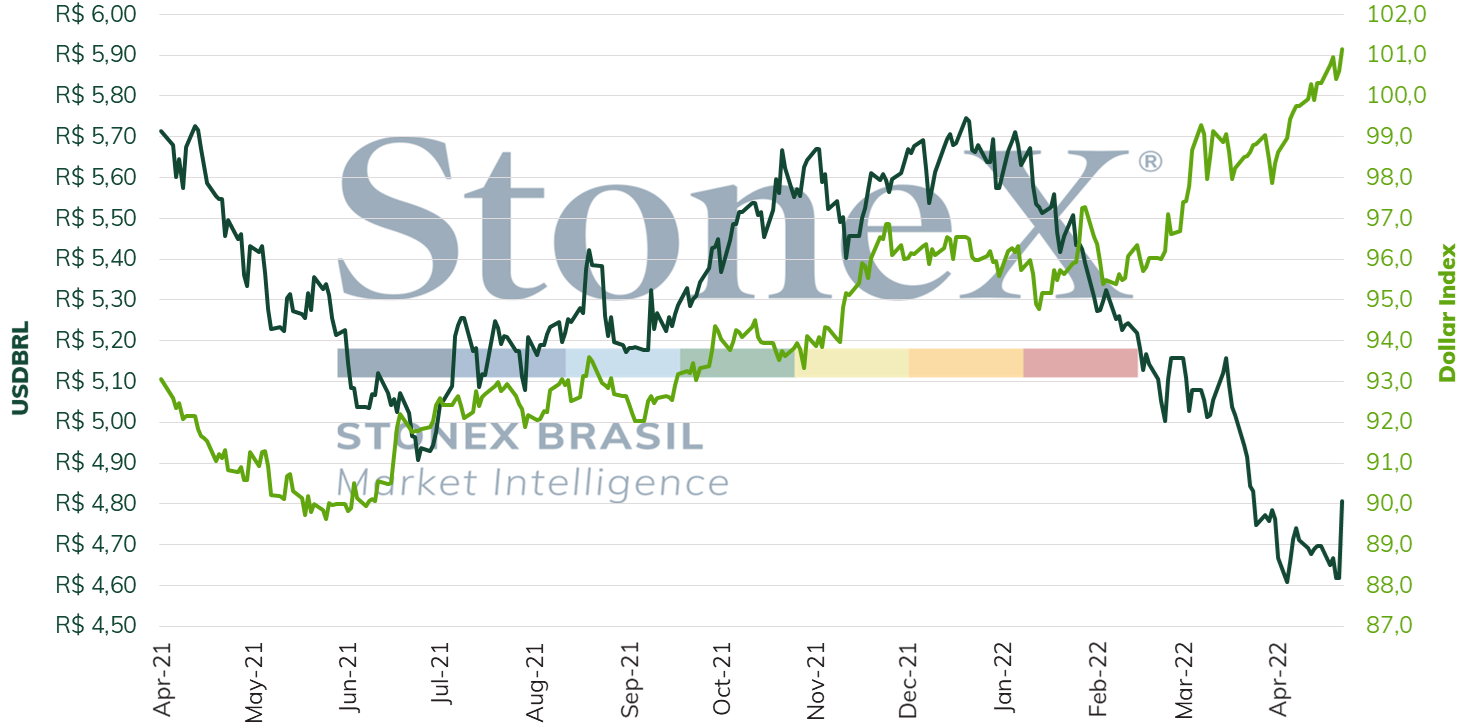
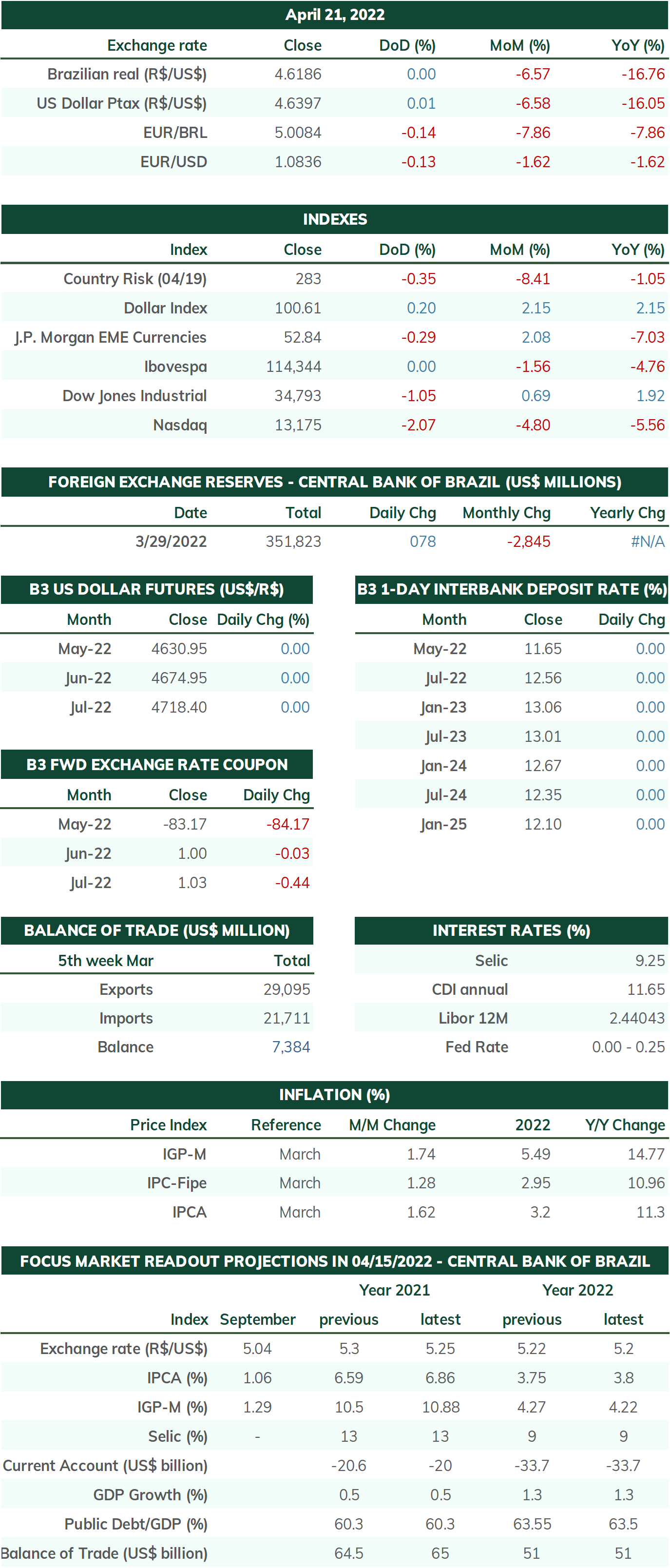
After weeks of accumulating the best performance of the year among the currencies most used by the financial market, the real was hit by an external and domestic storm in the trading session of Friday (22), when it depreciated by 4.1% and ended the day quoted at BRL 4.807. It should also be noted that it was not worse due to intervention by the Central Bank, which held an extraordinary auction of USD 571 million on the spot market - the first of the year - to contain the rise. The intraday high, registered at the auction announcement, was BRL 4.838, an increase of 4.8%.
It is important to note that the Brazilian currency had already risen by 0.3% last week, reflecting the strengthening of the American currency on the international scene. However, even this slight devaluation still placed the Brazilian currency among the best performing currencies internationally, i.e., it showed a small increase compared to the others. Last week, the international environment continued to raise bets that the Fed will be aggressive in its monetary tightening, and the flow of investments will continue to be more directed to the United States. This understanding should not change next week.
Brazil has a wide interest rate differential, which facilitates the attraction of investments even in the face of the readjustments that the Fed will make. On Friday, the real interest rate – the difference between the nominal interest rate minus inflation – in Brazil is only lower than that of Russia, a country that faces difficulties in attracting foreign investors. This wide Brazilian interest differential helps attract investors looking for "carry trade" strategies – taking financing in a low-interest country to invest in a high-interest country. However, one of the factors that contributed to Friday's sharp depreciation was comments by the president of the Central Bank, Roberto Campos Neto, giving more tranquility about the future of inflation in Brazil and signaling the monetary tightening cycle in Brazil is nearing its end. This posture of Campos Neto, already conveyed in other speeches and interviews, is not shared by market analyses, which usually point to a higher terminal level for the basic interest rate (Selic) than that suggested by the Central Bank.
However, what changed the direction of the exchange rate flows and made the Real depreciate by more than 4%, something extremely unusual, was the return of fiscal and political risks. Although there are important indicators to be released next week, such as the National Wide Consumer Price Index 15 (IPCA-15) and the labor market data in March, analysts' focus will likely remain on these risks. Throughout the week, press reports reported both that the President of the Republic, Jair Bolsonaro, wished to grant a linear readjustment to the federal civil service higher than 5%, without making explicit what the financing of this increase would be, and that the President of the Chamber of Deputies, Arthur Lira (PP-AL) gave an interview in which he affirmed there was a "risk" that the average benefit of the Brazil Aid program would be readjusted again beyond the current BRL 400 due to the "worldwide" high inflation since the values were approved, after having already been raised in December last year.
In the aftermath, Bolsonaro sparked a new crisis between the branches of government. A day after the STF convicted, by ten votes to one, Congressman Daniel Silveira (PTB-RJ) for the crimes of coercion in the course of the process and attack on the democratic rule of law, the leader of the Executive decreed pardon using a "constitutional grace" - an unprecedented measure for the 1988 Constitution and a form of pardon unused since December 1945. The decree with the grace was published in an extra edition of Thursday's Diário Oficial da União. Silveira had already been sentenced to a closed regime, a BRL 200,000 fine, and the loss of his mandate and political rights. While some congressmen have already filed appeals with the supreme court questioning legal aspects of the measure, the fact is that the executive branch leader has once again decided to enter into conflict with the Judiciary, as he has done in the past. The conflicts between powers raise the perception of risk associated with Brazil and may result in higher risk premium requirements by investors, making it difficult for foreign funds to enter the country and putting upward pressure on the exchange rate.
Finally, it is worth noting that the employees of the Central Bank of Brazil have decided to temporarily suspend the strike that began on April 1 as a "vote of confidence" in the negotiations that the president of the autarchy, Roberto Campos Neto, has carried out with the federal government to obtain a counterproposal for salary adjustments for the category. Between April 20 and 29, the Central Bank workers will maintain daily half-day shutdowns and standard operations. If no proposal is received by then, the workers say, the strike will restart on May 2. This week, the autarchy should update some of the no longer published statistics. So far, only the Top 5 update on Monday, and the Focus Bulletin for April 1st, 8th, 15th, and 22nd, on Tuesday have been announced.