StoneX logo

FX Weekly Summary (Brazil Issue)

By: StoneX Intelligence Brazil, StoneX Intelligence Brazil

USDBRL trends lower to end the week at BRL 4.871
 
Leonel Oliveira Mattos
Leonardo Rossetti
Vitor Andrioli
Fears of stagflation and dollar depreciation in the foreign scenario marked the week
Bullish Factors
  • The release of the FOMC minutes and public speeches by Fed officials should reinforce the urgency of the US central bank to control inflation in the country through a fast and intense monetary tightening, which would raise the profitability of dollar-denominated bonds, attracting dollar investments.

  • China's insistence on a "zero Covid" policy could worsen supply chain logistics and slow global economic growth, negatively affecting Brazilian exports to its main trading partner.

  • Crisis among the branches of the Republic and increased public spending raise the perception of fiscal and political risks associated with Brazil, resulting in higher risk premium demands by investors, hindering the inflow of foreign resources into the country and devaluing the exchange rate.

Bearish Factors
  • Fears that the spread of inflation and the economic slowdown may be more intense than anticipated may motivate a reallocation of investment portfolios, especially avoiding the US and seeking, among others, commodity-related assets.

  • The possibility of new sanctions on Russian oil by the European Union could provoke new highs in the international commodities prices, which indirectly benefits Brazilian exports of basic products and helps attract investments to the sector.

  • A drop in the IPCA-15 and a possible vote on a limit to the ICMS tax on fuels and energy may improve the assessment of the real profitability of Brazilian securities and contribute to the strengthening of the Brazilian real.

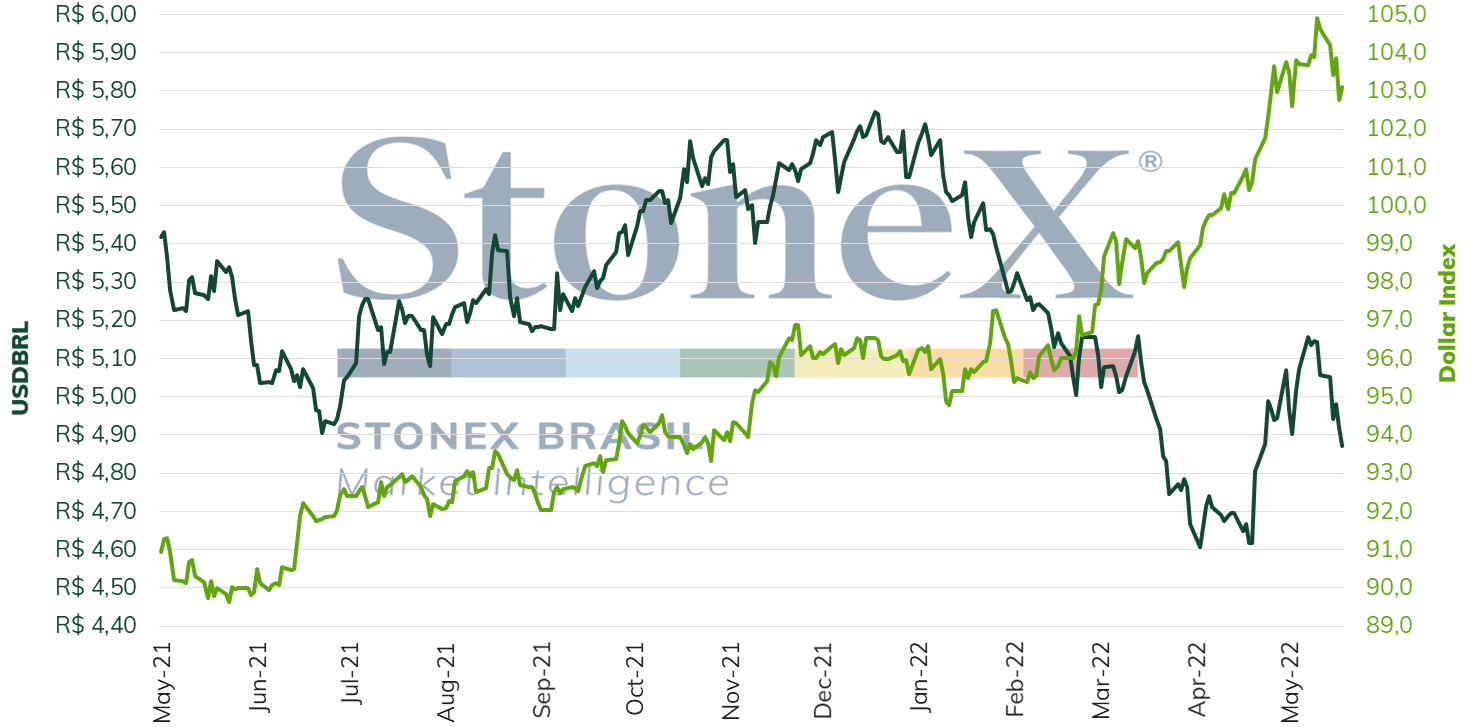
The USDBRL depreciated sharply last week to close Friday’s session (20) at BRL 4.871, a drop of 3.7% in the week, 1.5% in the month and 12.6% in the year. The Dollar Index paused its remarkable strengthening after six straight weeks of highs, ending Friday's session at 103.1 points, a variation of -1.5% in the week and stabilizing in the month. Still, the index accumulates an increase of 7.9% in the year. Growing fears that the reduction in economic growth and the acceleration in inflation will be greater than anticipated and may throw the world into a recession marked the week. The movement was intensified by the release of results from American retail companies much lower than expected, which motivated an outflow of investments from the United States, in general, and from the stock market, in particular, benefiting European markets, commodities and currencies of primary product exporting countries, such as Brazil.
USDBRL AND DOLLAR INDEX (POINTS)
image 38354
Source: CommodityNetwork Traders’ Pro. Design: StoneX.

Foreign Scenario

This week, attention should turn to the minutes of the May monetary policy decision meeting of the Fed's Federal Open Market Committee (FOMC) to be published on Wednesday (25). The document should reaffirm the commitment of the American central bank to reduce inflation rates in the country, prioritizing price stabilization over economic activity or even job creation. It will be important to monitor if the minutes include details about the expected interest rate level at the end of the monetary tightening and the pace required for this contraction. In the past two weeks, several Committee officials have spoken in favor of raising interest rates to their "neutral level" by the end of this year, which would include "multiple" 0.50 percentage point increases. Moreover, they have all highlighted their willingness to act more aggressively if the price acceleration continues to spread or intensify. This week's speakers include Federal Reserve Chairman Jerome Powell, Fed Vice Chair Lael Brainard, Kansas City Fed Chair Esther George, St. Louis Fed President James Bullard, Minneapolis Fed President Neel Kashkari, and Atlanta Fed President Raphael Bostic.

The Personal Consumption Expenditure Price Index (PCE), the inflation indicator most commonly used by the Fed to track consumer prices, will also be released this week. Median expectations point to an increase of 0.3% in April, down from March (+0.9%) due to a slowdown in the healthcare and financial services sectors. Thus, the retreat of the indicator should not be interpreted as a sign that inflationary pressures are lower by analysts and will probably have little weight in Federal Reserve's monetary tightening process. In addition, the release of preliminary Purchasing Managers' Index (PMI) data for the country should provide more details about cost pressures, logistical bottlenecks, and the country's businesses demand resilience.

Regarding the war between Russia and Ukraine, another week passes with little change in its scenario and no end in sight. Ukrainian troops were successful in a few counterattacks in the north, in Kharkiv, and the Russians made small advances in the east, in the Donbas region, near Rubijne and Popasna. The war continues to be of intense Russian artillery and bombardment, decimating Ukrainian civilian and military infrastructure, while Kiyv continues to defend itself and counterattack. The biggest breakthrough of the week was the surrender of the Mariupol fighters hiding in the Azovstal metallurgy site after 82 days of resistance. Sweden and Finland have requested to join the North Atlantic Treaty Organization (NATO), and so far, Moscow has not retaliated against the measure significantly, either militarily or economically.

Finally, it is worth noting that an analysis by Nomura bank on May 16 estimated that 38 Chinese cities are in partial or total lockdown, affecting 271 million people. This corresponds to approximately 20% of the Chinese population and 27% of China's Gross Domestic Product. In Shanghai, restrictions slowly eased after the city went five days without new coronavirus cases outside the quarantine zone. In other cities that have gone through lockdown, three days without new cases was an unofficial goal used by authorities before the quarantine state ended. Beijing is moving in the opposite direction, increasing restrictions without full lockdown status. Districts are administering the measures, and only essential sectors are operating freely.

Domestic Scenario

This week should be empty of indicators due to the continuity of the Central Bank servers' strike in Brazil. After the frustrated attempt by the Central Bank of Brazil's board of directors to propose a 22% salary readjustment, withdrawing the proposal on the same day, the National Treasury's employees have decided to go on strike from this Monday (23) and 70% of those who belonged to commissioned positions have requested their resignation. Several statistics are still not updated, such as fiscal, monetary and credit statistics, foreign sector statistics, weekly data on foreign exchange flows, commodity indices and even the Focus bulletin. The information vacuum hampers the ability to interpret economic movements in real-time.

This week, President Jair Bolsonaro said that the executive branch would cut spending by BRL 17 billion to fund a 5% across-the-board increase for federal employees without specifying which areas would be affected by the cut. However, in the release of its Primary Revenues and Expenses Evaluation report, the Ministry of Economy again stated that the adjustment is not yet defined and made no provision in the Budget for adjustments. There was a freeze of BRL 9.9 billion to comply with the spending cap, but it resulted from the forecast of increases in primary spending. For months the Presidential Administration has promised a 5% readjustment for civil servants, but, so far, there has been no formalization of the proposal in Congress.

It will also be important to follow the release of the National Broad Consumer Price Index - 15 (IPCA-15) for May. The indicator should slow down after an increase of 12.03% over 12 months in April due to the change in the electricity tariff flag from Water Scarcity to Green. However, it is known that the drop should be temporary and that it is also necessary to observe the other categories – in April, almost 80% of the 377 products that make up the IPCA-15 showed an increase. Therefore, the Central Bank expects a lag between the monetary tightening carried out since March of last year and its effects on prices. Hence, a much greater tightening of the basic interest rate (Selic) is unnecessary. On May 20, the interest rate futures market was pricing a 97% chance of a 0.50 percentage point readjustment in the Selic in June, from 12.75% to 13.25%.

Finally, this week, a bill may be voted to make fuels, electricity, telecommunications and transport an "essential goods" category, imposing a maximum rate of 17% on the Tax on the Movement of Goods and Services (ICMS) of these products. The president of the Chamber of Deputies, Arthur Lira (PP-AL), declared that he would put the project on the agenda next Tuesday (24) to reduce the price of these goods and services and, thus, contain the pressure on inflation indices. This proposal should face strong resistance from the states and their governors, whose tax revenue would be reduced with the project and possible constitutional challenges. In theory, it is up to the states to define the attribution of essentiality in applying ICMS.


image 35317
 
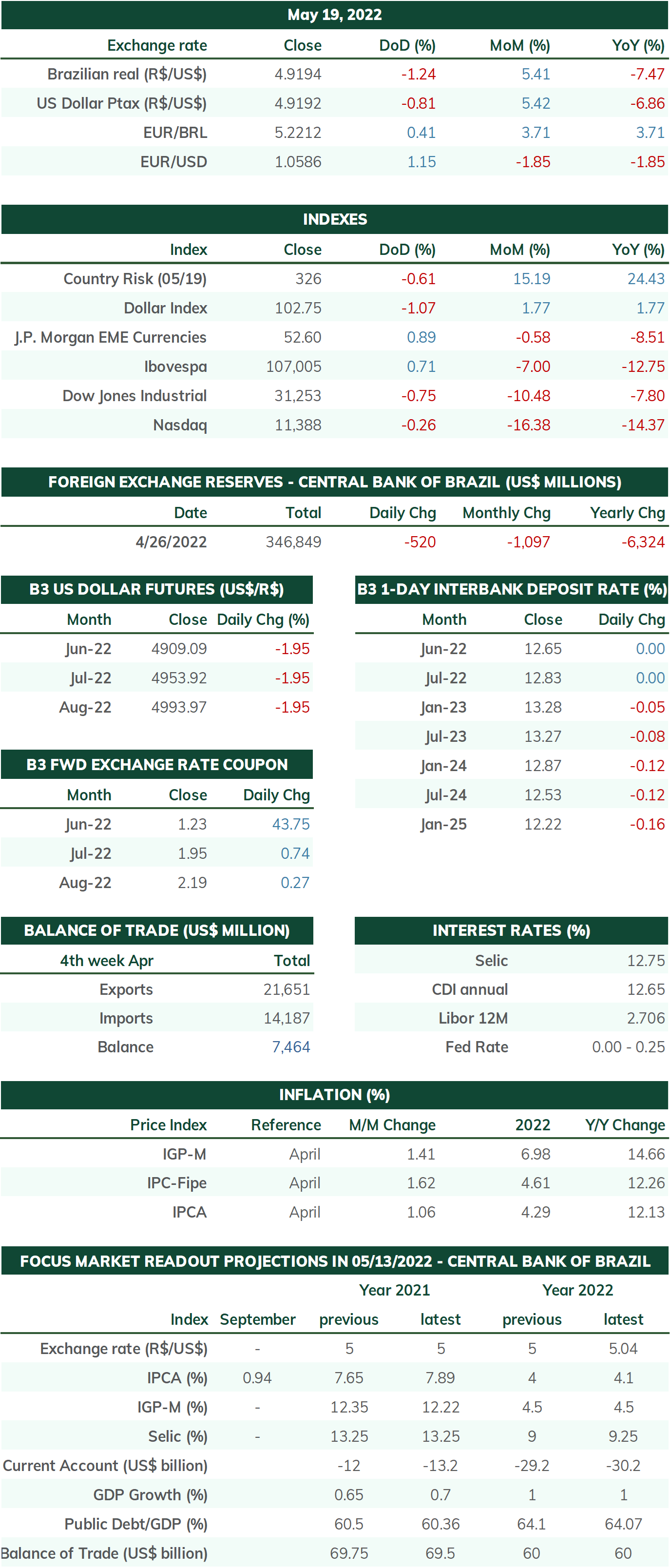
ECONOMIC INDICATORS
image 38355
Sources: Central Bank of Brazil; B3; IBGE; Fipe; FGV; MDIC; IPEA and CommodityNetwork Trader’s Pro.
 
  • Currencies

The StoneX Group Inc. group of companies provides financial services worldwide through its subsidiaries, including physical commodities, securities, exchange-traded and over-the-counter derivatives, risk management, global payments and foreign exchange products in accordance with applicable law in the jurisdictions where services are provided. References to over-the-counter (“OTC”) products or swaps are made on behalf of StoneX Markets LLC (“SXM”), a member of the National Futures Association (“NFA”) and provisionally registered with the U.S. Commodity Futures Trading Commission (“CFTC”) as a swap dealer. SXM’s products are designed only for individuals or firms who qualify under CFTC rules as an ‘Eligible Contract Participant’ (“ECP”) and who have been accepted as customers of SXM. StoneX Financial Inc. (“SFI”) is a member of FINRA/NFA/SIPC and registered with the MSRB. SFI is registered with the U.S. Securities and Exchange Commission (“SEC”) as a Broker-Dealer and with the CFTC as a Futures Commission Merchant and Commodity Trading Adviser. References to securities trading are made on behalf of the BD Division of SFI and are intended only for an audience of institutional clients as defined by FINRA Rule 4512(c). References to exchange-traded futures and options are made on behalf of the FCM Division of SFI . StoneX is a trading name of StoneX Financial Ltd (“SFL”). SFL is registered in England and Wales, Company No. 5616586. SFL is authorized and regulated by the Financial Conduct Authority [FRN 446717] to provide to professional and eligible customers including: arrangement, execution and, where required, clearing derivative transactions in exchange traded futures and options. SFL is also authorised to engage in the arrangement and execution of transactions in certain OTC products, certain securities trading, precious metals trading and payment services to eligible customers. SFL is authorised & regulated by the Financial Conduct Authority under the Payment Services Regulations 2017 for the provision of payment services. SFL is a category 1 ring-dealing member of the London Metal Exchange. In addition SFL also engages in other physically delivered commodities business and other general business activities which are unregulated and not required to be authorised by the Financial Conduct Authority. StoneX Group Inc. acts as agent for SFL in New York with respect to its payments services business. StoneX APAC Pte. Ltd. acts as agent for SFL in Singapore with respect to its payments services business. ‘StoneX’ is the trade name used by StoneX Group Inc. and all its associated entities and subsidiaries.
 
Trading swaps and over-the-counter derivatives, exchange-traded derivatives and options and securities involves substantial risk and is not suitable for all investors. Past performance of any futures or option is not indicative of future success. Indicators are not a trading system and are not published as a specific trade recommendation. The information herein is not a recommendation to trade nor investment research or an offer to buy or sell any derivative or security. It does not take into account your particular investment objectives, financial situation or needs and does not create a binding obligation on any of the StoneX group of companies to enter into any transaction with you. You are advised to perform an independent investigation of any transaction to determine whether any transaction is suitable for you. No part of this material may be copied, photocopied or duplicated in any form by any means or redistributed without the prior written consent of StoneX Group Inc.
 
© 2026 StoneX Group Inc. All Rights Reserved.

Satellite view of Earth at night showing illuminated cities across Asia and the Middle East

Discover more insights

Our subscribers have access to comprehensive market analysis from StoneX spanning commodities, equities, currencies and more.

StoneX: We open markets

Our market expertise, advanced platforms, global reach, culture of full transparency and commitment to our clients’ success all set us apart in the financial marketplace.

Reach

With access to 40+ derivatives exchanges, 180+ foreign exchange markets, nearly every global securities marketplace and numerous bi-lateral liquidity venues, StoneX’s digital network and deep relationships can take clients anywhere they want to go.

Transparency

As a publicly traded company meeting the highest standards of regulatory compliance in the markets we serve, our financials and record of accomplishment are matters of public record. StoneX’s commitment to “doing the right thing over the easy thing” sets us apart in the industry and helps us build respect, client trust and new partnerships.

Expertise

From our proprietary Market Intelligence platform, to “boots on the ground” expertise from award-winning traders and professionals, we connect our clients directly to actionable insights they can use to make more informed decisions and achieve their goals in the global markets.