Foreign Scenario
This week, the focus will be on Federal Reserve Chairman Jerome Powell's testimony to the US Congress as part of his biannual accountability routine. His remarks, and the demands made by American legislators, should focus on the urgent need to reduce the inflation rate and ease the heavy burden carried by American families. Last week, after the Fed adopted its biggest interest rate hike since 1994, Powell said he was "sharply focused” on returning price levels to their 2% target. However, this decision provoked intense volatility in the financial markets, which feared that the monetary tightening to be carried out by the American central bank could provoke an economic recession soon. On Friday (17), the interest rate futures market was betting mostly that interest rates will be between 3.50% and 3.75% by the end of 2022, representing a 2.0 percentage point increase in four decisions. Speeches by other Federal Reserve officials should also be highlighted in the media. This week's speakers include Cleveland Fed President Loretta Mester, Richmond Fed President Tom Barkin, Chicago Fed President Charles Evans, and Philadelphia Fed President Patrick Harker.
This week will be relatively sparse in economic indicators. However, there may be more weight than usual for the preliminary US Purchasing Managers' Index (PMI) data for manufacturing, services, and consolidated, which will be released on Thursday. In light of the intense concerns and heightened reactions of financial markets to the possibility of an economic slowdown soon, the previous PMIs can help understand the current state of manufacturing activity in the United States.
It is also important to note that the war between Russia and Ukraine continues to head towards becoming a long, drawn-out conflict, with little significant progress and significant depletion of war resources for both sides. Russian troops continue to focus efforts, and advancing at a slow rate, on the Donbas in eastern Ukraine. Moscow dominates all of Luhansk territory and now seeks to gain ground in Donetsk. Ukrainian military leaders have said that the Russians are fighting with troops smaller than a typical battalion size in an increasingly improvised ("ad hoc") manner and advancing on nine simultaneous fronts. Meanwhile, the Ukrainians have been more successful in their counterattacks in the border region near Kharviv in the north and Kherson in the south.
As the conflict continues, the pressure on the supply of various food, metal, and especially energy commodities remains high. To make matters worse, last week, there was a fire at a liquefied natural gas plant in Freeport, Texas. The damage will require repairs until September, preventing a return to full capacity production by the end of the year. The plant accounts for approximately 20 percent of US exports of the input. In addition, the Russian company Gazprom announced the reduction of about 40% in the supply of natural gas to Germany due to allegedly necessary repairs to the old Nordstream pipeline. The new Nordstream 2 pipeline is ready; however, its use has been prevented by sanctions against Moscow. The second half of the year is crucial for building up stocks for the winter season, a move that this reduction may threaten.
Finally, it is worth mentioning the Covid-19 situation in China. In Shanghai, less than two weeks after coming out of official quarantine status, municipal authorities have again banned face-to-face service in bars and restaurants in most districts and will require mass testing of the population every weekend until the end of July in an attempt to contain the growing number of cases in the city. In Beijing, authorities are in a "race against time" to contain a Covid-19 outbreak related to a 24-hour bar. So far, there have been 287 confirmed cases linked to this incident. This implies that millions of people undergo mandatory testing and partial confinements applied to districts with confirmed cases. For the time being, the authorities have not reimposed the restrictive measures that were in place in May, such as bans on bars and restaurants and social gatherings. Still, investors fear that the Chinese zero tolerance for the new coronavirus will put the capital on a new quarantine and isolation course. An analysis by Nomura bank on June 13 estimated that 6 Chinese cities are in partial or total lockdown, affecting a total of 67.9 million people, a weekly drop of almost 8% in the number of people in lockdown. This still corresponds to approximately 4.8% of the Chinese population and 9.0% of China's Gross Domestic Product.
Domestic Scenario
This week, the focus should continue on the decision of the Central Bank of Brazil’s Monetary Policy Committee (Copom). Last week, the Central Bank of Brazil adjusted its Selic rate from 12.75% p.a. to 13.25% p.a., in its 11th consecutive interest rate increase. In a statement, the Monetary Policy Committee said it anticipates another adjustment, of equal or lesser magnitude, at its next meeting in August. Concerning prices in Brazil, the document stated that consumer inflation continued to surprise negatively, both in more volatile components and in items associated with underlying inflation. In this scenario, the Central Bank now sees the IPCA at 8.8% at the end of this year, compared to a projection of 7.3% in the last meeting, from 3.0% to 4.0% in 2023, and 2.7% in 2024. However, the monetary authority warned about the fuel subsidy proposals in Congress, arguing that they "significantly reduce inflation in the current year, although they will raise, to a lesser extent, inflation over the relevant monetary policy horizon.
Fiscal and political risks should remain in the spotlight this week. Last week, the National Congress approved, in both legislative houses, the basic text of the complementary law project (PLP) 18/22, which classifies fuels, electricity, public transportation, natural gas and communications as "essential and indispensable," limiting the state ICMS rate charged on these goods. The proposal foresees compensation to the states by reducing debts with the Union every time the drop in state collection exceeds 5%. The approved text also reduces to zero the Cide and PIS/Cofins rates on gasoline until December 31, 2022. Currently, these federal taxes are already zeroed for diesel and cylinder gas. The rapporteur also chose to bring down to zero the PIS/Cofins levied on hydrous and anhydrous ethanol added to gasoline. In addition, a proposed constitutional amendment (PEC) was also approved, which maintains the competitiveness of biofuels against fossil fuels. This competitiveness is to be achieved through a favorable tax regime for biofuels, to be detailed in a complementary bill.
Even before Brazil’s President, Jair Bolsonaro, ratifies this legislation, Petrobras announced, on Friday (17), a 5.18% readjustment in the gasoline price (from BRL 3.86 to BRL 4.06/liter) and 14.26% increase in the diesel price (from BRL 4.91 to BRL 5.61/liter) sold at the company's refineries. The price of cylinder gas was unchanged (BRL 4.23/kg). Diesel had 38 days without readjustment, while gasoline had 99 days without readjustment. Even with these increases, StoneX estimates that diesel is still 45 cents cheaper than the prices charged internationally.
The reaction of the Executive and Legislative branches was swift and forceful. Bolsonaro stated on social media that "Petrobras can plunge Brazil into chaos. Its president, directors, and board members well know what happened with the truck drivers' strike in 2018, and the dire consequences for Brazil's economy and the lives of our people." The president of the Chamber of Deputies, Arthur Lira (PP-AL), said that the current president of the company, José Mauro Coelho, has already been "fired by the majority shareholder, which is Brazil" and that Coelho would be trying to "massacre [the government] for his dismissal." The executive was fired after only 40 days in the job after announcing a readjustment in diesel prices on May 9. However, the government took too long to indicate the composition of the new slate of the company's Board of Directors for Compliance's evaluation; therefore, Coelho is still in office on an interim basis. This will be the second replacement of Petrobras' CEO and Chairman of the Board of Directors carried out by the government only in 2022, in addition to having already replaced the Minister of Mines and Energy, who is directly responsible for the state-owned company.
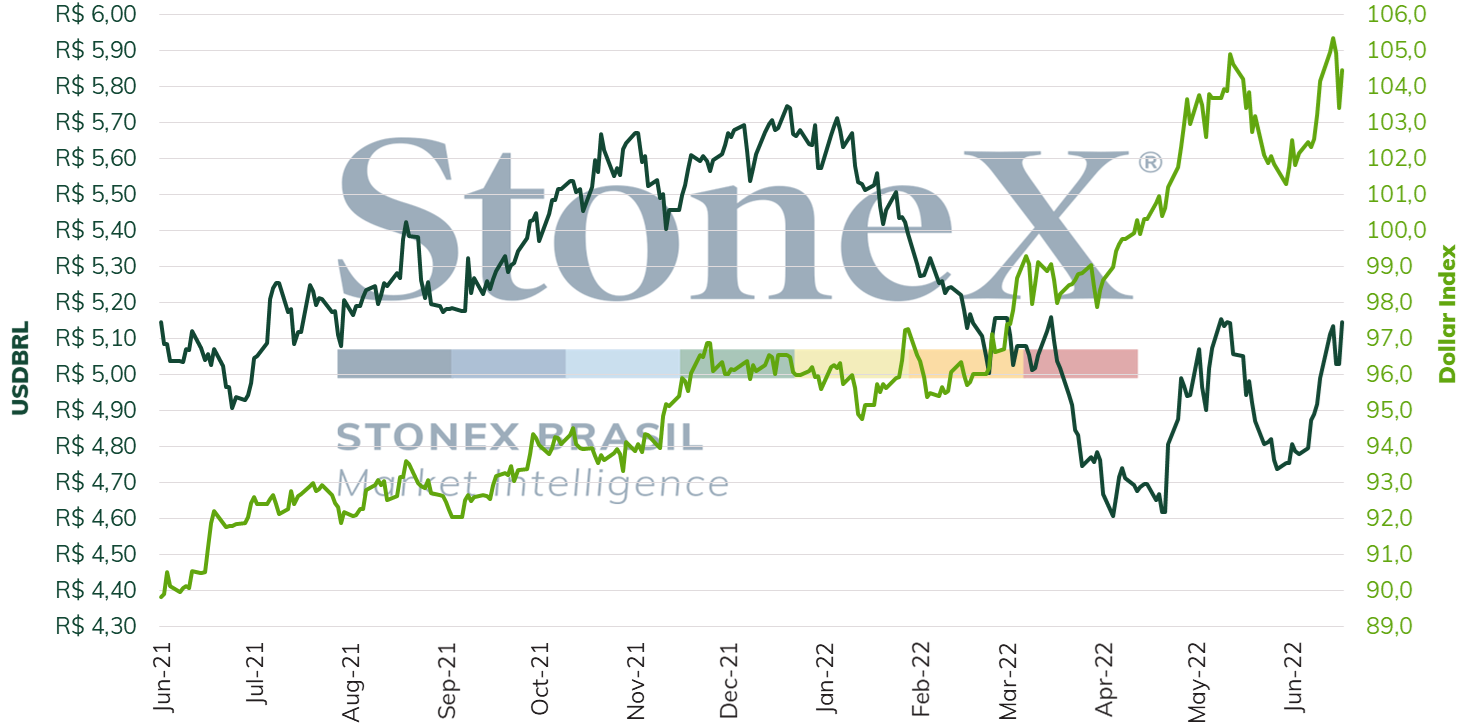
The heated public statements and the more direct interventions in management positions with the power to influence Petrobras' pricing policy may amplify the political risks associated with Brazil. In addition, such analysis associated with the subsidy projects that impose the loss of revenue in the order of ten billion reais four months before an election, circumventing the spending cap, may also raise the perception of fiscal risk associated with Brazil. Both risks could result in higher risk premium demands by investors, which could reduce the flow of foreign capital into the country and weaken the BRL.