Foreign Scenario
This week, attention should turn to the minutes of the June monetary policy decision by the Federal Open Market Committee (FOMC). Analysts point out that in previous monetary tightening, the Federal Reserve (Fed) has never ended its interest rate hike movement before the two-year yield curve reaches a positive real interest rate, i.e., above projected inflation for the next two years. Given the current persistent high price acceleration, this could mean that the Fed will still adjust the US federal funds rate significantly in the near term. Officials who spoke after the FOMC decision were in unison in warning of the risks of inflation continuing to surprise beyond expectations and the need for aggressive and rapid interest rate increases. On Friday (01), the interest rate futures market was betting mostly that interest rates will be between 3.25% and 3.50% by the end of 2022, representing a 1.75 percentage point increase in four decisions. Speakers this week include Fed Board of Governors member Christopher Waller and St. Louis Fed President James Bullard.
There will also be a focus on economic activity indicators in the United States, as investors are anxious to anticipate the possibility of a recession in the short term. For example, on Tuesday, the ISM institute publishes the services sector Purchasing Managers' Index (PMI) for June. After a lower-than-expected reading for the manufacturing PMI in the same period, when the index went from 56.1 points in May to 53.0 in June, most analysts anticipate a weakening for services as well, in line with expectations of an economic slowdown as early as Q4 2022. In addition, the June employment situation report may shed light on whether there is already some weakening of the labor market, which is currently at low unemployment rates.
In the conflict between Russia and Ukraine, the week saw further important territorial gains for the Russian army, not only in the Donbas region but also in the border region north of Kharviv and southwestern Ukraine between Kherson and Mykolaiv. Moscow has practically consolidated its hold on the city of Severodonetsk and is preparing to advance towards Lysychansk. The region is more open terrain, and numerical superiority in artillery and missiles favors the Russian advance, which is razing everything in its path. Kiyv continues receiving fresh supplies from the Western alliance, and it is too early to determine if there is any bias in the war. However, the advances to northern and southwestern Ukraine may indicate that Russia has goals beyond Luhansk and Donetsk's territories, even though these are undoubtedly its main targets. In the Donbas, after consolidating its hold on Severodonetsk, Moscow quickly gained territory through northern Donetsk, crossing Klynove, Popasna and Hirske, and has already reached Lysychansk. Because it is a less urban and wider territory, Russian artillery, missile, and air strike superiority are critical to conquests at the front. Meanwhile, Kiyv continues to plead with its partners for longer-range weapons to be able to defend itself more effectively but has so far been unsuccessful.
Finally, it is worth mentioning the Covid-19 situation in China. An analysis by Nomura bank on June 27 estimated that 5 Chinese cities are in partial or total lockdown, affecting a total of 67.6 million people, a weekly drop of almost 25% in the number of people in lockdown. However, this corresponds to approximately 4.8% of the Chinese population and 10.1% of China's Gross Domestic Product.
Domestic Scenario
This week’s focus will be on political news and heightened perceptions of fiscal and political risks related to Brazil. Last week, investors reacted badly to the approval of the proposed constitutional amendment (PEC) 1/2022 in the Federal Senate, in two rounds and by a large majority vote. The basic text of the project was presented at 11:40 am on Wednesday, modified on Thursday and approved on the same day by the parliamentarians. According to the rapporteur, Senator Fernando Bezerra Coelho (MDB-PE), the proposal's fiscal impact will be BRL 41.25 billion. Still, no details of the calculations were presented, and no other institution was able to make its estimate before the vote. In summary, the measures approved in the substitute text are the declaration of a "state of emergency due to the extraordinary and unpredictable rise in oil prices, fuels and their derivatives and the social impacts resulting therefrom", the temporary increase of BRL 200 in the income transfer program Auxílio Brasil for five months, the immediate inclusion of all families registered in the program who do not yet receive this benefit, the doubling of the value of the “bottled gas aid”, the creation of a financial aid of BRL 1000 for independent truck drivers for six months, the creation of a financial aid for taxi drivers of an unmentioned value, the subsidy for free public transportation for the elderly, financial compensation to the States to guarantee tax competitiveness of hydrous ethanol compared to gasoline, and the budgetary supplementation of BRL 500 thousand for the Programa Alimenta Brasil (aimed at buying the agricultural production of families and donating food to people in a situation of food and nutritional insecurity).
The report is explicit that the declaration of a state of emergency is necessary to evade the prohibitions of the Electoral Law, which prohibits the creation or expansion of social benefits in an election year, and "to give the necessary legal support to the different public policies, since the suggested recommendations do not respect the Fiscal Responsibility Law (exempts the need for compensation in the form of reduction of expenses or increase of revenues), are not accounted for in the spending cap (they would be financed by extraordinary credit) and do not obey the golden rule (allows indebtedness to finance the current expenses of the public sector).
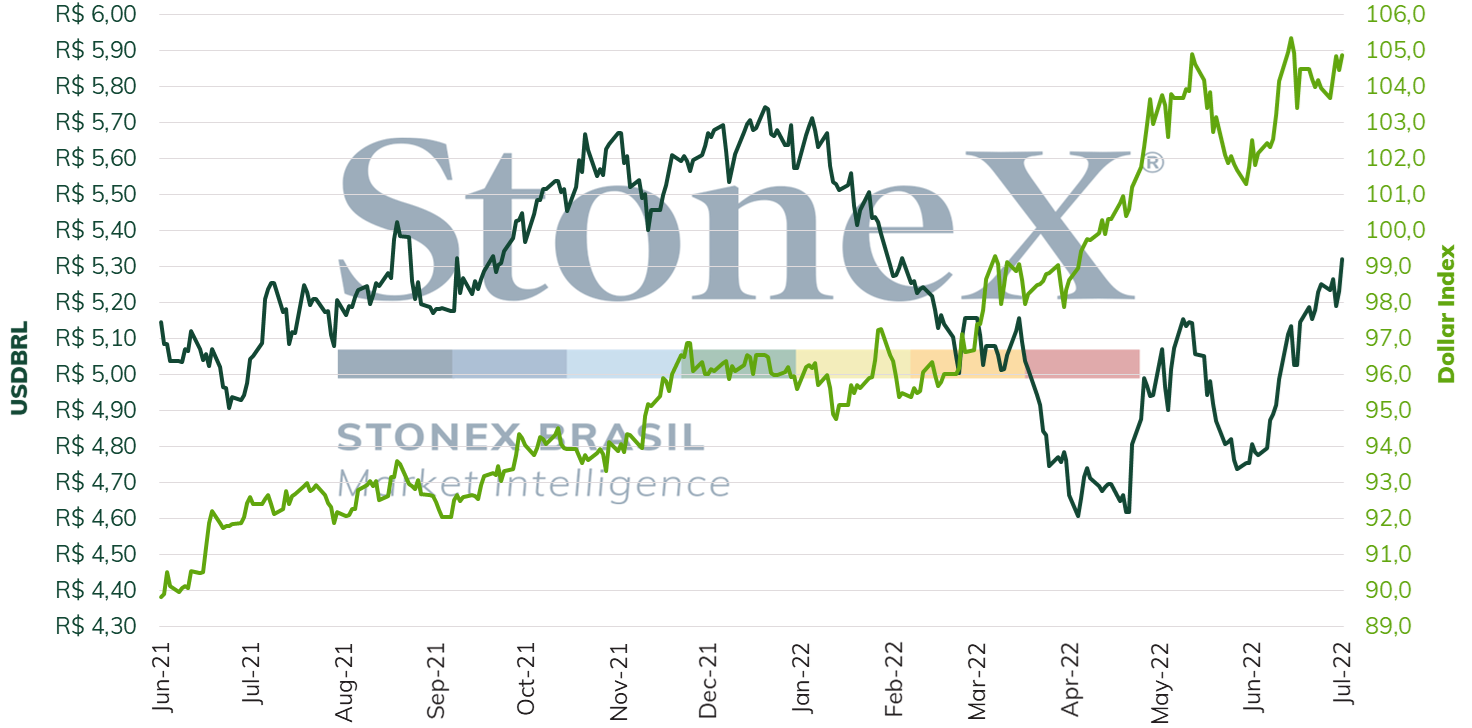
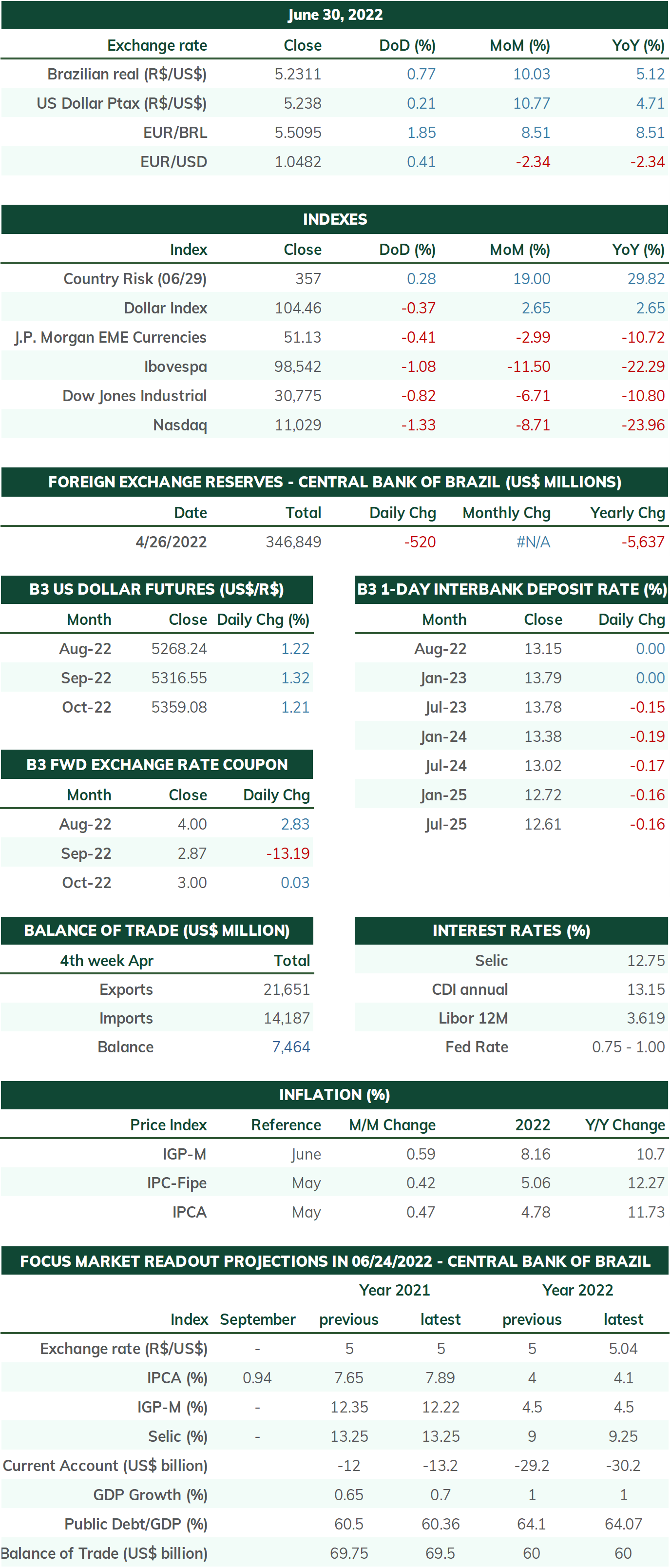
The decree of a state of emergency and the improvisations and changes in the public budget to the tune of tens of billions of reais almost three months before an election, evading the spending cap may raise the perception of fiscal risk associated with Brazil. Both risks could result in higher risk premium demands by investors, which could reduce the flow of foreign capital into the country and weaken the BRL. A measure of risk to the country, the spread on Brazil's 5-year Credit Default Swap contracts this week reached its highest value since May 2020, while net inflows of foreign capital at the B3 through June 29 remained very close to stable.
It is worth noting, however, that some specific indicators have suggested a possible expansion of the Gross Domestic Product (GDP). Firstly, the Central Bank (BC) updated its economic projections in its quarterly inflation report and raised its forecast for the 2022 GDP from 1.0%, made in March, to 1.7%, citing the higher-than-expected economic growth in the first quarter of this year and the income and consumption expansion measures adopted by the federal government. In addition, the Brazilian Institute of Geography and Statistics (IBGE) revealed that the unemployment rate decreased from 10.5% in the quarter ended in April to 9.8% in the quarter ended in May. It is the first time that the indicator registers a level below 10% since the beginning of 2016 and represents a significant drop compared to the 14.7% recorded in the same period last year. Finally, the Brazilian National Agency of Petroleum, Natural Gas and Biofuels (ANP) reported that, despite the rise in prices of oil and its derivatives, sales between January and May of all fuels reached the highest level since 2015, while sales between January and May of diesel oil is at its highest historical level (series starting in 2000). Traditionally, there is a strong correlation between fuel consumption and growth, so this high level suggests a warming economic activity.
However, it is necessary to point out that other national indicators indicate a deceleration of the internal expansion and that there is no clearly defined trend. Initially, the Central Bank has been carrying out a deep monetary tightening process for more than a year, which has brought the basic interest rate (Selic) from 2.00% p.a. to currently 13.25% p.a., making consumer and corporate financing more expensive. Besides this, the IBGE shows that the average income has been practically stationary since the beginning of the year and is 6.8% lower than the amount received last May (BRL 2,540 versus 2,726). It is also important to point out that there is great concern about the possibility of economic stagnation in the world's major economies, which could negatively impact Brazilian exports and drive the outflow of financial capital from Brazil.