StoneX logo

FX Weekly Summary (Brazil Issue)

By: StoneX Intelligence Brazil, StoneX Intelligence Brazil

USDBRL trends lower to end the week at BRL 5.074
 
Leonel Oliveira Mattos
Leonardo Rossetti
Vitor Andrioli
USDBRL reflects inflation relief in the US and Copom minutes in Brazil
Bullish Factors
  • Minutes of the Federal Open Market Committee's decision should highlight the urgency of the US central bank to control inflation in the country through a fast and intense monetary tightening, which would raise the profitability of dollar-denominated bonds and attract investments to this currency.

  • Water and energy crises in Europe can generate an environment of risk aversion and search for safe-haven assets, strengthening the dollar against other currencies.

  • Approaching October elections and the Bolsonaro administration's quest to improve its popularity through projects that increase spending, reduce tax collection, and do not respect the spending cap raise the perception of fiscal and political risks associated with Brazil, resulting in investors demanding a higher risk premium, hampering the inflow of foreign funds into the country, and devaluing the exchange rate.
    desvalorizando a taxa de câmbio.

Bearish Factors
  • Lower than expected readings for economic indicators in the United States may reinforce the interpretation that the country is going through a slowdown and that the Fed does not need to raise interest rates so much, favoring risky assets.

  • The consolidation of expectations that the Copom will no longer increase the Selic rate has increased. On the other hand, the appetite for variable income assets, especially equities.

  • Higher than expected readings for economic indicators in Brazil may improve assessments of the performance of the Brazilian economy, aiding an appreciation of domestic assets.

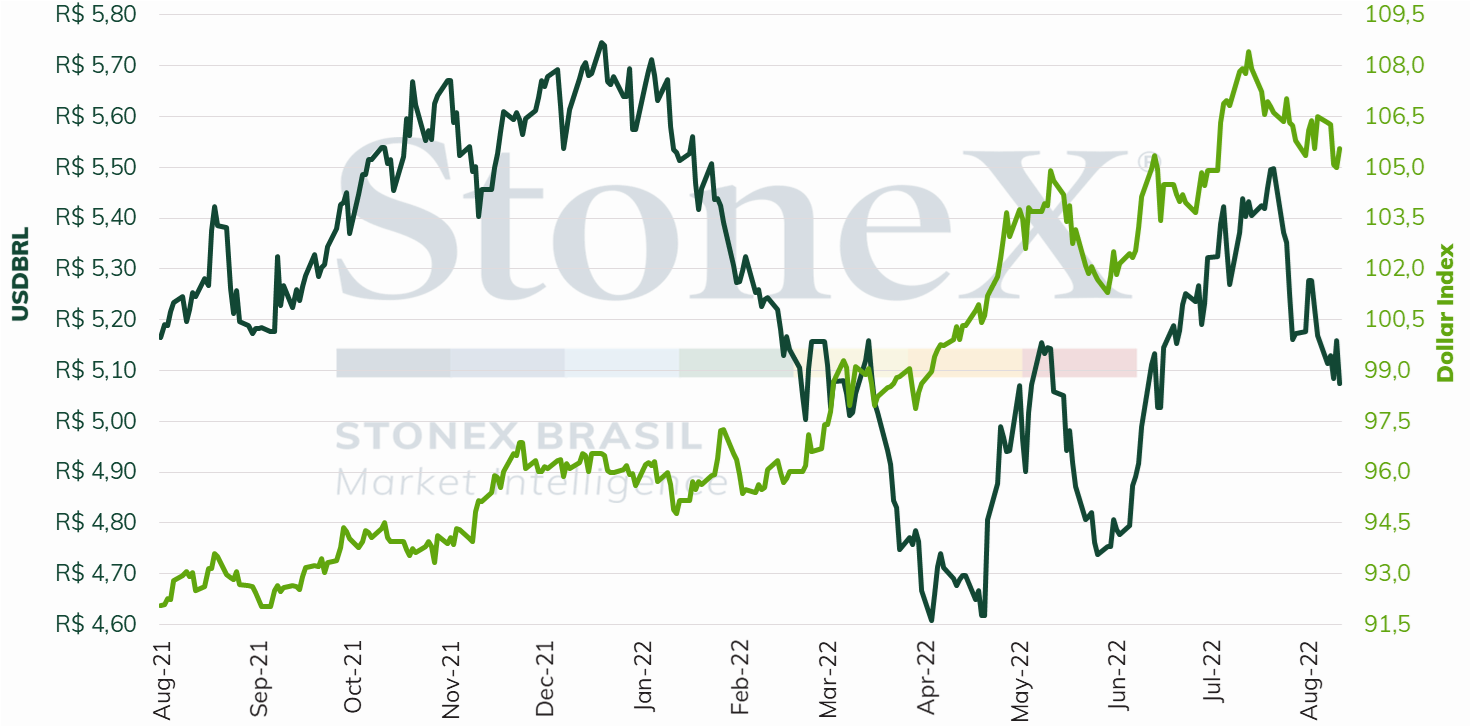
The USDBRL ended Friday’s session (12) quoted at BRL 5.074, a retreat of 1.8% in the week, 1.9% in the month and 9.0% in the year. Meanwhile, the dollar index closed the week quoted at 105.6 points, a change of -0.9% for the week, -0.2% for the month and +10.4% for the year. The lower than expected figure for the July Consumer Price Index (CPI) and the Producer Price Index (PPI) in the United States marked the week, raising hopes that the Federal Reserve (Fed) may moderate its pace of interest rate increases. In Brazil, the release of the minutes from the Monetary Policy Committee decision consolidated the interpretation that the interest rate readjustments ended in the last meeting, boosting, by contrast, the stock market in the country.

USDBRL AND DOLLAR INDEX (POINTS)
image 46594
Source: Commodity Network Trader’s Pro. Design: StoneX.

Foreign Scenario

This week, the focus will be on the monetary policy decision of the Federal Reserve’s (Fed) Federal Open Market Committee (FOMC). The document is expected to provide more detail on the future path for the US interest rate, particularly given the volatility of interpretations that have occurred since the decision on July 27. Immediately following the decision, an ill-placed comment by Fed Chairman Jerome Powell and the release that US gross domestic product (GDP) contracted for the second consecutive quarter sparked a wave of downward bets in the US interest rate futures market. Subsequently, FOMC officials sought to realign public perception regarding the Federal Reserve's willingness to remain aggressive in its pace of interest rate hikes, and bets quietly rose.

This week, the plot was similar, as the release of both the Consumer Price Index (CPI) and the Producer Price Index (PPI) below analysts' estimates generated hope that prices may begin a downward trajectory subsequently and that the Federal Reserve, therefore, may also moderate its pace of US interest rate adjustments. And once again, presidents of the Fed's regional offices have come out publicly to reiterate the institution's firm commitment to price stabilization and recovering expectations for future interest rates. It is worth pointing out that this volatility of interpretation is a direct result of the FOMC's lack of forward guidance and that, after major changes in public perceptions, the authorities that make up the Committee seek to use interviews, talks and speeches to, precisely, provide a guide to the future. Scheduled to speak this week are Kansas City Fed President Esther George and Minneapolis Fed President Neel Kashkari.

In addition to the Federal Reserve minutes, analysts should follow the release of retail sales and industrial production data, both for July, in search of more clarity about the current economic situation in the United States. The past few weeks have been marked by conflicting information, sometimes pointing to a slowdown, such as the negative second quarter GDP, lower than expected inflation readings, and the rising trend in weekly unemployment claims, and sometimes pointing to a vigorously heated economy, such as the net balance of job creation and generally good earnings releases from publicly traded companies.
In Europe, this week's concerns are centered on the continent's energy security, which is also experiencing a severe water crisis. Temperatures are so high and the lack of rainfall so severe that the continent will most likely face logistical difficulties due to the low quantity of water in the Rhine River. The amount of traffic is already down to a third of usual, causing delays, and the waterway is so low in some places that it may soon become impossible for large cargo vessels to pass through. The alternatives would be to wait for hypothetical future rainfall, reduce the ship's load, or circle the continent – all costly. Worse, August, September and October are historically the driest months for the Rhine basin, a bad omen for Europe.

Besides the increased costs and logistical delays, about one-third of all German imports of coal, liquefied natural gas, and iron ore occurs through the Rhine River. In addition, the drought in other regions of France is affecting the cooling capacity of nuclear power plants, forcing their output to decrease by approximately 34% compared to the same period last year. Of course, added to the trade and diplomatic crisis Europe is facing with Russia, the prices of energy supplies continue to hit record highs. It seems that the continent, Germany in particular, is more dependent than ever on Russia.

Regarding the war between Russia and Ukraine, this was another week very similar to the others, that is, a war of attrition, with minimal territorial advances, the predominance of defensive positions, and a lot of artillery exchange and bombing (especially by the Russians). For weeks, analysts have been mentioning the heavy burdens the invasion would place on the Russian army and the difficulties that the Kremlin would face in replacing new soldiers and artillery, missiles and other military armaments. While these reports may be true, on the battlefront, Moscow is getting the upper hand over Kyiv, both on the eastern front (Bakhmut, especially) and on the southern front (Mykolaiv, Kherson, and Zaporijia). This week, several officials from the United Nations and the International Atomic Energy Agency accused Russia of operating artillery strikes from or near the Zaporizhia nuclear power plant, risking a counterattack with serious consequences. The Ukrainians, for their part, accused Russian troops of trying to disconnect the plant from the power grid, possibly wanting to replace the connections to the Russian energy system.

Domestic Scenario

This week will be relatively empty of indicators, with only the Central Bank's Economic Activity Index (IBC-Br) for June and the Getúlio Vargas Foundation's GDP Monitor for the same period worthy of note. Thus, it is expected that the foreign exchange market will trade more in tune with foreign events.

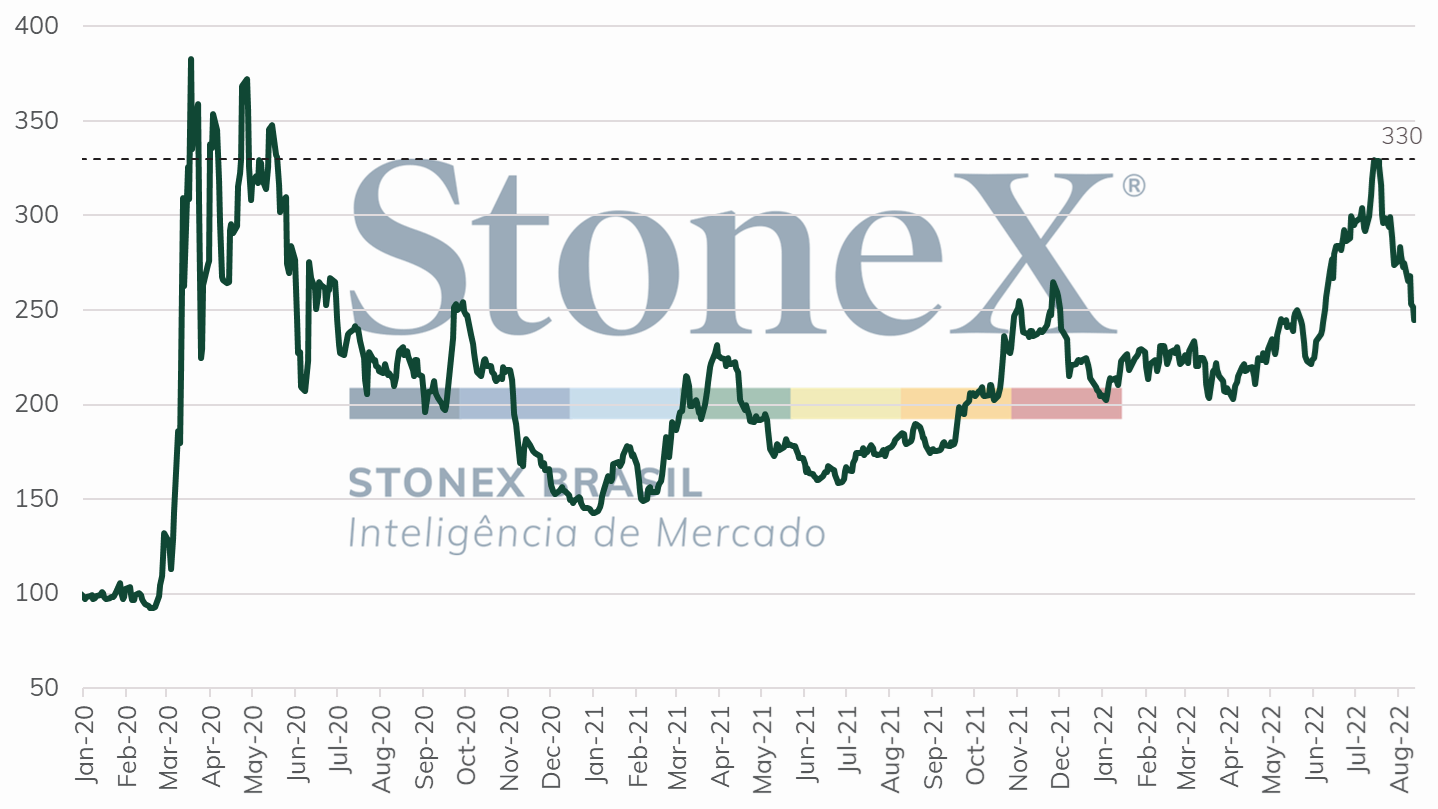
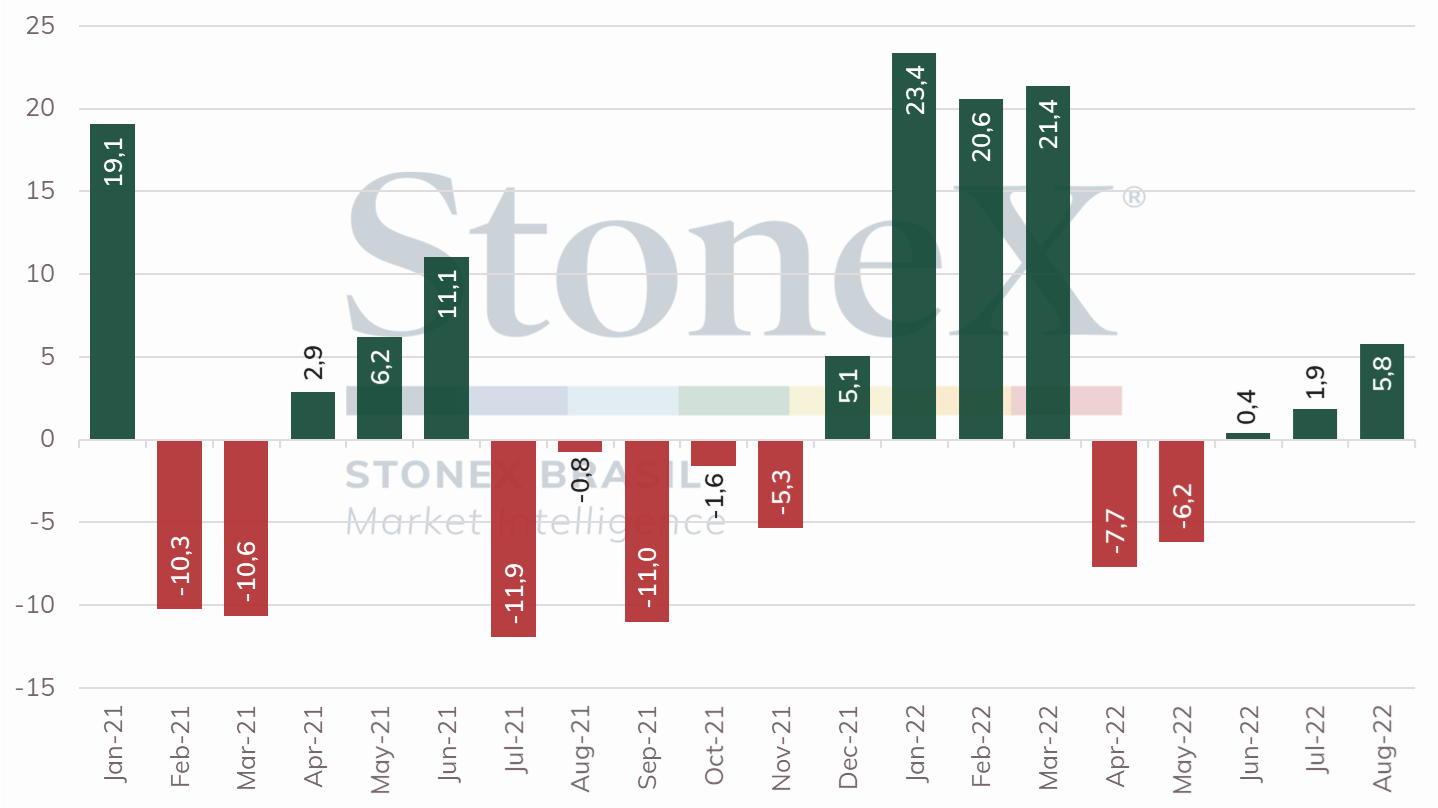
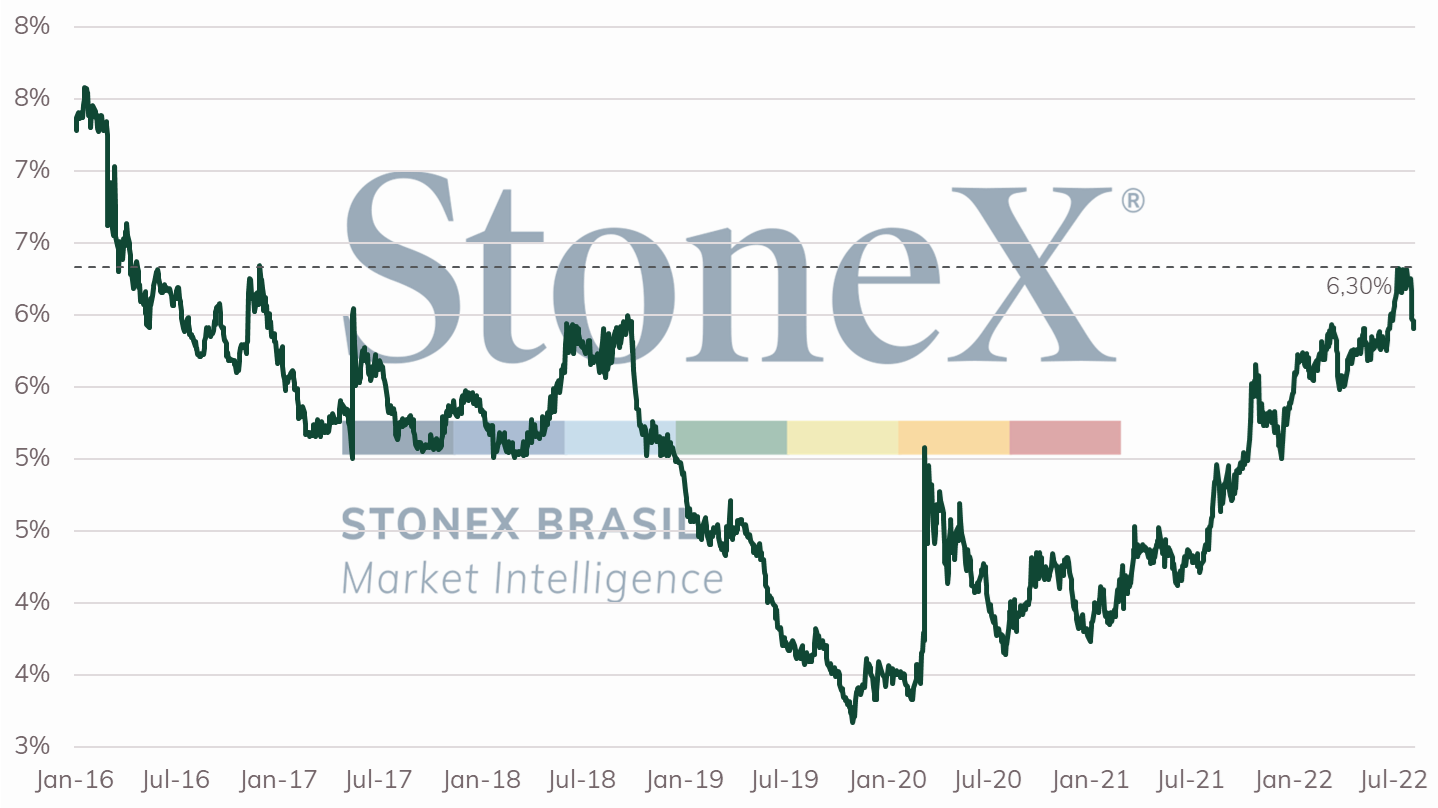
However, it is important to note a trend last week that could repeat this week: since the release of the minutes of the Monetary Policy Committee's decision (Copom) on Tuesday indicating that the Central Bank favors maintaining the basic interest rate (Selic) at 13.75% p.a. in the decision of September 21 (although Copom also states that it "will evaluate the need for a residual adjustment"), the strengthening of foreign inflows into Brazil has been observed, which has collaborated to the appreciation of the Brazilian real this week. The available data suggest a greater appetite for shares in the stock market (variable income) and Brazilian public debt securities (fixed income). One can observe, for example, the balance of foreign capital flows on the Bovespa. After almost exclusively negative balances up to July 15, these funds have turned mostly positive and have already accumulated BRL 5.79 billion in August (as of 08/10). The interest rates for financing public debt bonds in practically all modalities have dropped. The long-term NTN-B, which pays real interest (already compensated for the IPCA), returned to 5.91%, the same level as at the end of June. Similarly, one of the main measures of the country's risk, the spread of Brazil's 5-year Credit Default Swap contracts, returned to 244 points, also the same level as in June; that is, it demanded payment of 2.44% of the value of Brazilian public bonds each year as a CDS premium.
 

Spread of the Brazilian 5-year Credit Default Swap (CDS) contracts (basis points)
image 46595
Source: Bloomberg. Design: StoneX.
Balance of foreign capital flow on the B3 as of August 10, 2022 (BRL billion):
image 46596
Source: B3. Design: StoneX.
NTN-B purchase rate due on 05/15/2045 (% p.a.)
image 46597
Source: Tesouro Direto. Design: StoneX.

Finally, it is worth mentioning that the political news is increasingly agitated, but so far, without major impacts on the dollar traded in the interbank market. Despite relevant news almost every day, from polls to protests in defense of democracy, the impression is that the markets have already priced in this turbulent context. However, this does not seem to be a common electoral race, and new facts can always cause disturbances in the financial markets, particularly with domestic risk aversion.


image 35317
 
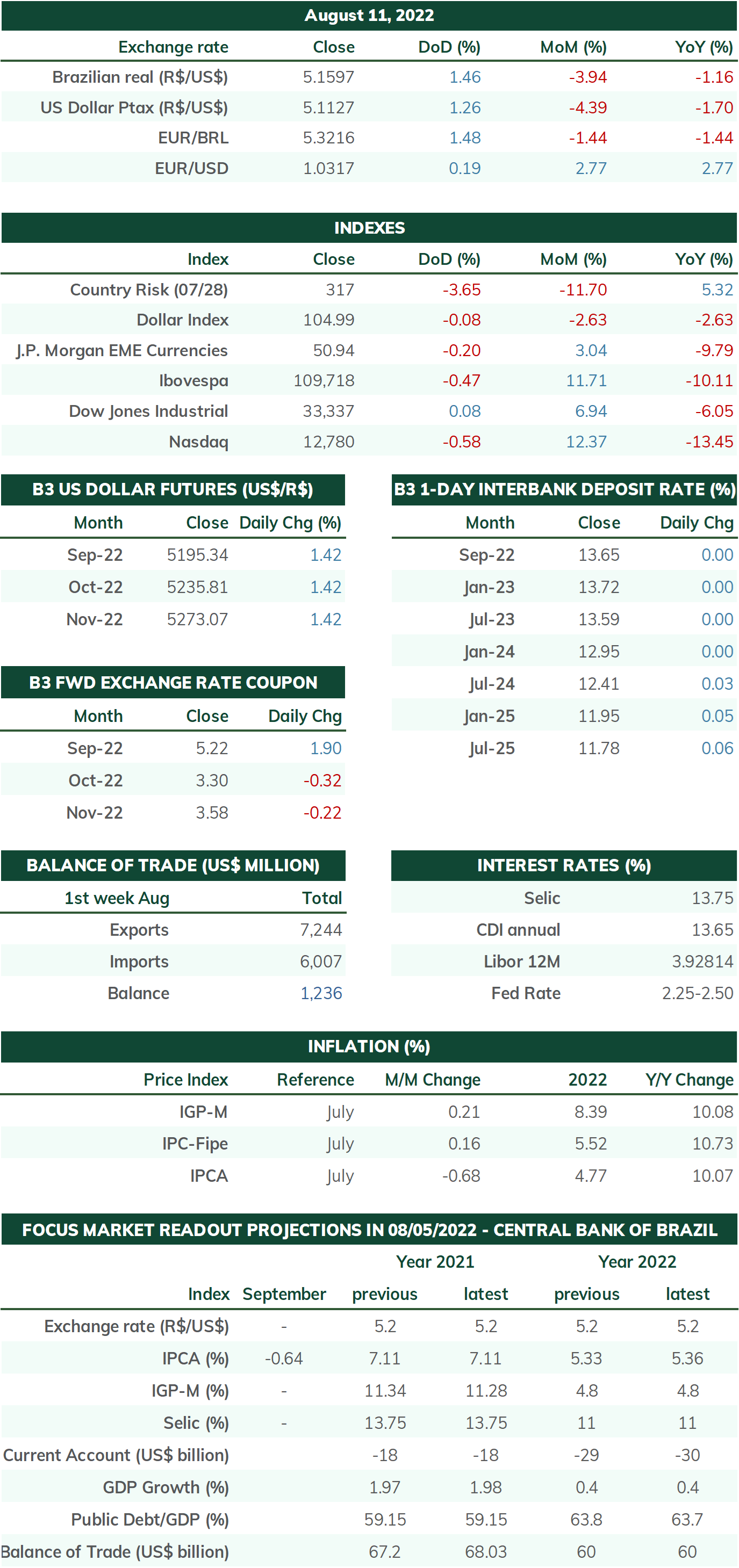
ECONOMIC INDICATORS
image 46598
Sources: Central Bank of Brazil; B3; IBGE; Fipe; FGV; MDIC; IPEA and CommodityNetwork Trader’s Pro.
 
  • Currencies

The StoneX Group Inc. group of companies provides financial services worldwide through its subsidiaries, including physical commodities, securities, exchange-traded and over-the-counter derivatives, risk management, global payments and foreign exchange products in accordance with applicable law in the jurisdictions where services are provided. References to over-the-counter (“OTC”) products or swaps are made on behalf of StoneX Markets LLC (“SXM”), a member of the National Futures Association (“NFA”) and provisionally registered with the U.S. Commodity Futures Trading Commission (“CFTC”) as a swap dealer. SXM’s products are designed only for individuals or firms who qualify under CFTC rules as an ‘Eligible Contract Participant’ (“ECP”) and who have been accepted as customers of SXM. StoneX Financial Inc. (“SFI”) is a member of FINRA/NFA/SIPC and registered with the MSRB. SFI is registered with the U.S. Securities and Exchange Commission (“SEC”) as a Broker-Dealer and with the CFTC as a Futures Commission Merchant and Commodity Trading Adviser. References to securities trading are made on behalf of the BD Division of SFI and are intended only for an audience of institutional clients as defined by FINRA Rule 4512(c). References to exchange-traded futures and options are made on behalf of the FCM Division of SFI . StoneX is a trading name of StoneX Financial Ltd (“SFL”). SFL is registered in England and Wales, Company No. 5616586. SFL is authorized and regulated by the Financial Conduct Authority [FRN 446717] to provide to professional and eligible customers including: arrangement, execution and, where required, clearing derivative transactions in exchange traded futures and options. SFL is also authorised to engage in the arrangement and execution of transactions in certain OTC products, certain securities trading, precious metals trading and payment services to eligible customers. SFL is authorised & regulated by the Financial Conduct Authority under the Payment Services Regulations 2017 for the provision of payment services. SFL is a category 1 ring-dealing member of the London Metal Exchange. In addition SFL also engages in other physically delivered commodities business and other general business activities which are unregulated and not required to be authorised by the Financial Conduct Authority. StoneX Group Inc. acts as agent for SFL in New York with respect to its payments services business. StoneX APAC Pte. Ltd. acts as agent for SFL in Singapore with respect to its payments services business. ‘StoneX’ is the trade name used by StoneX Group Inc. and all its associated entities and subsidiaries.
 
Trading swaps and over-the-counter derivatives, exchange-traded derivatives and options and securities involves substantial risk and is not suitable for all investors. Past performance of any futures or option is not indicative of future success. Indicators are not a trading system and are not published as a specific trade recommendation. The information herein is not a recommendation to trade nor investment research or an offer to buy or sell any derivative or security. It does not take into account your particular investment objectives, financial situation or needs and does not create a binding obligation on any of the StoneX group of companies to enter into any transaction with you. You are advised to perform an independent investigation of any transaction to determine whether any transaction is suitable for you. No part of this material may be copied, photocopied or duplicated in any form by any means or redistributed without the prior written consent of StoneX Group Inc.
 
© 2026 StoneX Group Inc. All Rights Reserved.

Satellite view of Earth at night showing illuminated cities across Asia and the Middle East

Discover more insights

Our subscribers have access to comprehensive market analysis from StoneX spanning commodities, equities, currencies and more.

StoneX: We open markets

Our market expertise, advanced platforms, global reach, culture of full transparency and commitment to our clients’ success all set us apart in the financial marketplace.

Reach

With access to 40+ derivatives exchanges, 180+ foreign exchange markets, nearly every global securities marketplace and numerous bi-lateral liquidity venues, StoneX’s digital network and deep relationships can take clients anywhere they want to go.

Transparency

As a publicly traded company meeting the highest standards of regulatory compliance in the markets we serve, our financials and record of accomplishment are matters of public record. StoneX’s commitment to “doing the right thing over the easy thing” sets us apart in the industry and helps us build respect, client trust and new partnerships.

Expertise

From our proprietary Market Intelligence platform, to “boots on the ground” expertise from award-winning traders and professionals, we connect our clients directly to actionable insights they can use to make more informed decisions and achieve their goals in the global markets.