

Market commentary Currencies- Thought Leadership Team
Banks preparing for the November 2026 deadline must look beyond ISO 20022 output to source data, client channels, automated structuring and exception controls.
Global Author
- Currencies
By: StoneX Intelligence Brazil, StoneX Intelligence Brazil


Participants at the Jackson Hole Symposium should highlight the urgency of the US central bank to control inflation in the country through a rapid and intense monetary tightening, which would raise the yield of dollar-denominated bonds and attract investments into this currency.
Water and energy crises in Europe can generate an environment of risk aversion and search for safe-haven assets, strengthening the dollar against other currencies.
High geopolitical tensions between China, the United States and Taiwan and the Zaporizhia nuclear power plant in Ukraine may trigger some adverse events that would provoke risk aversion and the search for safe-haven assets.
Forte apetite por ativos brasileiros está atraindo fluxos significativos de recursos estrangeiros para o país, contribuindo para o fortalecimento do real.
Leituras abaixo do esperado para indicadores econômicos nos Estados Unidos podem reforçar a interpretação de que o país passa por uma desaceleração e que, portanto, o Fed não precisa elevar tanto os juros, favorecendo ativos arriscados.
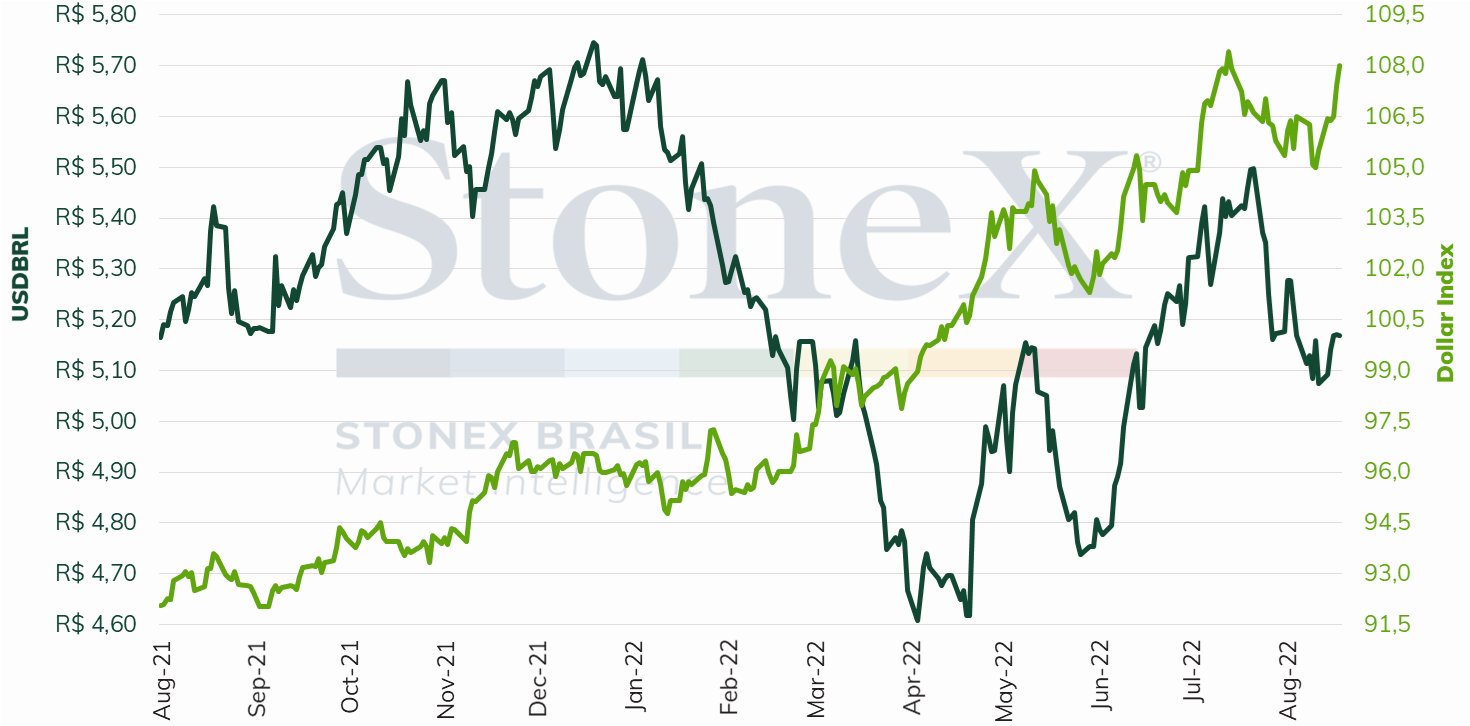
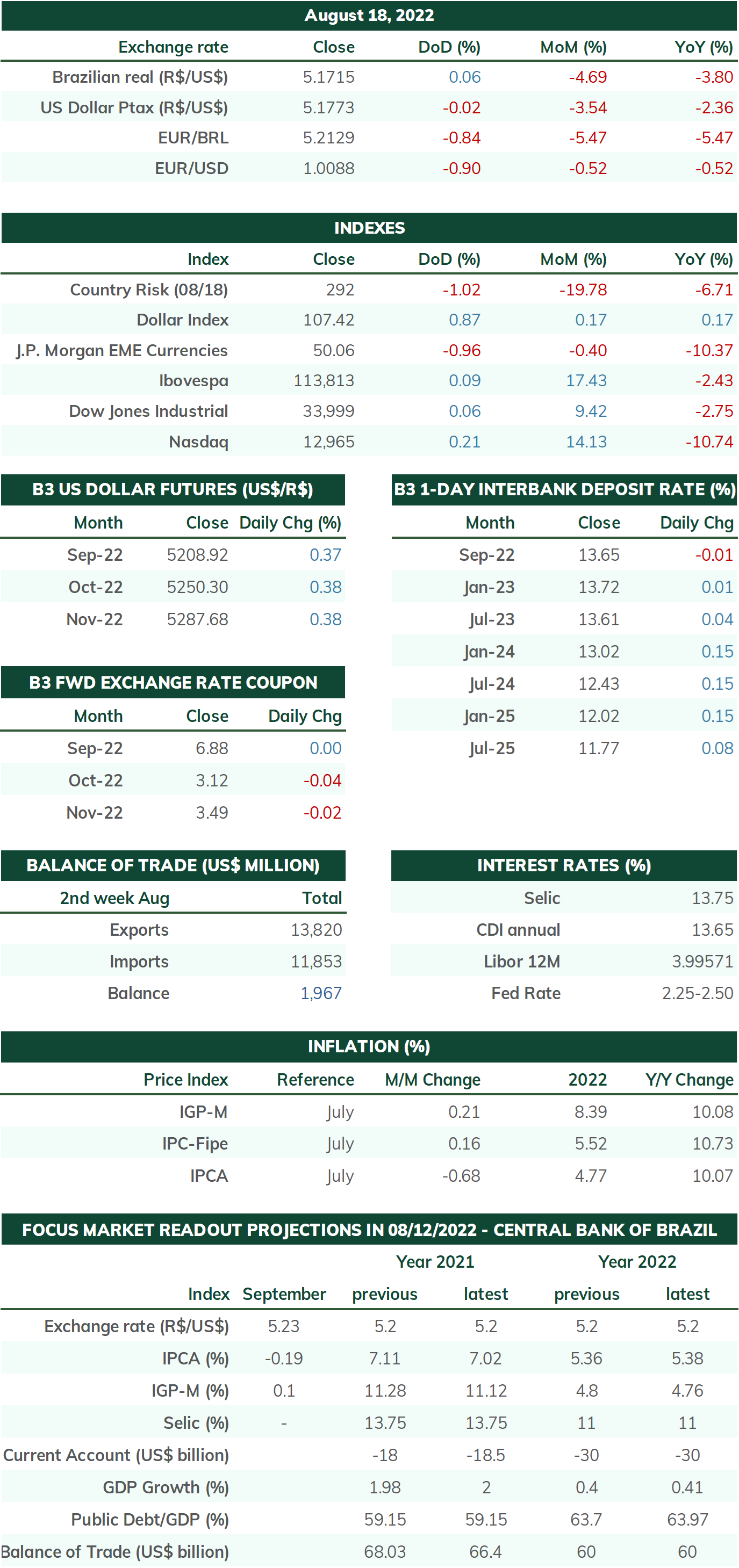
The USDBRL ended Friday’s session (19) quoted at BRL 5.169, a change of +1.9% in the week, -0.1% in the month and -7.3% in the year. Meanwhile, the dollar index closed the week quoted at 108.0 points, an increase of 2.4% for the week, 2.1% for the month and 13.0% for the year. The week was marked by strong pessimism as the risks of a global economic slowdown became more pronounced, with signs of a broad-based drop in demand in China, rising inflation in the United Kingdom and high pressure on production costs in Germany. In the United States, several Federal Reserve officials emphatically defended the need for a significant monetary tightening process to stabilize prices in the country. The prospects of an economic slowdown and higher interest rates have strengthened the dollar broadly and comprehensively against other currencies, both advanced and emerging economies.
Foreign Scenario
This week, attention should be on the Jackson Hole symposium, the stage where central bank officials speak about monetary policy and may serve as a venue for a more detailed communication of strategy. Still, analysts do not expect changes in the Federal Reserve's Chair Jerome Powell's speech, who is expected to continue to reinforce the importance and urgency of controlling the acceleration of inflation in the United States while at the same time not committing to any specific path for interest rate adjustments.
This week will also see the release of the Personal Consumption Expenditure (PCE) Price Index, the gauge most commonly used by the Federal Reserve to track prices for US consumers. After lower-than-expected readings for the Consumer Price Index (CPI) and the Producer Price Index (PPI) in July, the PCE is expected to remain near stable after growing by 1.0% in June. The University of Michigan Consumer Sentiment Index for August will also be published, another indicator frequently cited by Fed members. Complementing the analysis of the American economic situation will be the release of the August Purchasing Manager's Index (PMI) for manufacturing, services, and consolidated, signaling the strength of the productive activity. The Federal Reserve Chair Jerome Powell and the president of the Minneapolis Fed Neel Kashkari are scheduled to speak this week.
In Europe, there are still concerns about the energy crisis on the continent. The PMI previews should be analyzed in detail to see if there is any impact of the rising energy costs on business activity, as well as any indication of impacts of the low water volume on the Rhine River in Germany on logistic delays, inventory levels and new orders. Several rivers in France and Germany are well below their historical averages. Rhine River vessels must run at only 25% of their usual load to avoid the risk of running aground. This means that freight costs will rise dramatically, and logistics times for delivery will become progressively longer.
In addition, energy costs in general, and natural gas costs in particular, continue to rise exponentially, suggesting that the European economy will face a much deeper economic recession than the United States.
Concerning the war between Russia and Ukraine, the situation at the Zaporijia nuclear power plant remains very delicate, with Ukrainian President Volodymyr Zelenskyy stating that "the world is on the brink of a nuclear disaster. This week, video footage from inside the plant shows rows of military trucks parked next to a turbine, apparently in unit 2, next to one of the nuclear reactors. Military analysts and journalists have warned about statements by Russian officials, such as the head of Moscow's radioactive, chemical, and biological forces, Igor Kirillov, who denounced potential Ukrainian attacks on the nuclear plant, which could serve as a subterfuge for Russian sabotage seeking to blame Ukraine. Before the Russians' invasion of Ukraine in late February, the Kremlin observed the same types of false warnings to justify their subsequent aggression. Also, the United Nations Secretary-General António Guterres has implored Russia not to disconnect the plant from the Ukrainian power grid and then connect it to the Russian grid since an interruption in the power supply could stop the reactor cooling system and risk a reactor meltdown. In addition, last week's big news was Ukrainian attacks on key military assets in Crimea, a territory conquered by Moscow in 2014. An air base, ammunition depots, power stations, train stations, airports, bridges and logistic lines were attacked. It is unclear how Kyiv is carrying out these attacks since they are at a much greater range than any weapon Ukraine possesses or is known to possess. There is speculation of sabotage teams behind enemy lines or drones. The Kremlin is concerned about these attacks, has put its troops on high alert, and has replaced the military chief in the region.
Finally, the geopolitical atmosphere remains tense in the strait between China and Taiwan, with the mainland country conducting daily exercises that overstep the democratic island's line of autonomy and air defense. Moreover, following US House of Representatives Speaker Nancy Pelosi's August 2 visit to Taiwan, China hardened its stance with aggressive actions to test the limits of coexistence with its neighbor.
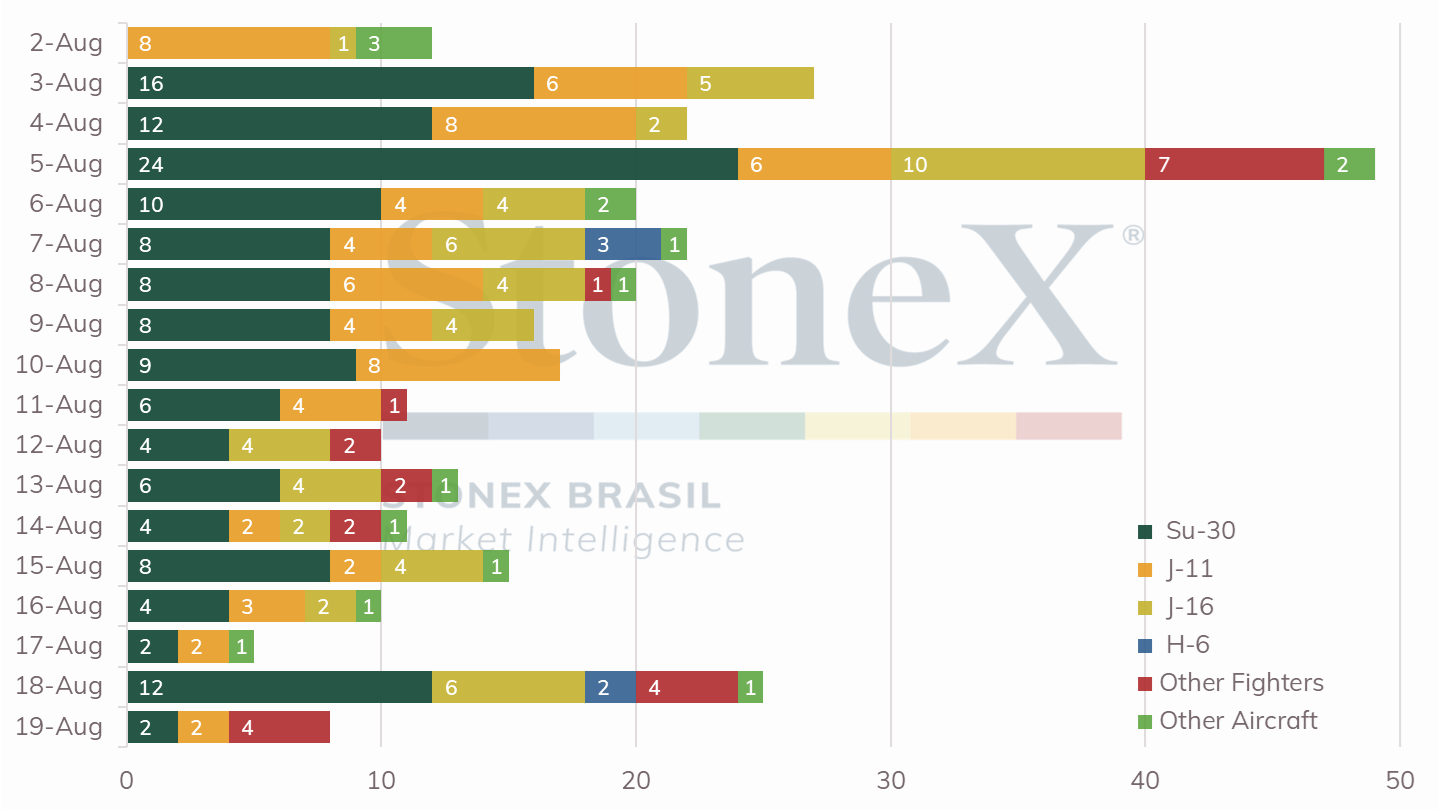
In addition to incursions on Taiwan's air dominance, something that hasn't happened since 2020, the Chinese government published an article entitled "The Taiwan Question and China's Reunification in the New Era," a sort of update of its official position on the issue and which also follows two other articles on the subject, one from 1993 and another from 2000. The drastic hardening towards Beijing in the document is clear, precisely in contrast to the previous positions. Terms like "negotiate" are absent in the new position paper, and guarantees given in the previous articles, such as that Taiwan could maintain its administrative and legislative autonomy, an independent judiciary, its political party and army, have all been removed. On the other hand, it is added that the "complete unification" of China is a "historic mission." However, it still states that it would be under the regime of "one country, two systems," just as Hong Kong had been promised - and later unfulfilled.
Domestic Scenario
This week will have a few important economic indicators. First, it is worth noting the National Broad Consumer Price Index 15 (IPCA-15) for August, in which deflation of 0.81% is expected due to fuel and electricity subsidies and the reduction in the prices charged by Petrobras for its fuels at refineries. In addition, the Central Bank will release the foreign sector statistics, which have been delayed since March. However, since the monetary authority has duly updated other indicators, there is an expectation that data for April, May and June will be published together.
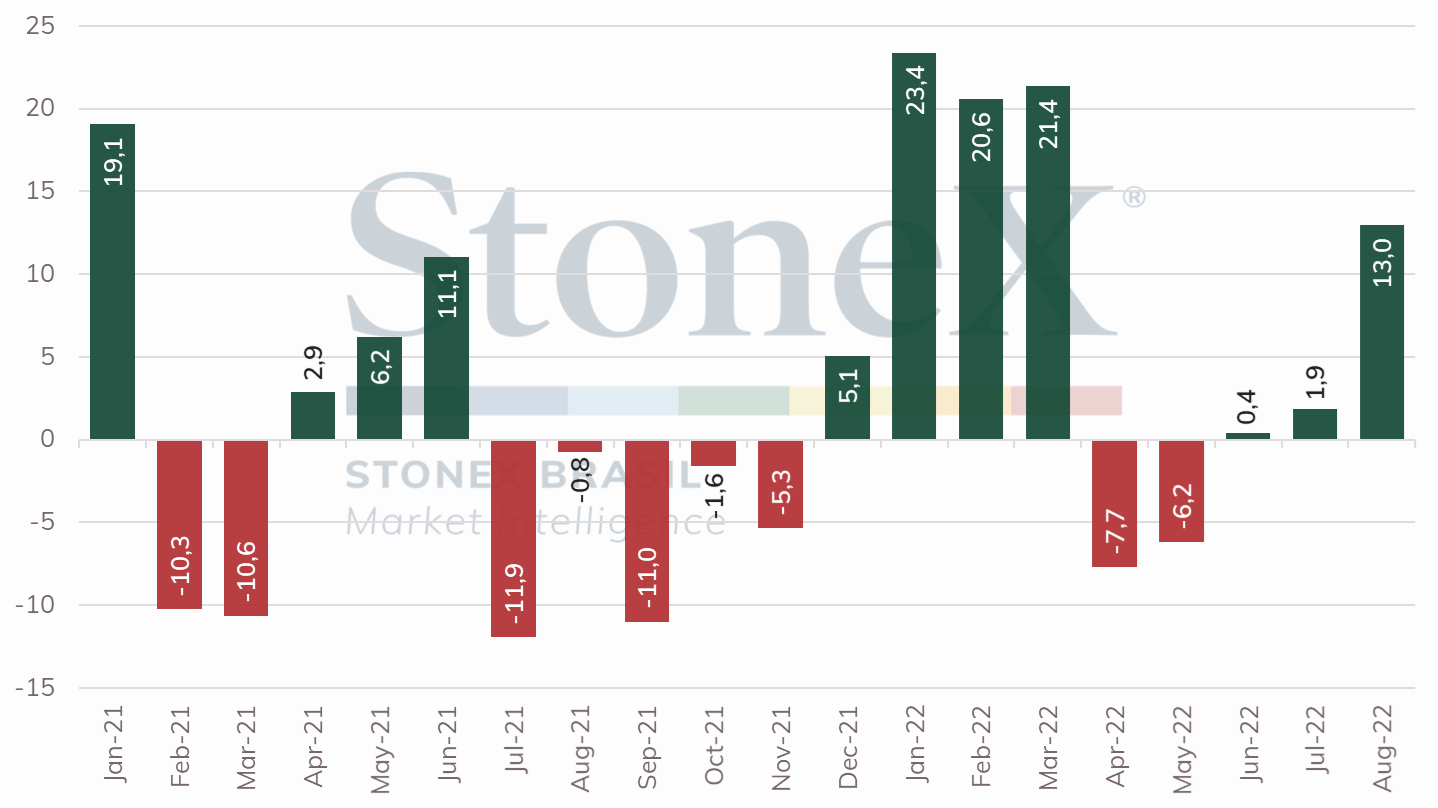
Last week, once again, there was a net inflow of foreign investment into the country even in the face of an environment of greater pessimism and caution in the global economy. As a result, the balance of foreign capital flows on the B3 accumulated a positive value of BRL 13.0 billion up to August 17. However, given the strong appreciation of the American currency, these flows were not enough to contain a weakening of the Brazilian real. It seems that this trend of a positive balance of financial transactions with the rest of the world should repeat itself next week.
Finally, it is worth mentioning that the political scene is quite heated after the official start of the electoral campaigns this past Tuesday (16). Over the past week, three in-person polls showed former president Luiz Inácio Lula da Silva with more than a 10-point lead over current president Jair Bolsonaro: Ipec (12-point lead), Quaest (12 points) and Datafolha (15 points). Moreover, the elections may move the national financial markets this week with individual interviews on the country's largest television news program.

The StoneX Group Inc. group of companies provides financial services worldwide through its subsidiaries, including physical commodities, securities, exchange-traded and over-the-counter derivatives, risk management, global payments and foreign exchange products in accordance with applicable law in the jurisdictions where services are provided. References to over-the-counter (“OTC”) products or swaps are made on behalf of StoneX Markets LLC (“SXM”), a member of the National Futures Association (“NFA”) and provisionally registered with the U.S. Commodity Futures Trading Commission (“CFTC”) as a swap dealer. SXM’s products are designed only for individuals or firms who qualify under CFTC rules as an ‘Eligible Contract Participant’ (“ECP”) and who have been accepted as customers of SXM. StoneX Financial Inc. (“SFI”) is a member of FINRA/NFA/SIPC and registered with the MSRB. SFI is registered with the U.S. Securities and Exchange Commission (“SEC”) as a Broker-Dealer and with the CFTC as a Futures Commission Merchant and Commodity Trading Adviser. References to securities trading are made on behalf of the BD Division of SFI and are intended only for an audience of institutional clients as defined by FINRA Rule 4512(c). References to exchange-traded futures and options are made on behalf of the FCM Division of SFI . StoneX is a trading name of StoneX Financial Ltd (“SFL”). SFL is registered in England and Wales, Company No. 5616586. SFL is authorized and regulated by the Financial Conduct Authority [FRN 446717] to provide to professional and eligible customers including: arrangement, execution and, where required, clearing derivative transactions in exchange traded futures and options. SFL is also authorised to engage in the arrangement and execution of transactions in certain OTC products, certain securities trading, precious metals trading and payment services to eligible customers. SFL is authorised & regulated by the Financial Conduct Authority under the Payment Services Regulations 2017 for the provision of payment services. SFL is a category 1 ring-dealing member of the London Metal Exchange. In addition SFL also engages in other physically delivered commodities business and other general business activities which are unregulated and not required to be authorised by the Financial Conduct Authority. StoneX Group Inc. acts as agent for SFL in New York with respect to its payments services business. StoneX APAC Pte. Ltd. acts as agent for SFL in Singapore with respect to its payments services business. ‘StoneX’ is the trade name used by StoneX Group Inc. and all its associated entities and subsidiaries.
Trading swaps and over-the-counter derivatives, exchange-traded derivatives and options and securities involves substantial risk and is not suitable for all investors. Past performance of any futures or option is not indicative of future success. Indicators are not a trading system and are not published as a specific trade recommendation. The information herein is not a recommendation to trade nor investment research or an offer to buy or sell any derivative or security. It does not take into account your particular investment objectives, financial situation or needs and does not create a binding obligation on any of the StoneX group of companies to enter into any transaction with you. You are advised to perform an independent investigation of any transaction to determine whether any transaction is suitable for you. No part of this material may be copied, photocopied or duplicated in any form by any means or redistributed without the prior written consent of StoneX Group Inc.
© 2026 StoneX Group Inc. All Rights Reserved.
Our subscribers have access to comprehensive market analysis from StoneX spanning commodities, equities, currencies and more.
Banks preparing for the November 2026 deadline must look beyond ISO 20022 output to source data, client channels, automated structuring and exception controls.
The US dollar index is rising on falling volume, and volume confirmation is the test that separates a trend with buyers behind it from a corrective bounce. Matt Simpson works through what the participation behind the advance is showing.

Dollar to reflect US economic data, Central Bank minutes, inflation in Brazil, and the Middle East

Our market expertise, advanced platforms, global reach, culture of full transparency and commitment to our clients’ success all set us apart in the financial marketplace.
Reach
With access to 40+ derivatives exchanges, 180+ foreign exchange markets, nearly every global securities marketplace and numerous bi-lateral liquidity venues, StoneX’s digital network and deep relationships can take clients anywhere they want to go.
Transparency
As a publicly traded company meeting the highest standards of regulatory compliance in the markets we serve, our financials and record of accomplishment are matters of public record. StoneX’s commitment to “doing the right thing over the easy thing” sets us apart in the industry and helps us build respect, client trust and new partnerships.
Expertise
From our proprietary Market Intelligence platform, to “boots on the ground” expertise from award-winning traders and professionals, we connect our clients directly to actionable insights they can use to make more informed decisions and achieve their goals in the global markets.