StoneX logo

FX Weekly Summary (Brazil Issue)

By: StoneX Intelligence Brazil, StoneX Intelligence Brazil

USDBRL trends lower to end the week at BRL 5.146
 
Leonel Oliveira Mattos
Leonardo Rossetti
Vitor Andrioli
Expectations of rising interest rates in the United States and Europe marked the week
Bullish Factors
  • Higher than expected readings for economic indicators in the US may reinforce the need for a rigid monetary tightening to control inflation in the country and raise expectations for interest rates, which would increase the profitability of dollar-denominated bonds and attract investments into that currency.

  • Water and energy crises in Europe could cause stagflation in the continent, creating an environment of risk aversion and search for safe-haven assets, especially the dollar.

  • High geopolitical tensions between China, the United States and Taiwan and the Zaporizhia nuclear power plant in Ukraine may trigger unanticipated adverse events that would provoke risk aversion and the search for safe-haven assets.

Bearish Factors
  • Commodities, in general, remain high-priced due to weather events around the world, attracting significant inflows of foreign funds to the country and contributing to the strengthening of the Brazilian real.

  • Better than expected readings for economic indicators in Brazil may improve the appetite for Brazilian assets and reinforce the inflow of foreign capital into the country, contributing to strengthening the BRL.

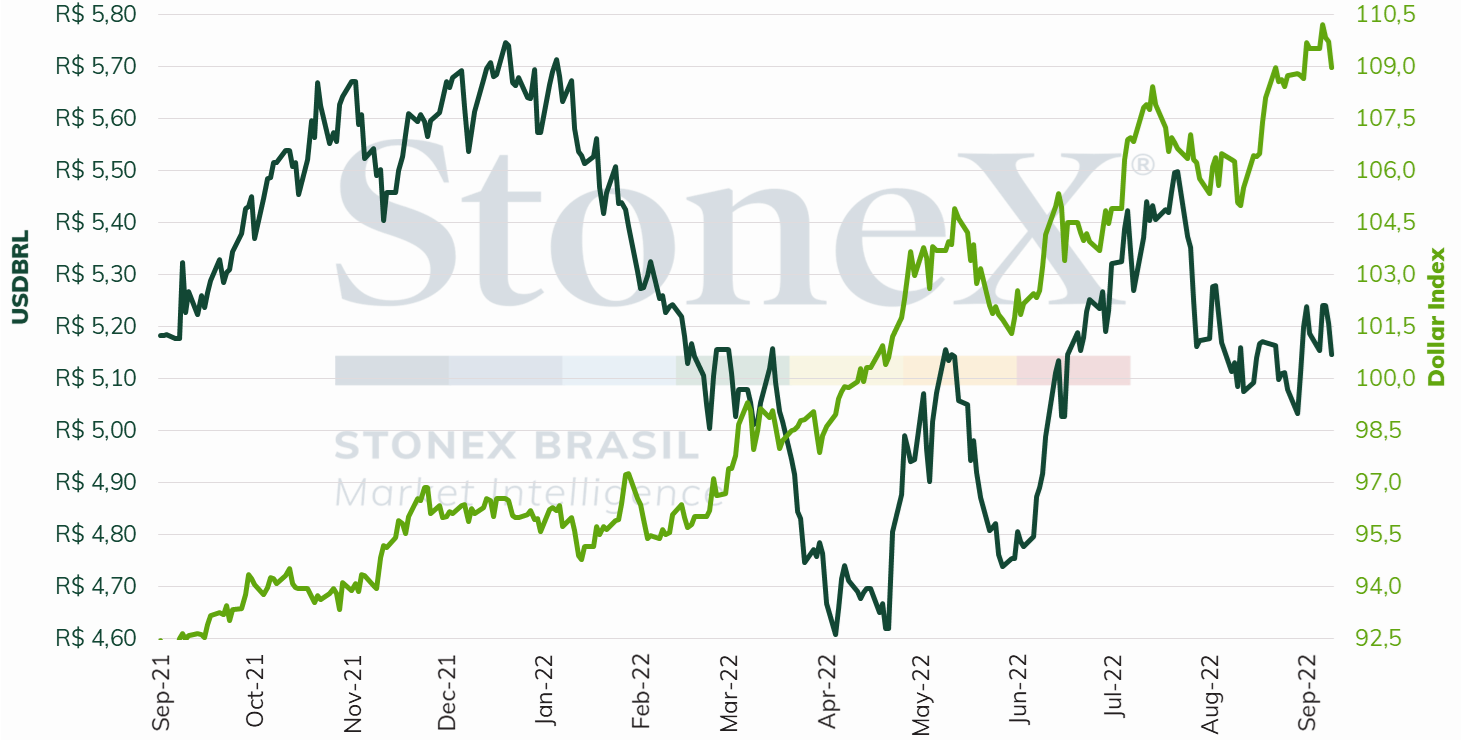
The USDBRL ended Friday’s session (09) quoted at R$ 5.146, down by 0.8% in the week, 1.0% in the month and 7.7% in the year. The dollar index closed the day quoted at 109.0 points, a variation of -0.5% in the week, +0.3% in the month and +14.0% in the year. Strong exchange rate fluctuations that, in turn, accompanied the changes in expectations of interest rate hikes in the United States, Europe and possibly Japan marked the week. Although there is a reading that global demand should slow down and that the main central banks will raise interest rates substantially, there is no consensus as to the speed of the economic slowdown or the degree of misalignment between these central banks that led to such volatility.

USDBRL AND DOLLAR INDEX (POINTS)
image 49076
Source: Commodity Network Trader’s Pro. Design: StoneX.

Foreign Scenario

This week, attention will be on the inflation readings for August in the United States and Europe. Financial markets have been greatly impacted by fears of a near-term slowdown in global demand brought on by persistently high and widespread inflation rates and rigid monetary tightening strategies by major central banks to regain price stability. In the US, the Consumer Price Index (CPI) and the Producer Price Index (PPI) are expected to fall slightly in August, mainly due to the decline in international oil prices. However, a slight increase is expected in the "core" of the indicator, which excludes the volatile energy and food components, suggesting that the inflationary problem is not yet overcome.

Besides the price indices, this week, the retail sales and food services for August will be released, as well as the industrial production for the same month. Such indicators will allow for a more up-to-date assessment of the conditions of the American productive activity and if there are signs of impacts from the current policy of tightening financial conditions being implemented by the Federal Reserve. Recent data for the labor market suggest that the US economy remains in expansion, so most estimates point to growth, albeit moderate, for both indicators.

In Europe, the situation is more complex and challenging. The serious energy crisis continues to be the topic of most attention and debate since the continuous reduction of natural gas from Russia has caused the steep rise in prices for this input and, as a consequence, strong cost pressures in the production of thermoelectric power, chemical products, and steel products. This week, the European Union, Britain, Switzerland, Finland, Sweden, and Germany released details of tax proposals designed to soften the impacts of the crisis on companies and consumers. Among the measures proposed, one can highlight emergency credits for power generators to avoid bankruptcy, tax subsidies to ease the rising electricity costs and the imposition of price caps for final consumers.

Finally, it is noteworthy that the International Atomic Energy Agency (IAEA) has issued a report on the situation at the Zaporijia nuclear power plant in Ukraine and confirmed several aspects previously warned by military analysts about the Russian occupation compromising the safety of the site. While the report does not seek to lay blame and focuses on charging "all relevant parties" to ensure the safe operation of the plant throughout the conflict, it specifically notes the presence of military equipment in the cooling turbines and around the plant, points out that the plant's operational staff are denied access to the local emergency center, which is occupied by the military, and need permission to access some technical areas of the plant, such as the cooling ponds, and cites the possibility of interference in decision-making by the presence of officials from Russia's state atomic energy agency (ROSATOM). With frequent reports of artillery attacks being fired from the vicinity of the plant, the risk of an emergency occurring and an inadequate response provoked by the presence of Russian troops is not negligible.

Domestic Scenario

In Brazil, this week's highlight will be the data for the Brazilian productive activity. After announcing deflation for August and a higher-than-expected growth for the second quarter Gross Domestic Product, analysts are waiting for information about retail sales and volume of services for August, as well as for the publication of the Central Bank's Economic Activity Index (IBC-Br) for the period. The expectation is that there will be a statistical carry from the July performance, implying growth for services and the IBC-Br, but retraction for retail.

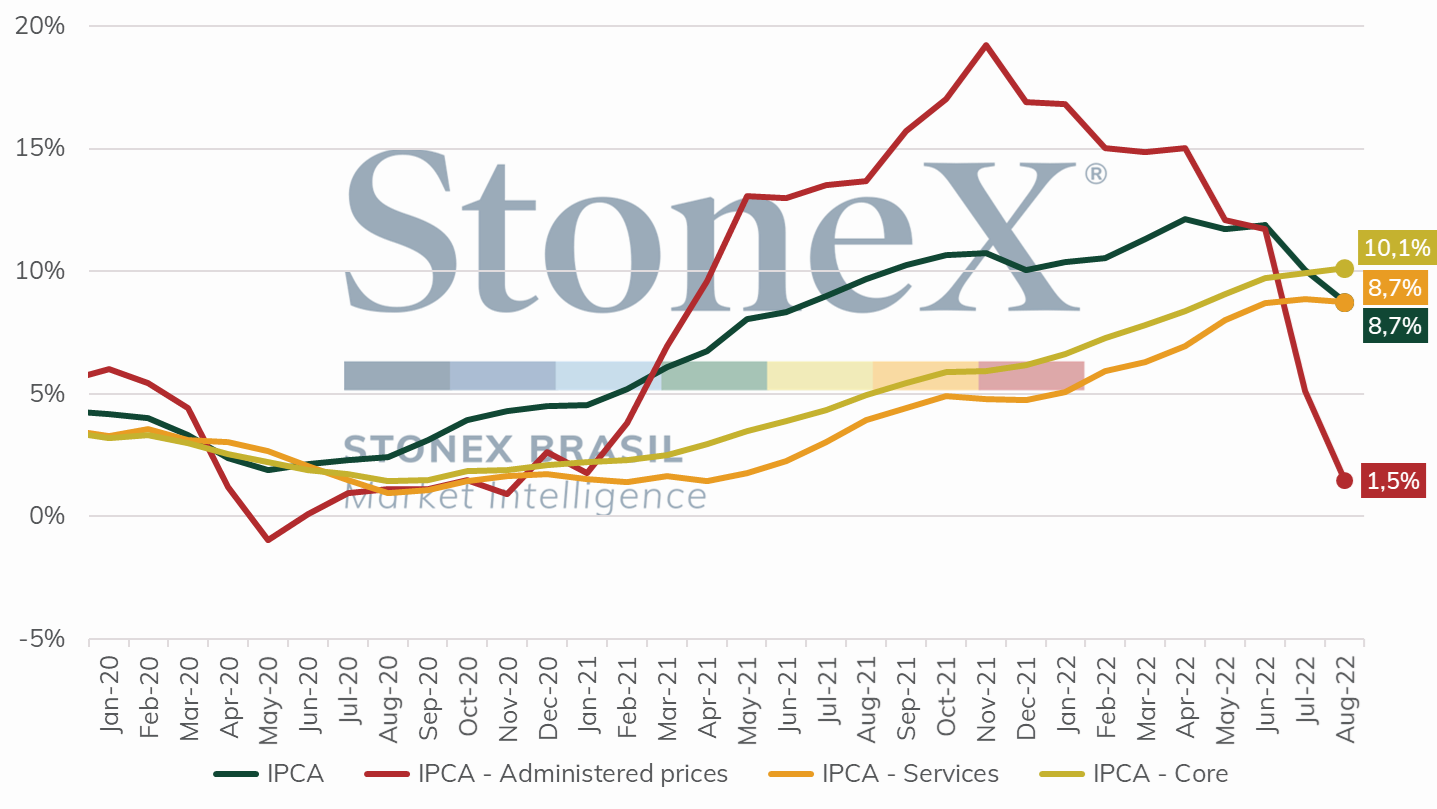
This week the National Broad Consumer Price Index (IPCA) showed a negative variation for the second consecutive month, going from -0.68% in July to -0.36% in August, accumulating a high of 8.73% in 12 months, the lowest accumulated figure since June 2021. However, this deflation was the result of the significant drop in commodities prices with considerable weight in its calculation, namely, fuels – gasoline (-11.64%), hydrous ethanol (-8.67%), diesel oil (-3.76%) and vehicular natural gas (-2.12%) – and residential electricity (-1.27%). These products, in turn, still reflect federal and state tax subsidies issued by the government in July and the drop in Petrobras' fuel prices at its refineries. When one checks these five items' total impact on the August IPCA, one observes a reduction of -0.80% in the index. In other words, by removing these products from the August inflation calculation, the result would be an increase of 0.44%. Another way to view this information is through the "core" of the IPCA, which removes the more volatile components of energy, fuel, food, and beverages from the calculation. Looking at the accumulated increase over 12 months, while the total IPCA retreats in August to 8.73%, its core remains in expansion to 10.12%. Monitored prices, which include fuels and electricity, dropped to 1.46%.

Inflation readings for Brazil (accumulated over 12 months)
image 49075
Source: IBGE - Brazilian Institute of Geography and Statistics. Design: StoneX.

Finally, with the proximity of the elections, investors should follow the next polls, especially Datafolha on Friday (09), Ipec next Monday (12) and Genial/Quaest next Wednesday (14). Since they are carried out in person, they are more closely monitored by the parties. The aim is to observe whether the tone considered more moderate by President Bolsonaro in the September 7 demonstrations will reduce his distance from the frontrunner, former President Luiz Inácio Lula da Silva, and take the election to the second round.


image 35317
 
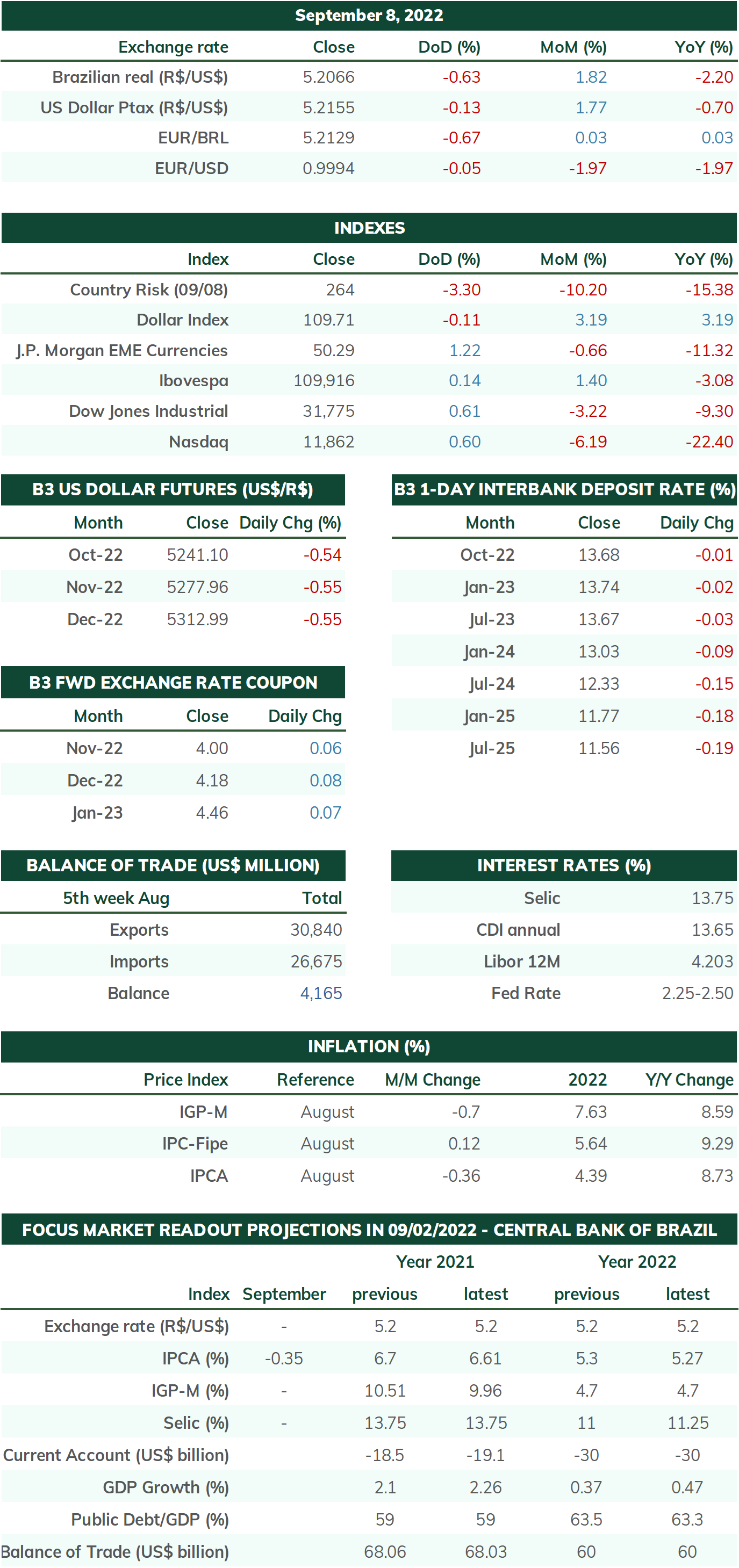
ECONOMIC INDICATORS
image 49077
Sources: Central Bank of Brazil; B3; IBGE; Fipe; FGV; MDIC; IPEA and CommodityNetwork Trader’s Pro.
 
  • Currencies

The StoneX Group Inc. group of companies provides financial services worldwide through its subsidiaries, including physical commodities, securities, exchange-traded and over-the-counter derivatives, risk management, global payments and foreign exchange products in accordance with applicable law in the jurisdictions where services are provided. References to over-the-counter (“OTC”) products or swaps are made on behalf of StoneX Markets LLC (“SXM”), a member of the National Futures Association (“NFA”) and provisionally registered with the U.S. Commodity Futures Trading Commission (“CFTC”) as a swap dealer. SXM’s products are designed only for individuals or firms who qualify under CFTC rules as an ‘Eligible Contract Participant’ (“ECP”) and who have been accepted as customers of SXM. StoneX Financial Inc. (“SFI”) is a member of FINRA/NFA/SIPC and registered with the MSRB. SFI is registered with the U.S. Securities and Exchange Commission (“SEC”) as a Broker-Dealer and with the CFTC as a Futures Commission Merchant and Commodity Trading Adviser. References to securities trading are made on behalf of the BD Division of SFI and are intended only for an audience of institutional clients as defined by FINRA Rule 4512(c). References to exchange-traded futures and options are made on behalf of the FCM Division of SFI . StoneX is a trading name of StoneX Financial Ltd (“SFL”). SFL is registered in England and Wales, Company No. 5616586. SFL is authorized and regulated by the Financial Conduct Authority [FRN 446717] to provide to professional and eligible customers including: arrangement, execution and, where required, clearing derivative transactions in exchange traded futures and options. SFL is also authorised to engage in the arrangement and execution of transactions in certain OTC products, certain securities trading, precious metals trading and payment services to eligible customers. SFL is authorised & regulated by the Financial Conduct Authority under the Payment Services Regulations 2017 for the provision of payment services. SFL is a category 1 ring-dealing member of the London Metal Exchange. In addition SFL also engages in other physically delivered commodities business and other general business activities which are unregulated and not required to be authorised by the Financial Conduct Authority. StoneX Group Inc. acts as agent for SFL in New York with respect to its payments services business. StoneX APAC Pte. Ltd. acts as agent for SFL in Singapore with respect to its payments services business. ‘StoneX’ is the trade name used by StoneX Group Inc. and all its associated entities and subsidiaries.
 
Trading swaps and over-the-counter derivatives, exchange-traded derivatives and options and securities involves substantial risk and is not suitable for all investors. Past performance of any futures or option is not indicative of future success. Indicators are not a trading system and are not published as a specific trade recommendation. The information herein is not a recommendation to trade nor investment research or an offer to buy or sell any derivative or security. It does not take into account your particular investment objectives, financial situation or needs and does not create a binding obligation on any of the StoneX group of companies to enter into any transaction with you. You are advised to perform an independent investigation of any transaction to determine whether any transaction is suitable for you. No part of this material may be copied, photocopied or duplicated in any form by any means or redistributed without the prior written consent of StoneX Group Inc.
 
© 2026 StoneX Group Inc. All Rights Reserved.

Satellite view of Earth at night showing illuminated cities across Asia and the Middle East

Discover more insights

Our subscribers have access to comprehensive market analysis from StoneX spanning commodities, equities, currencies and more.

StoneX: We open markets

Our market expertise, advanced platforms, global reach, culture of full transparency and commitment to our clients’ success all set us apart in the financial marketplace.

Reach

With access to 40+ derivatives exchanges, 180+ foreign exchange markets, nearly every global securities marketplace and numerous bi-lateral liquidity venues, StoneX’s digital network and deep relationships can take clients anywhere they want to go.

Transparency

As a publicly traded company meeting the highest standards of regulatory compliance in the markets we serve, our financials and record of accomplishment are matters of public record. StoneX’s commitment to “doing the right thing over the easy thing” sets us apart in the industry and helps us build respect, client trust and new partnerships.

Expertise

From our proprietary Market Intelligence platform, to “boots on the ground” expertise from award-winning traders and professionals, we connect our clients directly to actionable insights they can use to make more informed decisions and achieve their goals in the global markets.