Cenário Externo
Attention this week should be on economic activity and labor market indicators and their implications for the Federal Reserve's (Fed) monetary policy. The expectation is that the readings for the labor market will remain heated as employers fill vacancies that were already open before the Fed's more intense monetary tightening. In addition, some analysts point to a lag in the rise in interest rates by the central bank and its effects on the labor market, even if productive activity and economic growth already signal a more pronounced slowdown. Thus, it is likely that the pace of hiring will gradually slow before turning negative.
As for manufacturing indicators, such as Purchasing Managers' Indexes (PMI) and industry orders, the projection is that they also present a slower growth in September when compared to August but that they remain in positive territory due to both the high levels of inflation and the recent increase in interest rates. Overall, analysts visualize a significant economic slowdown starting in the last quarter of this year, with the possibility of recession being the majority, but not the consensus. No contraction should deter the Fed from maintaining its monetary tightening path. In contrast, unexpected growth in any of the indicators could have the opposite effect of raising the urgency of the monetary authority to raise its interest rates. Speakers this week include Atlanta Fed President Raphael Bostic, Richmond Fed President Tom Barkin, Kansas City Fed President Esther George, New York Fed President John Williams, Dallas Fed President Lorie Logan, Cleveland Fed President Loretta Mester, Board of Governors member Philip Jefferson, San Francisco Fed President Mary Daly, Chicago Fed President Charles Evans, Board of Governors member Lisa Cook, and Board of Governors member Christopher Waller.
In Europe, the coming week will also see important indicators to gauge the eurozone environment, such as the PMI for September, the Producer Price Index (PPI) for August, and the August retail sales. The continent's context is challenged due to the worse outlook for both price levels and economic activity than in the United States. Last week, European assets depreciated sharply due to the poor reception of the tax plan proposed by UK Prime Minister Liz Truss.
The tax stimulus package goes in the opposite direction of the Bank of England's monetary tightening. It has caused such turmoil in the financial markets that the British central bank has had to intervene in the long-term government bond market to avoid "risks to the financial system. Several analysts mention the new government's loss of fiscal credibility and that the pound may permanently damage its role in the international financial market.
Geopolitical tensions remain high between Europe and Russia this week. European countries face exponential electricity and natural gas costs after their Slavic neighbor reduced natural gas supplies to Europe by nearly 90% in retaliation for economic sanctions following its invasion of Ukraine. Last week, huge leaks were located in the Nord Stream 1 and 2 underwater pipelines. Neither was in operation, but damage to their structure precludes the possibility of an early return of supply. While Western countries claim that the Kremlin must have sabotaged the pipeline, Moscow claims it must have been the "Anglo-Saxons." Experts point out that the extent of the damage and the fact that three explosions occurred on two pipelines simultaneously suggests an intentional and orchestrated act. However, little is known about who might have been responsible.
Additionally, in the Russian-Ukrainian conflict, Russian President Vladimir Putin signed treaties recognizing annexation "referendums" in the occupied regions of Ukraine (Kherson, Zaporizhia, Donetsk, and Luhansk) and forwarding them to the country's parliament (Duma) for ratification. These referendums have not been recognized by any country outside the Kremlin's orbit of influence. In contrast, the United States and the European Union have promised to apply even more sanctions against Russia in retaliation for yet another flouting of diplomatic conventions. Furthermore, Putin again threatened that Russia would use "all available means" to defend its territory and that the United States "set a precedent" by using atomic bombs on Japan during World War II, suggesting a link between the annexation of Ukrainian territories and the use of nuclear weapons should Russia be attacked, but without making such a link explicit. While it is impossible to predict whether there is a point at which Putin would use nuclear weapons, it is noteworthy that Ukraine has attacked the Russian region of Belgorod and the occupation of Crimea in this war without Moscow escalating to the use of nuclear weapons.
Domestic Scenario
In Brazil, this week's highlight should be the results of the first round of elections for President of the Republic. The latest polls show clear favoritism for candidate Luiz Inácio Lula da Silva, with approximately 50% of valid voting intentions. This number is at the threshold necessary for victory in the first round, making it possible, but not probable, that the race would be concluded this Sunday. For investors, the first-round definition reduces uncertainty about macroeconomic variables four weeks earlier than initially anticipated. At the same time, it may encourage the PT candidate to make fewer concessions to sectors that have not supported him from the start. It is worth noting, however, that the Brazilian presidential candidate spent his entire campaign seeking to wave to the center parties and affirming that he would not make radical reforms in his government.
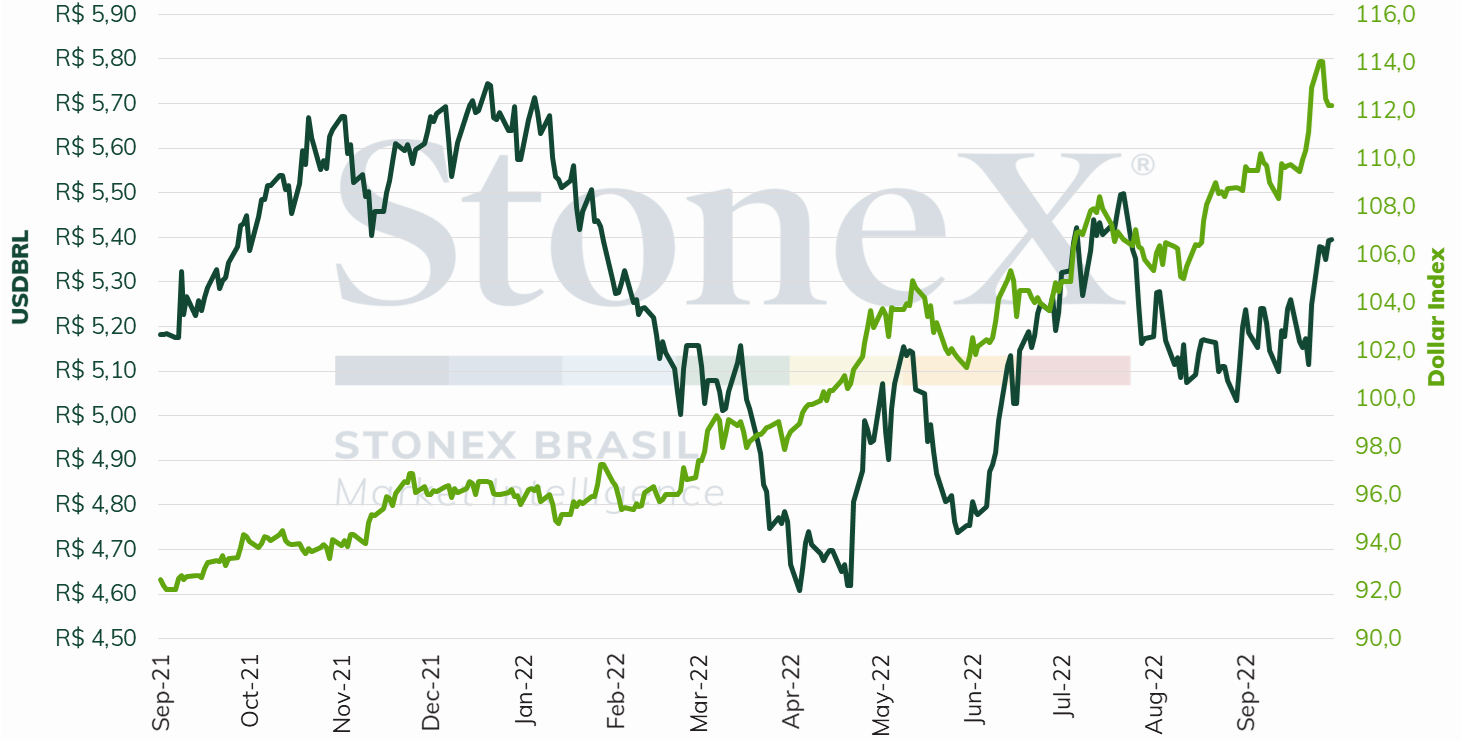
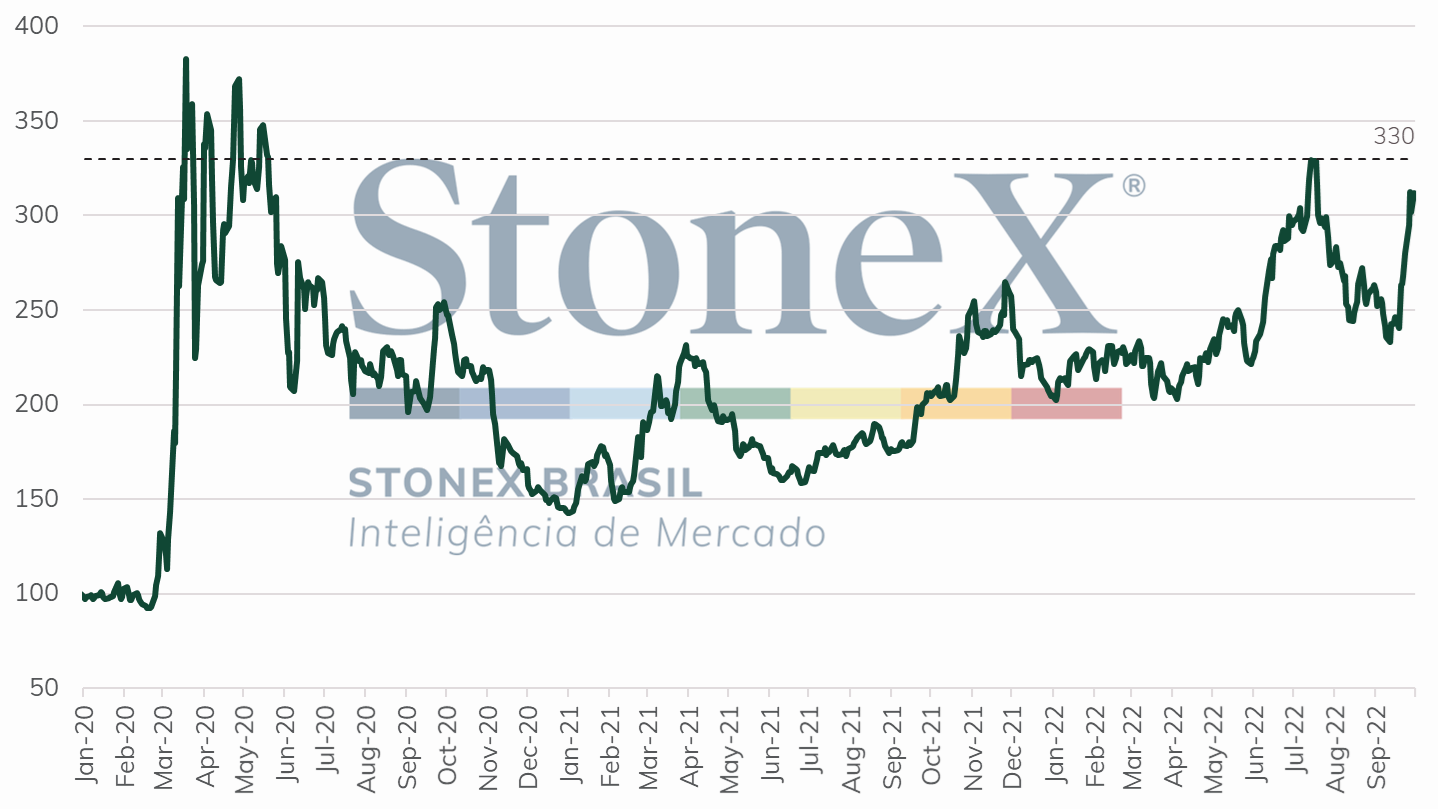
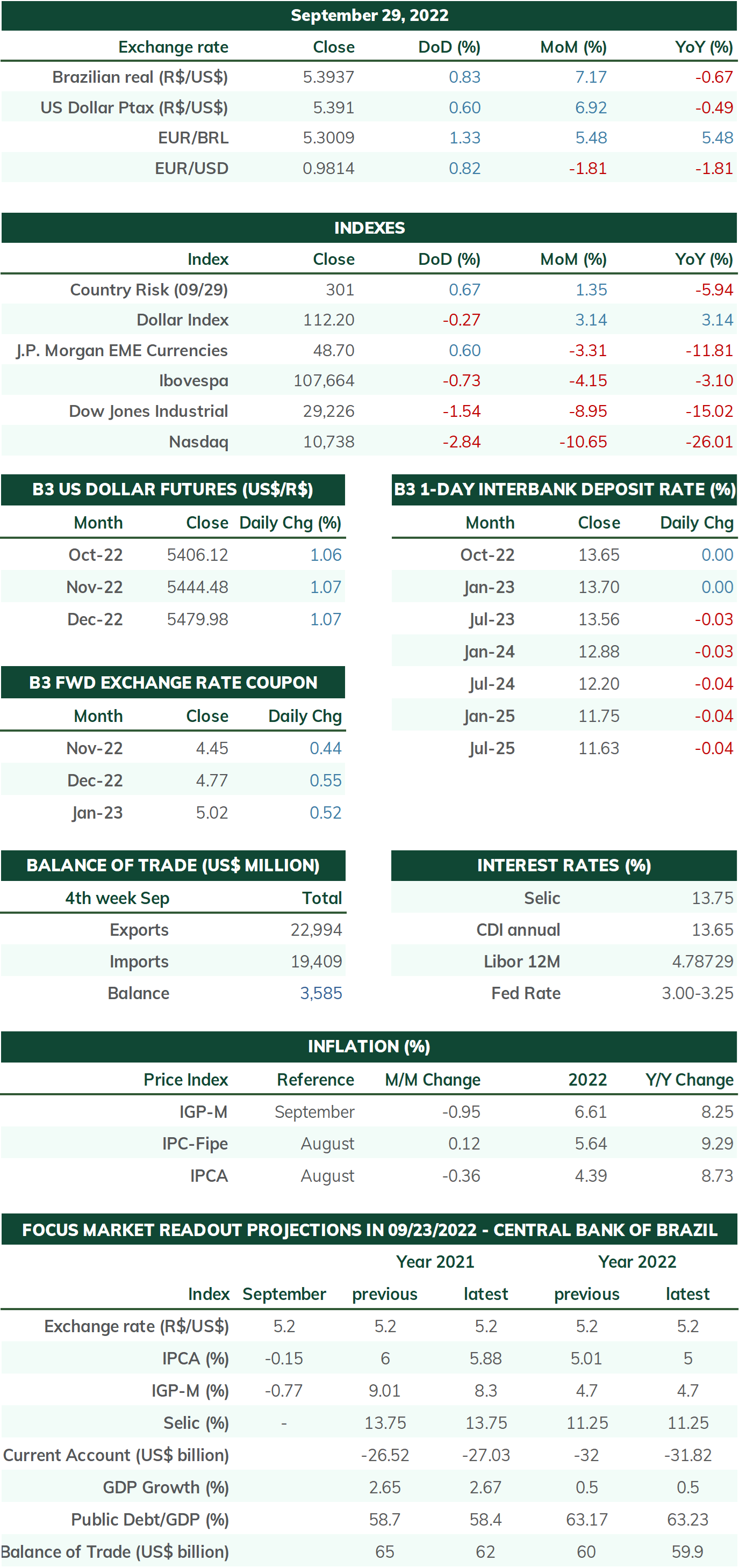
The proximity of the elections has contributed to an environment of great caution for investors in Brazil, contributing to the weakening of the Brazilian real throughout the week. One way to visualize this lower appetite for Brazilian assets is through the rates charged by the Credit Default Swaps (CDS) on bonds in the country, which went from 2.80% on September 23 to 3.12% on September 30.
Spread of the Brazilian 5-year Credit Default Swap (CDS) contracts (basis points)
Source: Bloomberg. Design: StoneX.
Additionally, this week holds the reading of production indicators that will allow a better contextualization of the economic scenario, such as the Purchasing Managers' Indexes (PMI) for September, the industrial production and trade surveys for August, and the trade balance for the same month. Furthermore, the quarterly inflation report, released by the Central Bank this week, highlighted the economic growth above expectations for the second quarter of this year and the possibility of a statistical charge for the third quarter, highlighting the good results for July.