Foreign Scenario
This week, attention will be on the release of the October Consumer Price Index (CPI), particularly the core of the indicator, i.e., when the volatile food and energy categories are excluded from the calculation. After two months of readings above projections, the median projection of analysts is for another substantial increase of +0.5% for the month and +6.5% for the accumulated over 12 months. The analysis of the surveyed groups shows, in general, a cooling in the prices of goods, but an acceleration in the prices of services, putting pressure on the Federal Reserve (Fed) to continue raising interest rates to combat this inflationary dynamic.
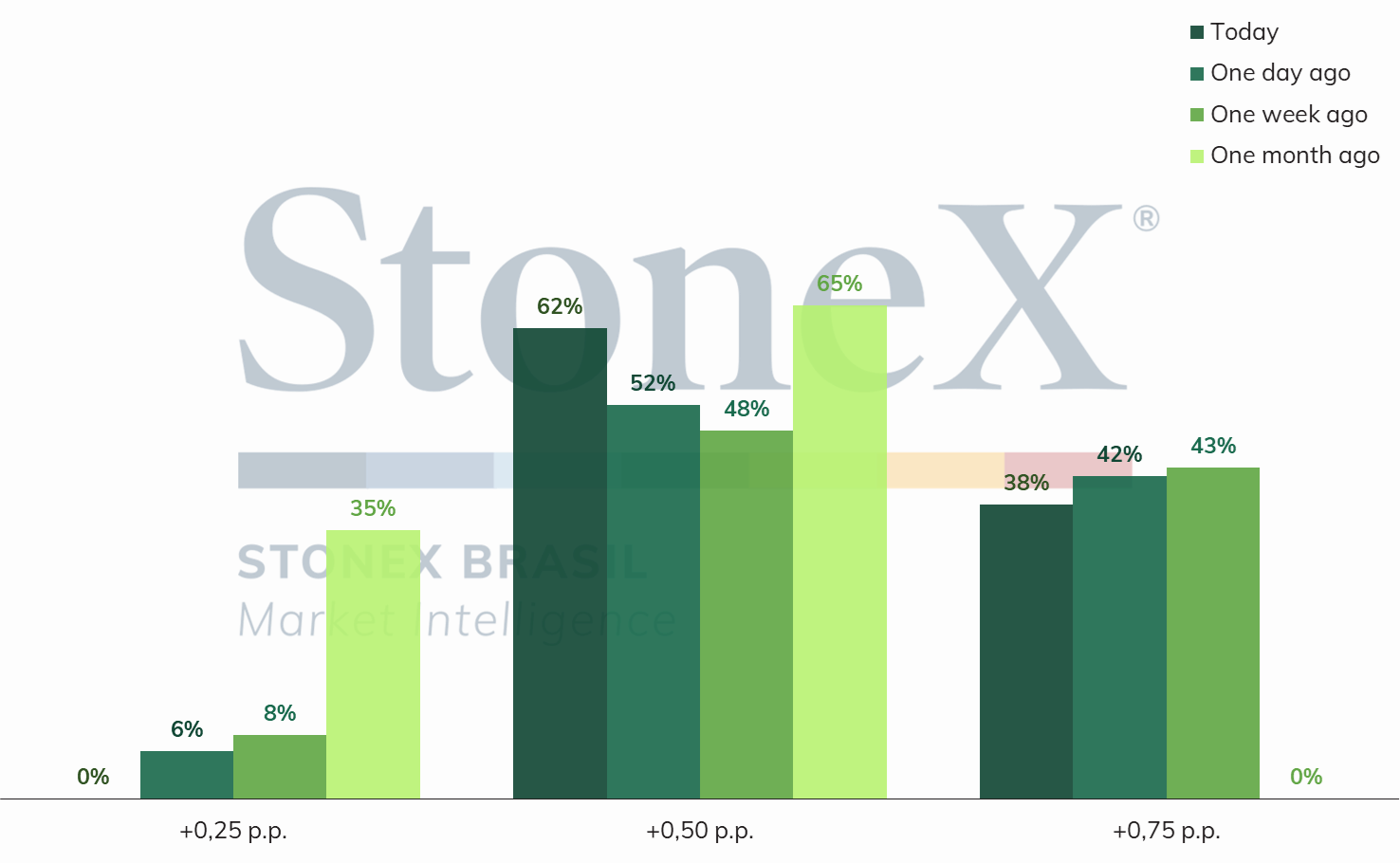
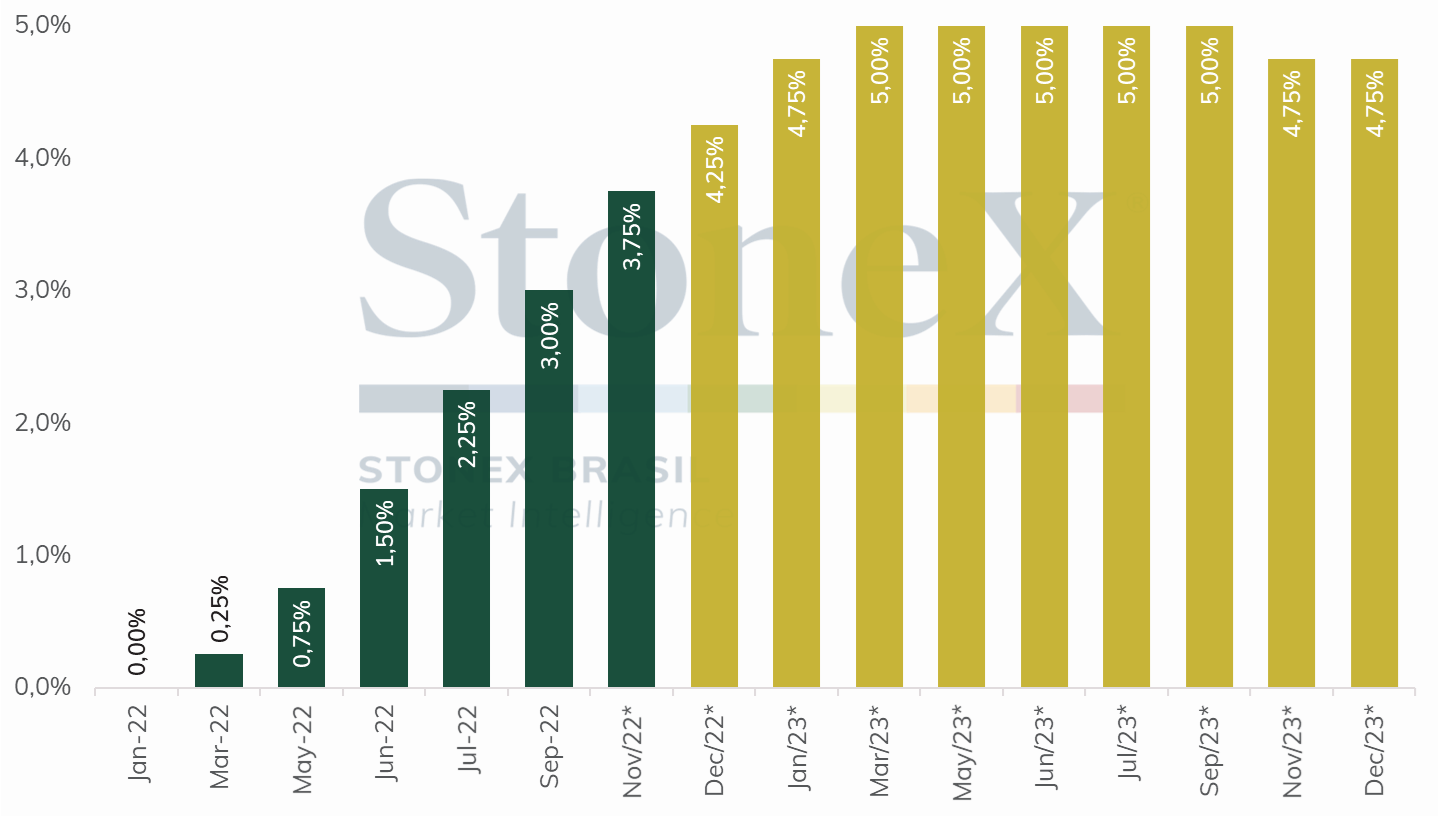
In the last decision of the Federal Open Market Committee, the president of the institution, Jerome Powell, validated the market rumors and stated that "at some point, it will become appropriate to slow the pace of increases. So that time may come as soon as the next meeting or the one after that." Thus, the interpretation that the next decision should be 0.50 p.p. and not 0.75 p.p. gained strength. However, Powell also signaled that the Fed will continue to readjust interest rates for longer, that it is still "very premature to be thinking about pausing [interest rate hikes]," and that the ultimate level "will be higher than previously estimated," pushing end-of-cycle expectations for March to the range between 5.00% and 5.25% p.a.
Bets for the Federal Reserve's interest rate decision on December 14
US interest rate history and higher probability bets on the futures market
Source: CME FedWatch Tool. Design: StoneX. Futures market interest rate probabilities as of November 04, 2022
It will be important to listen to Fed officials this week for more details on the direction and tone of the communication from here. The new speech will probably emphasize the need for a sequence of rate hikes rather than frontloading the increases, even if these increases are slowing down. It would also be interesting to see if any Fed members will offer any estimates for the final interest rate level, although this seems unlikely. This week, Boston Fed President Susan Collins, Richmond Fed President Tom Barkin, Philadelphia Fed President Patrick Harker, New York Fed President John Williams, Dallas Fed President Lorie Logan, Cleveland Fed President Loretta Mester, and Kansas City Fed President Esther George are scheduled to speak.
Additionally, the legislative elections (midterms) that will be held in the United States next Tuesday (08) may change the balance between the Executive and Legislative Branches in the country. Most polls indicate that the Republican party should win the majority of the House of Representatives and point to an equal division of 50 senators for each party (the vice-president, Democrat, would vote in case of a tie). With control of at least one of the houses of Congress, the Republicans can make Joe Biden's final two years in office more difficult and increase the chances that he will not be re-elected in 2024.
In Europe, the week will be relatively empty of indicators. Nevertheless, it will be noteworthy, after the surprises in the inflationary readings of the past week, to watch the speeches of the European Central Bank authorities and how they intend to deal with the double challenge of containing a price acceleration that is larger and more widespread than the other advanced economies while facing clear signs of deceleration and stagnation of productive activity.
Finally, the number of Covid-19 cases in China is rising, with a daily average of about 1,500 cases, almost double the previous week (about 830). This past week, Chinese asset markets experienced strong appreciation based on the hope that the authorities may plan to relax the current zero-tolerance policy against Covid-19. This expectation was based on social media posts showing purported meeting minutes from a top Chinese official, which discussed accelerating plans for a conditional reopening by March 2023. There is no document validation about its date or authorship, and it is best classified as a rumor.
Domestic Scenario
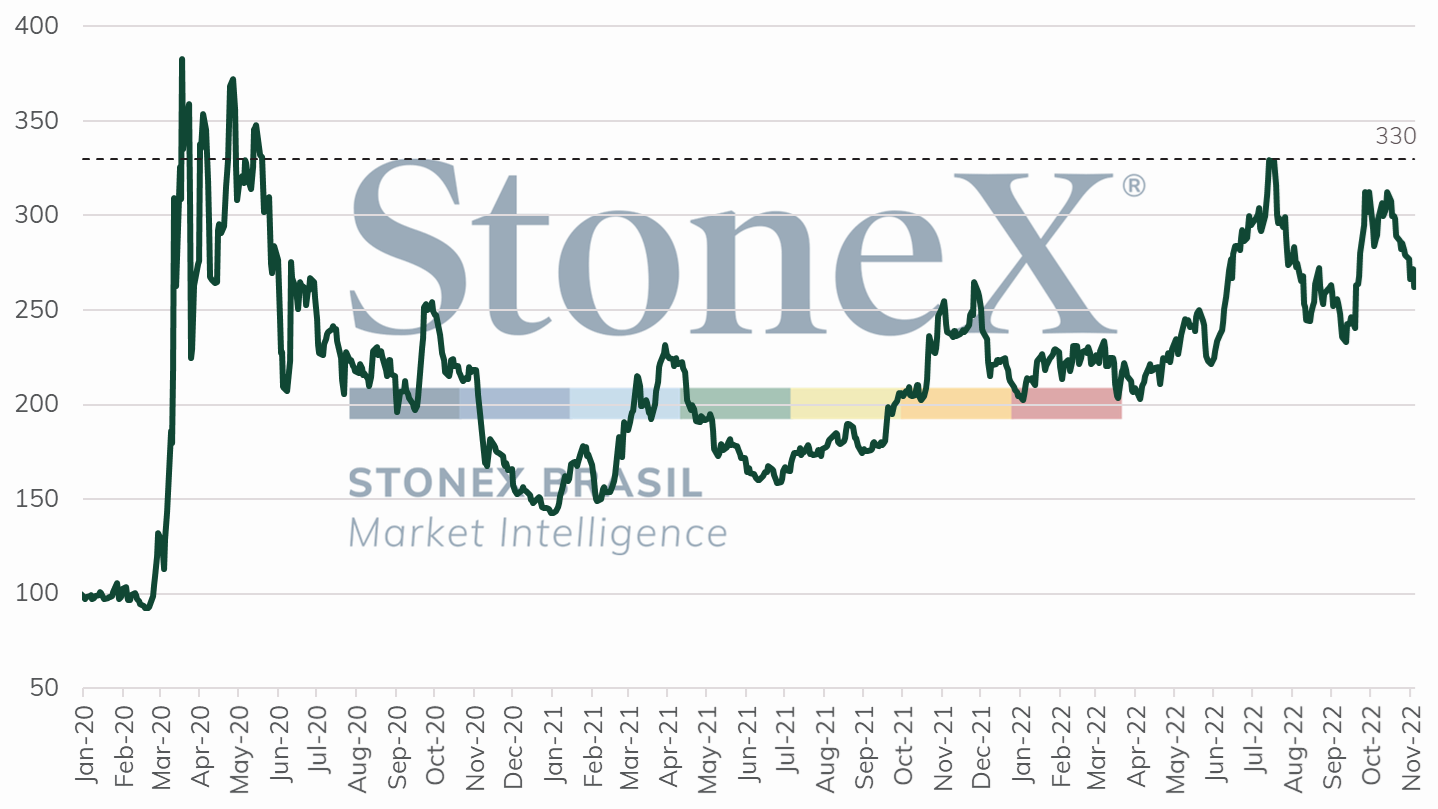
In Brazil, the highlight of the week should be the transition between the governments of Jair Bolsonaro and Luiz Inácio Lula da Silva, the definition of ministries and the negotiation of the 2023 Budget. After an initial movement of protests by Bolsonaro supporters and a silence of almost 48 hours by the current president regarding Lula's victory, the transition work began without major problems. On the contrary, it calmed the major fears of investors about a possible challenge to the election result. Thus, the perception of risks associated with Brazilian assets was reduced, and the flow of foreign investments, as in the stock market, was high throughout the week.
Spread of the Brazilian 5-year Credit Default Swap (CDS) contracts (basis points)
Source: Bloomberg. Design: StoneX.
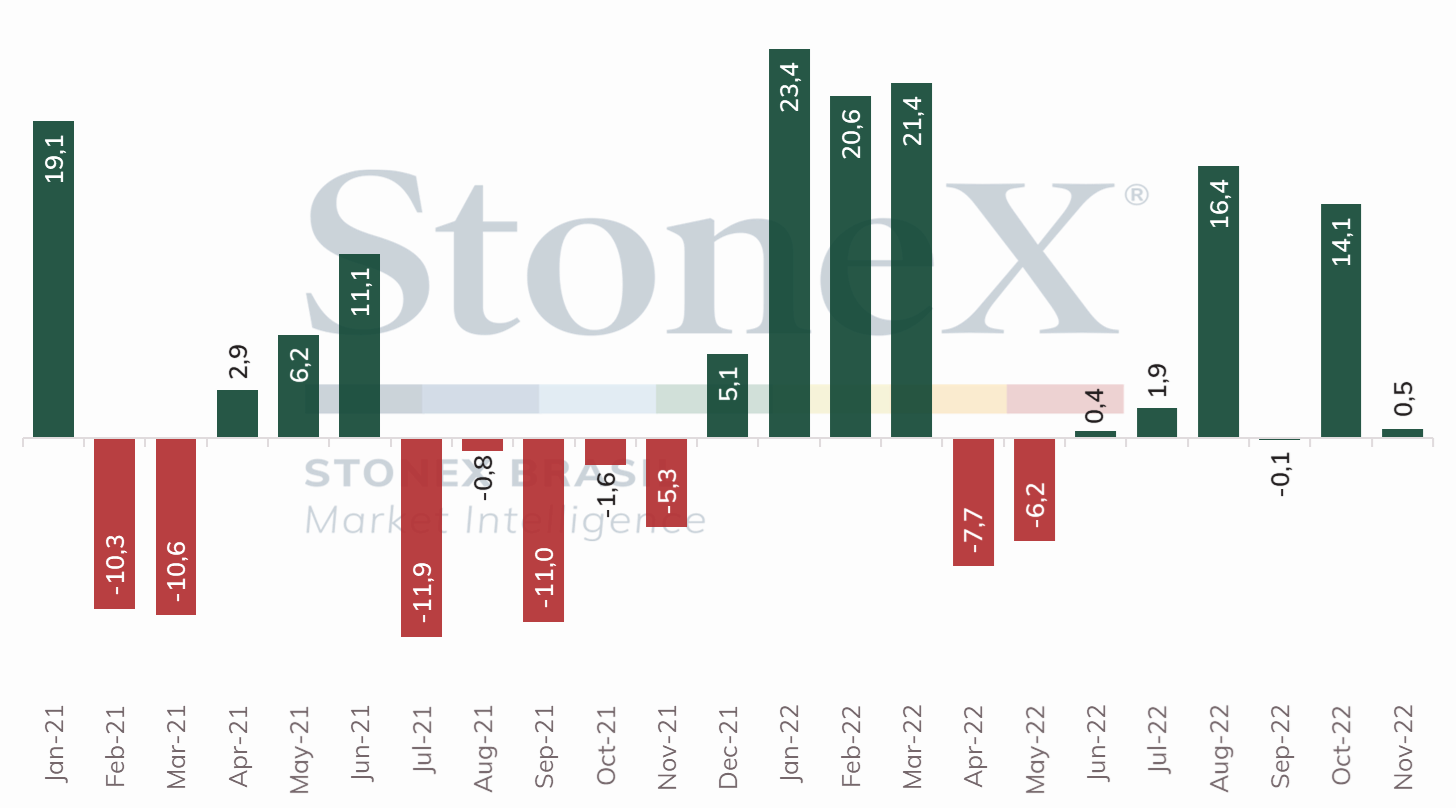
Balance of foreign capital flow on the B3 as of November 01, 2022 (BRL billion)
Source: B3. Design: StoneX.
The transition team, however, has stated that it is in no hurry to appoint the positions for the ministries, not even the expected Minister of Economy. The initial focus is on adapting next year's budget proposal to the next campaign accomplishments, such as maintaining the value of the Auxílio Brasil income transfer program at BRL 600, the inclusion of a BRL 150 bonus for mothers of children up to six years old, and the real increase in the minimum wage. Throughout the week, the possibilities of a proposed constitutional amendment (PEC) to exceed the spending cap during the transition between governments or the issuing of notable credits to finance expenses above the constitutional spending limit were debated. The state's fiscal capacity is at its limit after increasing spending by more than BRL 150 billion last year, partly made possible by using PECs and the declaration of a state of emergency in the second half of 2022.
Finally, following the National Broad Consumer Price Index (IPCA) release for October will be important. After three months of deflation, a 0.5% increase is expected in the monthly variation due to higher prices for food, health and personal care, and seasonal clothing hikes. In addition, September's retail sales and service volume data will be released, contributing to assessing the country's current economic situation.