Foreign Scenario
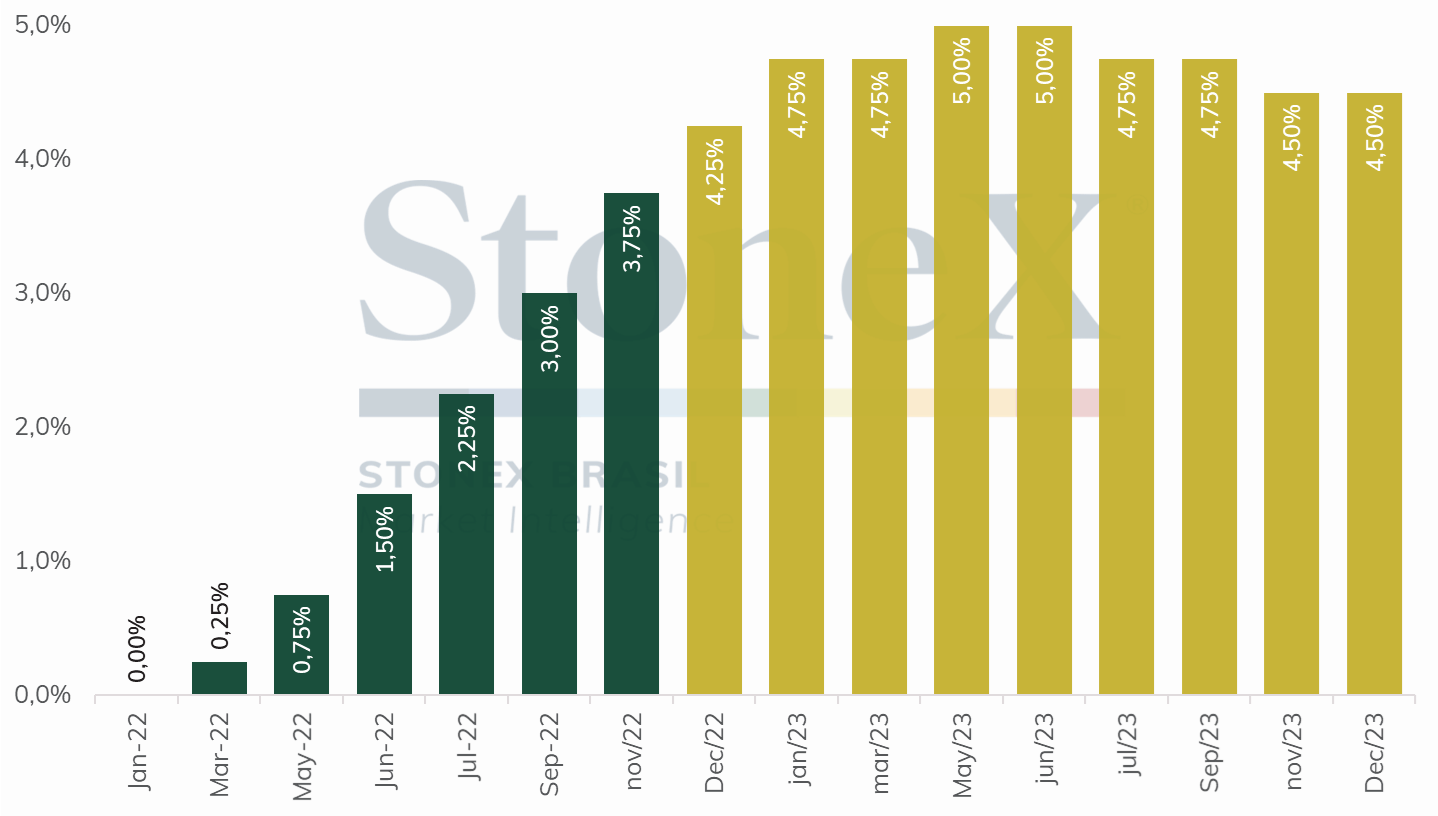
This week, the focus will be on the monetary policy decision of the Federal Reserve’s (Fed) Federal Open Market Committee (FOMC). After four consecutive readjustments of 0.75 p.p., most analysts evaluate that the American central bank will reduce the pace of interest rate hikes on Wednesday (14) to an increase of 0.50 p.p., raising the fed funds rate from a range between 3.75% to 4.00% p.a. to a range between 4.25% to 4.50% p.a. Additionally, the economic projections from the members of the Committee are eagerly awaited, which should signal a higher estimate for both the unemployment rate and the final level for the country's interest rates in 2023 than projected in September of this year, namely 4.4% and 4.6%, respectively. Investors will also evaluate the communiqué and the press conference for information regarding the path of interest rates, given that there is much debate about moderation of monetary tightening in the United States and the possibility of readjustments of 0.25 p.p. as of February. The contracts in the future interest rate markets have a high dispersion and low degree of confidence without reaching the 50% betting threshold any month after December.
US interest rate history and higher probability bets on the futures market
Source: CME FedWatch Tool. Design: StoneX. Futures market interest rate probabilities as of November 09, 2022.
The most important data to determine this trajectory of US interest rates could be the November Consumer Price Index (CPI), which will be released one day before the FOMC decision. Most estimates point to growth of between 0.3% and 0.4% for both the full index and the core indicator, consistent with a softening when looking at the year-to-date. In addition, the deceleration in prices is expected to be more pronounced in industrial goods, while components linked to labor income, services, and rent should remain under pressure. Finally, the week holds some economic data, such as the November retail sales and the December Purchasing Manager's Index (PMI) forecasts, which may also complete the picture of the country's situation and confirm - or refute - the agents' hypothesis that inflation in the country is already at its peak.
This week will also see the monetary policy decisions of the central banks of the European Union, England, Switzerland and Norway. Facing a more negative and challenging outlook on inflation and economic growth, the expectation is that all these monetary authorities will raise their interest rates substantially. Moreover, with the Federal Reserve raising interest rates to above 4.00% a year, the value between currencies has become misaligned throughout the year as central banks seek to reapproach the US to contain the weakening of their currencies.
Another highlight should be the fallout from implementing a price "ceiling" on Russian oil, of USD 60 per barrel, for every ship and insurer in the coalition of Western countries sanctioning Russia for its invasion of Ukraine. In addition, the countries demand that all tankers passing through their waters be insured - which has forced a bottleneck in ships wishing to pass through the Bosphorus strait in EU member Turkey. Although the West has generally reduced its dependence on Russian oil, the country is still the world's second-largest producer of crude oil and has sought to replace sales it has lost to the West with Eastern allies such as China and India. Therefore, the net effect of the price ceiling is still undetermined.
Finally, the situation in China regarding Covid-19 is worth noting. Last week saw a sequence of small, gradual relaxations throughout the country, with an end to the requirement of negative PCR tests for entry into public places and an end to the use of bars for forced immobilization of the population. Although several measures restricting mobility remain in place, for the first time since the pandemic began, there is a sense that the zero-tolerance policy is coming to an end - albeit slowly. Contradictorily, the daily average of cases fell over the week, from about 40,000 on November 27 to about 29,000 on December 4. The gradual easing of restrictive measures and the apparent spike in Covid-19 cases has amplified global investor optimism and appetite for Chinese assets.
Domestic Scenario
In Brazil, the week will have a full economic calendar. However, the focus should be on the processing of the Transition PEC in the Chamber of Deputies. After weeks of negotiations, the transition government had a significant victory by approving it both in the CCJ and in the Senate Plenary. The constitutional amendment does not remove funding for the Auxílio Brasil income transfer program (which will be renamed Bolsa Família) from the so-called spending cap but increases the constitutional spending limit for two years by BRL 145 billion and allows for additional investments of up to BRL 23 billion with "excess revenues." Lula's team expects to vote on the text this week, but political analysts point to a narrower base of support in this house, which may hinder its progress.
On Monday (12), Lula will also be certified by the Electoral Court, making him eligible to take office in January. On Tuesday (13), the president-elect is expected to announce the rest of his cabinet after having already anticipated the names for Finance, Defense, the Civil House, Foreign Relations, and Justice last Friday (09). After that, investors will follow, especially the rest of the names for the economic area, such as Planning Industry and Commerce, and the possible appointment of executive secretaries in these ministries. The choice of Haddad for Finance caused some initial discomfort because he is a PT politician and someone more in tune with the president himself, who, perhaps, will not challenge him in situations that require spending restraint. Therefore, it is believed that some of these names should be from a more liberal tradition and aligned with the business world.
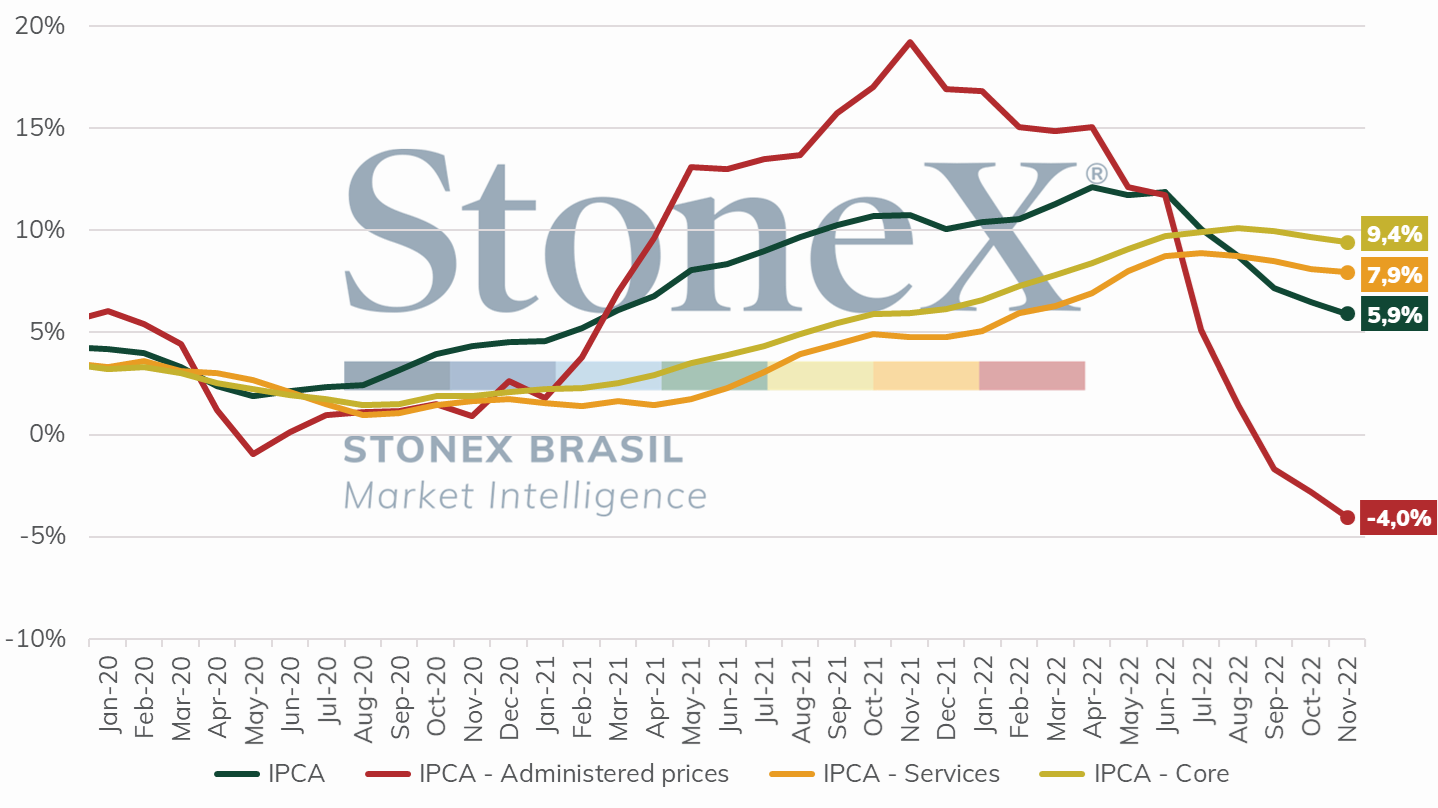
Finally, on Tuesday (13), the minutes of the latest decision of the Central Bank's Monetary Policy Committee (Copom) will also be published. Last Wednesday, the Committee warned about risks that the PEC 32/2022 could affect inflationary dynamics and Brazilian asset prices, so it is expected that the document elaborates on such risks. Furthermore, after the Copom decision, the National Broad Consumer Price Index (IPCA) for November was released, reinforcing the downward trend of the main inflationary index in Brazil, easing, at least momentarily, investors' fears.
Breakdown of the September IPCA according to selected groupings.
Source: Central Bank of Brazil. Design: StoneX.