Foreign Scenario
This week, the focus should be on the state of the global economic environment. In the past week, analysts' fears of a prolonged recession in 2023 increased after a string of monetary policy decisions by central banks in the United States and Europe. While some price indices are beginning to show signs that they may be starting to slow, such as the Consumer Price Index (CPI) in the United States, monetary authorities generally agreed that substantial interest rate rises in advanced economies are still needed to regain price stability.
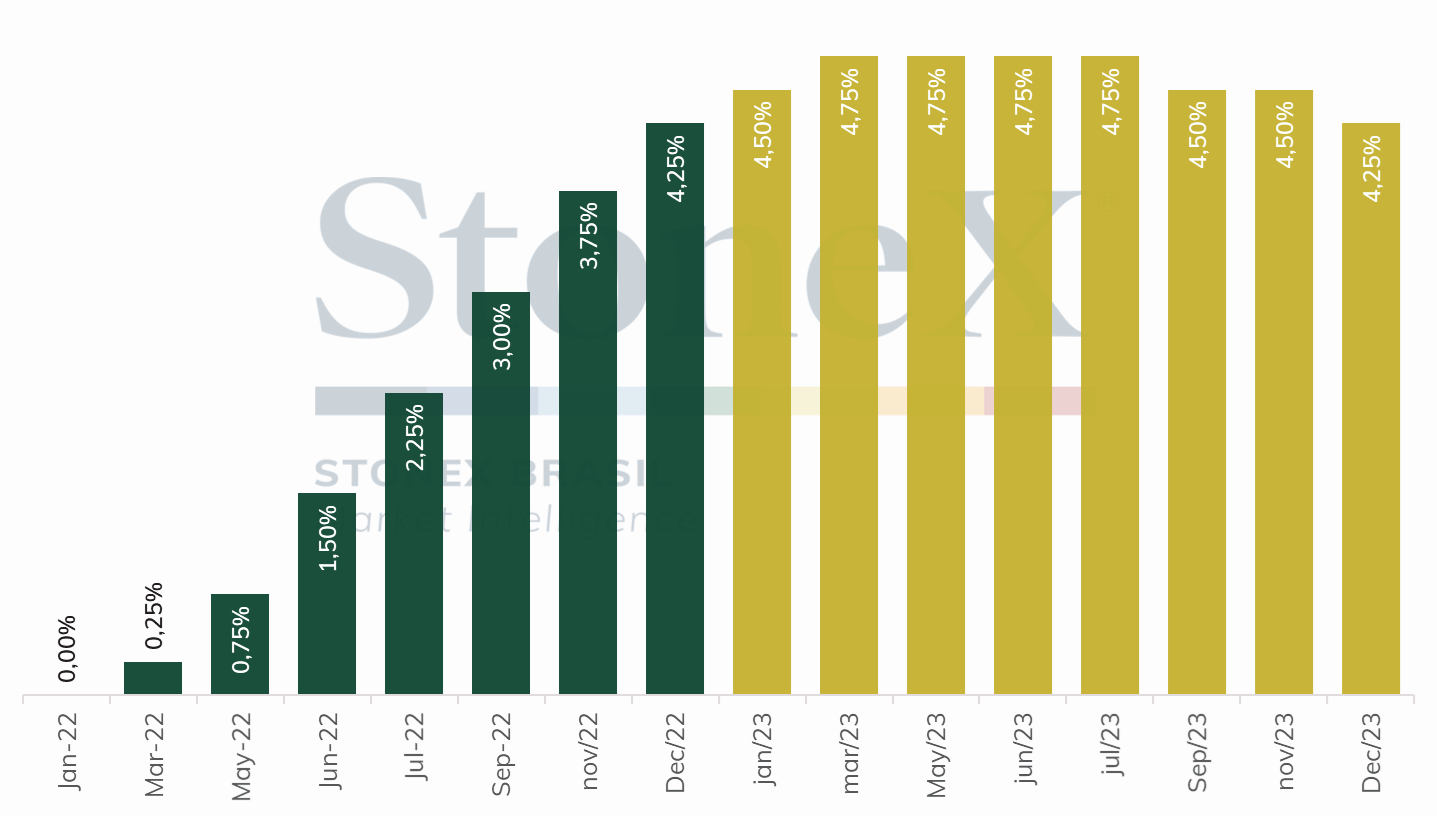
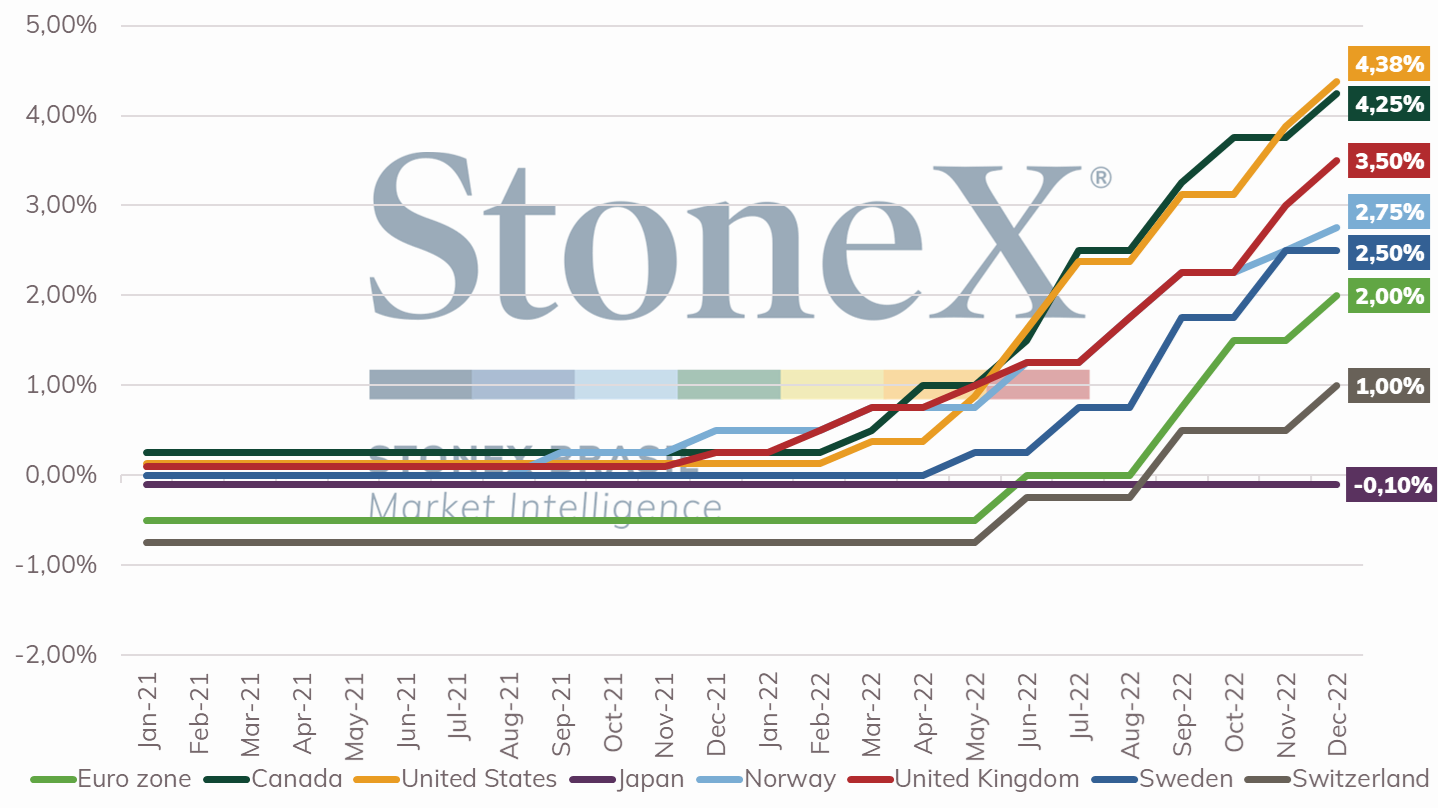
Such a message alarmed investors, who were betting on the possibility of easing monetary tightening by these authorities. For example, the Federal Reserve (Fed) has projected that it anticipates the federal funds rate in a range between 5.00% and 5.25% pa. in December 2023, while the interest futures market bets mostly on a range between 4.25% and 4.50% for the same period. Moreover, the European Central Bank has already announced the possibility of another three readjustments followed by 50 basis points, bringing the bloc's deposit interest rate to at least 3,50% pa. The picture was completed on Friday (16), with the previews of the Purchasing Managers' Index (PMI) for November signaling contraction for both the eurozone and the United States, amplifying perceptions that the New Year will be one of a lot of interest, little growth and, hopefully, high but declining prices. This week's economic data will be seen particularly through the prism of a recession.
American interest rate history and most likely bet on the future interest market
Source: CME FedWatch Tool. Design: StoneX. Interest futures market probabilities. December 16, 2022.
Interest rates of central banks responsible for Dollar Index currencies
Source: Bank for International Settlements (BIS). Design: StoneX.
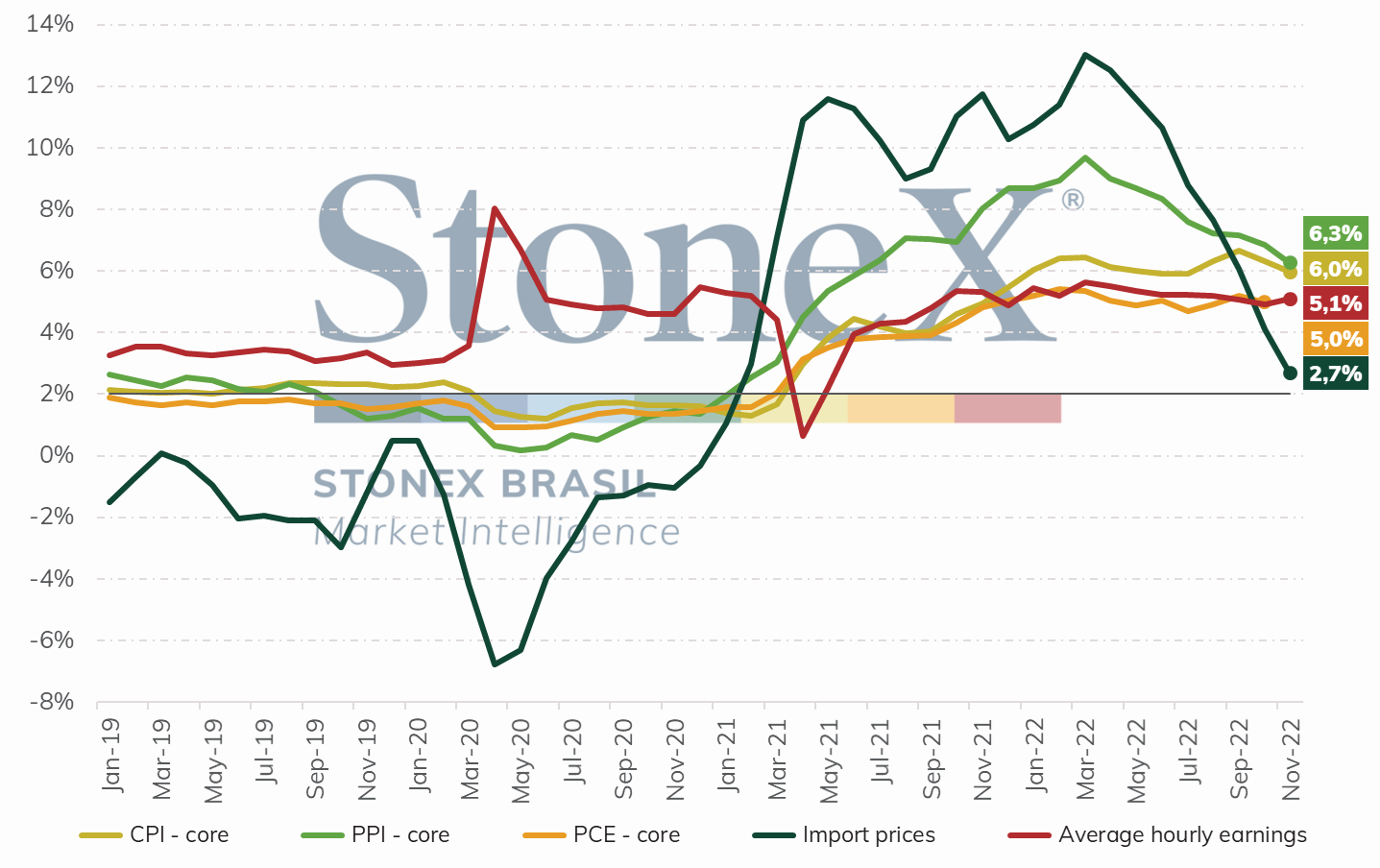
Accordingly, the most relevant economic data of the week will be the Personal Consumption Expenditures (PCE) Price Index, a measure most used by the Fed to monitor consumer prices and that can confirm – or refute – the hypotheses that prices have begun to moderate in the US and that there is room for the US central bank to be more cautious in its interest rate hikes.
Inflation measures for the United States (accumulated over 12 months)
Source: Federal Reserve Bank of St. Louis. Design: StoneX.
Domestic scenario
In Brazil, the week will be light on indicators. The focus should remain on the Transition PEC in the Chamber of Deputies. After a week of much resistance and no progress, the deadline for the amendment to take effect in January 2023 is increasingly tight, as legislative activities close next Thursday. The PEC would need to be approved in two instances in the Plenary of the Chamber, and then the budget would need to be approved within that deadline. The congressmen, on the other hand, await the definition of the judgment of the so-called "secret budget" by the Superior Federal Court (STF), scheduled for Monday (19), which, in practice, constitutes an important measure of parliamentary support in exchange for the release of public funds. With the deadline running out, investors expect the transitional government to agree to give in and reduce the amount it proposes to increase to the spending ceiling, currently at BRL 145 billion, or reduce the validity period of the constitutional amendment from two to one year. If there is no consensus, The Last way out would be to publish a provisional measure to release extraordinary credits to finance the increase in expenses, which would be accounted for outside the spending ceiling.
Finally, it is noteworthy that the budgetary disarrangement of the end of Jair Bolsonaro's government is so serious that the Ministry of Economy needed to publish a provisional measure of BRL 7,56 billion in extraordinary credits – that is, outside the spending ceiling – to be able to pay off the year-end Social Security benefits, a recurring and predictable expense. This fact highlights the need to readjust the 2023 budget, although the necessary amount can be discussed.