Foreign scenario
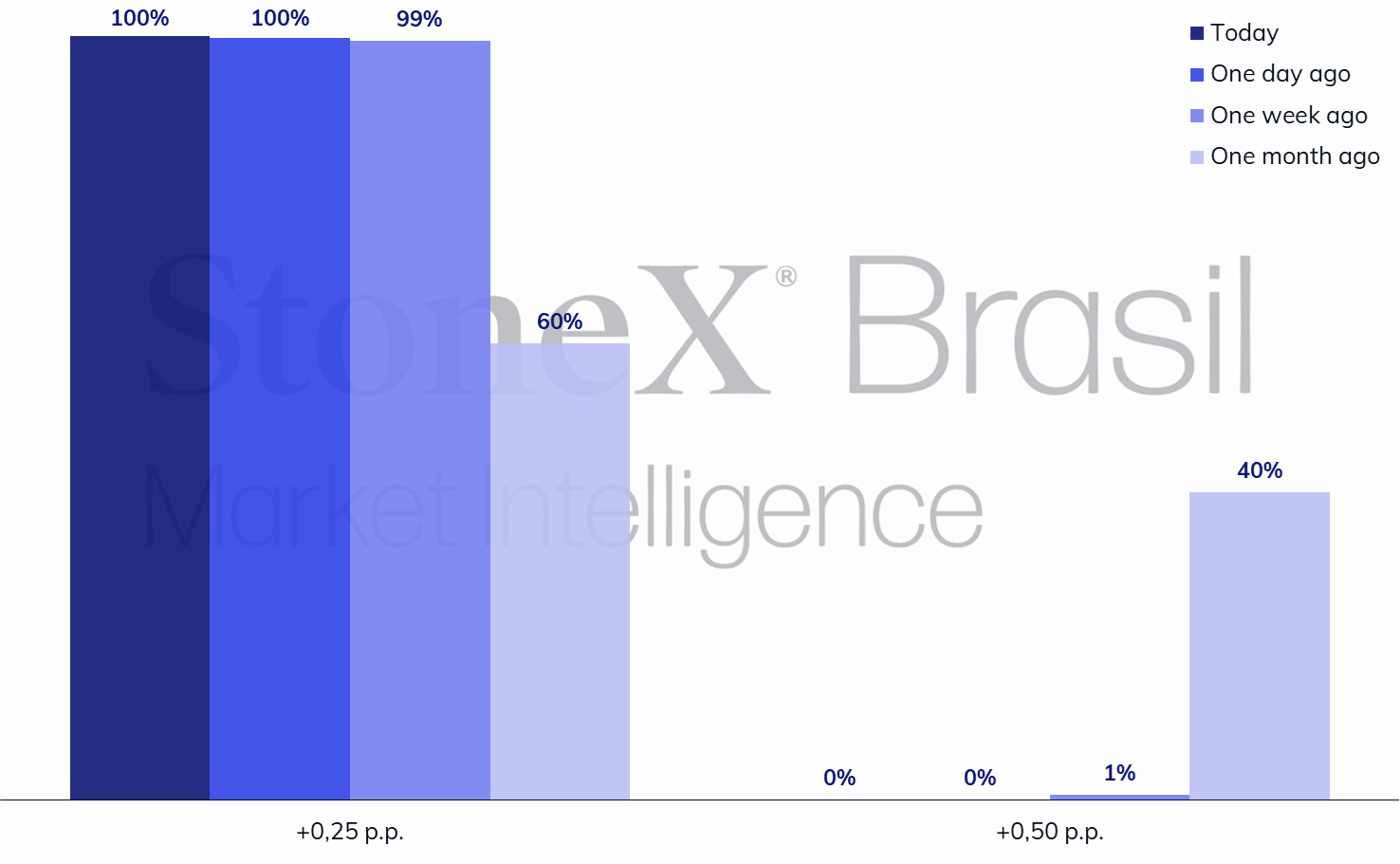
This week, the focus will be on the monetary policy decision of the Federal Reserve's Federal Open Market Committee (FOMC). There is almost consensus among analysts that the committee will continue to moderate the pace of monetary tightening and raise the interest rate by 0.25 p.p., moving from a range between 4.25% and 4.50% p.a. to the range between 4.50% and 4.75% p.a. However, there is greater doubt regarding the end of the interest rate increase cycle, that is, what will be the final level of interest when the readjustments are interrupted. It is believed that the statement of the decision should keep unchanged the excerpt that assesses as "appropriate a sequence of new readjustments," and investors followed the press conference of Fed Chairman Jerome Powell closely to observe if there are any signals in this regard. Powell is expected to stress that reducing the pace of interest rate hikes from 50 to 25 basis points does not represent a loosening commitment to restoring inflationary stability. In speeches and lectures in recent weeks, the members of the Monetary Authority were practically unanimous in warning that, although the last months have presented encouraging figures, the risks of price acceleration persisting in a resilient and widespread way in 2023 are relevant, requiring a sequence of increases in the country's interest rate to a final level above the 5,00% p.a. mark.
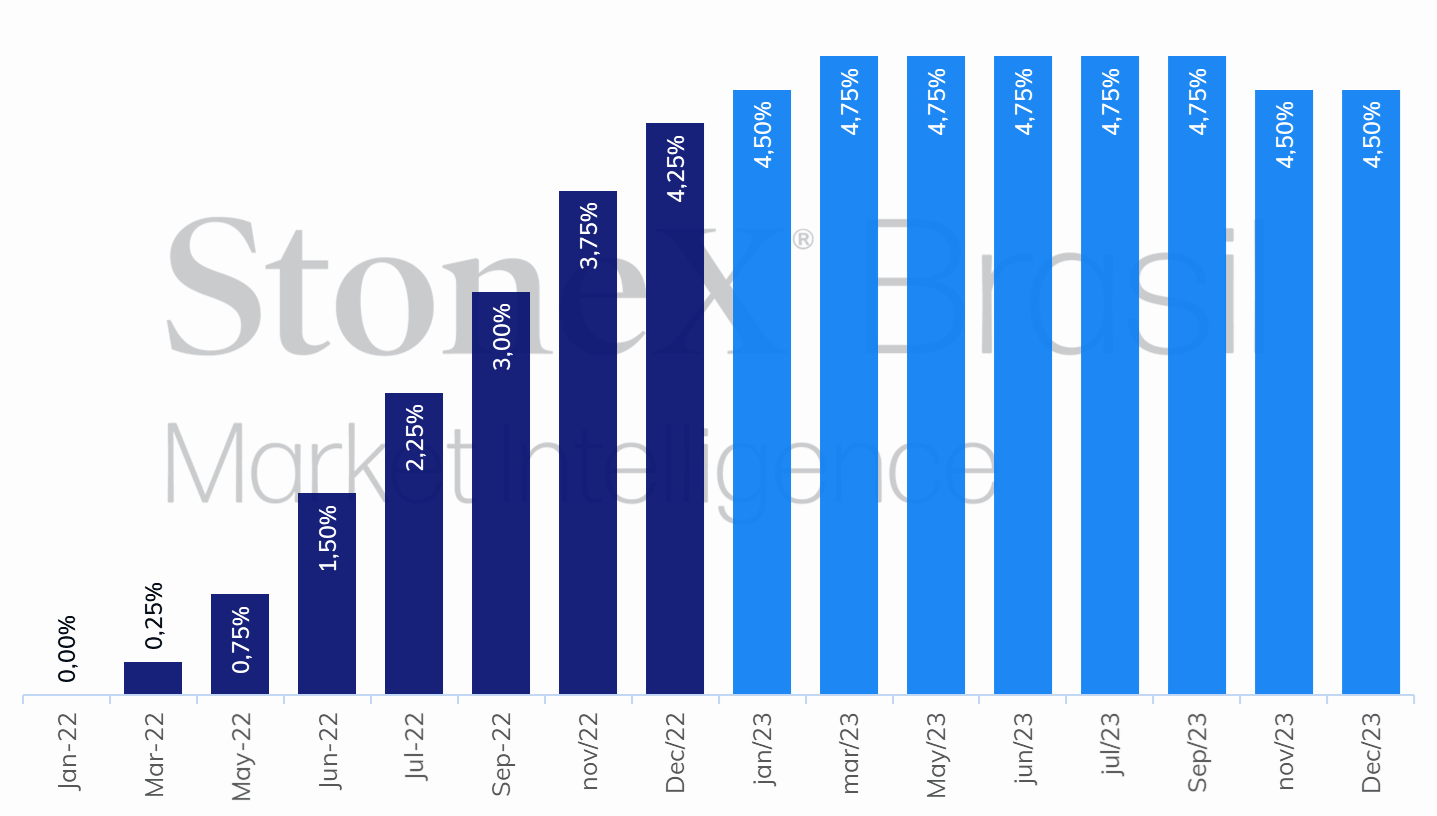
It is noteworthy, too, that the minutes of the last FOMC meeting were quite explicit in mentioning that no member of the Committee anticipated interest rate cuts in 2023. Still, most bets on the interest futures market continue to price in one or two cuts at the end of the year. Powell is expected to reemphasize the risks of premature monetary easing, and interest rates should remain stable for long after the bull run has ended.
Bets ON the Federal Reserve interest decision of February 01
American interest rate history and most likely bet on the future interest market
Source: CME FedWatch Tool. Design: StoneX. Interest futures market probabilities on January 27, 2023
This week will also bring a sequence of indicators for the American labor market, emphasizing the Employment Situation Report for January on Friday (03). Analysts expect that these indicators will continue to signal a labor market with low labor availability but with a decreasing pace of job expansion (the median of estimates points to a creation of 185K new jobs in January, compared to 223K in December) average labor remuneration (from an accumulated gain of 4,6% in 12 months to 4,3%). In addition, after a better-than-expected reading for the Purchasing Managers' Index (PMI) released by S&P Global, analysts are waiting for the release of the index estimated by ISM for the United States. The median of the estimates points to a deepening of the industrial contraction, with the PMI going from 48.4 to 48.0 points, but a weak recovery in services, rising from 49.6 to 50.3 points (50 points divide between expansion and contraction).
In addition, the week holds monetary policy decisions for the European Central Banks (ECB) and the British central bank (BOE). For the ECB, despite an easing of the most recent inflationary indicators, the majority expectation is that the Monetary Authority "maintains the course," in the words of its president, Christine Lagarde, and carry out three consecutive increases of 0,50 p.p. in its next three decisions. The decision is less clear for the BOE, one of the first central banks in the G7, to start its monetary tightening cycle. Most analysts expect another 0.50 p. p. readjustment, but several indicators signal that the British economy is stagnant or perhaps already in a recession. Therefore, some agents bet on a readjustment of 0.25 p.p.
Finally, it is worth noting the release of the January PMI indices for China this week, the first after considerable measures to reopen the country's economy. After disappointing figures in December, investors are anxiously awaiting a positive performance that will boost global risk appetite, severely shaken by the prospects of high-interest rates and economic recession in the United States and Europe. Another point of attention will be the Covid-19 infection numbers in the Eastern country after a week of holidays for the Lunar New Year, in which many urban dwellers return to their rural hometowns for visits.
Domestic scenario
In Brazil, the focus will be on the decision of the Central Bank of Brazil's Monetary Policy Committee (Copom). The unanimous expectation of analysts is that the basic interest rate (Selic) will be maintained at 13,75% p.a. in the committee's first decision after the inauguration of the new Luis Inácio Lula da Silva government. In its statement, the question is how Copom will pronounce itself regarding the greater perception of fiscal risks under the new government. Despite a concentrated effort by the new Finance Minister, Fernando Haddad, to prioritize measures aimed at maintaining fiscal responsibility, investors' fears remained amplified after the initial expansion of the budget, after the transition PEC, and, especially, a sequence of criticisms by Lula of fiscal stability and inflation targets.
In addition, the month-end PTAX rate on January 31 should bring a lot of trading volume to the foreign exchange market. Last week, the exchange flow was quite significant due to the maintenance of high commodity prices and the prospect of ending the monetary tightening cycle in the United States, which makes the BRL carry trade more attractive due to its high-interest differential.