- Consumer Price Index (CPI) in the US expected to maintain a trend of mild moderation in January, reinforcing the perception that the Federal Reserve is not likely to cut its key interest rate until May and strengthening the dollar.
- US retail sales in January may underscore the perception of a healthy economy and reinforce interpretations that the Federal Reserve will be cautious in carrying out its cycle of interest rate cuts this year, favoring the US interest rate differential and strengthening the dollar.
- Negotiations between the Executive and Legislative branches to resume progress on the economic agenda may involve postponing the payroll tax reapportionment measures, which could worsen the fiscal outlook for 2024 and raise the perception of fiscal risks for Brazilian assets, weakening the Brazilian real.
The week in review
The week was marked by the release of strong data for the US services sector, which reinforced the prospect that the Federal Reserve's interest rate cut cycle will start later in May or even June. In Brazil, the minutes of the latest Copom decision consolidated the outlook for cuts of 0.50 p.p. to the basic interest rate (Selic), even though services inflation may be slightly higher than expected by the Committee.
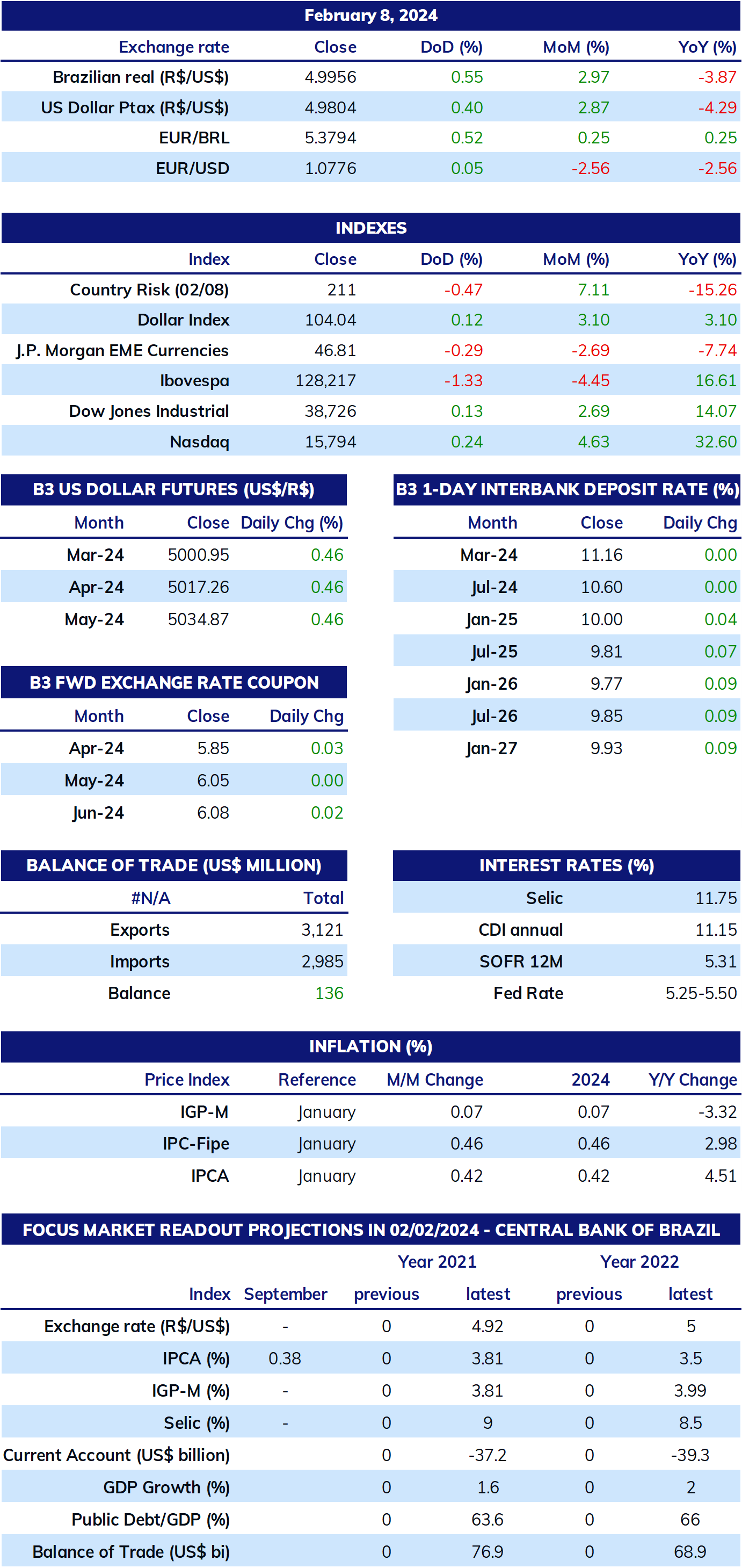
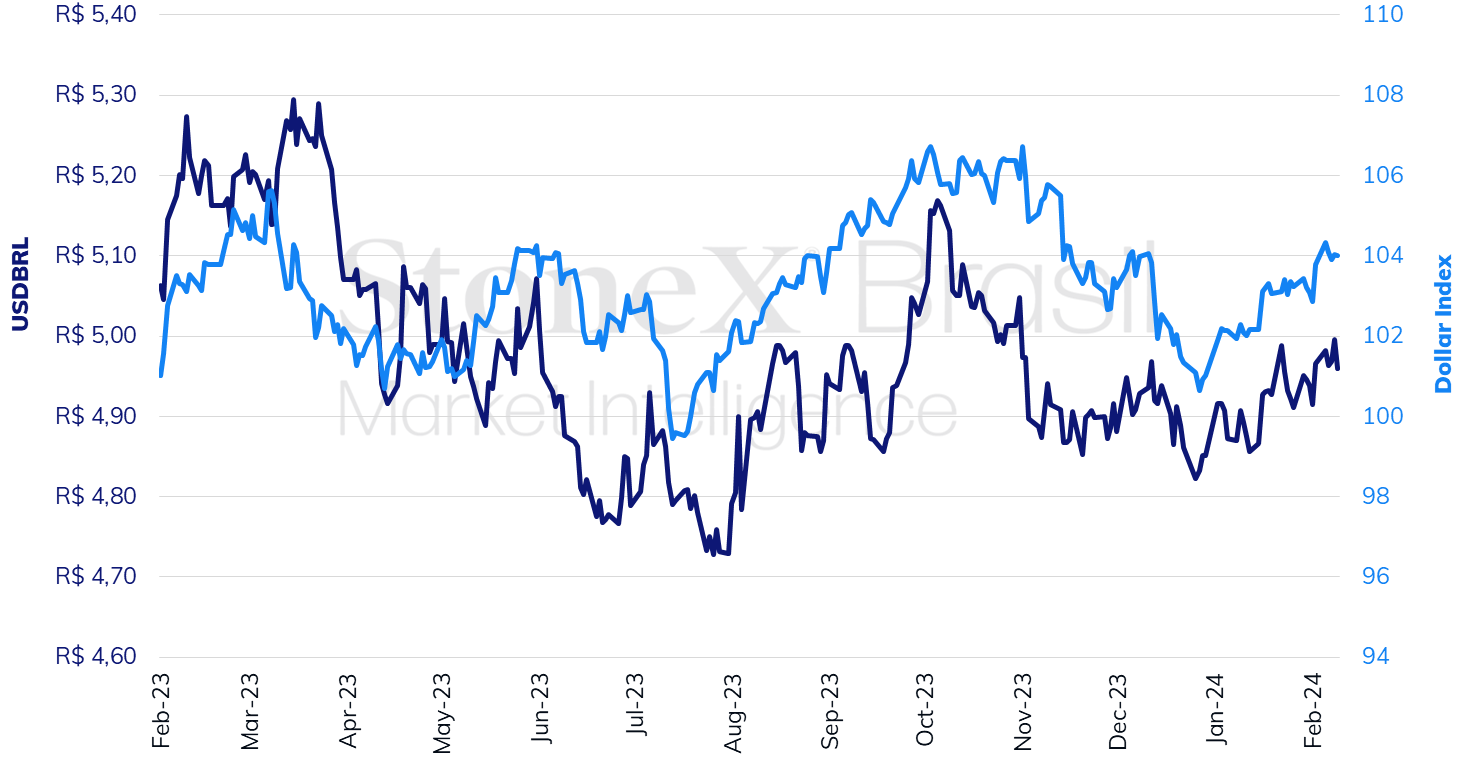
The dollar traded on the interbank market ended the week slightly down, closing Friday's session at BRL 4.960, a variation of -0.1% for the week, +0.4% for the month and +2.2% for the year. The dollar index closed Friday's trading session up for the sixth consecutive week, at 104.0 points, a weekly gain of 0.2%, a monthly gain of 0.9% and a yearly gain of 2.9%.
THE MOST IMPORTANT EVENT: US inflation
Expected impact on USDBRL: bullish
If, on the one hand, the data for productive activity and the labor market are exceeding analysts' estimates and signal a strengthening US economy, on the other, inflation data have remained relatively benign so far and indicate a trend of gradual price moderation. In fact, in the last monetary policy decision, Federal Reserve Chairman Jerome Powell said that the Federal Open Market Committee (FOMC) was not expecting better inflation readings to start a cycle of interest rate cuts, but only that the current moderation be confirmed for a few more months in order to boost the Committee's confidence in price stabilization. As a result, the Consumer Price Index (CPI) for January is expected to be very similar to that of December, with a rise of 0.2% in the headline indicator and 0.3% in its core, which excludes the volatile energy and food components. Accumulated growth over 12 months would rise from 3.4% in December to 3.1% for the headline index and from 3.9% to 3.7% over the same period for the core. If these projections are confirmed, they should reinforce the perception that the Federal Reserve will still keep interest rates stable in March and will not begin a cycle of interest rate cuts until May.
US retail sales
Expected impact on USDBRL: bullish
Retail sales are expected to lose momentum after December's strong rise, driven by sales related to the end-of-year festivities, but should continue to expand and signal that personal consumption in the US remains strong. Sales growth is expected to rise from 0.6% in December to 0.3% in January, while "core" sales, which exclude more volatile categories such as automobiles, building materials and fuel, are expected to rise from 0.4% in December to 0.2% in January.
Frictions between the Presidential Administration and Congress
Expected impact on the USDBRL: bullish
After the intense wear and tear caused by the Executive's initiatives with the Legislative branch during the parliamentary recess, such as issuing the Provisional Measure (MP) proposing the payroll tax hike and President Luiz Inácio Lula da Silva's veto of parliamentary committee amendments, the week was marked by conflicts, sharp public exchanges and canceled meetings. In search of an agreement, last Friday (09), President Lula met with the President of the Chamber of Deputies, Arthur Lira (PP-AL), and agreed that political articulation will no longer be led by the Minister of Institutional Relations, Alexandre Padilha, and will pass into the hands of the Civil House Minister, Rui Costa. In addition, the Ministry of Finance is negotiating with Congress on changes to the scope and timeframe of the payroll tax exemption, seeking a compromise and possibly even withdrawing the Provisional Measure and submitting instead a Bill as a matter of urgency, with a 45-day deadline for its analysis, with the new terms negotiated, which gives congressmen greater negotiating power compared to a Provisional Measure.