- Introduction
- Pound Outlook
- U.S. Dollar Outlook
- GBP/USD Outlook
- GBP/USD Technical Analysis (weekly)
Introduction
GBP/USD has fallen 2% across the first half of the year, with most of those losses coming in Q2 as the U.S. dollar staged a powerful recovery. This was more of a USD-strength story than a notable GBP-weakness narrative, given that sterling gained against the euro, the yen, the Swiss franc, Canadian dollar, and New Zealand dollar in the same period, but GBP underperformed only the Australian dollar.
Looking ahead, the balance of risks points to a mild downside bias for GBP/USD across Q3 as widening Fed-BoE policy divergence continues to favour the U.S. dollar. However, the pair could stabilise and recover towards year-end if falling energy prices feed through into lower U.S. inflation, allowing markets to look beyond Fed tightening and towards policy potential easing in 2027.
Pound Outlook
Inflation
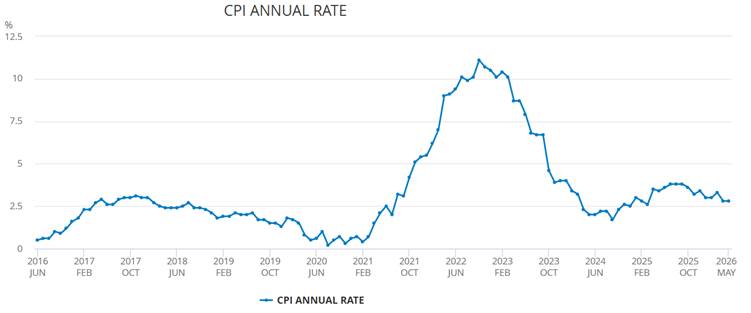
UK inflation surprised to the downside in May, remaining unchanged at 2.8% year-on-year despite expectations for a rise above 3%.
Combined with falling oil prices as supply through the Strait of Hormuz normalises, a weakening labour market and slowing economic growth, the inflation outlook appears less threatening than previously feared.
The BoE has already revised down its inflation forecasts and now expects CPI to rise to 3.25% by year-end, compared with 3.6% previously. This suggests the peak in inflation may be lower than feared, reducing the urgency for monetary tightening.
UK Economy
The UK economy is losing momentum.
While GDP grew a solid 0.6% in Q1, activity contracted by 0.1% in April as higher energy costs and weaker demand weighed on growth. PMI data suggest little improvement since then.
Private-sector activity contracted for a second consecutive month in June, with the composite PMI falling to a 14-month low. More concerningly, services activity, which accounts for the majority of UK economic output, fell to its weakest level in more than three years.
At the same time, labour market conditions continue to soften. Job vacancies have fallen to their lowest level in five years, while unemployment sits at 4.9% and wage growth is slowing.
Taken together, the data point to an economy that is slowing faster than inflation is rising, particularly given that oil prices have fallen back to pre-Middle East conflict levels, potentially limiting the need for a BoE hike.
However, this could all change should the conflict in the Middle East ramp up again. Although we don’t see this as the base case scenario.
Bank of England Outlook
Markets are currently pricing just one rate hike from the Bank of England before year-end.
Governor Andrew Bailey has become increasingly cautious about tightening policy, reflecting concerns over weak growth and a cooling jobs market.
The BoE appears caught between inflation that remains above target and an economy that is showing signs of slowing, while oil prices also fall. As a result, the BoE seemed more comfortable in wait and see mode in the June meeting.
This leaves the BoE looking more dovish than the Federal Reserve which is weighing on sterling.
Political Uncertainty
Political uncertainty has emerged as an additional headwind for the pound.
At the time of writing, Keir Starmer has resigned and the process of selecting a replacement is underway. Andy Burnham remains the frontrunner, although uncertainty remains over both the timing of the transition, and the policy direction of the next government. If there is no opposition Andy Burnham could be in power by early July. If there is a contest it could be Andy Burnham takes power by September.
For markets, the key issue is fiscal policy.
Burnham has indicated he may seek greater flexibility within the government's fiscal rules. While there has been little detail on what this would mean in practice, investors remain sensitive to any suggestion of higher borrowing given the UK's already stretched fiscal position.
Public sector borrowing continues to run ahead of forecasts, leaving little room for significant increases in spending without risking a negative reaction in the gilt market.
The appointment of the next Chancellor will therefore be closely watched. A fiscally cautious choice such as Wes Streeting could reassure investors, while any indication of a more expansionary fiscal approach (Ed Miliband) could put pressure on both gilts and sterling.
U.S. Dollar Outlook
U.S. Economy
The U.S. economy has remained remarkably resilient despite a series of shocks, including tariffs, labour market disruption and the conflict in the Middle East.
Rather than slowing sharply, economic activity has continued to expand, supported by strong business investment, robust consumer spending and a resilient labour market.
The U.S. has also benefited from its position as a major energy producer. Unlike many economies, higher oil prices provide support to parts of the domestic economy, helping cushion the impact of energy shocks.
Meanwhile, labour market conditions remain healthy, with three consecutive months of solid job creation.
Inflation
Inflation remains the key issue. CPI has risen to 4.2%, while Core PCE, the Fed’s preferred gauge of inflation, rose 3.4%, a three-year high, keeping inflation well above the Fed's target.
As a result, markets have significantly repriced expectations for U.S. interest rates. The possibility of up to three Fed rate hikes before year-end has helped drive a breakout in the U.S. dollar.
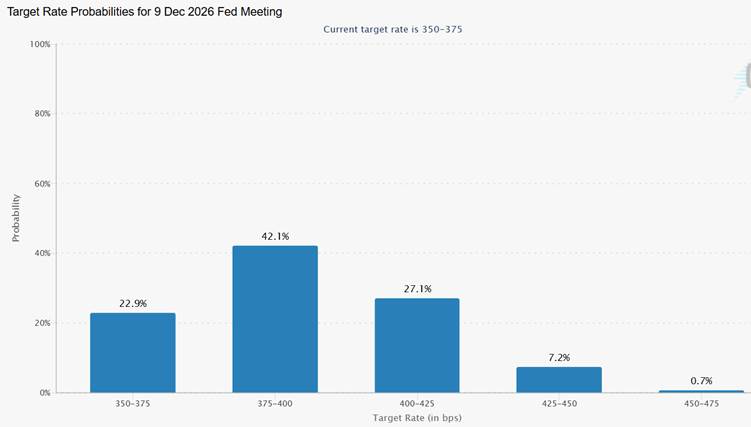
The key difference between the U.S. and UK outlooks is that the Federal Reserve is looking increasingly hawkish under the new Fed Chair Kevin Warsh, debating whether rates need to move higher, while the Bank of England is questioning whether growth is too weak to justify hikes.
That widening Fed-BoE policy divergence remains the strongest argument for further GBP/USD weakness in Q3.
Looking beyond Q3, the sharp fall in oil prices back towards pre-conflict levels should gradually ease U.S. inflationary pressures heading towards Q4. If this feeds through into Core PCE, markets could begin scaling back expectations for further Fed tightening and instead start looking towards policy normalisation or easing in 2027. That would remove one of the dollar's biggest sources of support and could allow GBP/USD to recover into year-end.
US mid term elections in November could also result in some USD volatility but rarely create a lasting on their own. The USD typically returns to trading on interest rate differentials and macro fundamentals within days or weeks.
GBP/USD Outlook
The balance of risks points towards a weaker pound and stronger U.S. dollar over the coming quarter.
Cooling UK inflation, slowing growth, a weakening labour market and political uncertainty all reduce the likelihood of BoE tightening at all.
Meanwhile, the U.S. economy remains comparatively resilient, inflation remains elevated, and markets at least one rate hike looks likely, possibly as soon as September.
Still, with inflation likely to cool in the U.S. towards the end of the year, GBP/USD could recover in Q4 if the political outlook is supportive.
GBP/USD, technical analysis (weekly chart)
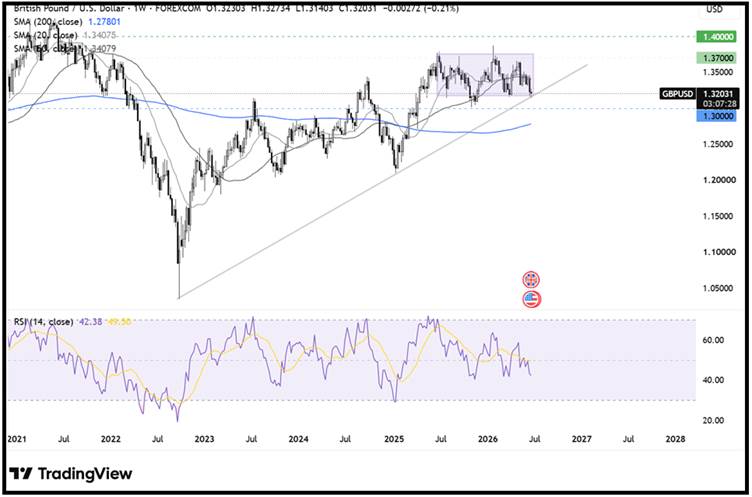
GBP/USD continues to trade above its long-term rising trendline, with support dating back to late 2022. More recently, the pair has been range-bound, capped by 1.3800 on the upside and supported around 1.3200 on the downside. GBP/USD has also slipped below the 50 SMA.
Sellers, supported by the RSI below 50, will look for a break below the 1.3150 horizontal support level and the rising trendline to bring 1.3000, the psychological level and the November 2025 low, into focus. A break below here would expose the 200 SMA at 1.2770.
On the upside, resistance can be seen at 1.3550, where the 50 SMA is located. A rise above this level would turn attention to 1.3750.