The market was looking forward to the 2023/24 planting intentions and 2022/23 quarterly March 1st stock position reports from the US, which were released last Friday (31). In the case of planting, this is the first USDA figure based on a survey with the country's producers.
Soybeans
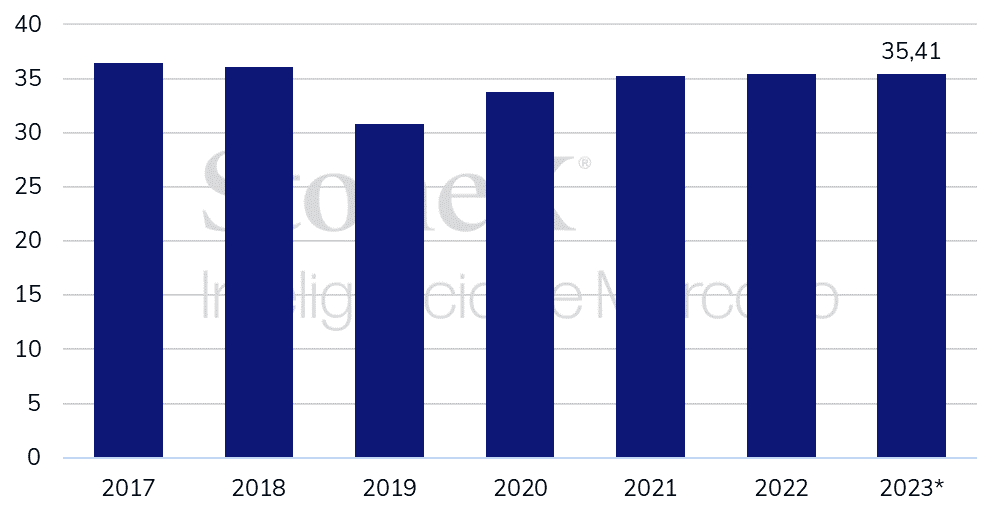
For soybeans, the 2023/24 area was 35.41 million hectares, exactly in line with the Agricultural Forum number in February. It should be noted that this area also means stability in relation to the USDA's final number for 2022 of 35.39 million hectares.
In general, the market was betting on a slightly larger soybean area, since the country's balance sheet is not snug, with ending stocks for 2022/23 estimated at 5.72 million tonnes, a situation that tends to get even tighter, considering the result of the stocks position on March 1st.
According to the USDA, on March 1st, the US had 45.86 million tonnes of soybeans, six months after the 2022/23 crop (Sep/22 to Feb/23). This volume was below the average of expectations, which were at 47.41 million, but still within the range, which ranged from 43.5 to 52 million tonnes.
As much as this result indicates that the country's soybean consumption (domestic and exports) was stronger on average between December and February, another very plausible possibility is a negative adjustment of the 2022/23 production, signaling that the USDA overestimated the country's crop and the actual supply turned out to be lower.
In any case, if the planted area really does not grow in 2023, the US would tend to maintain the trend of a tighter supply balance also in the 2023/24 cycle. On the other hand, as the soybean planting window is a few weeks later than that of corn, it could end up gaining area at the last minute, especially considering that regions in the north of the country's producing area still register significant snow cover, which may delay/impact corn planting.
US soybean planted area (million hectares)
Source: USDA. Design: StoneX. *Planting intentions.
Corn
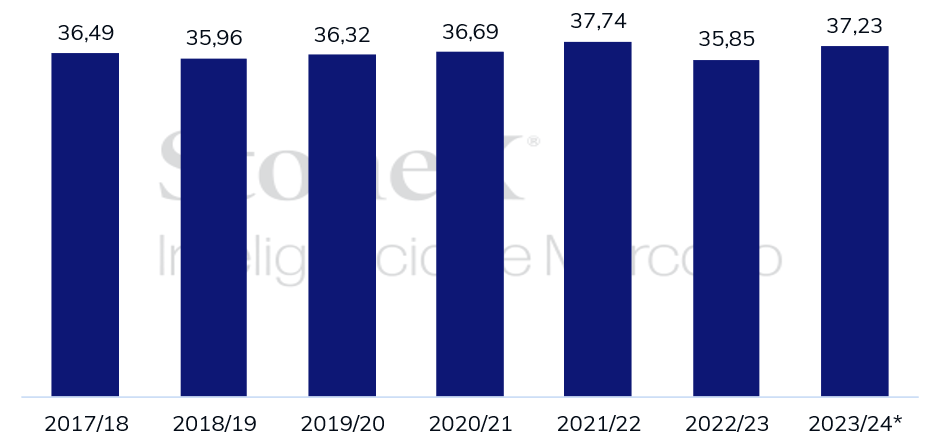
For corn, the market expected an increase in planted area compared to last year, when the US planted 35.85 million hectares, due to the tight balance of supply and demand seen not only in the US, which was affected by adversities in the 2022/23 season, but also worldwide, due to the Russian-Ukrainian war and the Argentine crop failure.
Without bringing any major surprises, the Department indicated that US producers intend to plant 37.23 million hectares, a number slightly above the projection by the Agricultural Forum (36.83 million) and the average of market estimates (36.78 million). This expected increase of 1.38 million hectares compared to 2022 was driven mainly by North Dakota (+323,750 ha), Minnesota (+141,640 ha) and Indiana (101,170 ha).
Although the area released at the end of March is based on a survey with producers and provides a good indication of how much will be sown, the final number is subject to major changes, as the weather over the next few months will be of great importance to carry out the planting.
Considering the area mentioned in the Planting Intentions Report, the percentage of the area that will not be harvested (which includes both abandoned area and that destined for silage), calculated by the Agricultural Forum (8.7%), and a yield of 11. 4 t/ha, also brought by the Forum, the US would produce 387.5 million tonnes, 38.7 million more than what was produced in 2022/23 (348.8 million) and 4.3 million above the number estimated by the Forum (383.2 million).
Maintaining the Forum's total demand estimate for the 2023/24 US crop (368.1 million tonnes), the country would end the next season with ending stocks of 52.2 million tonnes and a stocks/use ratio of 14.2%, a significantly more comfortable condition than in 2022/23 (32.2 million and 9.1%), also above what was brought in the Forum (47.9 million and 13%).
However, it is also important to consider that a yield of 11.4 t/ha would be a record for the US and was the reason for a lot of opposition from the market. If we consider the highest average productivity in the US so far (11.09 t/ha), recorded in the 2021/22 season, the country will reach a production of 377 million tonnes. In a scenario without rationing, that is, maintaining total demand as estimated by the Forum at 368.1 million tonnes, the 2023/24 cycle would end with carryover stocks of 41.7 million tonnes and a stocks/use ratio of 11.3%, a more comfortable situation than in 2022/23, but more restricted than indicated by the Forum's estimates.
US corn planted area (million hectares)
Source: USDA. Design: StoneX. *Estimated.
Wheat
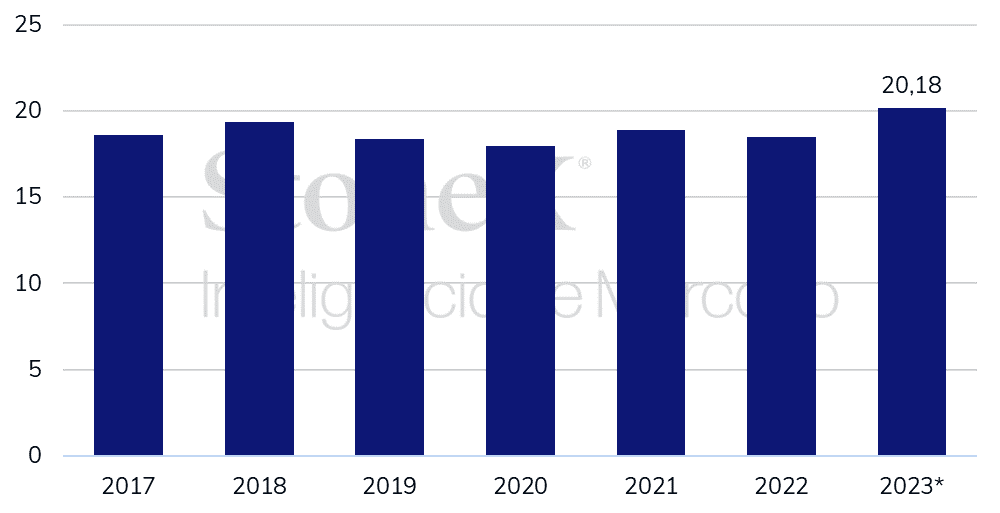
In the case of wheat, planting prospects for the US were very close to what was indicated in the Agricultural Forum and the 10-years average, around 20.03 million hectares.
To a large extent, the expected area of 20.19 million tonnes in 2023 reflects the increase in the winter wheat area, which makes up the bulk of US production. If the projection materializes, the winter area will increase from 13.48 to 15.18 million tonnes.
The increase is observed mainly in Texas, Oklahoma, Kansas, and Colorado, resulting in a total increase of 1.01 million hectares in these states together.
Despite the expectation of growth in these areas, it is worth mentioning that these are producing regions that faced severe drought conditions during the current crop and have little chance of recovery, when observing the classifications of crops in the Plains, which have been reported by the USDA. As such, the market appears skeptical of the increase in winter wheat hectares reported by the USDA.
Only 16% of the winter wheat crop in Kansas, the top wheat producer, is in good/excellent condition, with 57% of its crops remaining in poor/very poor ratings as of April 2. Colorado and Oklahoma saw very subtle improvements in their condition, while Texas lost 5 percentage points, leaving only 18% of its crops in good/excellent condition.
Therefore, the Planting Intentions report divides opinions for wheat, given that the weather continues to be a decisive factor for the expansion of planted area, and the monitoring of crop conditions indicates concerns for producers.
US wheat planted area (million hectares)
Source: USDA. Design: StoneX. * Planting intentions.