As harvest progresses, the US crop continues to be closely monitored, with new estimates still to come. At the same time, the 2020/21 supply and demand balance is heading towards consolidation, with the USDA's October report expected to bring new adjustments and incorporate the result of the quarterly stocks position on September 01 released on September 30.
Soybean
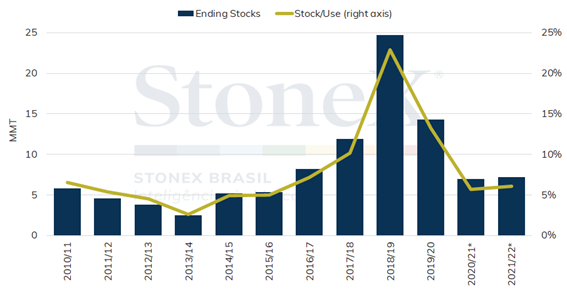
For soybean, the stocks stood at 6.97 million tonnes, a level considerably above the average of the market's expectations of 4.74 million and above the latest USDA estimate, since this result is equivalent to the ending stocks of the 2020/21 crop.
However, it was not the result of the stocks itself that was the most surprising, but the reason for this increase, since production was revised, with an increase of 2.2 million tonnes to 114.75 million tonnes.
The downward trend of soybean prices in Chicago in recent months was already a sign that the supply and demand balance in the US might not be as tight as estimated. However, the lack of this information, that the production was higher than expected, also affected the market behavior. For example, crushed soybean levels were lower than expected in several months, indicating certain rationing amid the low availability perspectives.
Considering the 2020/21 crop's ending stocks reinforcing the supply for the 2021/22 cycle, it can be noted that, even without demand variables changes, the North American supply and demand balance situation is not exactly comfortable, with a stock-use ratio of around 6%.
US soybean ending stocks and stock-to-use ratio
Source: USDA. Design: StoneX. *Estimate.
As soybeans production and consumption are very concentrated in a few countries, any change can alter this greater availability of North American soybeans. Currently, for example, the South American crop is central, with the possibility of La Niña occurrence. In addition, the USDA is with a production estimate for Argentina, at 52 million tonnes, more optimistic than what was released by institutions in the country, with forecasts below 50 million due to a continued fall in planted area.
On the demand side, the possibilities of changes in the estimates are also significant. For example, US export sales are considerably weaker than in the same period last year, with lower purchase volumes from China standing out. In addition, there are concerns about Chinese feed consumption amid low hog prices.
Another important point is the biofuels market, with possible changes in the mandatory blend in the US and cuts in other countries, amid strengthened prices for vegetable oils.
Corn
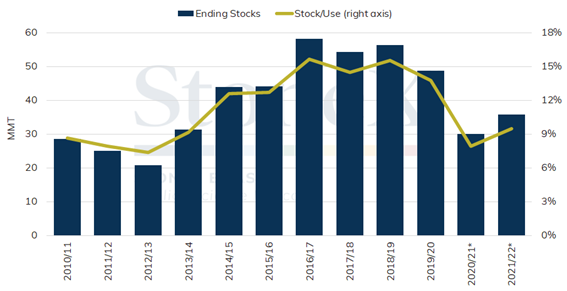
In the case of corn, the quarterly stocks report showed 31.4 million tonnes, lower than the market's average expectations of 29.21 million tonnes and close to the upper limit of the estimated range, which varied between 25.35 million 31.80 million tonnes.
Like soybean, the revision of the US 2020/21 production, with adjustments in area and productivity, conditioned these higher stocks for the end of the cycle.
Besides being higher than expected by agents, ending stocks exceeded the September WASDE estimate by 1.26 million tonnes or 4.2%. Still, it cannot be said that the US balance sheet situation is exactly comfortable, as this is the lowest ending stocks since the 2013/14 crop when the number was 31.29 million tonnes.
With the carryout a bit more comfortable and sticking with USDA's September S&D estimates for the US 2021/22 crop, the country's balance sheet is also expected to be less tight at the end of this season, with ending stocks reaching 37.03 million tonnes.
However, again, it is important to reinforce that, even growing, the scenario for the balance is still not "calm," with the stock-to-use ratio remaining around 9%, a level that usually indicates a lot of volatility in the market.
US corn ending stocks and stock-to-use ratio
Source: USDA. Design: StoneX. *Estimate.
The 2021/22 season is still beginning, and many things can still happen, and significant changes in the North American balance sheet cannot be ruled out. However, production is less subject to changes with the US harvest progress, but the demand side is not defined.
Just as China started to buy significant volumes of North American corn in the 2020/21 crop, the opposite may happen. Even though the USDA estimates indicate that the country will import 26 million in 2021/22, the same level as in 2020/21, the US will face greater competition from Ukraine, which should record a significantly more robust crop than last season, much damaged by the drought in the Black Sea region.
Another factor still involving China is the fear of a possible reduction in demand for corn for feed in the country. In addition, the hog prices and margins in China are at very low levels, which may discourage the use of grain for animal feed.
Another issue that may impact the market is a change in the biofuels policy in the US. The ethanol sector is responsible for a large part of North American corn consumption, and a revision of the RFS could significantly impact grain demand.