On Friday (08), the USDA released its monthly supply and demand report (WASDE), which is always highly anticipated by the market. Although the focus is already on the 2022/23 crop, the Department's numbers for the new cycle will only start to be released in May. Thus, the April release brought updates for the 2021/22 crop.
Soybean
The USDA again raised the 2021/22 export estimate to 57.6 million tonnes for US soybeans, pushing ending stocks back to 7 million tonnes. The country's shipment outlook has been rising amid declines in South America, but the expected total is still lower than that recorded in the 2020/21 cycle, at 61.5 million tonnes.
As expected, in South America, there was another cut in the Brazilian soybean crop, which fell to 125 million tonnes, while Argentina's production was stable at 43.5 million tonnes.
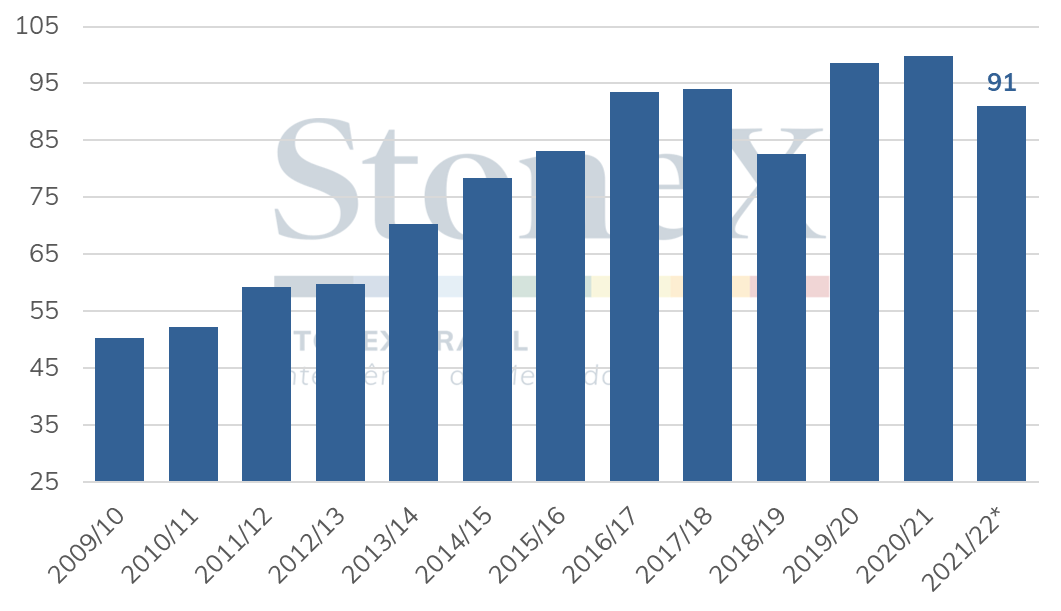
As has been the trend in recent reports, the USDA has once again cut the number of imports from China from 94 million to 91 million tonnes. The justification for this adjustment was the weaker pace of Chinese crushing between October 2021 and March 2022, with a record of 4.2 million tonnes less than a year earlier.
In addition, it is worth remembering that the Asian country has bought far fewer North American soybeans compared to the same period last year.
With cuts in both demand and supply, the world 2021/22 ending stock has changed little, standing at 89.6 million tonnes.
In the May report, estimates for the 2022/23 crop will incorporate US planting intentions, with yields at historical trend (Agricultural Forum number), which will indicate record production for the country. However, until a definition is closer to reality, both concerning area and yield, there is still much to happen, remembering that the critical phase of grain filling in the US is concentrated in August.
Soybean imports – China (MMT)
Source: USDA. Design: StoneX. *Estimate.
Corn
Concerning the changes made in corn S&D estimates, starting with the US, it can be said that the USDA made few adjustments to its figures. The Department increased the use of the grain for ethanol production in 2021/22 to 136.5 million tonnes, up from 135.9 million tonnes in the last report. On the other hand, the USDA cut with the same intensity the use for feed, which went from 143.5 million to 142.9 million tonnes. With this, total domestic consumption remained at 315.8 million tonnes. With no changes in the other supply and demand elements, US ending stocks remained at 36.6 million tonnes.
Regarding the Ukrainian crop, whose numbers were much awaited due to the continuing conflicts in the country, the USDA promoted significant changes. As expected, amid the logistical problems caused by the war against Russia, Ukraine's exports were again reduced, from 27.5 million to 23 million tonnes. On the other hand, domestic consumption in the country increased by 2.3 million tonnes to 13.2 million tonnes. As a result, Ukrainian ending stocks rose by 2.2 million tonnes to 6.55 million tonnes.
On the South American crop side, the highlight was the increase in the Brazilian 2021/22 crop production by 2 million tonnes to 116 million. Amid expectations of greater availability of Brazilian grain and lower Ukrainian shipments, the country's exports were raised by 1.5 million tonnes to 44.5 million tonnes. In addition, the Department also increased its estimate for domestic consumption by 0.5 million tonnes to 73 million. Even with the variation in production having been offset by changes in the demand for corn in Brazil, ending stocks in 2021/22 suffered a slight reduction of 80,000 tonnes to 5.15 million, reflecting a reduction of the same intensity in the ending stocks of the 2020/21 crop, now estimated at 4.65 million.
About Argentina, the only change in the balance for the 2021/22 crop was an increase of 160,000 tonnes in ending stocks due to a change of the same volume in ending stocks for the previous crop.
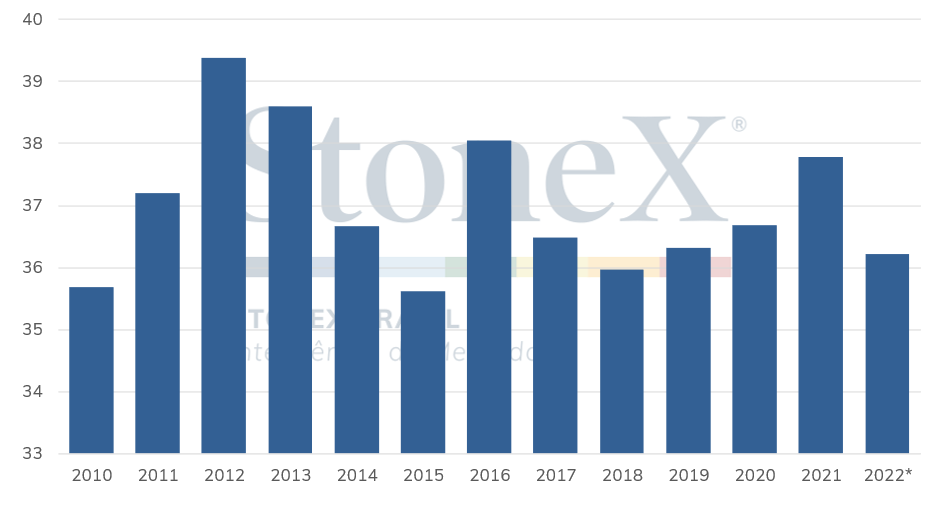
It will be very important to follow next month's WASDE since the USDA will bring its first numbers for the 2022/23 season. Much has been made about Ukrainian production, as corn planting in the country begins in April, and with the ongoing war, the impact on field work is expected to be significant. According to Ukrainian Agriculture Minister Roman Leshchenko, the country's farmers are expected to plant up to 3.3 million hectares of grain, almost 40% down from the 2021/22 crop. In addition, it will be interesting to see how concerns regarding the international availability of the grain will affect the next season's planting. In the Planting Intentions report, the USDA indicated that the US would plant 36.2 million hectares of corn in 2022/23, 1.6 million less than the 2021/22 crop and 1 million less than expected by the market. However, it is worth noting that much of the survey was conducted before the conflict between Russia and Ukraine, not fully accounting for the rally that tensions in the Black Sea caused in corn prices.
Corn exports trend (MMT)
Source: USDA. Design: StoneX. *Estimate.
Wheat
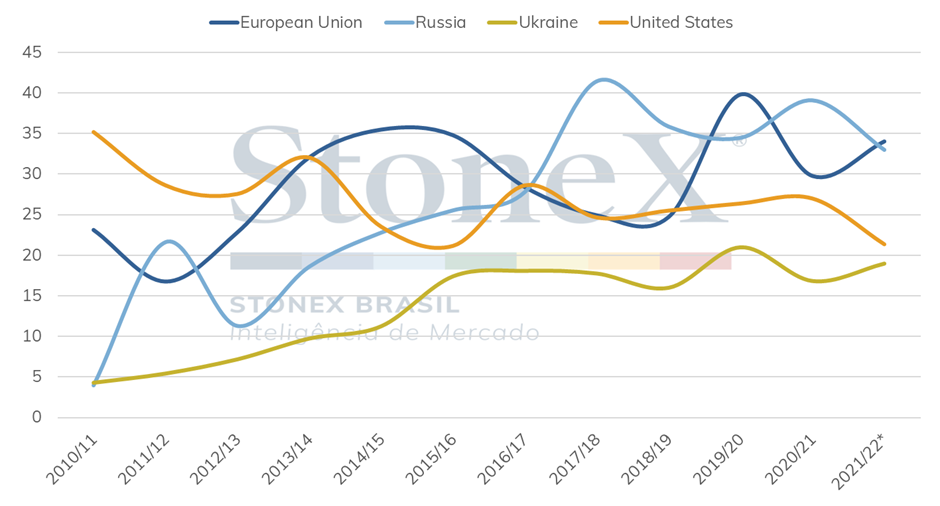
For the US domestic wheat, the USDA has maintained the trend addressed in the March report in most of its estimates. Domestic supply continues at a reduced level and with less domestic use. Higher ending stocks and lower export estimates were more contrasting. Exports remain the lowest since 2015/16, which, if realized, will be around 21.36 million tonnes, 410,000 tonnes below the previous estimate, as the US remains uncompetitive for most markets. Projected ending stocks for 2021/22 increased by 680 thousand tonnes to 18.45 million tonnes, representing a 20% reduction from the previous year.
The WASDE report continued to draw attention to bullish factors on the international scene. For example, before the conflict between Russia and Ukraine, the estimate was that Ukraine would export 24 million tonnes while Russia would commit to 35 million tons. However, as the conflict progressed, the expectation fell to 19 million tonnes and 33 million tonnes, a reduction of 12% in the total.
On the other hand, global supply for the 2021/22 crop year showed a slight increase due to higher carryin in Pakistan, Brazil, Saudi Arabia and higher production in Argentina, offsetting the contraction in the European Union. However, the world consumption projected for 2021/22 had an indicative increase of about 3.8 million tonnes, corresponding to 791.1 million tonnes.
Wheat exports trend (MMT)
Source: USDA. Design: StoneX. *Estimate.
Regarding the cotton market, the release of the April WASDE report did not generate as much volatility in the market as expected, for little changing the supply and demand variables. The Department did not bring any change for the 2021/22 crop in the US, and, with that, the ending stocks of the country remain estimated at 760,000 tonnes, with the stock/use ratio at 67.2%.
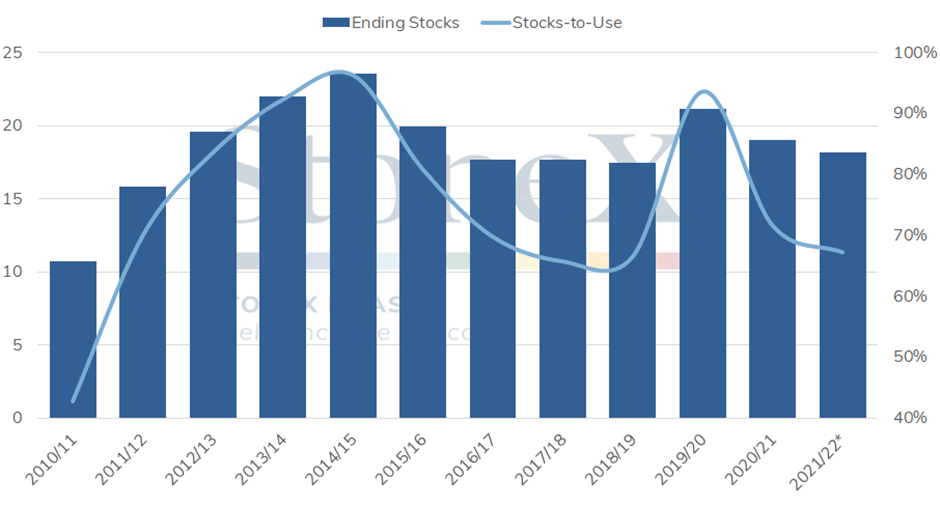
Suppose there is any consideration to influence the prices of natural fiber. The USDA update can be considered bearish by the expectation of world stocks slightly higher than previous estimates, which went from 17.98 million to 18.15 million tonnes. This occurred, especially by reducing 110 thousand tonnes in global cotton consumption, a direct reflection of the cut in Chinese demand to 8.49 million tonnes. The Asian giant had already been importing less cotton in recent months, and the surge in Covid-19 in the country should affect the recovery of its economy and, therefore, the demand for cotton.
Overall, the USDA also cut exports from some countries, such as Brazil and India, which should be affected by this lower Chinese consumption, and are now estimated at 1.72 million and 1.13 million tonnes. Finally, it is worth noting the revision in Pakistan's production, from 1.26 million to 1.31 million tonnes, which pushed global production slightly up, from 26.09 million to 26.17 million tonnes, supporting the relief in the world stock/use ratio in the 2021/22 cycle, projected at 66.3% in March and revised to 67.2% – now 4.39 percentage points below the 2020/21 crop.
Evolution of world ending stocks (MMT) and stock/use ratio (%)
Source: USDA. Design: StoneX. *Estimate.