China is a major player in the global commodities market and the main importer of several agricultural products. As such, the level of Chinese economic activity and demand is always a crucial factor for the world, especially for the countries that supply the Asian giant the most.
Since the beginning of the pandemic, China has adopted very restrictive measures to contain the spread of the coronavirus, which has, on several occasions, negatively impacted the country's economy, bringing concerns regarding Chinese imports to the market. Recently, the China Customs Department (GAAC) released its May data, which will be discussed throughout this material.
Soybean
As on the supply side, soybean demand is also very concentrated, especially in China, a country that has already imported almost 100 million tonnes of soybean in the 2020/21 season.
In the 2021/22 crop, Chinese purchases are being followed even more closely as the country adopts a very restrictive stance in the fight against Covid-19, putting a large number of people in lockdown whenever new cases appear, besides the fact that US sales to the Asian country are considerably behind the previous cycle.
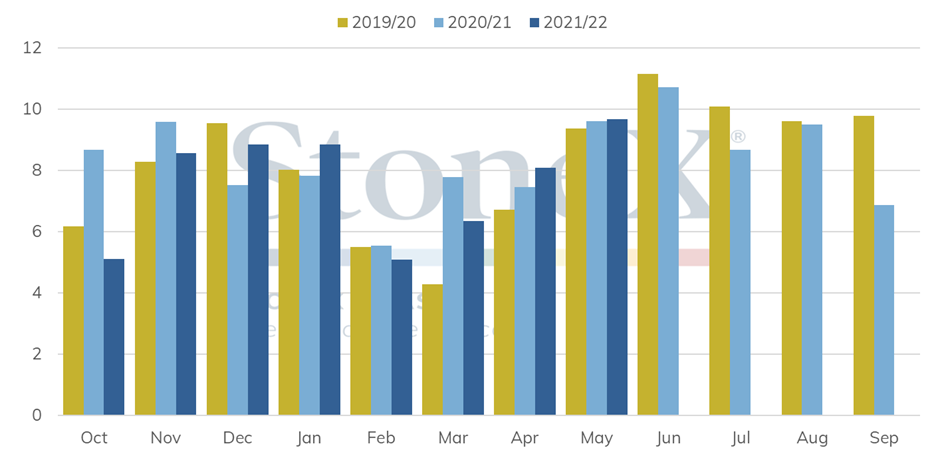
Soybean imports from China in the first two months of the 2021/22 crop year (October and November 2021) were considerably lower than a year earlier, at 13.7 million, down from 18.3 million tonnes. However, in the following months, there was a recovery. Still, when considering the accumulated between October 2021 and May 2022, the country received 60.6 million tonnes from abroad, compared to 64 million the previous year.
This result would not raise concerns when considering that import estimates for the 2021/22 crop year as a whole are lower than the 99.7 million tonnes recorded in 2019/20. The USDA estimates Chinese imports at 92 million tonnes. Moreover, in the 2019/20 crop, through May, China had imported 57.9 million tonnes and ended the crop year receiving 98.5 million tonnes.
However, the current context is different. Even though China has eased the lockdown measures in Shanghai and other locations, the zero-tolerance policy against Covid-19 continues. Moreover, even with this relaxation, there are doubts about the performance of the country's economy.
In the soybean complex, with weaker demand, Chinese crushing margins have moved into the negative field, and hog industry margins consistently perform poorly. In addition, soybean meal stocks are high.
Thus, the country's demand is in the spotlight, with any evidence pointing to a worse-than-expected performance negatively affecting international soybean prices.
Soybean monthly imports – China (MMT)
Source: Chinese Customs. Design: StoneX.
Corn
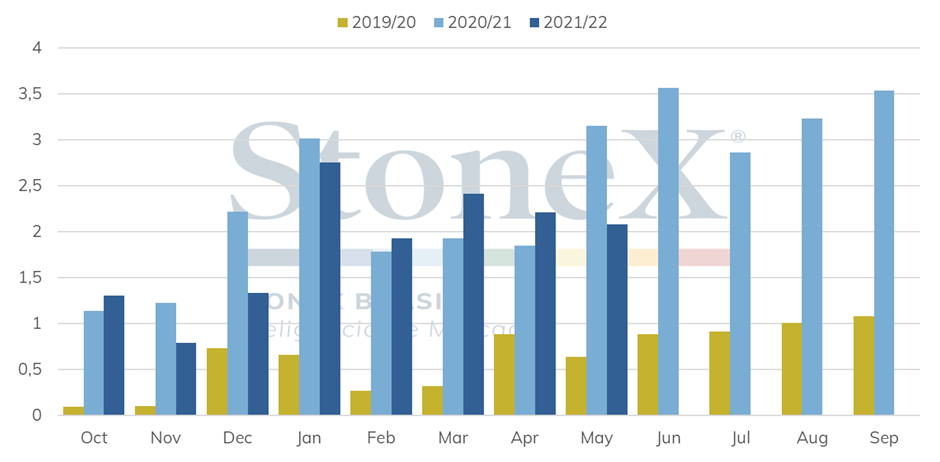
China, which until the 2018/19 crop (Oct-Sept) was not a major importer of corn, has begun to completely change its presence in the international market from 2019/20. According to GAAC data, corn imports by the Asian country increased from 4.5 million tonnes in 2018/19 to 7.6 million in 2019/20 and 29.5 million in 2020/21. Much of this movement can be explained mainly by two factors. The first was the problems with the domestic crop, and the second was the increased demand for feed by the livestock sector in the country, especially the hog industry. After the African Swine Fever outbreaks and the significant reduction in the pig herd, the government has adopted a policy in favor of the technification of the hog industry, which contributed to the intensification of the use of feed and consequently to the increase in the demand for corn.
Besides greater technification, the recovery of the hog herd has also increased the demand for corn, which has not been accompanied by Chinese production, requiring greater imports.
In addition to the variation in the volume purchased, a change in the imports' origin was also observed.
Between the 2017/18 and 2019/20 seasons, Ukraine was the origin of about 80% of the corn imported by the Asian giant, while the US had average participation of 14%. However, in 2020/21, this scenario has changed radically, with 69% of the grain imported by China originating from the North American country and 29% from the Eastern European country.
It is important to understand that Ukraine does not usually keep high grain stocks to understand the reason for this change in the grain's origin, which would make it difficult to supply a sudden increase in Chinese demand, making China intensify its relationship with other players. In addition, in 2020, the Black Sea country was hit by significantly warmer and drier-than-usual weather, resulting in a significant reduction in Ukrainian production and its exportable surplus, contributing to the country's declining representativeness in the Asian giant's imports.
After reaching a record production in 2021/22, of 42.1 million tonnes according to the USDA, it was expected that Ukraine could again strengthen its ties with China. However, that is not what is likely to happen this season. Despite a promising start, with the Asian country importing 5.7 million tonnes between October 2021 and April 2022, against 5 million in the same period of the previous season, the Black Sea conflict and the disruption of the Ukrainian logistic chain have significantly damaged the country's grain exports. In May (the first month in which a noticeable impact of the war on the volume of corn entering China was observed), only 127,000 tonnes of Ukrainian corn were imported by the Asian giant, against 1.26 million tonnes in the same period last year.
Even if the tendency is that in the 2021/22 season, the country shows a reduction in its imports after the strong increase in Chinese purchases observed in recent years, the volume should not be low, estimated by the USDA at 23 million tonnes. For 2022/23, the Department estimates an imported volume of 18 million tonnes.
Amid prospects of maintenance of Chinese imports at high levels, the Asian government seems to be adopting strategies to protect itself from possible new supply problems. Accordingly, it is worth mentioning the signature of the phytosanitary protocol to release Brazilian corn exports to the Asian country.
The expectation for this agreement has existed for quite some time. Still, it is worth mentioning that exports will not immediately occur since China needs to qualify establishments and regulate the varieties of corn that will be allowed. There have already been reports of Brazilian corn being purchased by China for delivery in September. No official source has confirmed the information, but it may show a certain Chinese interest in speeding up the procedures. It is most likely that a more intense volume of shipments of Brazilian corn to China will only start to be seen next year, but it is still difficult to estimate what the volume of such shipments will be and if there will be any change in the structure.
Corn monthly imports – China (MMT)
Source: Chinese Customs. Design: StoneX.
Wheat
Concerns over global wheat supply capacity have been a major concern for countries and organizations worldwide. How players will position themselves amidst the search for trade routes for wheat remains in the spotlight since the outbreak of the Black Sea conflict and intensifying weather problems worldwide.
China has been an important player on the demand side since the beginning of the Covid-19 pandemic, as it is markedly concerned with food security given its territorial and population proportions. According to the United States Department of Agriculture (USDA), its domestic demand grew by 14% compared to the 2019/20 crop year and the estimate for the 2022/23 crop year, from 126 million to 144 million tonnes. Part of this demand is reflected in the increase in domestic wheat production of 1.4 million tonnes for the same comparison period.
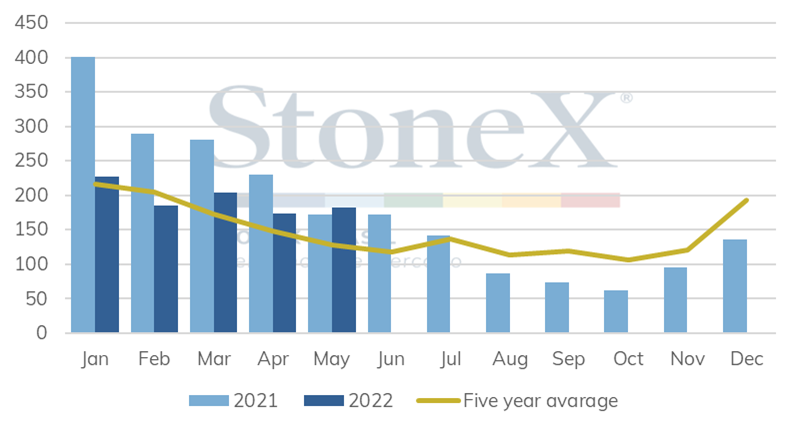
Despite being the largest producer country of this grain, China also has relevance as an importer to maintain the domestic demand cited. The volume imported in March 2022 practically doubled from the same period in 2021, going from 439 thousand tonnes to 861 thousand tons. The average imported volume indicates a downward trend for the coming months, but with reservations, since the Chinese economic activities are being resumed with the relaxation of strict measures to fight the virus.
Concerning trading partners, the participation of Australia and the United States among the main exporters stands out. Australia went from the fifth to the first largest exporter of wheat, from 1.9 million tonnes in 2017 to 2.74 million tonnes in 2021 (+44%). While the United States exported 1.55 million tonnes in 2017 and 2.72 million tonnes in 2021 (+75%). The other countries in this supply chain, France, Canada and Kazakhstan, remained among the top five exporters for China, losing positions only to Australia and the United States.
Wheat monthly imports – China (MMT)
Source: Chinese Customs. Design: StoneX.
With the recent lockdowns in China in regions such as Shanghai and nearby provinces between late March and June this year, activity in the Chinese textile sector faced logistical difficulties that delayed production. Among them, in particular, were rising freight costs and labor expenses due to restrictions imposed by the country's zero-COVID strategy.
In addition, delays in feedstock deliveries and a possible drop in cotton goods due to the lockdowns in cities with important urban centers also contributed to a worsening performance of the industry, affecting cotton import levels.
According to a survey by the Jiangsu Textile and Apparel Industry Association with data referring to April and May, the period of isolation of the provinces, at least 99% of textile companies in the Jiangsu region had a decline in production of at least 20%, resulting from the logistical and labor difficulties of recent months, with around 25% of respondents reducing production by half. Although this is a province, it is reasonable to assume that these problems affect other regions, causing similar impacts throughout the rest of the country.
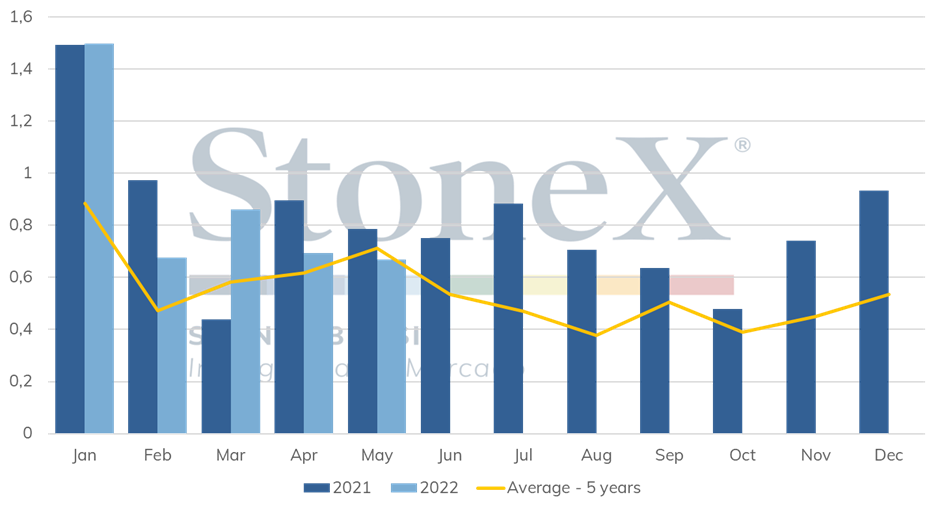
From China's trade balance data, it can be seen that the amount of cotton imported in May (182,000 tonnes) managed to exceed the average of the last five years and the value registered in 2021 (+5%). Until then, the cotton import levels exceeded the average for the period but have not yet reached the level of 2021 (in April, there was a 25% drop in cotton imports from the previous year and 15% compared to March). The May data thus indicate a resumption in the pace of imports, which is probably a result of the progressive relaxation of lockdowns in different provinces throughout the month, triggering the resumption of consumption by the textile sector.
So far, China has imported 972 thousand tonnes, and imports may grow even more after the relaxation in June. According to USDA estimates for the 2021/22 crop, China should show a drop of almost 9% in cotton production (-500,000 tonnes), which will probably boost the purchases in foreign markets throughout the year. Moreover, data from sales and exports of cotton released by the USDA in June indicate an intense resumption of Chinese purchases of the North American crop 21/22, the largest supplier of lint to the country (58% of market share in 2022).
Despite the expected expansion of cotton imports in 2022, there are still uncertainties about whether the amount should continue to rise. Among them is the concern with the global and domestic demand for products derived from the fiber. Furthermore, it is not possible to evaluate yet if the lockdown period has impacted family income - or other social indicators such as unemployment - in the short term. Still, if it has, purchasing these goods may be postponed, with agents prioritizing essential goods. In addition, possible new lockdowns in Beijing and Shanghai resulting from an increase in Covid-19 cases may again impact the textile sector and the internalization rate.
Cotton monthly imports – China (TMT)
Source: Chinese Customs. Design: StoneX.