The acreage and quarterly US stocks reports, released on the last business day of June, are always highly anticipated by the market and usually move grain prices.
In 2022, it was no different, with a scenario of planting delays in the US, lack of rainfall in some regions, excess in others, and conflict in Ukraine, besides the planting intentions report in March having surprised agents by bringing a larger acreage for soybeans over corn.
Soybean
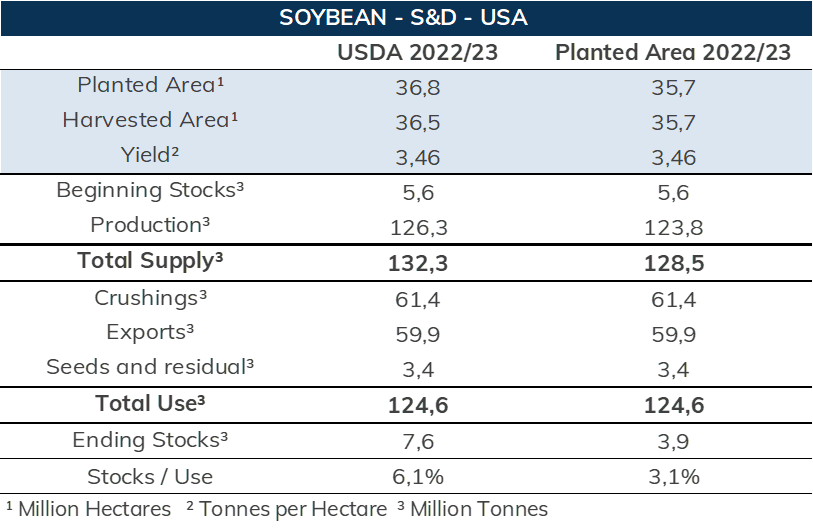
For soybeans, expectations were for a slight decrease of about 200,000 hectares in acreage compared to March, given the estimate of 36.8 million hectares. However, the June revision brought the soybean area to 35.7 million hectares, more than a million hectares below the last number and again below the corn area.
It is important to point out that there may still be revisions to acreage, even more so this year, since the USDA must again collect information from the Dakotas and Minnesota, states that showed more considerable delays in planting due to excessive rainfall. Even so, if there is an upward revision, it should not be very significant.
Furthermore, as much as the area is relevant, it is central to follow the productivity since small variations have the potential to lead to big changes in production. For example, for soybeans, August concentrates most of the grain filling in the US, a stage in which crops cannot lack water.
By incorporating this smaller acreage in the current USDA balance, without making changes in productivity and demand, the scenario would be tight, ending stocks at 3.9 million tonnes and the stock/use ratio at 3.1%.
Even with the possibility of a tight balance, with the smaller acreage, soybean prices did not support an appreciation immediately after the report since there are concerns on the demand side, at a time of possible recession and with doubts about the strength of Chinese consumption.
Sources: USDA and StoneX. Design: StoneX.
The quarterly data for the 2021/22 crop stocks ended up on the backseat before the surprise with the acreage since the result stood in line with the average of market expectations (slightly above), indicating that the US had 26.4 million tonnes of oilseeds in stocks on June 1.
Corn
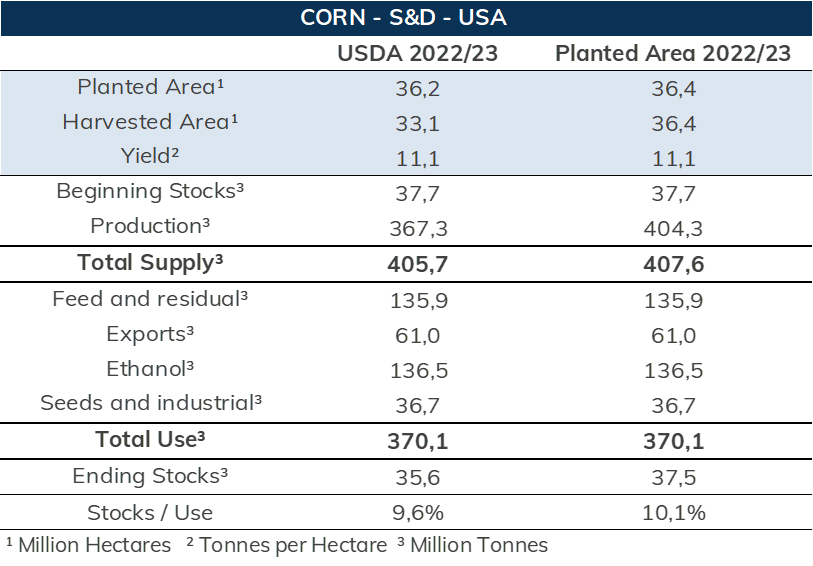
Unlike soybean numbers, which came very different from what the market expected, the acreage report did not bring big surprises for the corn market. While the average estimates pointed to acreage at 36.41 million hectares in 2022/23, 190 thousand hectares above the last USDA's number, the report brought total acreage to 36.39 million hectares, virtually in line with the agents' expectations.
Considering the new acreage and the latest yield estimate from USDA, US production in 2022/23 would be raised to 369.2 million tonnes, 0.5%, or 1.9 million tonnes, above the figure reported in the June WASDE.
Regarding corn stocks, the USDA reported that its position on June 1, 2022, stood at 110.39 million tonnes, 5.97 million tonnes above that recorded one year earlier and only 70,000 tonnes above-average market estimates.
Maintaining the total demand estimated by USDA in the June report of 378.2 million tonnes (domestic consumption at 316 million and exports at 62.2 million tonnes), ending stocks for the 2022/23 crop would stand at 37.5 million tonnes versus 35.6 million in the last WASDE, with the stock/use ratio at 10.1%, 0.5 p.p. above the last estimate.
With the corn acreage issue no longer one of the main unknowns for the market at the moment, the US crop condition is gaining more and more attention. As the grain enters important stages of development, this will be a crucial point for pricing the grain. The latest USDA crop follow-up report showed that 67% of the corn crop was in good or excellent condition on June 26, compared to 64% at the same time last year.
July will be a crucial month for the performance of the North American crop. As much as the forecasts currently point to favorable weather for the development of the grain crops, it is not unusual to see sudden changes in the weather models. Therefore it will be essential to follow them closely.
Sources: USDA and StoneX. Design: StoneX.
Wheat
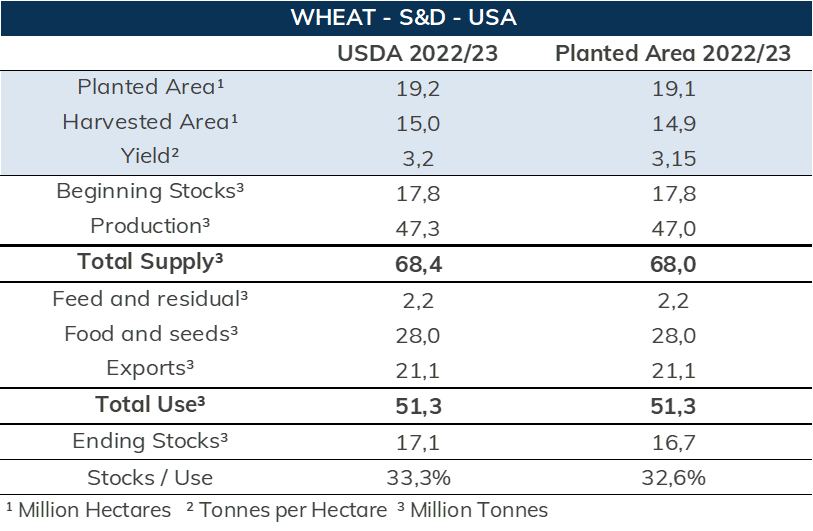
Expectations for US wheat were for a significant pullback in acreage because of severe weather conditions faced by producing regions and delayed planting. However, the revision brought the wheat area to 19.06 million hectares, only 120,000 hectares less than the Prospective Plantings report released in March.
Last season, 18.9 million hectares were planted with wheat, indicating that the estimate for the current crop increased the acreage by 1% compared to 2021. For winter wheat, an area of 13.76 million hectares is expected, while spring wheat's outlook is about 4.50 million hectares. Regarding stocks, the USDA reported that as of June 1, the volume totaled 17.96 million tonnes, down by 22% from last year.
The acreage and stock data eagerly awaited by the market were accompanied by direct movement in prices. The possible increase in wheat supply influenced by the larger acreage led to the immediate drop in prices in the main session on Thursday (30).
Despite the relevance of the acreage and the immediate effect on prices in the futures market in the United States, productivity is an essential variable to weigh expectations for the crop since any change alters the production of the crop.
The crop follow-up reports released weekly by the USDA have drawn attention because they have indicated below-average percentages for good or excellent conditions. For Texas, Oklahoma and Colorado, especially, a considerable part of the crop is being evaluated as poor, which worries producers about the balance of the winter crop.
Sources: USDA and StoneX. Design: StoneX.
The North American 2022/23 cotton crop is experiencing an exceptionally unfavorable moment. The droughts in the south of the country in May and June were not reversed, which was detrimental to the development of cotton in the early stages, and affected Texas, the largest US supplier and responsible for about 40% of domestic production. Besides the lack of rainfall, the high temperatures, above average for spring, further aggravated the water stress.
Thus, even with cotton prices near the historical highs in NY, the market expected to reduce the country's acreage, influenced by the weather adversities mentioned above. However, we saw an increase in the figure released by the USDA on Friday (01), from 4.9 million to 5.05 million hectares, a variation of 2% between reports. The expansion of acreage in Texas was responsible for this result (+4.4%), while states like Arkansas and Mississippi, for example, had reductions (-3.8% and -2%, respectively).
Despite surprising agents, the result did not significantly impact cotton prices on the ICE, as the perception is that this increase in acreage will be overcome by the growth of the abandonment rate in 2022/23. Normally, this rate is already high; the average for the last five years is around 20% for the national level and 32% for Texas. However, this indicator will likely increase significantly from the new figures and the USDA estimates of declining production for the next cycle.
The crop follow-up reports released weekly by the agency reinforce this projection because the percentage of cotton in good or excellent condition is well below average for all producing states, especially Texas. These factors, coupled with the lack of prospects for drought relief, should drive abandonment rates higher and reverse the gains from the increase in acreage.