StoneX logo

Grains Weekly Analysis

By: StoneX Intelligence Brazil, StoneX Intelligence Brazil

Commodity prices show high volatility
 
Ana Luiza Lodi
Isabela Garcia
João Pedro Lopes
  Nuria Brito
  Luigi Bezzon
SIGNIFICANT CHANGES OCCURRING EVEN OVER A SINGLE SESSION LED TO DAILY LIMIT ADJUSTMENTS
The commodities markets have been showing high volatility in recent months, with significant changes in a single session, from one day to the other, in weekly and monthly comparisons.
Notably, the volatility currently registered is still not close to that observed around 2008.
Soybean, corn and wheat

The coronavirus pandemic starting in 2020 resulted in disrupted supply chains, a race for commodities such as wheat, and concerns about demand worldwide amidst social isolation measures to prevent/decrease the spread of the disease.

This scenario impacted commodity prices in the face of the pandemic's uncertainty. The measures to combat the disease varied between countries, and after the first few months, the pressure to relax social isolation increased, and by the end of 2020, vaccines became available. With this, 2021 began more optimistically, with fewer restrictive measures in most parts of the world and a more significant recovery in economic activity. 

Central banks moved to stimulate the economy by reducing interest rates and adopting monetary easing measures. However, this greater availability of money, stimulating demand, was not accompanied by a proportional expansion of supply, a situation that supported the prices of many products, including commodities, in addition to the imbalance in the logistics chains, such as the crisis of the lack of containers in important global cargo hubs, which ended up being poorly distributed around the world. 

With this, a scenario of higher price inflation was created, as the monetary authorities retreated from their expansionary measures and started to raise interest rates, which, as a result, has fueled the possibility of a recession.

Added to the macro context, 2022 started with the heightening of geopolitical tensions, with the invasion of Ukraine by Russia. This situation brought price spikes for corn and wheat since Ukrainian corn has great weight in the export market and wheat from the two countries directly involved in the conflict. As for soybeans, prices also reacted, but in a more moderate way, since the war's reflexes are indirect, through the vegetable oil market, since Ukraine and Russia are the main players in the world's sunflower market.

Currently, there are doubts about the size of Ukrainian production in 2022/23, and an agreement has been formed to allow the country's grain to flow through the Black Sea, whose ports have been blocked by Russian forces. However, there are still many doubts about the volumes to be exported.

Another point that has also moved prices is the new US crop. At first, a larger acreage was estimated for soybeans than corn as corn has higher production costs and the inputs were also expensive. Then there were delays in the country's spring planting as the lowland areas, where wheat is grown, faced drier conditions.

More recently, the USDA reported that soybean acreage is expected to be lower than corn acreage, and drier and warmer weather in the Midwest is on the radar, contributing to price volatility in recent weeks, and should continue to be seen in the coming months.

Besides this, the 2022/23 soybean planting starting in September and summer corn planting starting in October in Brazil should bring another point of attention to the market. Thus, the weather in the coming months will be of great importance for the performance of the new Brazilian crop and will be another element that will bring price volatility. On August 1, StoneX will release its first estimates for 2022/23 soybean and corn summer crops. 

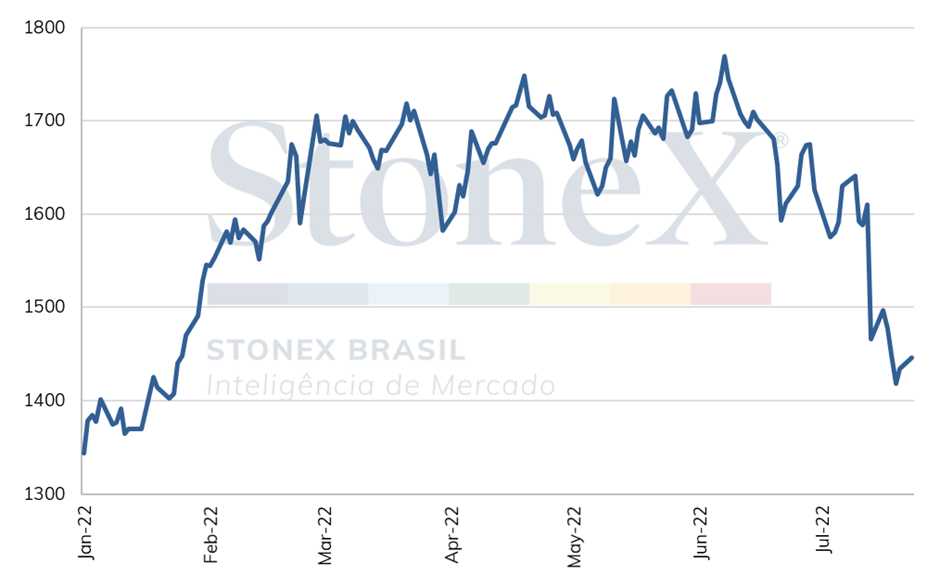
Soybean quotes on the CBOT- (cents/bushel)    

image 44738
Source: CME. Design: StoneX.

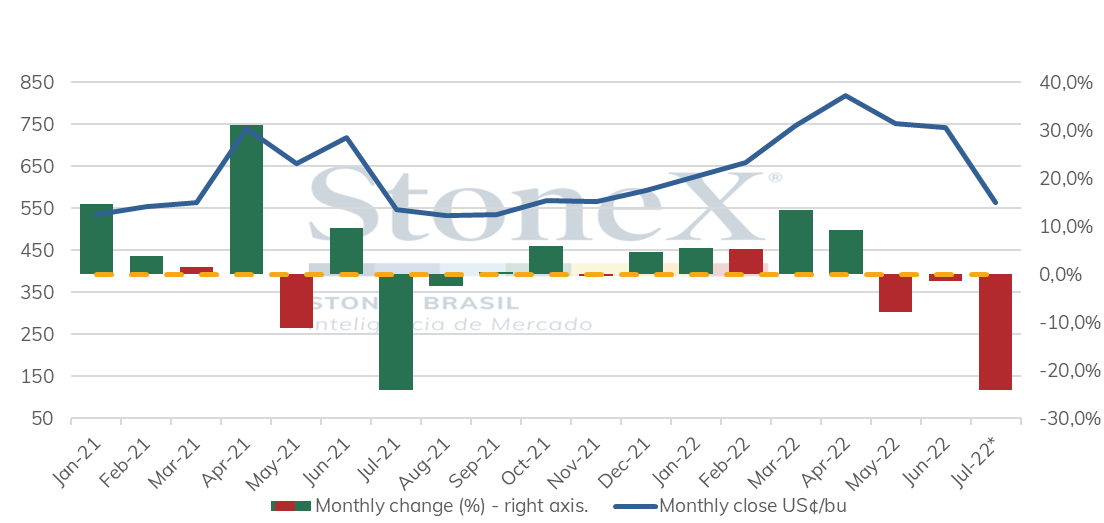
Corn monthly close on the CBOT - nearby contract (c/bu) and monthly change (%)    

image 44741
Source: CME. Design: StoneX. *As of 07/22/2022.
 
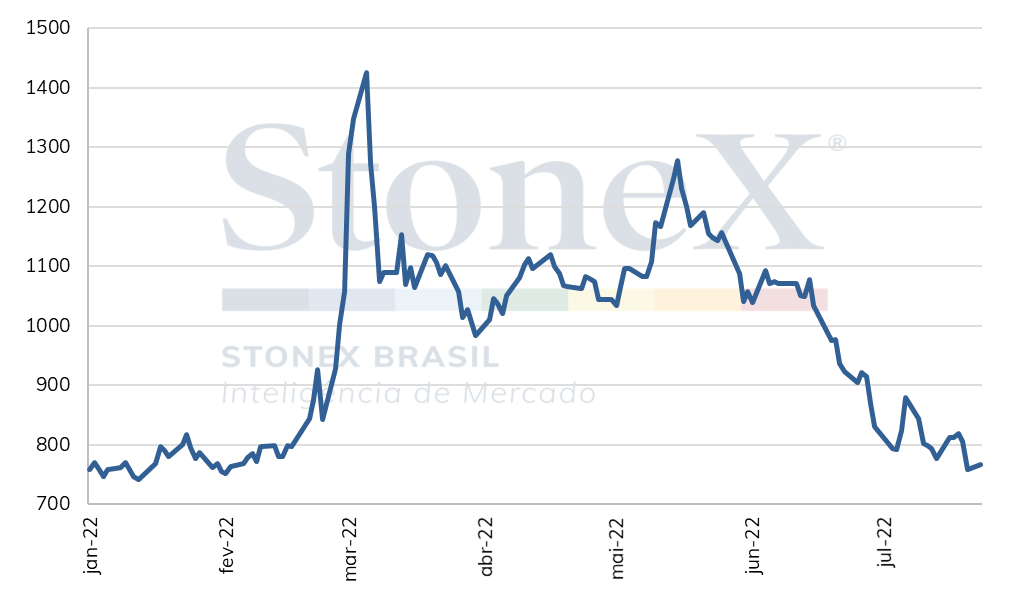
Wheat quotes on the CBOT - Nearby contract (c/bu)image 44595Source: CME. Design: StoneX.
Cotton

Cotton has undergone major turbulence in recent weeks, moving from historically high quotes to a sharply lower trend, which managed, in just three weeks, to bring down the value of futures by up to 30%. However, causes related to traditional fundamentals, such as supply and demand, have played a secondary role in explaining the recent fluctuations due to the large participation of speculative agents in the market during the 2021/22 cycle. 

The cotton prices trend has suffered major inflections in recent years. In 2020, with the pandemic and lockdowns, the textile sector was severely affected, destroying part of the cotton demand that year. Most goods derived from natural fiber are considered non-essential and more income sensitive. In other words, in times of crisis, families prefer to postpone the consumption of second necessities in favor of essential goods. In addition, with the limited movement of people, the physical commerce of clothing, for example, decreased, which further harmed the cotton market. With supply exceeding demand, producer prices and profitability sank, contributing to a drop in production for the next cycle. However, with government aid and income transfer policies, as well as the resumption of people movement after vaccines at the beginning of 2021, the demand for cotton goods began to grow again, encountering lower supply, which supported prices.

Since then, the upward trajectory of prices has encountered few negative sessions, attracting funds and other speculative investors, especially because of the dynamics of on-call positions. Thus, these agents entered the market massively: the strategy consisted in holding the long positions and selling them to the guarantors near contract expiration, when the market becomes less liquid and buying pressure supports prices. Thus, contract after contract of the 2021/22 cycle, prices went on a new upward trajectory, reaching their peak in May this year, when the N22 reached USD 158.2/lb. 

The good times ended as the world economy began to show signs of stagflation in 2022 and 2023. The movement in the financial market in June affected several assets, especially agricultural commodities, as investors sought safer sources of income amidst pessimistic expectations. Since then, cotton has suffered from a significant exodus of these speculative agents, which has put pressure on prices. In July, the December/22 contract reached US¢ 83.22/lp, a drop of 47.4% from the year's high. Thus, while this movement does not stop, it is likely that cotton will continue to decline and lose the gains of recent years.
 

Cotton quotes on the ICE- Nearby contract (c/bu)    

image 44742
Source: ICE. Design: StoneX.
 
Vegetable Oils

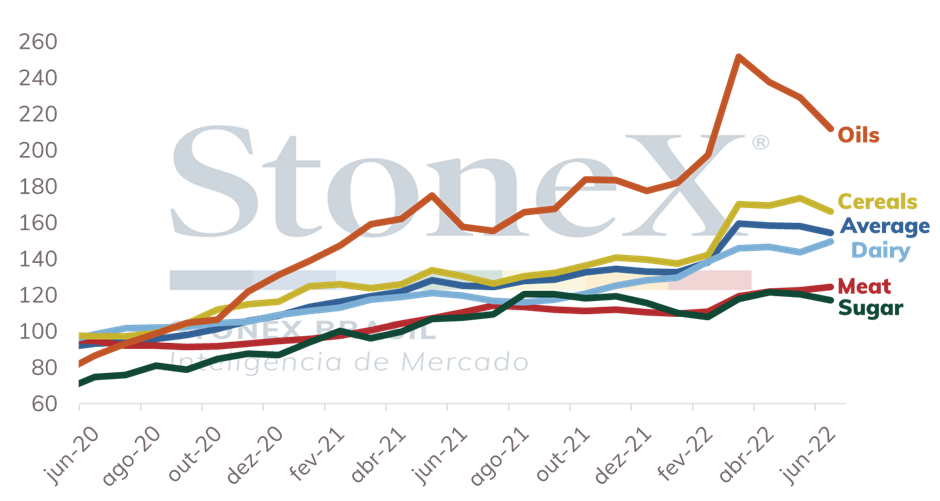
Also following the global macroeconomic context and accentuated by several market internal ups and downs, the vegetable oil complex has experienced great volatility over the last six months, alternating between a strong and steady pace of increase, which lasted since 2021, and an intense sequence of corrections, which started in June/22.

Fueled initially by the resumption of food consumption and as a feedstock in biofuels production, after the impacts caused by the pandemic, vegetable oil prices led the increases among the main food categories over the last two years, according to the FAO/UN food price index. However, after soybean and palm oil prices jumped about 35% over the past year, driven by factors such as rising biodiesel mandates in major consuming countries and production problems observed in palm oil crops in Malaysia and canola in Canada, in early 2022, the upward momentum intensified. 

In the first five months of this year, new bullish factors were seen in the vegetable oil market and boosted prices. The war in Ukraine limited the global supply of sunflower oil, the world's 4th most consumed oil. Soon after, another big boost came in May when Indonesia, the largest palm oil-producing country, decided to ban exports for about a month, seeking to protect the domestic market from inflation amidst palm prices experiencing record highs in the period. The measure did not work out and resulted in great dissatisfaction among palm producers in the country, whose stocks reached full capacity and production had to be halted due to lack of available storage. 

In June, the Indonesian government re-cleared exports and a stimulus package for palm oil shipments in the country to relieve the high oil stocks, such as removing export taxes until the end of August. Thus, since the start of Indonesia's export release, the international market has been flooded with a large quantity of palm available on the spot market, although demand for the product has remained weak due to the high price levels that the ban had driven foreign buyers.

Between the beginning of June and July 25, the palm oil price on the Bursa Exchange retreated 42% on the nearby contract, returning to the lowest price in 1 year. In other words, palm oil has experienced a historical high and an annual low in about two months. 

Following the palm oil downturns in Southeast Asia, the soybean oil market in South America has also been marked by high volatility over the past few months. The Chicago soybean oil nearby contract reached an all-time high in May this year and has dropped by 30% since then. 

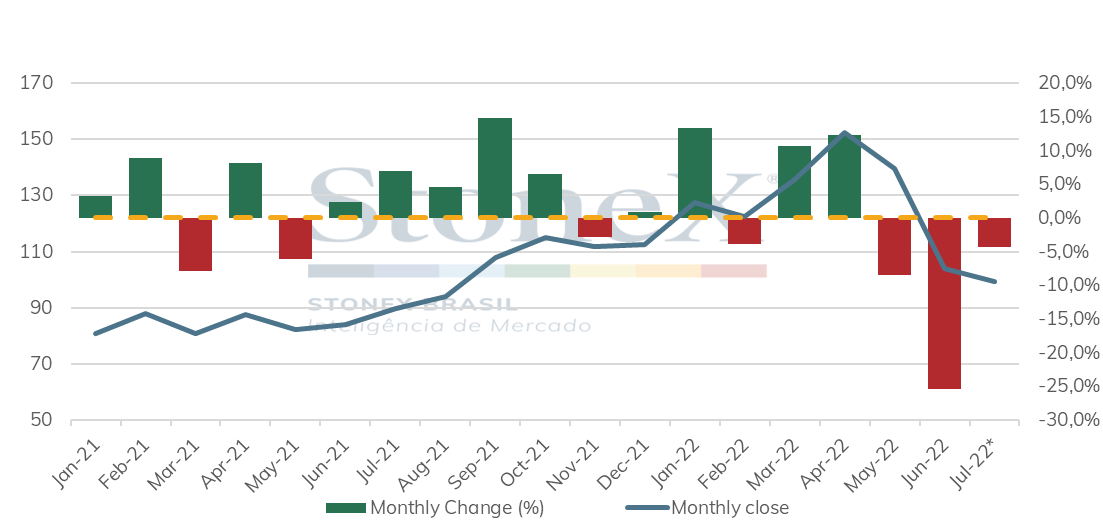
Food price index: FAO/UN

image 44739
Source: FAO/UN. Design StoneX.
 
 
  • Grains & Oilseeds

The StoneX Group Inc. group of companies provides financial services worldwide through its subsidiaries, including physical commodities, securities, exchange-traded and over-the-counter derivatives, risk management, global payments and foreign exchange products in accordance with applicable law in the jurisdictions where services are provided. References to over-the-counter (“OTC”) products or swaps are made on behalf of StoneX Markets LLC (“SXM”), a member of the National Futures Association (“NFA”) and provisionally registered with the U.S. Commodity Futures Trading Commission (“CFTC”) as a swap dealer. SXM’s products are designed only for individuals or firms who qualify under CFTC rules as an ‘Eligible Contract Participant’ (“ECP”) and who have been accepted as customers of SXM. StoneX Financial Inc. (“SFI”) is a member of FINRA/NFA/SIPC and registered with the MSRB. SFI is registered with the U.S. Securities and Exchange Commission (“SEC”) as a Broker-Dealer and with the CFTC as a Futures Commission Merchant and Commodity Trading Adviser. References to securities trading are made on behalf of the BD Division of SFI and are intended only for an audience of institutional clients as defined by FINRA Rule 4512(c). References to exchange-traded futures and options are made on behalf of the FCM Division of SFI . StoneX is a trading name of StoneX Financial Ltd (“SFL”). SFL is registered in England and Wales, Company No. 5616586. SFL is authorized and regulated by the Financial Conduct Authority [FRN 446717] to provide to professional and eligible customers including: arrangement, execution and, where required, clearing derivative transactions in exchange traded futures and options. SFL is also authorised to engage in the arrangement and execution of transactions in certain OTC products, certain securities trading, precious metals trading and payment services to eligible customers. SFL is authorised & regulated by the Financial Conduct Authority under the Payment Services Regulations 2017 for the provision of payment services. SFL is a category 1 ring-dealing member of the London Metal Exchange. In addition SFL also engages in other physically delivered commodities business and other general business activities which are unregulated and not required to be authorised by the Financial Conduct Authority. StoneX Group Inc. acts as agent for SFL in New York with respect to its payments services business. StoneX APAC Pte. Ltd. acts as agent for SFL in Singapore with respect to its payments services business. ‘StoneX’ is the trade name used by StoneX Group Inc. and all its associated entities and subsidiaries.
 
Trading swaps and over-the-counter derivatives, exchange-traded derivatives and options and securities involves substantial risk and is not suitable for all investors. Past performance of any futures or option is not indicative of future success. Indicators are not a trading system and are not published as a specific trade recommendation. The information herein is not a recommendation to trade nor investment research or an offer to buy or sell any derivative or security. It does not take into account your particular investment objectives, financial situation or needs and does not create a binding obligation on any of the StoneX group of companies to enter into any transaction with you. You are advised to perform an independent investigation of any transaction to determine whether any transaction is suitable for you. No part of this material may be copied, photocopied or duplicated in any form by any means or redistributed without the prior written consent of StoneX Group Inc.
 
© 2026 StoneX Group Inc. All Rights Reserved.

Satellite view of Earth at night showing illuminated cities across Asia and the Middle East

Discover more insights

Our subscribers have access to comprehensive market analysis from StoneX spanning commodities, equities, currencies and more.

Related articles for Grains & Oilseeds

Perspective: Morning Commentary for August 6

August 6 – This morning’s stronger-than-expected U.S. labor data offered markets some relief, reinforcing confidence in the economy while giving the Fed greater flexibility to raise rates should inflationary pressures reaccelerate in next week’s July data. Stock futures are pointing to a mixed open to start the day, with the tech-heavy Nasdaq showing the most weakness. The VIX has fallen notably from yesterday’s spike above 18.4 as it starts the day hovering just below the 16-mark. The dollar is quietly higher as it trades just above 99.8, holding in the tight range seen thus far this week as traders continue to digest data to shape expectations for the Fed’s next move, which we’ll dive into in more depth below. Long-term treasury yields have relaxed slightly from their recent spike, with 30-year yields starting the day trading just above 5.19%, while 10-year yields trade above 4.64%, and 2-year yields sit below 4.22%. Crude oil is modestly higher to start the session after sharp declines earlier in the week, with nearby WTI up 1.8% to trade at $76.40 and nearby Brent up 2.4% to trade at $81.40. Meanwhile, the ags are quietly mixed to start the day.

Mike Castle
Mike Castle
  • Grains & Oilseeds
  • Energy
  • Dairy
  • Renewable Fuels
  • Cocoa
  • Coffee
  • Cotton
  • Sugar
  • Meats & Livestock
  • Forest Products

Perspective: Morning Commentary for August 5

August 5 – U.S. equities markets are on fire this week, with both the Dow Jones and S&P 500 setting new all-time highs yesterday with futures indicating further gains again today; the marketplace remains optimistic over a deal with Iran despite no evidence of such as of yet. Crude oil is working on a lower high and low today but remains slightly on the high side on the session, while the dollar is retreating back towards Monday’s nearly two-month low. The ten-year note is steady-to-lower this morning (though solidly lower so far this month) at 4.605%, while the VIX index continues to rebound into mid-week at almost a 17-point reading this morning.

Matt Zeller
Matt Zeller
  • Grains & Oilseeds
  • Energy
  • Dairy
  • Renewable Fuels
  • Cocoa
  • Coffee
  • Cotton
  • Sugar
  • Meats & Livestock
  • Forest Products

Perspective: Mid-Day Commentary for August 4

August 4 – The Dow Jones is absolutely piling on gains today, adding a similar number that led to yesterday’s record, with the benchmark index now nearing the 54k-point mark through mid-morning. The S&P also hit a new record, while the NASDAQ is exceeding both those gains on a percentage basis. The marketplace is optimistic on a U.S.-Iran trade deal, though the proposed resolution is still being “circulated between the parties”.

Mike Castle
Mike Castle
  • Grains & Oilseeds
StoneX: We open markets

Our market expertise, advanced platforms, global reach, culture of full transparency and commitment to our clients’ success all set us apart in the financial marketplace.

Reach

With access to 40+ derivatives exchanges, 180+ foreign exchange markets, nearly every global securities marketplace and numerous bi-lateral liquidity venues, StoneX’s digital network and deep relationships can take clients anywhere they want to go.

Transparency

As a publicly traded company meeting the highest standards of regulatory compliance in the markets we serve, our financials and record of accomplishment are matters of public record. StoneX’s commitment to “doing the right thing over the easy thing” sets us apart in the industry and helps us build respect, client trust and new partnerships.

Expertise

From our proprietary Market Intelligence platform, to “boots on the ground” expertise from award-winning traders and professionals, we connect our clients directly to actionable insights they can use to make more informed decisions and achieve their goals in the global markets.