Over the past few months, a point that has attracted the market's attention and is one of those responsible for the high volatility of grain prices is the conflict between Russia and Ukraine. The Black Sea region is of great importance for several commodities, and the damage caused to logistics, infrastructure and production in Ukraine has already affected, directly or indirectly, the price level and supply of products in several countries.
Most recently, an agreement between Ukraine and Russia, intermediated by the UN and Turkey, was made possible to create a Ukrainian export corridor through the Black Sea. Its signing was cause for great euphoria as it would contribute to an increase in the global supply of grains, which could alleviate prices and the concern related to food availability in some regions, especially in North Africa and the Middle East, which depend significantly on grain imported from Ukraine.
However, despite the signing, much uncertainty surrounded the market, as many still questioned whether Russia would abide by the agreement. Then, on July 23, less than 24 hours after the agreement was signed, Russia attacked the Ukrainian port city of Odesa, already violating one of the terms of the agreement, which mandated the safe passage of any ship loaded with grain leaving three Ukrainian ports, including Odesa.
Despite the attack, preparations for exports continued to be made, and on August 1, the first grain ship left Ukraine after the beginning of the conflict with Russia. The ship was bound for Lebanon, but the operation was not completed as the buyer refused to receive the product, claiming a delay of more than five months. It was reported that the supplier was looking for a new buyer in the Middle East and North Africa region and is now on its way to a Ukrainian port.
However, even with these initial adversities, the issue of Ukrainian shipments has taken a more optimistic turn, and the pace of exports via the Black Sea has advanced. Indeed, the volume observed so far is still well below that recorded before the conflict, but as new vessels leave Ukrainian ports and there are no records of non-compliance with the agreement, the hope grows that the country can resume its important role in the international grain market.
By Tuesday morning, 33 cargoes had left Ukrainian ports under the agreement with Russia, carrying 720,000 tonnes of food products, a volume well below the country's potential, remembering that there are still many products that have not been exported since the beginning of the war and that a new crop is entering the market. By this date, there were still 18 ships loading or awaiting authorization at Ukrainian ports.
Since the beginning of the conflict, Ukraine has tried to transport its products to the foreign market via alternative sea routes, via the Black Sea. However, the volumes shipped have dropped considerably since February 24. In June and July, before the new crop enters the market and when exports are usually lower, corn and sunflower oil shipments even registered good volumes, using alternative ways. On the other hand, wheat exports continued to be very low.
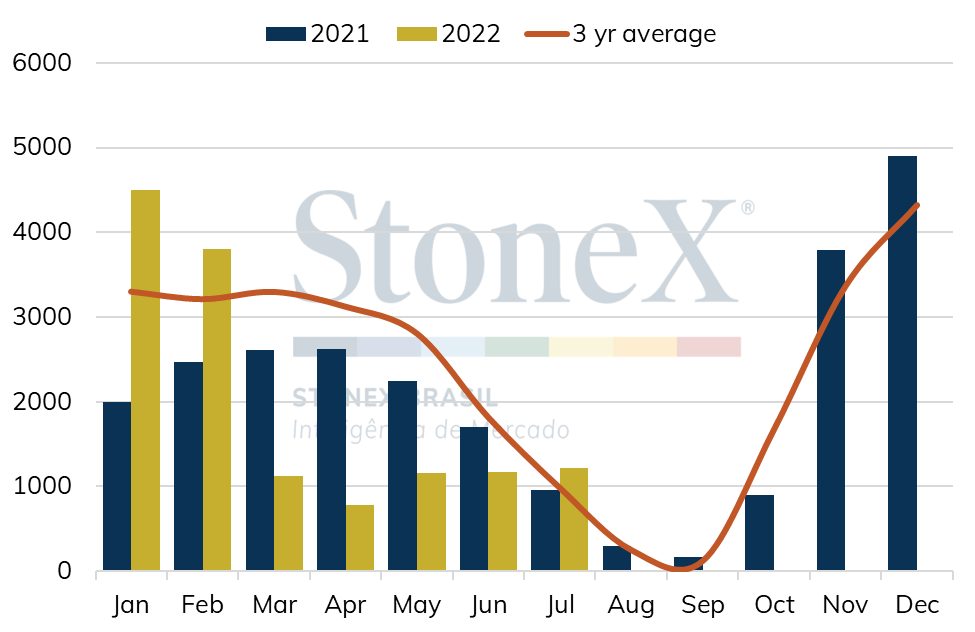
In the case of corn, the exports between January and July 2022 add up to 13.8 million tonnes, against an average for the same period of 18.6 million. It is noteworthy that in January and February this year, the Ukrainian cereal exports were very heated, exceeding the 2021 record and the average.
Corn monthly exports - Ukraine (TMT)
Source: Bloomberg. Design: StoneX.
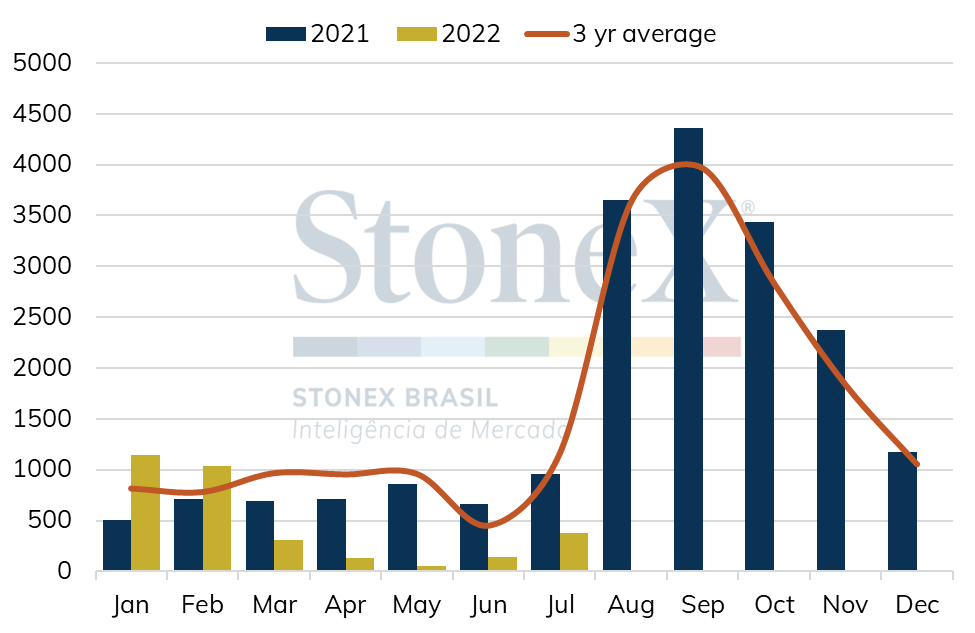
For wheat, exports in the first seven months of 2022 reached 3.2 million tonnes versus the last three-year average of 6.1 million tonnes. As in the case of corn, in January and February, shipments were very heated. It is also important to highlight that August to November is the period of higher wheat exports. Accordingly, it is important to highlight the pace of shipments in the coming months, although they should continue short of usual.
Wheat monthly exports - Ukraine (TMT)
Source: Bloomberg. Design: StoneX.
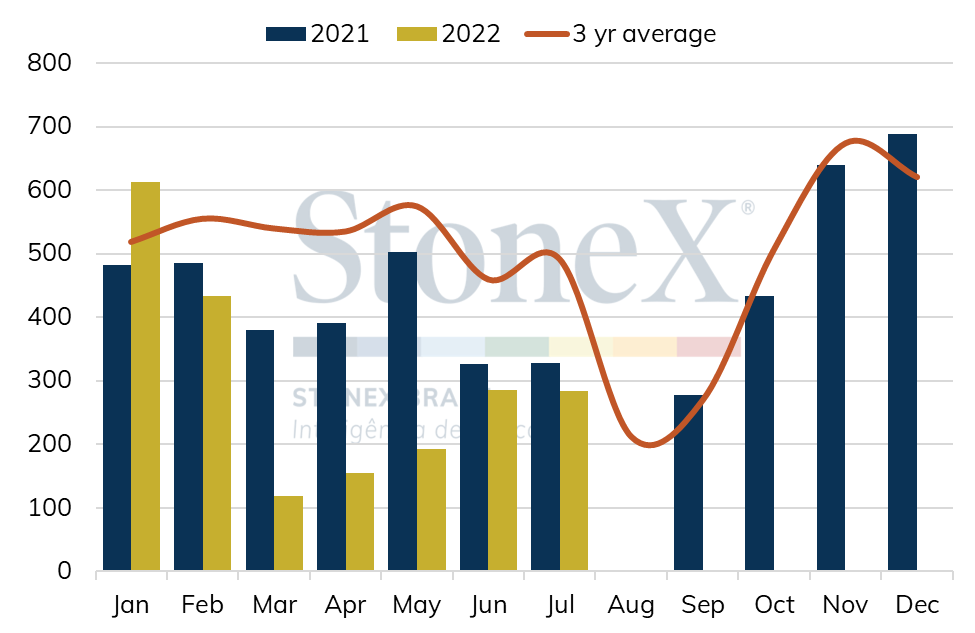
As for sunflower oil, the situation is similar. Exports reached 2.1 million tonnes between January and July this year compared to the average between 2019 and 2021 at 3.7 million tonnes. For vegetable oils, the higher volumes tend to be exported in the last quarter of the year and also in January.
Sunflower oil monthly exports - Ukraine (TMT)
Source: Bloomberg. Design: StoneX.
Therefore, with the maintenance of the safe passage agreement through the Black Sea, it is important to follow the volumes to be shipped in the coming months when the Ukrainian supply will be higher.