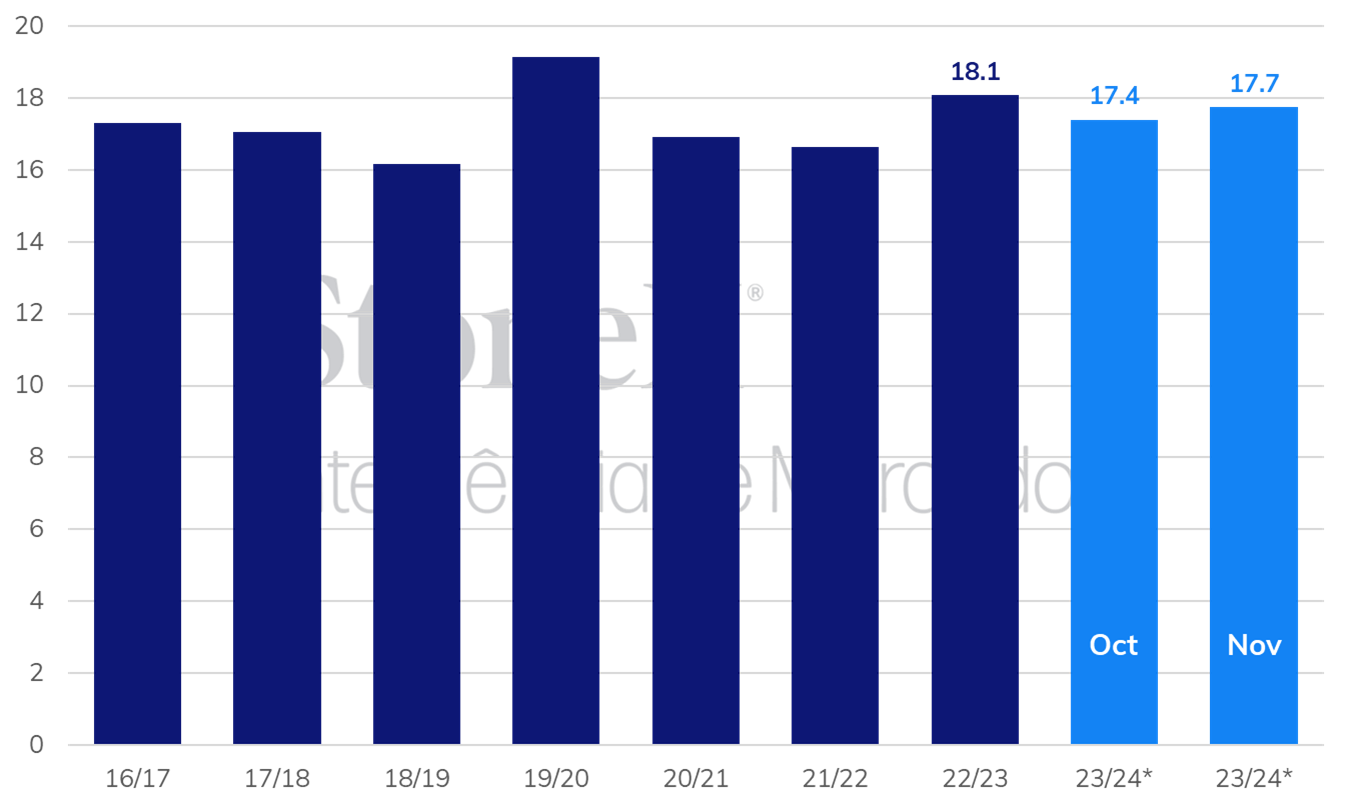
The Department raised its estimate of US production for 2023/24 to 112.4 million tonnes due to positive productivity revisions. This result exceeded market expectations, which were betting on stability, around the last USDA figure of 111.7 million tonnes. There were no changes in the expected demand variables for the US 2023/24 crop, with the increased production reflected in a hike in ending stocks, estimated at 6.67 million tonnes, a figure above the market's average estimate of 6.04 million tonnes.
The big highlight for the South American crop was the hike of 2 million tonnes in Brazil's 2022/23 crop, reaching 158 million tonnes, a figure quite close to StoneX's estimate (157.7 million tonnes). Despite the questions regarding the adverse weather conditions recorded in important producing regions of Brazil and Argentina, the USDA did not change its figures for these countries' 2023/24 crops. Brazilian production is estimated at 163 million tonnes, 2 million less than the latest figure from StoneX. The Argentine crop is projected at 48 million tonnes, 2 million tonnes below the number from the Buenos Aires Grain Exchange (BCBA).
Despite the absence of reviews for the upcoming South American crop, the weather in the region has been the subject of several debates and will continue to be closely monitored. As mentioned, adverse conditions for developing the next cycle have been recorded in Brazil and Argentina. Despite initial estimates pointing to a high South American supply, weather conditions are needed to reach the region's potential.
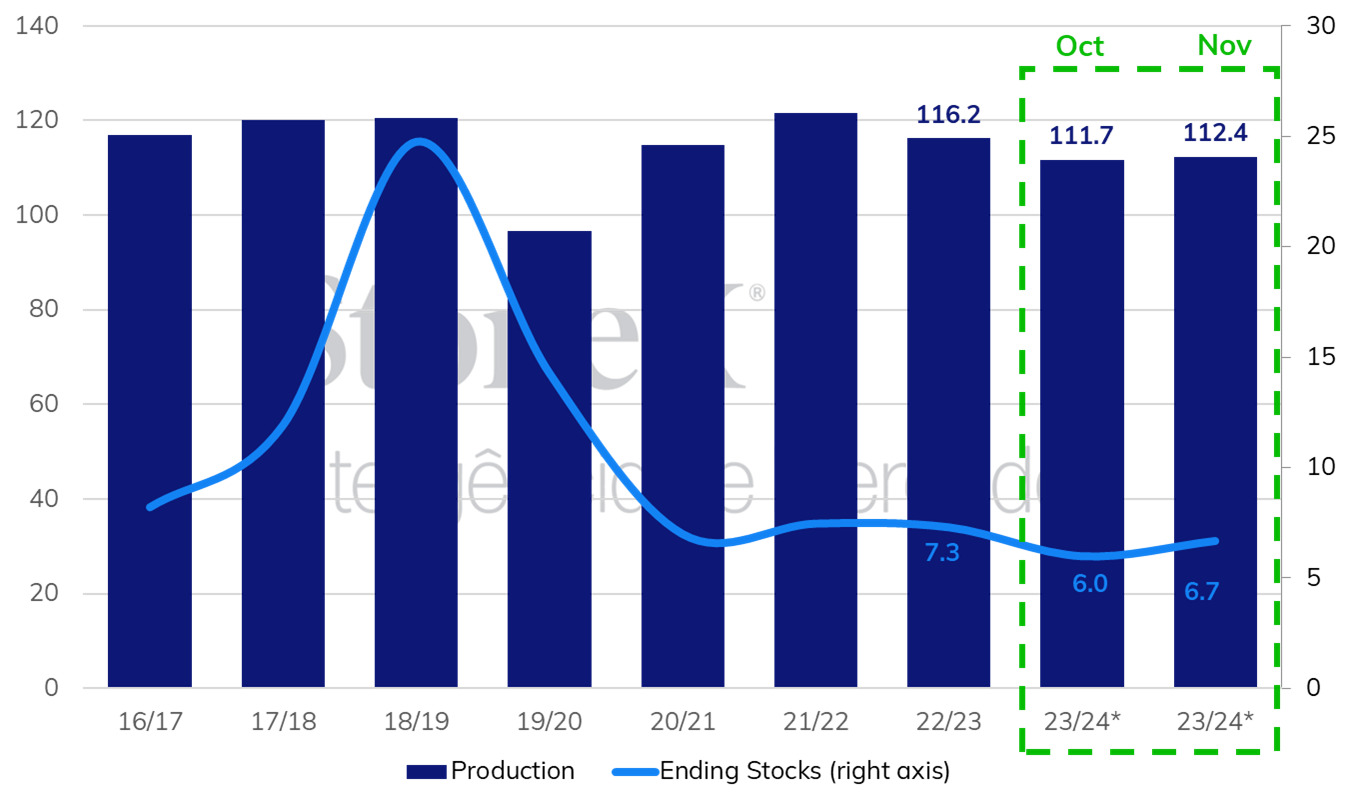
Like in the case of soybeans, one of the highlights of the report for corn was the increase in US production for 2023/24, from 382.6 million to 387 million tonnes, the highest value in the historical series. In addition to a new record, the volume exceeds the market estimate average by about 4 million. Amidst the increased availability of corn in the US, the Department also made positive revisions to its domestic consumption and exports figures, to 314.7 million (+0.6%) and 52.7 million (+2.5%), respectively. On the other hand, even with the hike in consumption variables, the estimate for the country's ending stocks increased by 2.1% compared to the October report to 54.76 million tonnes, above the trade's average estimate of 54.1 million tonnes.
Another relevant factor from the last report was the revision in Ukraine's crop. Despite the conflict in the Black Sea, which raised some concerns, such as the producers' ability to access feedstocks, the Department once again raised its estimate for the country's 2023/24 production. With the justification that Ukrainian crops have presented suitable conditions for their development in the current season and supported by reports of excellent yields in the areas harvested so far - which already represent about 60% of the total - the country's production was increased to 29.5 million tonnes, a hike of 5.4% versus the previous month and a growth of 9.3% on an annual basis.
The USDA also did not change its estimates for South American corn crops. Brazilian production for 2023/24 remains estimated at 129 million tonnes, a volume close to StoneX's latest estimate (128 million tonnes). In the case of Argentina, the figure of 55 million tonnes from the Department for the 2023/24 season is in tandem with the one disclosed by BCBA.
Globally, the balance of revisions was a hike in the global ending stocks in 2023/24, of 0.8% on a monthly comparison, to 315 million tonnes, about 3 million more than the trade's average estimate and the highest since 2017/18 (341.6 million tonnes).
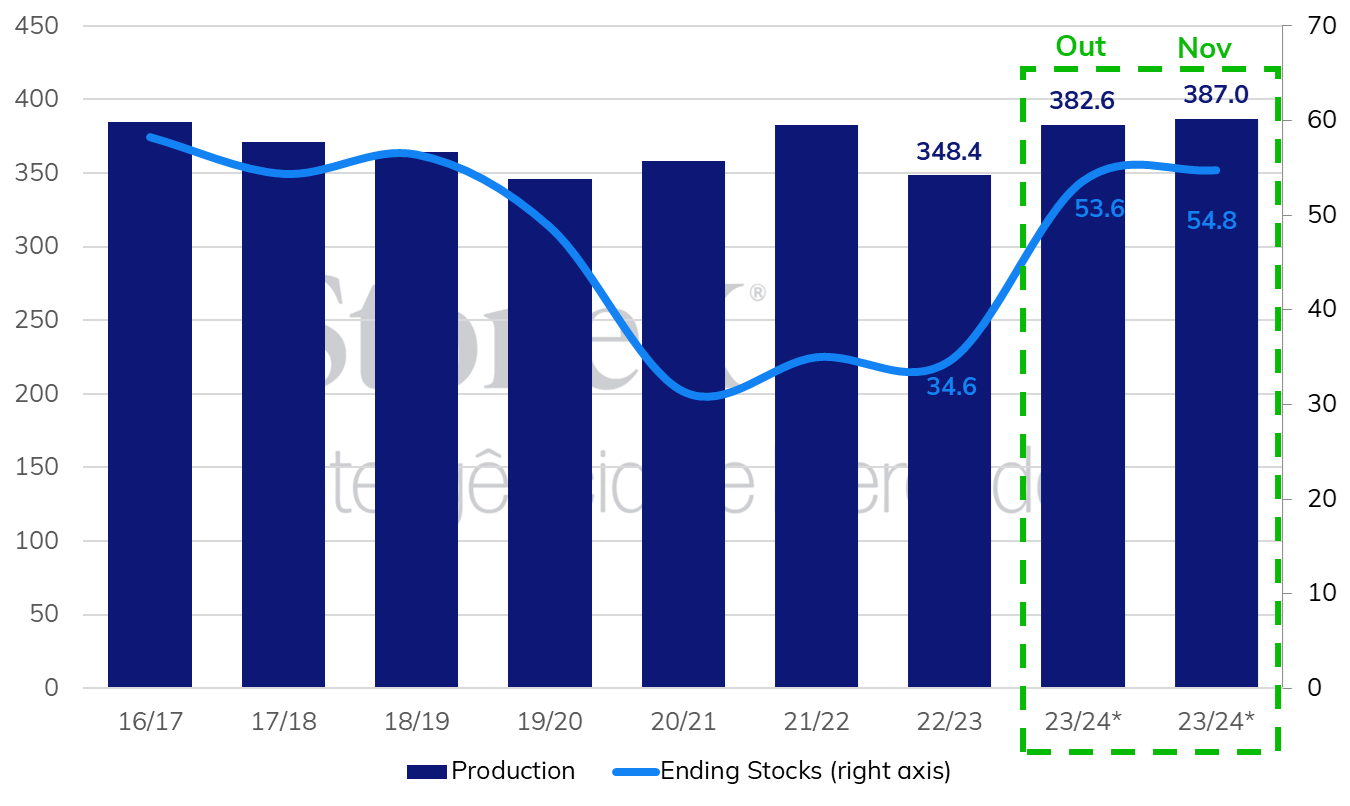
For wheat, the latest USDA report indicated a 0.2% decrease in global production in 2023/24, compared to the previous month, with an expected 782 million tonnes. The reduction occurs due to the expected losses in Argentina, Kazakhstan, and Brazil, despite the better expectations for Russian production. The crop in Russia increased by 5.9% compared to the October report, reaching 90 million tonnes, and if realized, it would be the 2nd largest in the historical series.
In Argentina, the wheat belt is concentrated in three provinces: The Russian harvest was increased by 5.9% compared to the October report, reaching 90 million tonnes, and if realized, it would be the 2nd largest in history. In Argentina, the so-called wheat belt is concentrated in three provinces: Buenos Aires (42% of production), Córdoba (20%), and Santa Fé (18%). And it was precisely in these regions where precipitation has been below average. Maturation occurs first in the last two provinces, affected by the lack of moisture. Accordingly, the recent rains recorded in Argentine soil would have little potential to improve yields significantly. The new estimated production is 15 million tonnes, below the figure released in October (16.5 million tonnes) and the BCBA's estimate of 15.4 million tonnes.
The wheat produced in Kazakhstan fell 8% compared to last month and 27% compared to last year. In this case, the moisture weather is the reason for the decrease in expected yields. The majority of the production in the country is concentrated in the Center-North region, and the harvest is mostly done between August and September. However, due to excessive rainfall, a delay in the harvest and a decrease in the quality of the kernels was observed.
The sharp rains also affected Brazilian wheat, which had production reduced by 4.1% compared to the previous month, totaling 9.4 million tonnes. This value indicates an annual reduction of 11.3%, while the harvested area remains unchanged at 3.4 million hectares. The USDA indicates that the volume of rainfall well above normal recorded in the north of Rio Grande do Sul has reduced the quality of the grain and the productive potential even further.
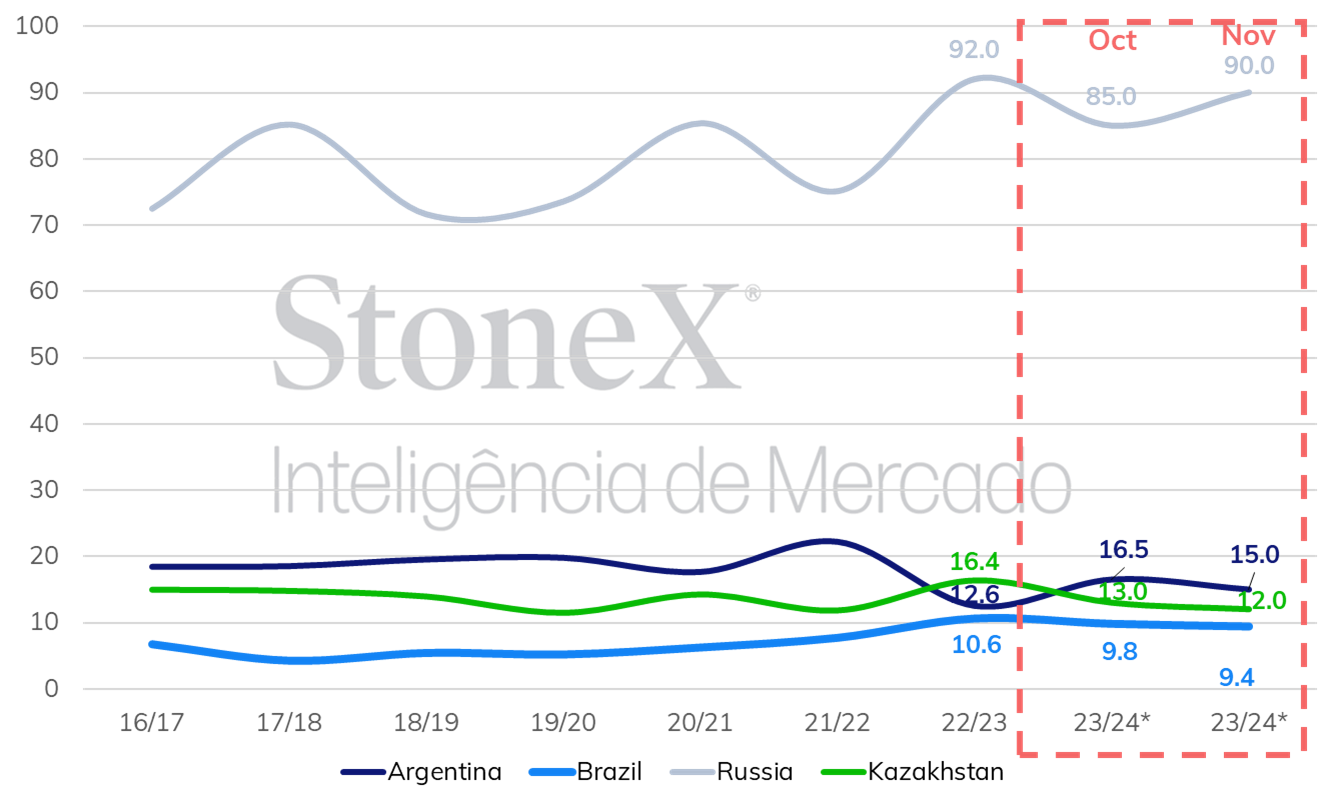
Looking at the cotton market, the report once again reflected problems with global demand for cotton, a fact that the market has been monitoring for some time. In addition, there was also a positive review for production, mainly driven by productivity hikes in US crops.
More specifically, when we look at the demand, the new figure of 25.1 million tonnes (110,000 less than last month's estimate) for global consumption corresponds mainly to downward revisions in Vietnam's demand. The country, which practically has no cotton production, is one of the main textile producers in the world and, therefore, one of the major feedstock consumers.
On the supply side, a positive revision of 180 tmt was reported in global production. The figure mainly reflects a hike in US production, as the country's Center-South region had a higher average productivity of cotton crops. However, the American production estimate is lower than the Brazilian one for the 2023/24 crop.
China, India, and Brazil did not undergo supply and demand revisions. Still, hikes in Asian stocks could be observed, mainly driven by higher imports and changes in beginning stocks. The movement also contributes to the revision of global stocks, estimated at the end of the 2023/24 crop at 17.74 million tonnes, 340 thousand more than in the previous season.
Thus, cotton's supply and demand balance remains comfortable in abundant stocks. The greatest comfort in the swing is highlighted mainly in the American case, which accumulates the most significant relative revisions in supply hikes and drop in demand, as already explored. Accordingly, the USA was the country that showed the highest relative increase in carryout.
Therefore, the report tends to be bearish for cotton quotes, especially those corresponding to contracts traded in New York. It should be noted, however, that the magnitude of this repricing, especially after the recent movement of technical sales, limits the room for the bearish revisions brought by the latest WASDE to promote sharper drops in ICE/NY.