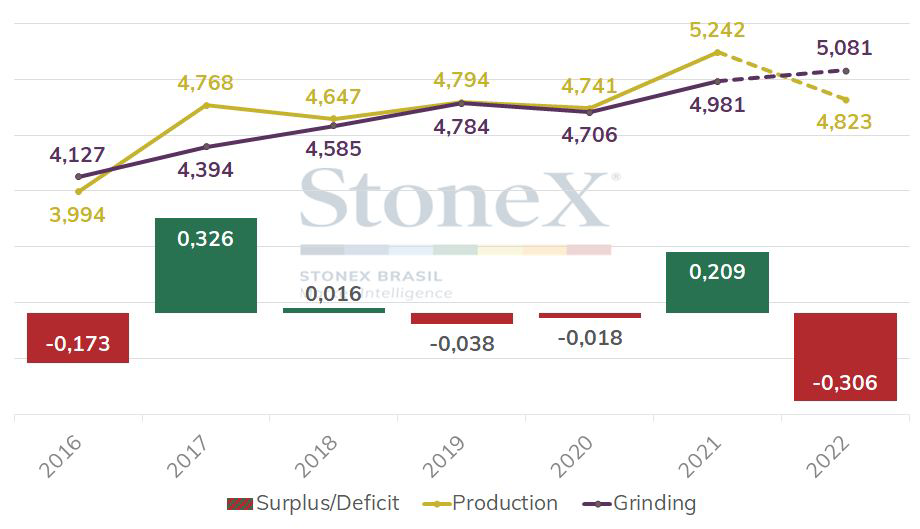
CoffeeNetwork (New York) – The 2020/21 cocoa season still remains on record as the year during which a historic production was achieved. Global production benefited from conducive weather conditions and based on revised data, the production for the 2020/21 cocoa year is estimated at 5.242 million tonnes, up by almost 11% compared to the preceding season’s 4.741 million tonnes. In comparison to the production data published in the previous Bulletin, a minor downward revision of almost 3,000 tonnes has been made. Whereas data for Cameroon has been increased by 2,000 tonnes, a decrease of an aggregate of 5,000 tonnes for minor exporting countries has also been made. World grindings in this issue have been revised downwards by almost 17,000 tonnes when compared to the previous Bulletin. Total adjustments made include a deduction of 10,000 tonnes for Indonesia and an aggregate of about 7,000 tonnes for minor importing countries. Thus, compared with the data published in the previous Bulletin, the 2020/21 season is estimated to have ended with a global production surplus of 209,000 tonnes.
REVISION TO 2021/22 ESTIMATES
The assessment at the end of the 2021/22 season depicts that global production declined year-on-year by 8% to 4.823 million tonnes. Less favourable weather conditions and diseases affected the harvest in most West African countries with the greatest impact witnessed in Côte d’Ivoire and Ghana. Compared to the 2020/21 season, production in Côte d’Ivoire declined by almost 6% or 127,000 tonnes while that of Ghana was down by 34% or 359,000 tonnes. On the contrary, global cocoa use in 2021/22 continued following the upward trend of the previous season and rose by 2% to 5.081 million tonnes. Côte d’Ivoire and Malaysia were the main drivers for the year-on-year increase. Grindings were up by 9% or 55,000 tonnes in Côte d’Ivoire, and up by 11% or 38,000 tonnes in Malaysia. Resumption of freight activities and the opening of economies post COVID-19 contributed to the improvement in grindings activities.
Compared to data published in the previous Bulletin, production has been adjusted downwards by 67,000 tonnes, which resulted from a deduction of 79,000 tonnes for Côte d’Ivoire in addition to an aggregate increase of 12,000 tonnes for other countries.
Regarding grindings, changes have been made for Cameroon (up by 23,000 tonnes), Côte d’Ivoire and Malaysia (up by 15,000 tonnes each) and Indonesia (up by 10,000 tonnes). Minor adjustments totalling 53,000 tonnes, when deducted from the adjustments for the aforementioned countries totalling 63,000 tonnes, indicate an increment of 10,000 tonnes as compared to the grindings data in the previous Bulletin.
PRODUCTION
For some years now, the growth in cocoa production in major cocoa producing countries (especially Côte d’Ivoire1 and Ghana 2), has been linked to the harvests from cocoa farming in protected forest areas. This malpractice has led to deforestation in these countries. According to the Cocoa & Forests Initiative, “Côte d’Ivoire and Ghana respectively lost 25% and 8% of their humid primary forest between 2002-2019, with a significant portion of deforestation attributable to cocoa farming expansion”3.
The net effect of the above revisions is a global production deficit of 306,000 tonnes compared with the Secretariat’s earlier projection of 230,000 tonnes in the previous Bulletin. The total statistical stocks of cocoa beans for the considered period are therefore estimated to have declined to 1.622 million tonnes, equivalent to 31.9% of the estimated 2021/22 grindings.
As most cocoa trees in major producing countries are old and producing less as their fertility dwindles, farmers move to virgin forests for farming. These new fertile farms produce more beans compared to the old farms with aged trees. Thus on the one hand, they contribute to a rise in output while on the other hand adding to deforestation4. Within the West African region, among other programs aimed at achieving a sustainable global cocoa economy, programs that are mainly focused on curbing deforestation are meticulously implemented and will likely, in the medium term, contribute to a slowdown in the growth of cocoa production. This is because intense efforts are underway to ensure that cocoa beans harvested from protected lands are eliminated from the supply chain.
Furthermore, the EU legislative proposal for regulation on deforestation-free products will disincentivise these farm practices. In fact, under this proposal, cocoa operators5 and large6 traders7 will be responsible for carrying out comprehensive, effective and continuous due diligence to prove that their cocoa beans and products are not linked to deforestation or forest degradation.
It was also anticipated that the historic production of the 2020/21 season could be maintained. Unfortunately, this did not materialise as production for the 2021/22 season encountered many challenges which affected the crop, including less conducive climatic conditions, diseases, switch to other crops like rubber and inflationary pressures that impacted the prices of important farm inputs such as fertilizer. The season therefore failed to meet the historic levels of the 2020/21 season and ended up with a production shortfall of about 306,000 tonnes.
At the end of the 2021/22 season, contrasting developments prevailed in the main cocoa growing regions. Compared to the previous season, Asia’s production rose by almost 5% from 254,000 tonnes to 266,000 tonnes, followed by the Americas, up by 3% from 933,000 tonnes to 963,000 tonnes. On the contrary, Africa’s production slumped by 11% or 460,000 tonnes from 4.054 million tonnes to 3.594 million tonnes. In terms of total world production, Africa accounted for 75% of world output, while the shares of the Americas and Asia and Oceania were 20% and 5%.
AFRICA
CÔTE D’IVOIRE
Based on official statistics, production in Côte d’Ivoire recorded a decline of almost 6% or 127,000 tonnes, i.e. from 2.248 million tonnes in the preceding year to 2.121 million tonnes for the 2021/22 season. The decline has been attributed to less favourable weather conditions that prevailed during certain periods of the season. The 2022/23 season has commenced with the guaranteed price to be paid to farmers set at 900 CFA per kilogram which is equivalent to US$1,364 per tonne. As at 13 November 2022, cumulative volumes of arrivals of cocoa beans in Côte d’Ivoire were reported at 466,000 tonnes, down by 12% compared to the corresponding period of the previous season. Current torrential rains which are detrimental to soil nutrients and could cause an outbreak of black-pod disease, coupled with increasing prices of farm inputs, are likely to affect the country’s production.
GHANA
In Ghana, the 2021/22 season witnessed a significant reduction from 1.047 million tonnes in 2020/21 to 688,602 tonnes. The fall in production was due in part to the devastating effect of the Cocoa Swollen Shoot Virus Disease (CSSVD), illegal mining on cocoa farms and a reduced use of fertilizer due to high prices. For the 2022/23 season, the producer price in Ghana has been increased to 12,800 Ghana cedis per tonne, or US$1,251 per tonne. It should be noted that over the past six main seasons, farm gate prices in US dollar terms have been higher in Ghana compared to Côte d’Ivoire until the main crop of the 2022/23 season when the situation was reversed as a result of the sharp depreciation of the Ghanaian cedi vis-à-vis the US dollar.
CAMEROON
For the past few seasons, Cameroon has witnessed a gradual growth in production. The establishment of processing factories, namely Neo Industry and Atlantic Cocoa, has increased the local demand for beans and consequently prices. This in turn has boosted the interest in the cocoa production activities in the country. For the 2021/22 season, Cameroon’s production is estimated at 295,165 tonnes.
NIGERIA
In Nigeria, the government’s efforts to improve cocoa production are bearing fruits. The establishment of the National Cocoa Development Committee to rehabilitate old farms, promote the use of high yield species and encourage local consumption has contributed to the growth in production. For the 2021/22 season, production is estimated at 280,000 tonnes.
AMERICAS
BRAZIL
With a sizeable market for cocoa and chocolate products, much of Brazil’s cocoa production to date is insufficient to cover the needs of cocoa processors within the country, much less for export. For the 2021/22 season, production is estimated at 220,000 tonnes, which is about 100% of the country’s cocoa usage.
ECUADOR
With a growing market for Latin American cocoa beans, production in the region continues to develop. Indeed, major manufacturers aiming to be close to their source of supply are attracted to the region. For example, in Ecuador, Barry Callebaut has established a US$10 million state-of-the-art cocoa bean cleaning, drying and export facility in Duran, near the port of Guayaquil8. For the 2021/22 season, Ecuador’s production is estimated at 370,000 tonnes.
DOMINICAN REPUBLIC
Traded as organic cocoa and classified as Fine Flavour cocoa, the Dominican Republic’s cocoa production did not demonstrate any significant growth over the past few years until the season under review. Production is estimated at 80,000 tonnes for the 2021/22 season and reflects an increase of 7% as compared to 2020/21.
COLOMBIA
Production in Colombia, at an estimate of 70,000 tonnes for the 2021/22 season, met the country’s cocoa usage and trade activities needs.
PERU
Peru’s cocoa production has been increasing for the past few years, as it continues to gain support from policies focusing on social and ecological principles. Compared to the 2020/21 season, Peru’s production increased by 3% from 156,000 tonnes to 160,000 tonnes in 2021/22.
ASIA & OCEANIA
Cocoa production in Asia continues to be far less than the region’s cocoa use requirements. As much as the government of Indonesia is addressing the upstream sector of the cocoa industry, production which is estimated at 180,000 tonnes for the 2021/22 season, fell short of the quantity needed to meet the country’s processing needs. The same goes for Malaysia, whose production is estimated at 700 tonnes for the 2021/22 season. In Papua New Guinea, efforts by the government, NGOs and other partners are underway to increase the economic returns and opportunities from the cocoa industry. For the 2021/22 season, production is estimated at 42,000 tonnes.
GRINDINGS
Global cocoa demand held up in 2021/22 and remained resilient to the inflationary pressures of the global macroeconomy.
Indeed, chocolate manufacturers have reported a boom in sales9. In addition, recent developments such as innovative efforts by manufacturers to adapt to consumer preferences for healthy products have also contributed to the increased demand for more value addition in cocoa.
Compared to the previous year, the Secretariat estimates that grindings increased in Europe by 2.3% to 1.850 million tonnes, followed by Asia and Oceania by approximately 2% to 1.175 million tonnes, and then Africa by almost 8% to 1.128 million tonnes. Inversely, grindings in the Americas fell by about 5% to 928,000 tonnes. In terms of total world grindings, Europe accounted for 36.4% of world output, Asia and Oceania 23.1%, Africa 22.2% and the Americas 18.3% (Figure 6).
As published by regional cocoa associations, the notable increase stemmed from Europe and Asia. During the third quarter of 2022, although European grindings published by the European Cocoa Association (ECA) indicated a 1.6% decline year-on-year to 369,679 tonnes, on the basis of a crop year, cumulative grindings in Europe during 2021/22 increased year-on-year by 2.68% from 1,434,631 tonnes to 1,473,084 tonnes. Based on the latest available statistics, grindings for the Netherlands, Germany and France for the season are up year-on-year at 630,000 tonnes, 480,000 tonnes and 140,000 tonnes respectively.
On the contrary, North American quarterly grindings statistics published by the National Confectionery Association (NCA) for the Q3.2022 period, fell year-on-year by 3.37% to 119,244 tonnes and cumulative data for the 2021/22 season indicated a decline of 3.44% from 483,078 tonnes to 466,451 tonnes. It is worth noting that though grindings have declined in the North America Free Trade Agreement (NAFTA) region, net imports of semi-finished products in bean equivalent for the first nine months of the 2021/22 season increased by 22% from 332,316 tonnes to 406,375 tonnes, hence suggesting that the drop observed in grindings in the region is somehow compensated by the importation of cocoa processed abroad. The Secretariat’s forecasts for the United States, Canada and Mexico are 380,000 tonnes, 100,000 tonnes and 60,000 tonnes respectively.
The enthusiasm to participate in the downstream segment of the supply chain has led major cocoa exporting countries to provide incentives for investors to engage in cocoa processing at origin. Consequently, grindings in the main exporting countries have generally followed an upward trend. For the 2021/22 season, Côte d’Ivoire is estimated to have increased cocoa grinding activities by 9% from almost 620,000 tonnes in the 2020/21 season to 675,000 tonnes in 2021/22. Grindings for Ghana are estimated at 320,000 tonnes, slightly down by 1%. In Southeast Asia, data from the Cocoa Association of Asia (CAA) followed an upward trend and showed that cocoa grindings increased by 9.53% from 210,970 tonnes in Q3.2021 to 231,080 tonnes in Q3.2022. With regards to the 2021/22 crop year, cumulative data published by CAA showed a 4.79% increase from 863,239 tonnes to 904,597 tonnes. For the 2021/22 season grindings in Indonesia are estimated to be virtually the same as for the previous season at 480,000 tonnes. In Malaysia, cocoa processing significantly increased by 11% from 338,000 tonnes in 2020/21 to 375,000 tonnes in 2021/22.