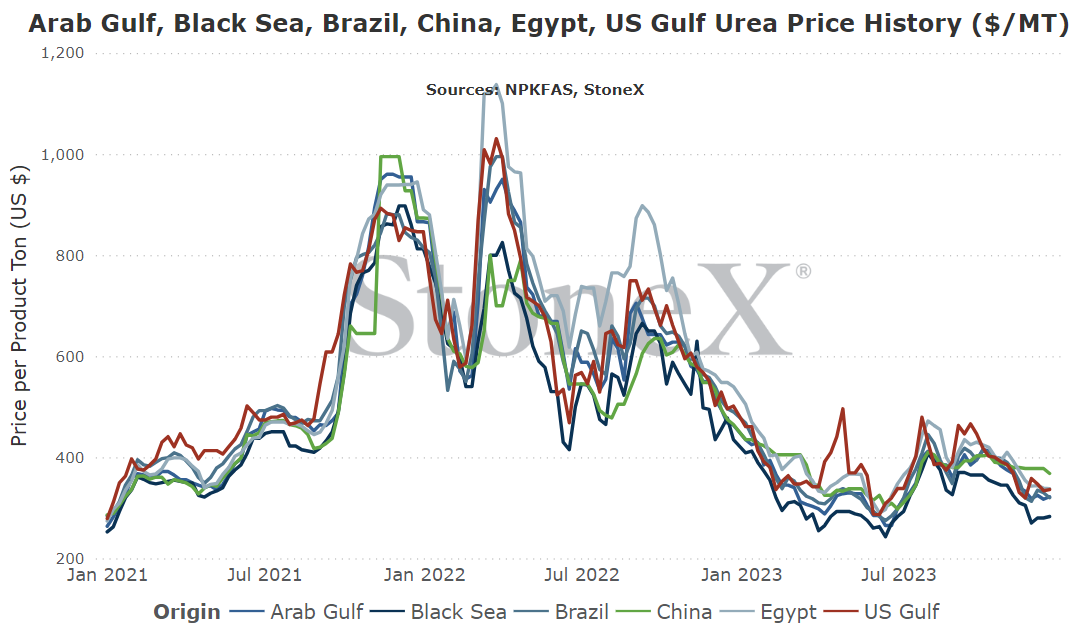
A lot of my outlook doesn't depend solely on the India urea purchase tender announcement from just before Christmas but on the world's demand reaction to it. What I mean is if it is India alone, I struggle to see prices firm but if other regions step forward, now we have bullishness. Also, do not underestimate shipping lanes in the Red Sea/Persian Gulf/etc. I cannot understate how nervous that makes me.
Today, it doesn't seem as though there is really any reason for prices to rally on fundamentals but I see a lot more upside potential in the market than downside. If forced to pick, I'll take the bullish perspective moving forward.
Again, if global buyers stay back and force manufacturers to ship product without being "called" on, values will struggle to find footing. However, today's values are very attractive and there is a lot of political tension out there.
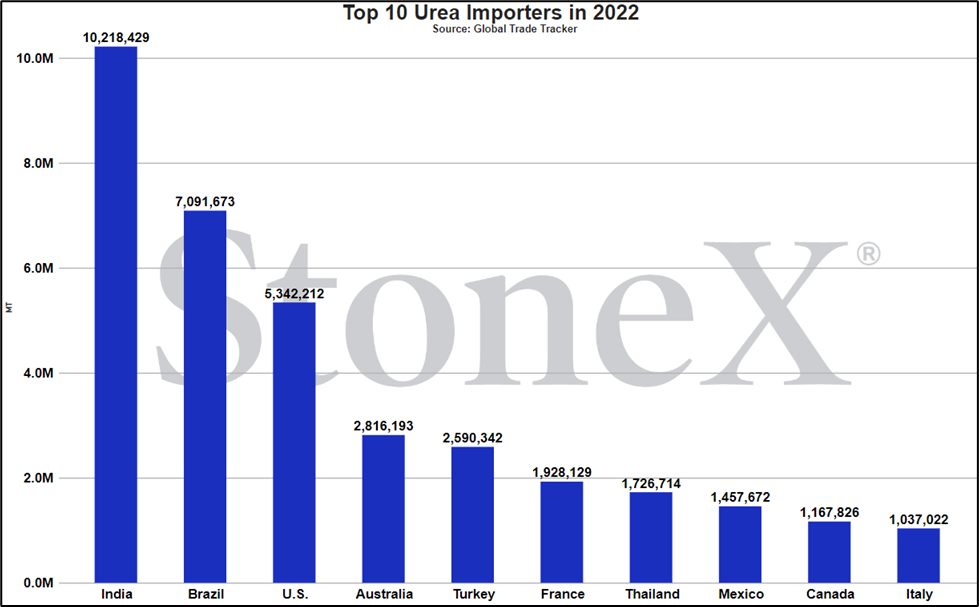
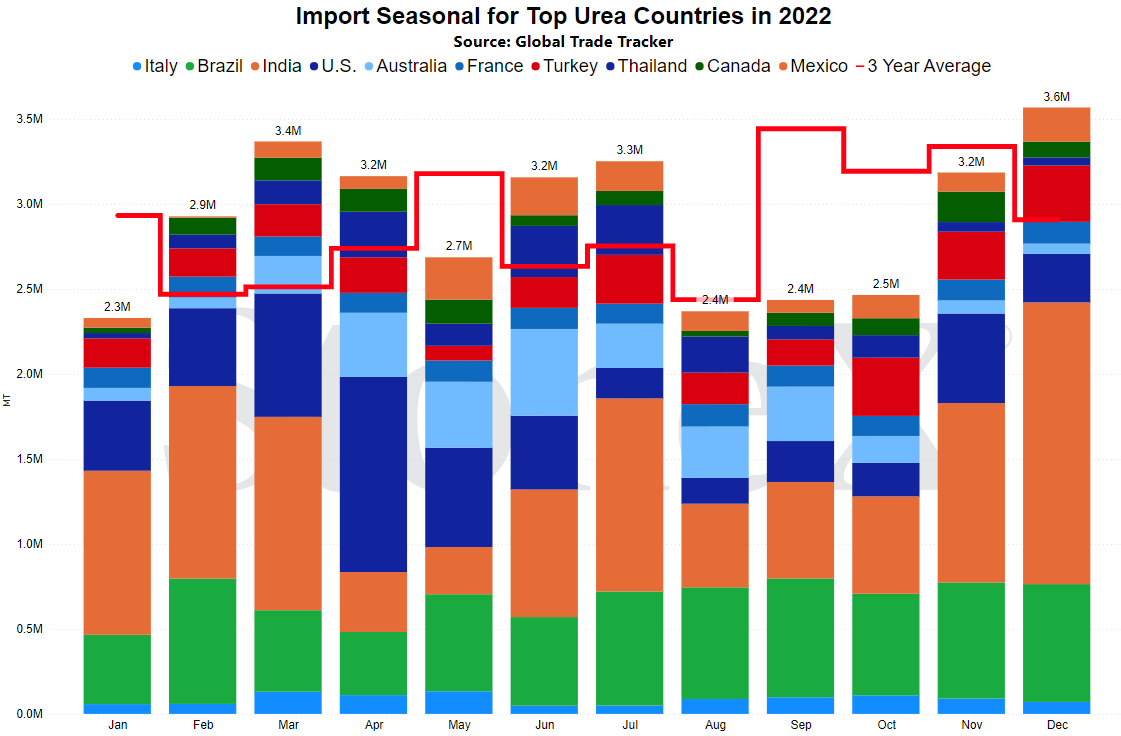
Chinese export restrictions tighten the global market
Under normal circumstances, Chinese urea exports account for around 10% of the global annual export volume. So it makes sense that if they start putting restrictions on what can and cannot be exported, it should be taken into account.
That brings us to the present.
The Chinese government has stated that they intend to reduce the number of urea tons exported from January 2024 thru March 2025 to approximately 4MMT. To put that into perspective, China typically exports around 5 - 5.5MMT per calendar year. Breaking those out, that reduces the average monthly rate by about 40%. That ain't nothin!
Now, the question is will that remain? If we were to suddenly see global prices spike and inventories get tighter, it is not out of question that the government could restrict that number further. On the flip side, if production rates remain high and domestic Chinese storage fills quickly, we could see them give a short term boost to the number. Either way would cause a market move to be greater (upside and down).
Today, we have to take their word on the announcement but we always know that we have to treat them from a reactionary standpoint as it is VERY difficult to get accurate information from them.
Why does this matter for Australian farmers?
From an overall global S&D perspective, China reducing their exports by this much means supplies are tighter which will help support price ideas. Doesn't mean values cannot go lower but it has yet another hurdle to do so.
From a more regional perspective, there is now more competition. Countries typically dependent on Chinese exports will now be forced to go find new supply elsewhere in the world. That could be in direct competition to typical Aussie supply points. Manufacturers/sellers, having more sales opportunities, are going to be a little more bold/proud in their price ideas. If you are selling a tractor and you have 5 folks lined up to buy it, you feel more comfortable asking a higher price. Same goes for fertilizer.
The opposite also holds true if China backs off the program. If they suddenly allow a lot more exports, that will flood the market and cause buyers to step back.
With Australia being so closely linked to the Asian region, this means more.
Drought in Brazil puts urea demand in question
One of the standout stories to end the year has been the lack of rain in Brazil. It is bad enough that our team in country have declined their corn acreage expectations by nearly three quarters of a millions acres.
For fertilizer, the immediate question is what it switches to.
Many are indicating that they will convert these acres from corn and take a chance on soybeans. For urea, that is a problem. If you are new to the industry, soybeans do not need a lot of nitrogen so cutting this many acres of corn will have a decent effect on their overall nitrogen demand. Like many things in Brazil, things can change quickly. It feels too early to completely write off their demand...but there are a LOT of indications we can start taking those steps.
For a global urea market that was already struggling with demand, losing Brazil's expected demand certainly doesn't help build a bullish outlook
Why does this matter for Australian farmers?
In simplified terms, this lowers expected global urea demand. If supplies remain unchanged and demand goes down, Econ 101 says that prices should fall.
It doesn't guarantee that, but it is a notch on that side of the equation.
If Brazilian demand is down, tons that were earmarked for them will now be forced to compete and find another home. Logical thought is that tons would flow to N.A. given the proximity...but then tons earmarked for N.A. need to find a new home. Wash everything out and you end up with cheaper tons that might target Australia at some point.
With season so far out, doubt there is a big swing but it is something to watch going forward.
India surprises the market with a Christmas purchase tender announcement
This announcement has had a fun little journey. When India wrapped up their last purchase tender a couple months back, many in the industry (myself included) assumed we would see them again 2nd half December. Then, as the days and weeks rolled by, we started to back up into 1st half/mid-January. Their new urea production was going very well. Also had global values under pressure so the longer they waited, the lower prices might go. In fact, just before Christmas break, I was all but convinced it would be a 2024 issue.
That would not be the case. At first, I was frustrated for them, thinking it was a "stupid" move to come in so early. By the end of the day, I thought it might have been the smartest move they could have made!
Normally, when India announces a purchase tender, the market gets excited and prices rise. It is not uncommon to see values up $20 - $40 shortly after the announcement. That is frustrating for them. What better way to combat it than to do it when a lot of the industry is on holiday. With so many less participants in the office, the excitement level doesn't build. Also, values are down fairly well from the last tender, shipping lanes are starting to be questioned (more below) and China is threatening to cut exports.
Like I said, by the end of the day, I thought it was a brilliant move and I had to eat my words!!!
So, offers are due no later than January 4th. This also has a very wide shipment window, ending on February 29th (it will never not feel weird to write Feb 29). In their last tender, there were 2MMT offered that did not get accepted and there have been millions of tons produced since then. It would not be shocking to see a huge amount of tons offered.
Still, like any tender, we need to see what happens. More to come...
Why does this matter for Australian farmers?
This is more of a general world market story. No more an effect on Australia than anywhere else around the world.
If the result of the India purchase tender is lower global pricing, Australia could see some downside on pricing. Opposite for upside.
Just something to watch to get a feel for market direction.
Middle East tensions/attacks jeopardizing shipping lanes
Well, this is a story that we have discussed in the past but really hoped it wouldn't become true.
Unfortunately, we need to talk about what is happening in the news and what it means for the urea marketplace.
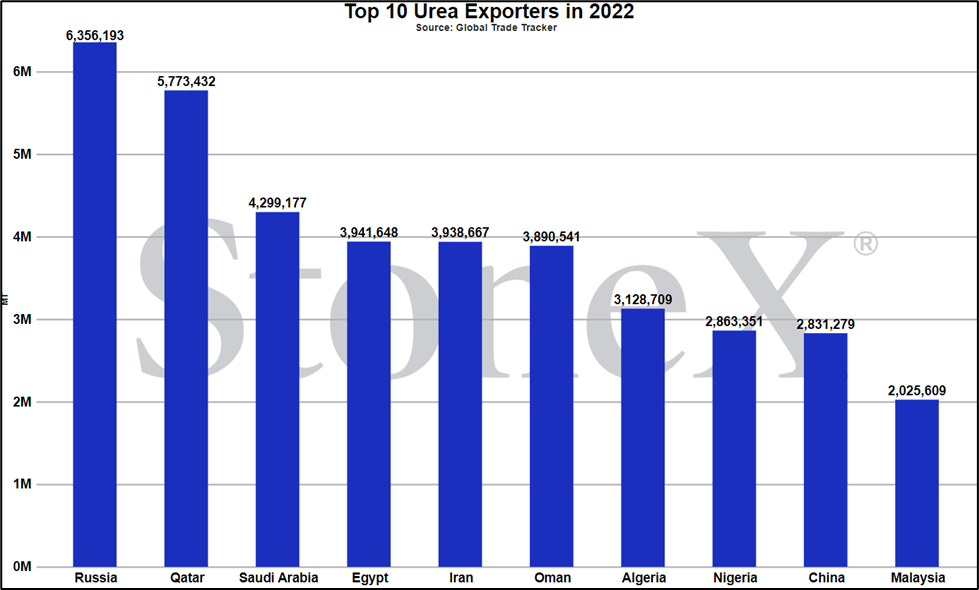
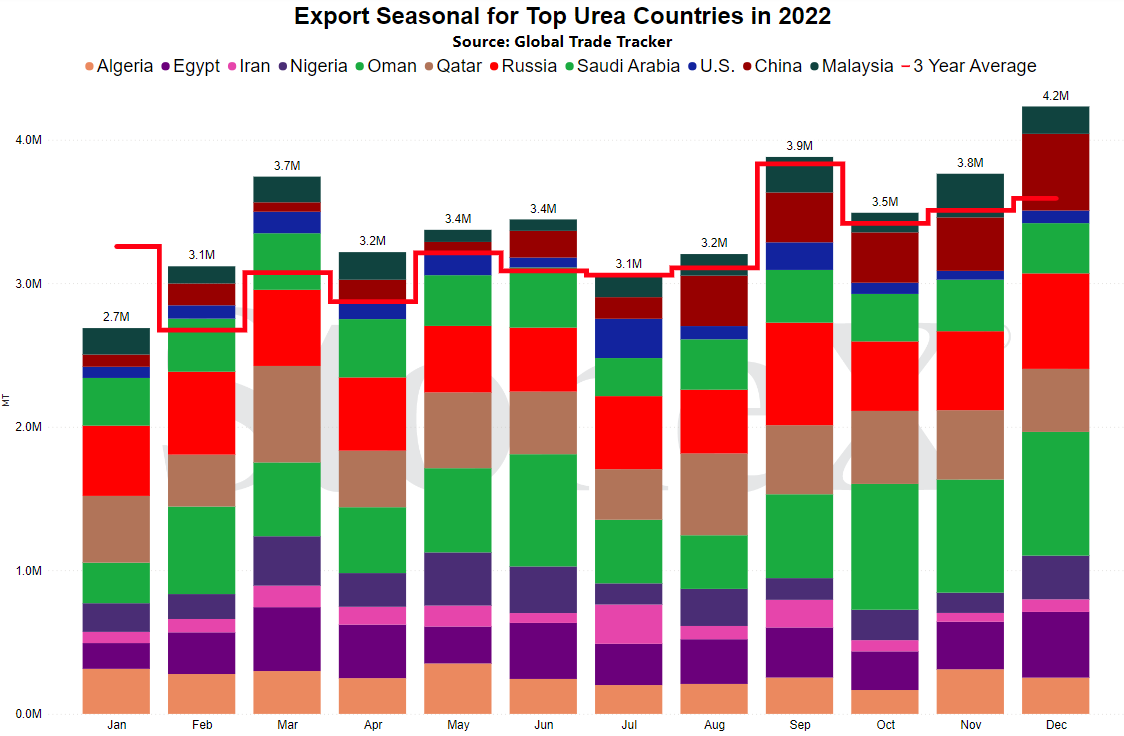
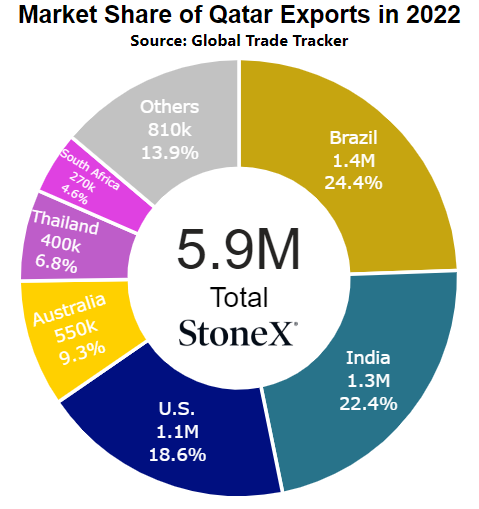
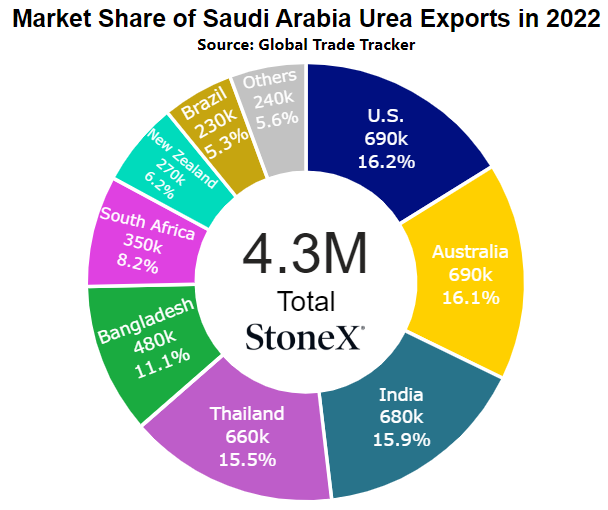
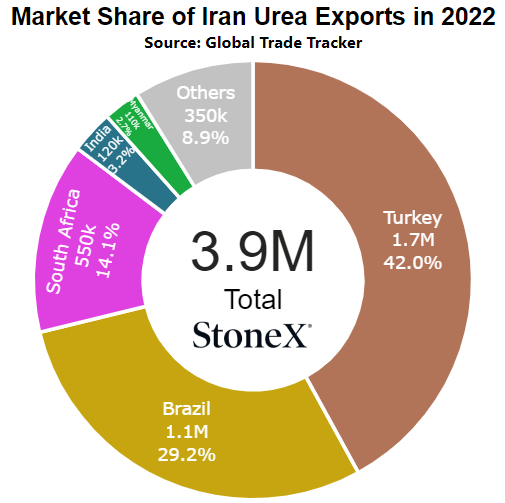
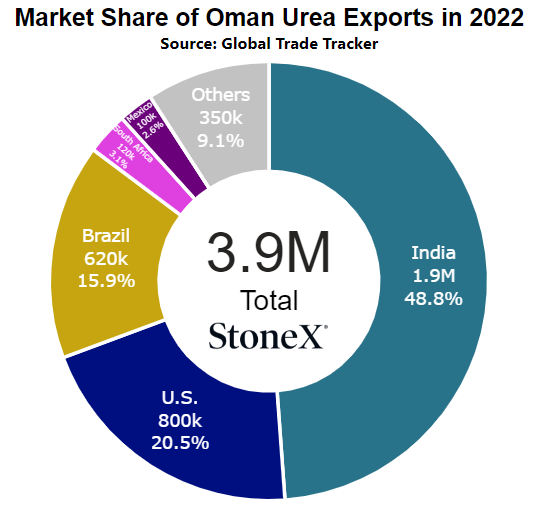
The story leading the news cycle today is Houthi and Iranian attacks on vessels in the Red Sea and off the coast of India. As we discussed last month, this is a worst case scenario for urea. There do not seem to be any effect on North African shipping lanes...but the worry is that these attacks will lead to a broader war that could cause their input costs to rise as a result. Then there is the Middle East and its reliance on the Red Sea and Persian Gulf. The graph below shows just how many tons originate from this area. To say it is substantial would be an understatement.
The good news is that reactions to these attacks have been limited. We have not seen anyone "fly off the handle"...yet. Right around Christmas, some U.S. soldiers were injured (one or two critically) by an attack. That could be the straw that breaks the camel's back. It's one thing to send some drones/missiles toward a well equipped Aegis class ship. Attacking actual troops...that is hard to ignore.
Please keep an eye on the region. Tensions are very high and we are not far removed from a broader situation. If that happens, the media will spend a lot of time talking about oil shipments being hampered...but urea utilizes the same lanes and that will hurt.
Why does this matter for Australian farmers?
This could be a very big deal for Australia.
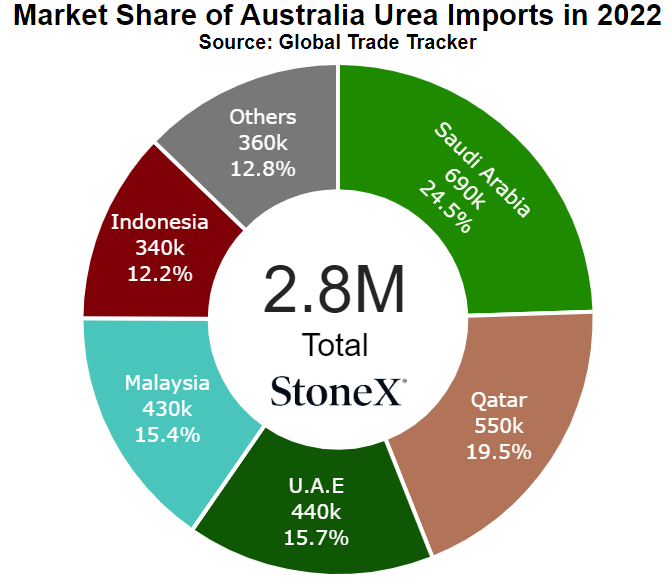
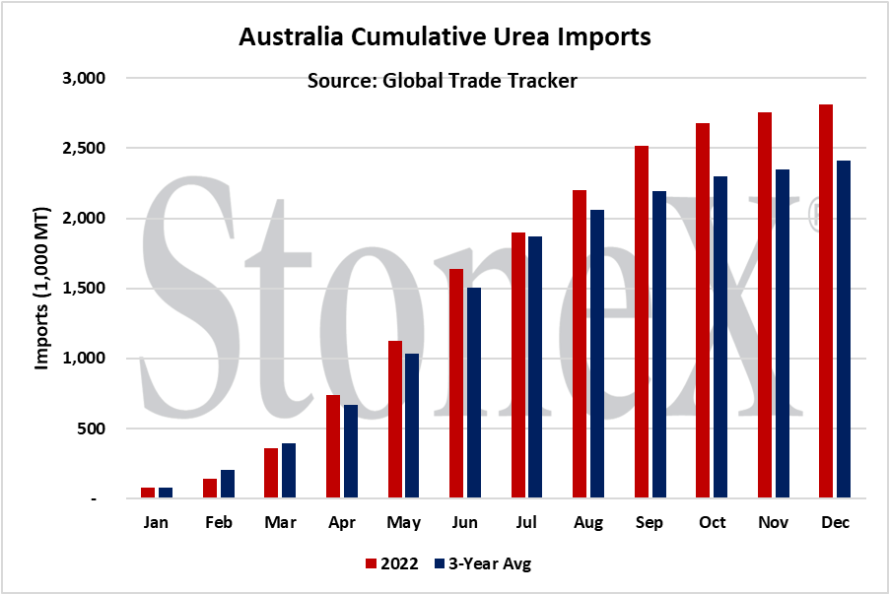
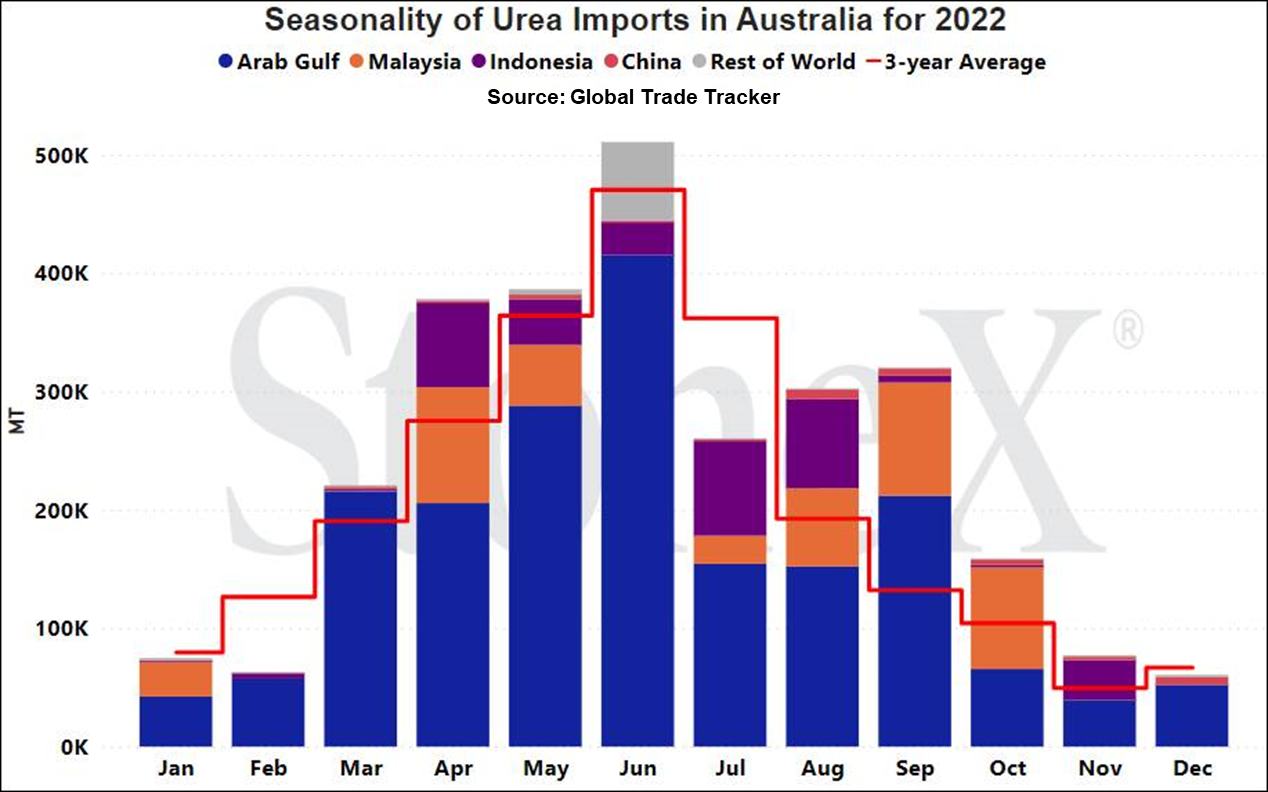
Go back toward the top of this newsletter and look at the breakout of origins for Aussie urea shipments. There are a lot of percentages connected to countries in the Middle East.
Now, please do not take this as my saying "I absolutely believe that shipping lanes will be impacted and ultimately shut down". So far, the response has been very controlled which has kept it from spreading...but patience can only be worn so thin. If you start seeing in the news that attempted attacks are rising, actual successful attacks are happening and/or a broader war is starting to open, it will be worth having a conversation with your supplier sooner than you normally would.
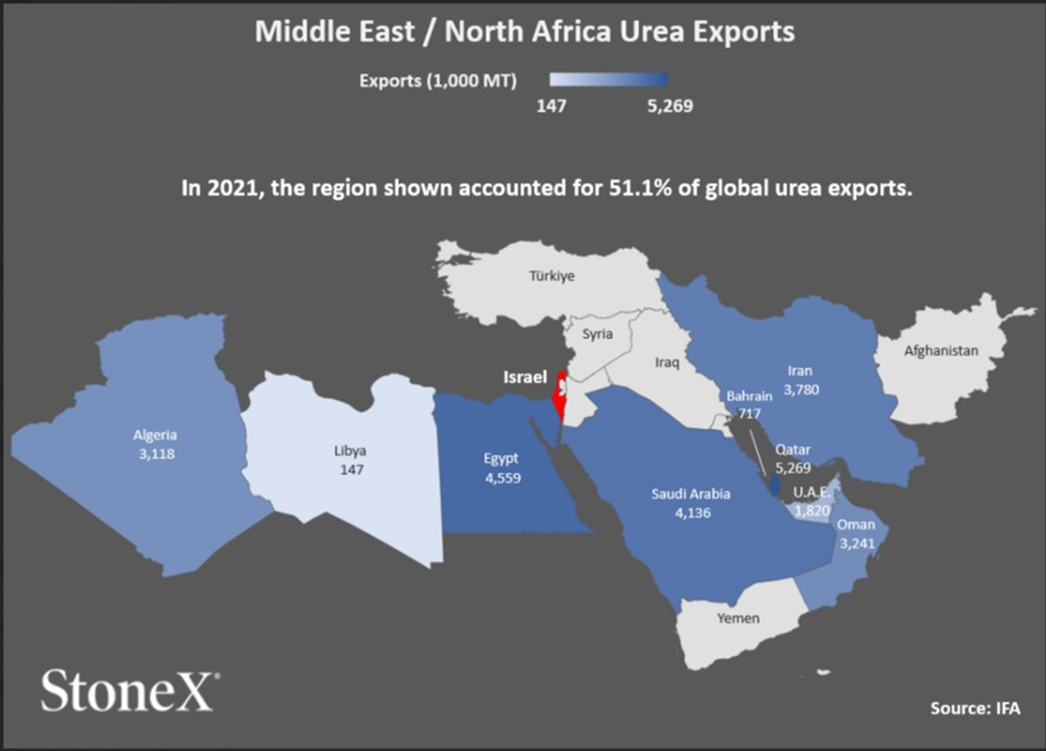
Number 1 exporter (as a region, not as individual nations)
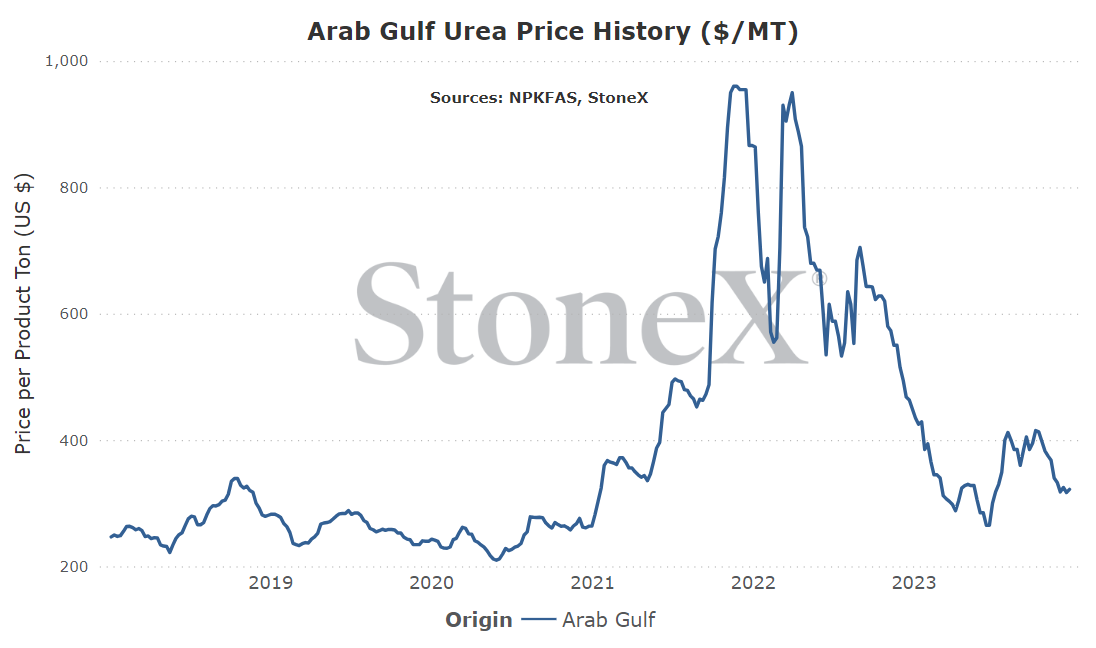
Vs 30 days ago - -3% or approximately $11 lower
Vs 90 days ago - -16% or approximately $63 lower
Vs 6 months ago - +22% or approximately $57 higher
Vs 1 year ago - -31% or approximately $142 lower
Egypt
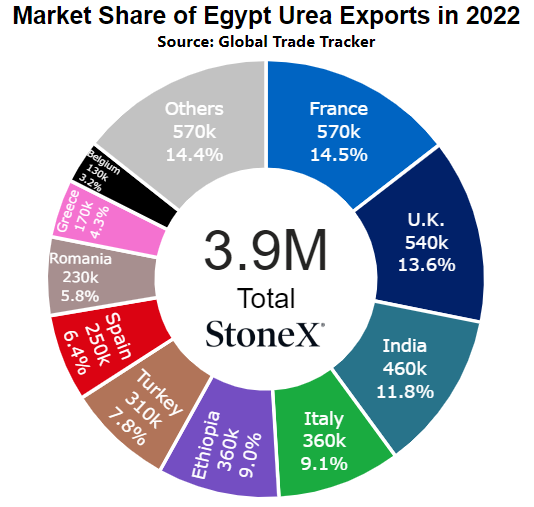
Number 4 global exporter in 2022
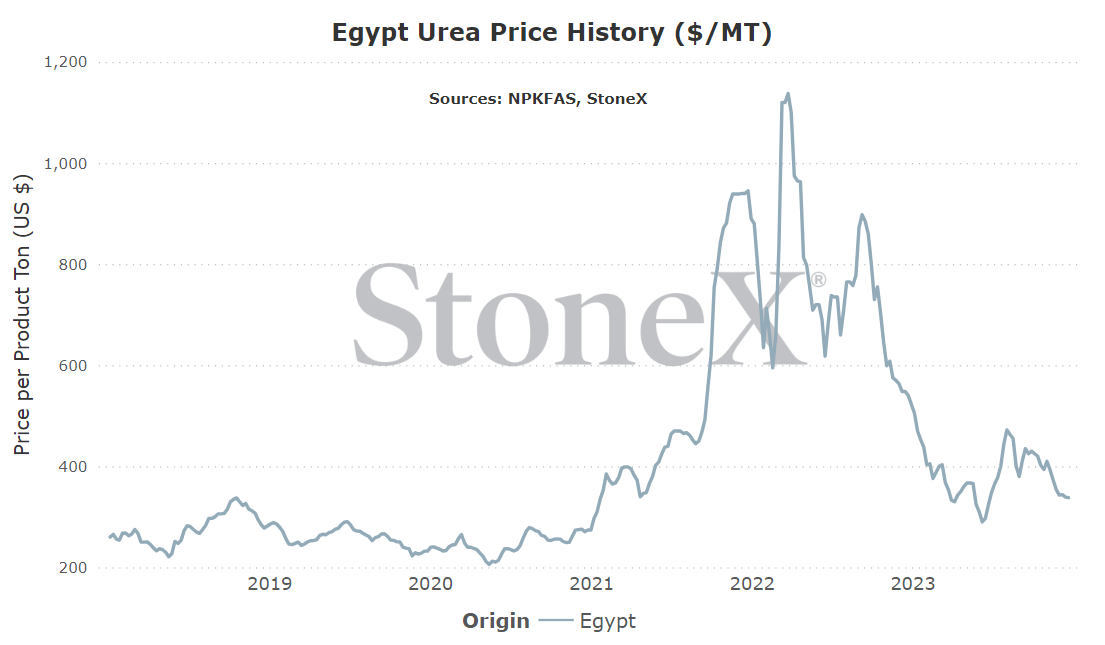
Price comparisons
Vs 30 days ago - -4% or approximately $16 lower
Vs 90 days ago - -20% or approximately $87 lower
Vs 6 months ago - +4% or approximately $15 higher
Vs 1 year ago - -37% or approximately $202 lower
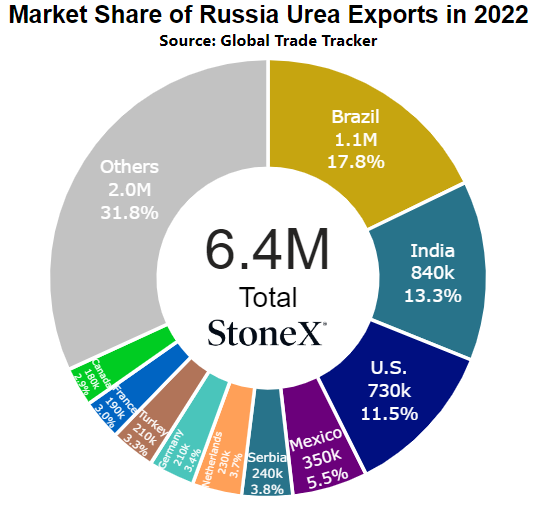
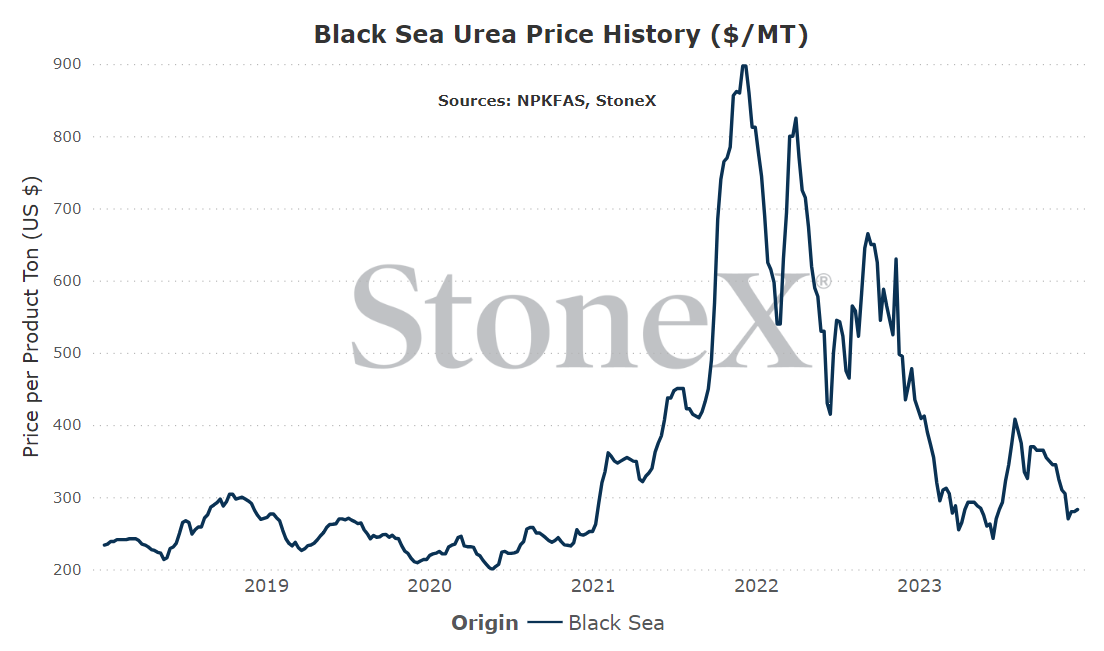
Black Sea
Number 1 global exporter in 2022
Price comparisons
Vs 30 days ago - -7% or approximately $23 lower
Vs 90 days ago - -23% or approximately $83 lower
Vs 6 months ago - +5% or approximately $13 higher
Vs 1 year ago - -35% or approximately $153 lower
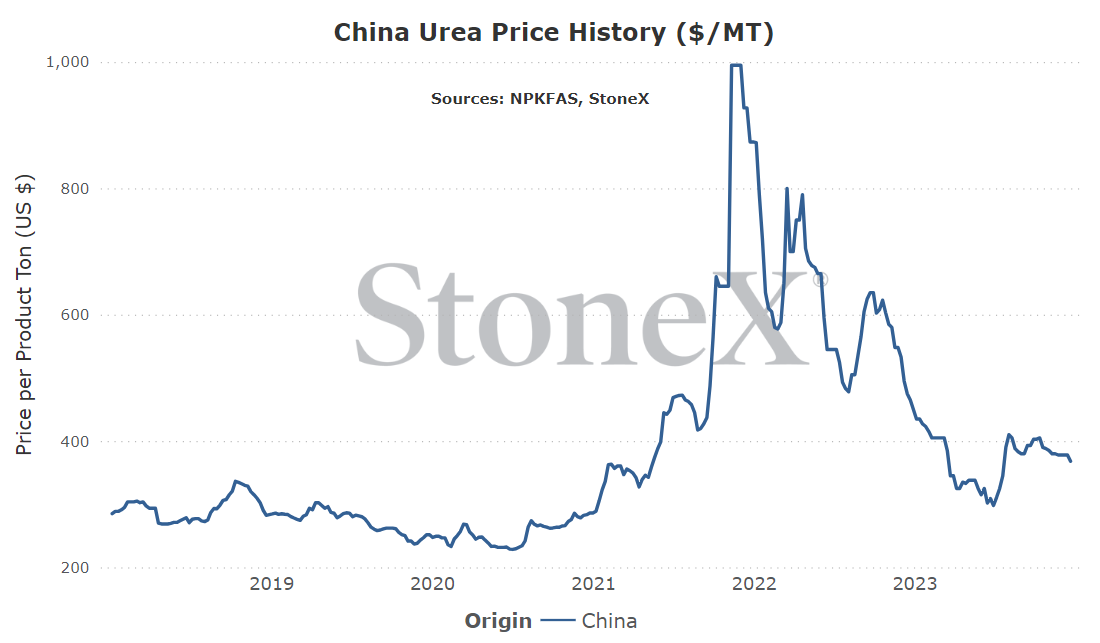
China
Number 9 global exporter in 2022
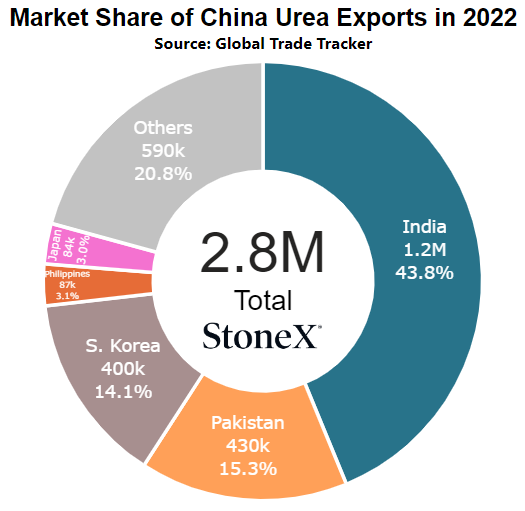
Price comparisons
Vs 30 days ago - -3% or approximately $10 lower
Vs 90 days ago - -6% or approximately $25 lower
Vs 6 months ago - +19% or approximately $59 higher
Vs 1 year ago - -21% or approximately $98 lower
- Middle East tension - I really, really do not want this to be a story. Unfortunately, Houthis continues to target Red Sea vessels with attack drones. Iran was linked to an attack on a vessel off the coast of India. Global production rates are obviously very important...but mean little if the market is unable to move the product. If these attacks escalate, at best vessel freights will climb and at worst will shut down. It is impossible to forecast Black Swan events...but this one is on the radar.
- Rebound in global demand - India surprised the world in stepping in just before Christmas weekend with a urea purchase tender. Now, if we see other global buyers step forward, manufacturers will have sales options...and typically that leads to higher price ideas. While we haven't seen a reaction yet, there is a lot of buying to be done before spring.
- China follows thru with export restriction plans - during "normal" times, China accounts for around 10% of global urea exports and based on announcements/reports, they will be cutting back exports from January 2024 thru March 2025 approximately 40% on average (typical 5MMT exported calendar year vs 4MMT proposed export allowance Jan '24 thru Mar '25). That would be a chunk of inventory missing from the global S&D.
- India goes ahead solo - in the bullish factors, I listed the world stepping in for competition with India which would drive prices higher. However, there are still a lot of tons in the marketplace looking for homes. In India's last purchase tender, there were 2M tons that we left in the market. Then think of all the production since that time. This doesn't feel like India can mop up global excess supply on its own. If the rest of the world stays out, prices probably continue to see pressure.
- China reverses course and exports heavily - never underestimate politics. Right now, the Chinese government is discussing/threatening export restrictions. However, domestic China can only hold so many tons and production rates continue to be heard solid. Low global values and full domestic storage could have the government turn a 180 and start allowing unexpected heavy exports. It wouldn't be the first time they have surprised us.
- European natural gas values fall, causing nitrogen production to restart - in the week's since Hamas's attack on Israel, the Dutch TTF market has fallen substantially. It topped out around $18MMbtu (for winter months) but has since dipped back into the $10 - $11MMbtu range. If gas values continue to drop, it is not out of the realm of possibility that offline production could restart. It will not be easy (old plants + winter temps + uncertain market outlook = tough restart decision), but it is possible.
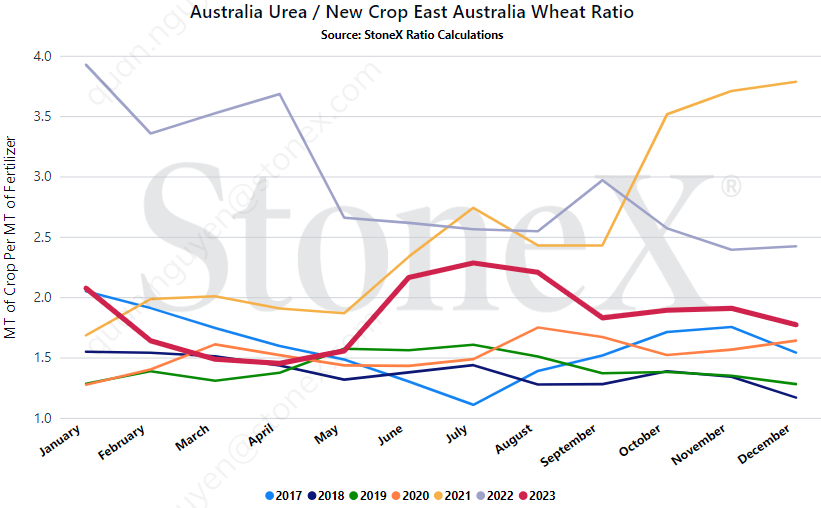
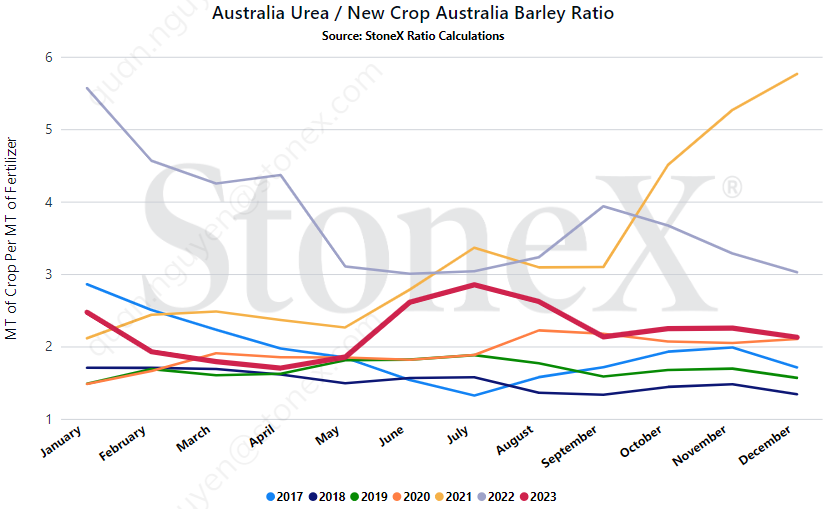
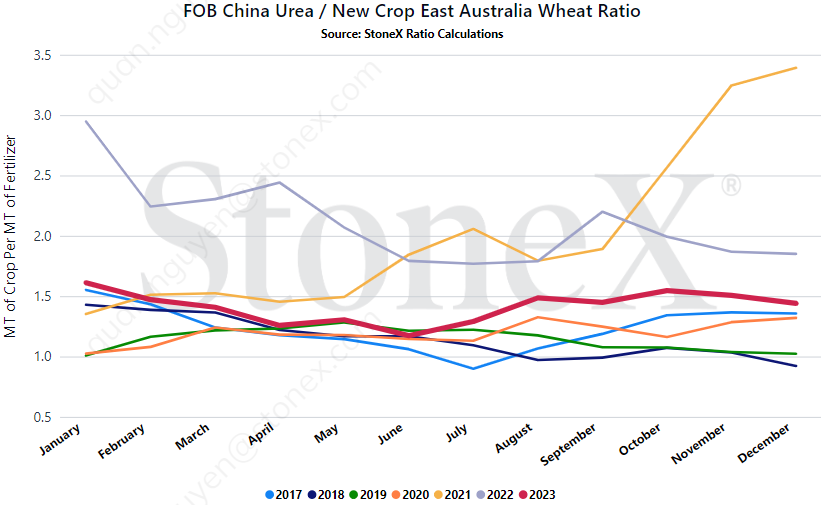
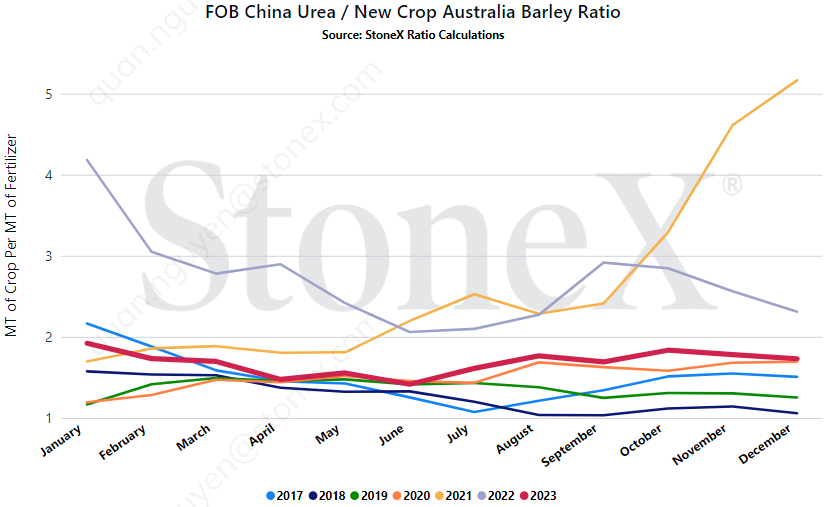
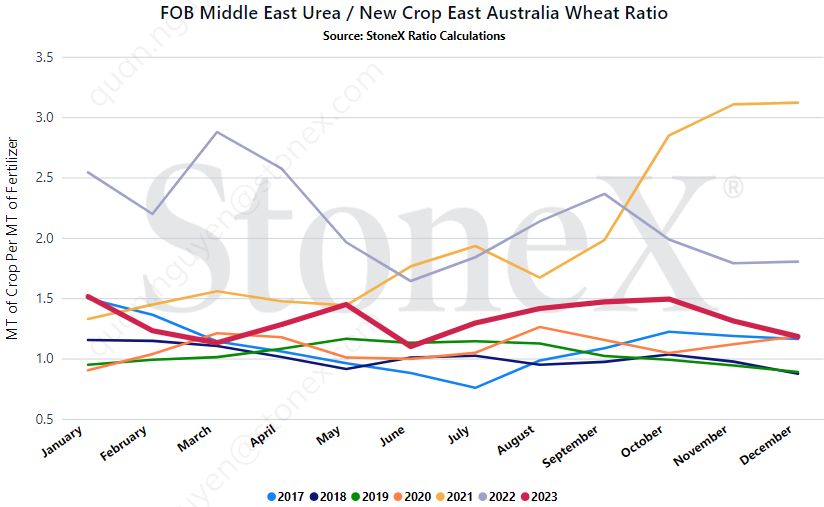
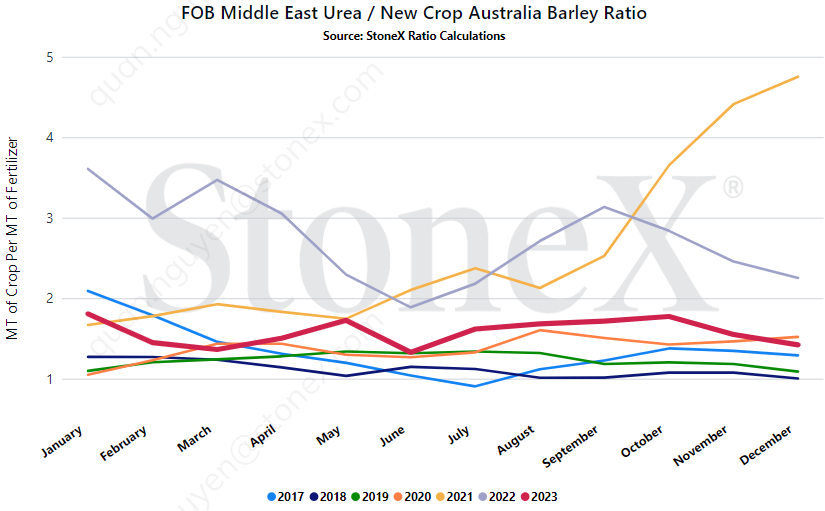
We believe that only looking at the flat price of either grains or fertilizer can be misleading:
-
Only selling grain can hurt you if fertilizer prices rise substantially
-
Only buying fertilizer can hurt you if grain prices fall
We look at the ratio "value" to get a better indication of where we are or how many bushels of X does it take to pay for 1 ton of fertilizer.
Would you rather:
-
Spend 135 bushels to pay for 1 ton of urea
-
Spend 55 bushels to pay for 1 ton of urea
When we compare the current ratio value against recent years, we start to see if we are high or low.
YOUR VALUES MAY LOOK DIFFERENT
- Middle East tension - so far, the world has not responded as many believe it should in reaction/retaliation to vessel attacks. I continue to question how long that patience will last. Worst, I fear that these parties are merely testing the waters before going full scale. If you wake up one morning to a broad war breaking out, enjoy your morning coffee and breakfast...and then ponder a trip to your local retailer. Every morning I wake up and check the news for just such a story...I would suggest everyone consider doing the same.
- World reaction to India buying - so far, the reaction has been mute which makes sense. India picked a perfect time to step into the market with so many out on holiday (much fewer parties in the market means less reaction). Also, their shipment window is thru February 29th (writing Feb 29 is never going to feel "right") which is very wide. Today, I lean toward the world largely ignoring this and continuing to hold out for better pricing...but I've been wrong before.
- Chinese export plans - right now, we are proceeding with the anticipation that China is reducing exports by approximately 40% per month thru March 2025. If they change their mind and start exporting more heavily, it will be bearish. If they further restrict exports, it will be bullish.
StoneX Ratio Calculation
The ratio calculation is derived from Bloomberg historical grains values as well as fertilizer values from StoneX, NPKFAS, and Argus.
The calculation is simply dividing the fertilizer price by each grain price.
All data was sourced from StoneX unless otherwise noted.